Multiple US aircraft downed or damaged in bruising day of losses in Iran war
US UH-60 Black Hawk helicopters refuelling from a KC-130 aircraft near Iran’s border before entering Iranian airspace.
Several US aircraft were shot down or damaged and crews injured on Friday in one of the worst days for the US military in the war with Iran, with search operations ongoing for a missing US aviator in southwestern Iran.
An F-15E Strike Eagle fighter jet was shot down over Iran, marking the first confirmed loss of an American warplane to Iranian fire in the current conflict, according to US officials.
The aircraft was carrying two crew members who ejected before the crash. US officials said one pilot was rescued, while efforts to locate the second were still ongoing as of early Saturday.
Videos obtained by Iran International showed US military aircraft flying at low altitude in Iran's Kohgiluyeh and Boyerahmad province in the country's southwest.
One of the helicopters carrying a rescued crew member from the F-15 was hit by small-arms fire, injuring those on board, but landed safely in Iraq, US officials told CBS News.
In a separate incident the same day, another US aircraft—an A-10 Thunderbolt II—was hit in the Persian Gulf region, CBS reported citing US officials. The pilot was safely recovered after ejecting.
Iran says its air defenses shot down the warplane, but US officials have not disclosed the cause of the crash.
Iranian authorities also announced a reward for the capture of any surviving US pilot, calling for them to be handed over alive to security forces.
The downing of the F-15E suggests Iran retains the capability to strike US aircraft, despite repeated assertions by President Donald Trump and War Secretary Pete Hegseth that American forces had established air dominance during the five-week war.
The F-15E Strike Eagle is a twin-seat, dual-role fighter introduced in the 1980s, capable of both air-to-air and air-to-ground missions. It can reach speeds exceeding Mach 2 and carry a payload of more than 20,000 pounds, and has been used in multiple US military operations in recent decades.
The A-10 Thunderbolt II, commonly known as the Warthog, is a single-seat, subsonic attack aircraft introduced in the late 1970s and designed primarily for close air support missions.
Built for durability and firepower, it is optimized to engage ground targets such as tanks and armored vehicles, and is centered around a powerful 30mm cannon. The aircraft can reach speeds of around 450 miles per hour and carry a payload of up to roughly 16,000 pounds.
Amnesty International said on Thursday that Iran’s recruitment of children as young as 12 for roles linked to the Islamic Revolutionary Guard Corps amounts to a war crime.
The statement follows remarks aired on state media by IRGC official Rahim Nadali, who said the minimum age for participation in support roles such as patrols, checkpoints and logistics had been lowered to 12 under a campaign encouraging volunteers.
“Given that the age of those coming forward has dropped … we lowered the minimum age to 12,” Nadali said, adding that 12- and 13-year-olds could take part if they wished.
“The Iranian authorities are shamelessly encouraging children as young as 12 to join an IRGC-run military campaign,” Amnesty said, adding that “recruiting children under 15 into the armed forces constitutes a war crime.”
The group cited video and eyewitness accounts which it said showed minors deployed at checkpoints and patrols, some carrying weapons, exposing them to risk as US and Israeli strikes target IRGC-linked sites across the country.
The development has revived concerns over the use of minors in security roles in Iran, including during the 2022 protests triggered by the death of Mahsa Amini, when images appeared to show children and teenagers in military-style gear.
Human rights groups have also accused Iranian authorities of killing child protesters during past crackdowns, with the Center for Human Rights in Iran saying more than 200 children were killed during unrest earlier this year.
Amnesty said the recruitment comes despite Iran’s commitments under the Convention on the Rights of the Child, which prohibits the use of children in military activities, and called on authorities to immediately stop enlisting anyone under 18.
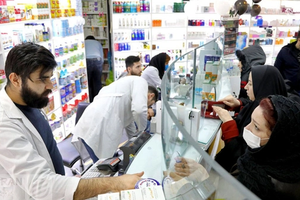
Residents told Iran International that severe shortages and soaring prices for key medicines, including insulin and blood thinners, have persisted over the past month, with some insulin brands reaching seventy million rials (≈$46.7).
Several citizens said the price of Ryzodeg insulin jumped from 12 million rials (≈$8) to 76 million rials (≈$51). Five-dose packs of NovoRapid and Lantus now sell for 15–18 million rials (≈$10–$12).
A resident reported that the blood thinner Plavix, crucial to preventing strokes and heart attacks, rose from 7.5 million rials (≈$5) to 27 million rials (≈$18) in recent weeks.
An ordinary Iranian citizen earns approximately $100–$150 per month.
Shortages leave patients struggling
Before the war and US-Israeli attacks, insulin was already limited, with insurance covering only one dose per week. Residents say the scarcity has now reached crisis levels.
One citizen in Parand near Tehran said: “I couldn’t find my diabetes medications for a month, even without a prescription. Two types, Lantus and Apidra, usually last a week each, but I ran out completely.”
Another said his mother had to travel from Karaj to Qazvin (over 110 km) to obtain essential medicines. Tehran residents report difficulty finding Asentra (sertraline) for depression and Iran-made blood thinner Osvix.
Supply chain disruptions deepen crisis
Residents link shortages to halted imports from Turkey and Dubai. A transit driver said fewer registered shipments have reduced cargo flow. Local distributors have paused sales, while pharmacies face delayed deliveries and payments.
“Our city has more pharmacies than any other shop, but even acetaminophen is unavailable,” a Sari resident in northern Iran said.
The shortages coincide with rising food prices and widespread business closures, adding to economic strain.
However, Mohammad Reza Aref, First Vice President, said on Wednesday that strategic drug reserves are in good condition and ordered “immediate import” of essential medicines. Residents, however, continue to report high prices and irregular availability.
Global healthcare impact
NHS England chief executive Sir Jim Mackey warned that the Iran war could disrupt healthcare supplies internationally. Speaking to LBC Radio on Wednesday, Mackey said syringes, gloves, and intravenous bags may become scarce due to the closure of the Strait of Hormuz.
“A team has been set up across the NHS to assess risks through the supply chains. Almost everything may be at risk, as Britain relies heavily on imports for medicines and healthcare equipment,” Mackey said.
Medicines UK chief executive Mark Samuels said Britain could face further shortages if the conflict prolongs, noting that 85 percent of NHS medicines are generic and largely sourced from India.
Argentina has designated Iran’s Islamic Revolutionary Guard Corps a terrorist organization, broadening a years-long effort by Buenos Aires to hold Tehran and its proxies responsible for the deadliest attacks in the country’s history.
In a statement issued on Tuesday, President Javier Milei’s office said Argentina had added the IRGC to its public registry of individuals and entities linked to terrorism and its financing, a move that allows financial sanctions and operational restrictions.
“The National Government has declared the Islamic Revolutionary Guard Corps (IRGC) a terrorist organization,” the statement said.
Argentina tied the decision directly to the 1992 bombing of the Israeli Embassy in Buenos Aires, which killed 29 people and wounded more than 200, and the 1994 bombing of the AMIA Jewish community center, which killed 85 people and wounded more than 300.
“The Republic of Argentina was the victim of two of the most serious terrorist attacks in history, perpetrated in the 1990s by the operational arm of the IRGC in the region, the Hezbollah organization,” the statement said.
It added that judicial investigations and intelligence work had found that both attacks were “planned, financed and executed with the direct participation of senior officials of the Iranian regime and operatives of the Revolutionary Guard.”
The announcement also renewed attention on Ahmad Vahidi, the IRGC chief commander and former Iranian defense minister, who has long been sought by Argentine authorities over the AMIA case.
Argentina said Interpol red notices had been issued for several Iranian citizens, “among them former Defense Minister Ahmad Vahidi, who was recently appointed to lead the IRGC.”
The move goes beyond Argentina’s earlier designation of the Quds Force, the IRGC’s extraterritorial arm responsible for operations abroad.
A State Department cable earlier this month showed Secretary of State Marco Rubio had instructed US diplomats to press foreign governments to designate both groups as terrorist organizations.
Milei’s office cast the decision not only as a security measure, but as a moral and political one.
“The President Javier Milei hopes that this decision will settle a historic debt of more than 30 years with the families of the victims,” the statement said.
It added that his government remained committed to “recognizing terrorists for what they are.”
Milei’s statement ended in broader ideological terms, saying the government was determined to align Argentina with “Western civilization” while confronting those “who want to destroy it.”
Photo of Alireza Jafari, an 11-year-old fifth-grade student, who has been identified as a child soldier among those killed recently.
The death of 11-year-old Alireza Jafari, the first known child recruit killed during the Iran war, underscores what rights advocates describe as a governing doctrine that places regime survival above civilian protection amid mounting wartime pressure.
Jafari, a fifth-grade student, was killed at a military checkpoint in Tehran during US and Israeli airstrikes targeting military sites, according to Hengaw, a Norway-based Kurdish human rights organization that monitors abuses in Iran.
In an interview with the state-affiliated Hamshahri newspaper, the boy’s mother said that because of a “shortage of personnel,” his father had taken him to the checkpoint. He was later killed in a drone strike while stationed there.
The Basij Organization confirmed that the 11-year-old died “while on duty” at a checkpoint on Artesh Highway as a result of the strike.
Why he was sent remains difficult to verify. In Iran’s tightly controlled information environment, families often speak under pressure, with state scrutiny and the threat of reprisals limiting candor.
The case comes as officials with the Islamic Revolutionary Guard Corps have openly acknowledged lowering the minimum age for war-related support roles to 12.
Rahim Nadali, a cultural official with the Guards in Tehran, said in remarks aired on state media that an initiative called For Iran was recruiting participants for patrols, checkpoints and logistics.
“Given that the age of those coming forward has dropped and they are asking to take part, we lowered the minimum age to 12,” he said, adding that 12- and 13-year-olds could now take part if they wished.
The state-backed recruitment drive makes Jafari’s death more than an isolated case. Together with precedent from the Iran-Iraq war, it suggests children even younger than the officially stated minimum may also be drawn into the war effort.
For rights advocates, the case reveals both a propaganda strategy and a manpower crisis inside a weakened state.
“They want to recruit these young people, use them as a kind of human shield. Because if they attack these kids, they start saying, ‘Oh look, they attack kids,’ and that’s what they’re doing,” said Shiva Mahbobi, a former political prisoner and London-based human rights advocate.
The child was placed at a military checkpoint even as the regime knew such sites were active targets of Israeli strikes, underscoring the degree to which minors were knowingly exposed to lethal risk.
A recruitment poster for Iran's Basij militia. It says people should inquire at their local mosque for further details.
Analysts say the reliance on minors also points to deeper strain within the regime’s security structure. After months of domestic unrest, wartime losses and reported cracks within some IRGC ranks, including defections, the state appears increasingly short on trusted personnel for checkpoint and support roles.
“They have actually called upon younger people to come and tried to recruit them. It shows they are preparing for a battle where they know they will need many more forces,” Mahmood Amiry-Moghaddam of the Norway-based Iran Human Rights organization told Iran International.
“It also shows they are not in a good condition. They are struggling for their survival.”
“They have only one principle, which is holy to them, and that’s to preserve the establishment," he added.
Through his human rights organization, Amiry-Moghaddam has documented cases from the January crackdown in which the regime placed weapons in the hands of minors and sent them to fire on protesters, exploiting the hesitation many civilians feel when confronted by a child.
A holy pledge: preserve the regime
The use of children in conflict, rights groups say, is not new. It reflects a longer doctrine in which vulnerable lives are used to offset military weakness and preserve the state.
“The Islamic Republic used a large number of child soldiers during the war with Iraq. They also sent Afghan children to fight in Syria,” said Shahin Milani, executive director of the Iran Human Rights Documentation Center.
“Given the pressure they are under, it is not surprising that they have resorted to using minors to man checkpoints. Perhaps they want to keep their trained fighters for more critical roles. Since it came to power in 1979, the Islamic Republic has relied on sacrificing its soldiers to compensate for technological inferiority.”
That logic, rights defenders argue, crosses from military expediency into deliberate political calculation.
“Hiding behind children is not new. The Islamic Republic used children in the war with Iraq as well, brainwashing them with propaganda and giving them keys to heaven," said Roya Boroumand, co-founder and executive director of the Abdorrahman Boroumand Center.
The move comes despite Iran’s obligations under the Convention on the Rights of the Child, which prohibits the use of children in military activities. Iran signed the treaty on September 5, 1991 and ratified it on July 13, 1994.
For Boroumand, the use of minors reflects a governing doctrine in which human life is subordinated to state survival.
“They are disposable and instruments for a higher purpose. In this case, the loss of children’s lives increases the political cost of war for their enemies. So rather than protecting and evacuating them to safe shelters, they deliberately expose them to danger,” she said.
So far, UNICEF has not publicly condemned the Islamic Republic’s stated policy of recruiting children into war-related support roles. Iran International has reached out to UNICEF’s communications team for comment.
People walk near Iranian missiles in a park in Tehran, March 26, 2026.
A leaked internal directive from the IRGC’s missile command appears to show that the use of civilian locations to conceal, support and in some cases facilitate missile launch operations is not ad hoc, but structured, documented and built into operational planning.
The 33-page document shared with Iran International by the hacktivist group Edalat-e Ali (Ali’s Justice) has been marked “very confidential” and is titled Instruction for Identification, Maintenance, and Use of Positions.
The document is attributed to the Specialized Documents Center of the Intelligence and Operations Deputy of the IRGC's missile command.
A framework for missile operations
What emerges from the directive is a bureaucratic framework for missile deployment that goes well beyond hardened silos or underground “missile cities.”
The text lays out categories of launch positions, inspection procedures, coding systems, site records, chains of responsibility and rules for maintaining access to a wide network of locations that can be used before, during and after missile fire.
Its significance lies not only in the variety of launch positions it defines, but in the explicit inclusion of non-military environments in that system.
In its introduction, the document says missile positions are an inseparable part of missile warfare tactics and argues that the enemy’s growing ability to detect, track and destroy missile systems requires special rules for identifying, selecting, using and maintaining such positions.
It adds that the use of “deception,” “cover” and “normalization” alongside other methods would make the force more successful in using those positions.
That language is important. It suggests the document is not merely about protecting fixed military assets. It is about making missile units harder to distinguish from their surroundings and harder to detect in the first place.
The implication of the directive is that it describes a system for embedding missile activity within ordinary civilian geography.
Rather than relying only on conventional military facilities, the document sets out a model in which missile units can move across a wider landscape of pre-identified sites selected for concealment, access and operational utility.
The result is a structure that appears designed to preserve launch capability while reducing visibility and complicating detection.
The clearest indication comes in the section on what the document describes as artificial dispersion or cover positions. These include service, industrial and sports centers, as well as sheds and warehouses – places that are civilian in function or appearance, but can be repurposed to hide missile units.
The conditions listed for such sites include being enclosed, not overlooked by surrounding buildings, and either lacking CCTV cameras or allowing them to be switched off.
Taken together, those requirements point to a deliberate screening process for civilian sites that can be used as missile cover. The concern is not only protection from attack, but invisibility within the civilian landscape.
The broader structure of the document reinforces that conclusion. It contains sections on site identities, naming and coding, inspections of routes and positions, record maintenance and responsibilities across intelligence, operations, engineering, communications, safety, health and counterintelligence.
This is the language of a standing system, not an improvised wartime workaround.
An Iranian couple walks near Iranian missiles in a park in Tehran, March 26, 2026.
A system for concealment
Farzin Nadimi, a senior defense and security analyst at the Washington Institute who reviewed the document for Iran International’s The Lead with Niusha Saremi, said the text points to a database-driven effort to identify areas around missile bases that can be used for different kinds of positions.
He said the IRGC missile force appears to have mapped not only launch positions, but also dispersal, deception and technical positions – the latter being places suitable for storing launchers and support vehicles and, when needed, preparing missiles for firing.
“These technical positions,” Nadimi said, “can include large, covered spaces such as industrial sheds or sports halls, where missile launchers and support vehicles can be brought inside, and where missiles can be mounted onto launchers, warheads attached and, in the case of liquid-fueled systems, fueling operations carried out.”
That point is critical. If civilian-looking or civilian-owned structures are being used not only to shelter launchers, but also to prepare them for launch, then the document describes more than concealment. It describes the embedding of missile operations inside civilian infrastructure.
A network built for dispersal
Nadimi also said the directive places repeated emphasis on speed – getting launch vehicles into these buildings quickly before launch and returning them to cover quickly afterward.
In his reading, the database tied to these positions includes technical features of each site, access routes and nearby facilities, including the nearest medical center, police station and military post.
It also, he added, records whether use of the property can be coordinated in advance with the owner, including contact details, or whether occupation could occur without prior coordination in urgent cases.
If so, that would suggest the system extends down to the level of property access and local civilian surroundings, turning seemingly ordinary sites into preplanned nodes in a missile network.
The document’s own emphasis on route inspection, site profiles, records and coded classification supports the picture of a missile force operating through a dispersed support architecture rather than through fixed bases alone.
Iranian missiles displayed in a park (March 26, 2026)
Why this puts civilians at risk
Nadimi warned that the use of civilian environments is especially troubling because many IRGC launchers are themselves designed to blend into civilian traffic.
“Many of these launchers essentially resemble civilian vehicles or trailers,” he said.
He added that larger launchers for Khorramshahr missiles can be covered with a white casing that makes them look like an ordinary white civilian trailer, while the towing vehicle is also typically white.
Smaller launchers, he said, are often painted not in conventional camouflage but in ways that make them less conspicuous in civilian surroundings.
That observation fits closely with the document’s emphasis on cover, concealment and post-launch disappearance. The combination of disguised launch vehicles and preidentified civilian sites suggests an operational doctrine built around blending missile units into non-military space.
According to Nadimi, this has direct consequences under the laws of war.
“The use of civilian environments, structures and buildings for this purpose is unlawful under the laws of war,” he said. “It removes the protection those buildings would otherwise have and turns them into legitimate military targets.”
The danger, he added, is that civilians living or working in such places may have no idea a missile launcher is being hidden in their vicinity until they themselves are exposed to attack.
An organized doctrine, not an exception
The leaked directive therefore appears to document something broader than the existence of underground missile facilities or dispersed launch sites.
It points to an organized method for extending missile operations into the civilian sphere – using industrial buildings, service facilities, sports complexes, warehouses and other non-military spaces as part of a launch architecture designed to survive surveillance, evade detection and preserve firing capability under wartime pressure.
In that sense, the document is not just about positions where missiles are launched from. It is about how a military force can fold launch operations into everyday civilian geography – and in doing so, transfer the risks of missile warfare onto places and people that outwardly have nothing to do with it.