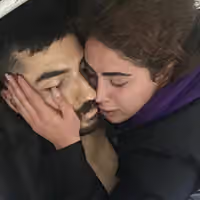
Photo of Alireza Jafari, an 11-year-old fifth-grade student, who has been identified as a child soldier among those killed recently.
The death of 11-year-old Alireza Jafari, the first known child recruit killed during the Iran war, underscores what rights advocates describe as a governing doctrine that places regime survival above civilian protection amid mounting wartime pressure.
Jafari, a fifth-grade student, was killed at a military checkpoint in Tehran during US and Israeli airstrikes targeting military sites, according to Hengaw, a Norway-based Kurdish human rights organization that monitors abuses in Iran.
In an interview with the state-affiliated Hamshahri newspaper, the boy’s mother said that because of a “shortage of personnel,” his father had taken him to the checkpoint. He was later killed in a drone strike while stationed there.
The Basij Organization confirmed that the 11-year-old died “while on duty” at a checkpoint on Artesh Highway as a result of the strike.
Why he was sent remains difficult to verify. In Iran’s tightly controlled information environment, families often speak under pressure, with state scrutiny and the threat of reprisals limiting candor.
The case comes as officials with the Islamic Revolutionary Guard Corps have openly acknowledged lowering the minimum age for war-related support roles to 12.
Rahim Nadali, a cultural official with the Guards in Tehran, said in remarks aired on state media that an initiative called For Iran was recruiting participants for patrols, checkpoints and logistics.
“Given that the age of those coming forward has dropped and they are asking to take part, we lowered the minimum age to 12,” he said, adding that 12- and 13-year-olds could now take part if they wished.
The state-backed recruitment drive makes Jafari’s death more than an isolated case. Together with precedent from the Iran-Iraq war, it suggests children even younger than the officially stated minimum may also be drawn into the war effort.
For rights advocates, the case reveals both a propaganda strategy and a manpower crisis inside a weakened state.
“They want to recruit these young people, use them as a kind of human shield. Because if they attack these kids, they start saying, ‘Oh look, they attack kids,’ and that’s what they’re doing,” said Shiva Mahbobi, a former political prisoner and London-based human rights advocate.
The child was placed at a military checkpoint even as the regime knew such sites were active targets of Israeli strikes, underscoring the degree to which minors were knowingly exposed to lethal risk.
A recruitment poster for Iran's Basij militia. It says people should inquire at their local mosque for further details.
Analysts say the reliance on minors also points to deeper strain within the regime’s security structure. After months of domestic unrest, wartime losses and reported cracks within some IRGC ranks, including defections, the state appears increasingly short on trusted personnel for checkpoint and support roles.
“They have actually called upon younger people to come and tried to recruit them. It shows they are preparing for a battle where they know they will need many more forces,” Mahmood Amiry-Moghaddam of the Norway-based Iran Human Rights organization told Iran International.
“It also shows they are not in a good condition. They are struggling for their survival.”
“They have only one principle, which is holy to them, and that’s to preserve the establishment," he added.
Through his human rights organization, Amiry-Moghaddam has documented cases from the January crackdown in which the regime placed weapons in the hands of minors and sent them to fire on protesters, exploiting the hesitation many civilians feel when confronted by a child.
A holy pledge: preserve the regime
The use of children in conflict, rights groups say, is not new. It reflects a longer doctrine in which vulnerable lives are used to offset military weakness and preserve the state.
“The Islamic Republic used a large number of child soldiers during the war with Iraq. They also sent Afghan children to fight in Syria,” said Shahin Milani, executive director of the Iran Human Rights Documentation Center.
“Given the pressure they are under, it is not surprising that they have resorted to using minors to man checkpoints. Perhaps they want to keep their trained fighters for more critical roles. Since it came to power in 1979, the Islamic Republic has relied on sacrificing its soldiers to compensate for technological inferiority.”
That logic, rights defenders argue, crosses from military expediency into deliberate political calculation.
“Hiding behind children is not new. The Islamic Republic used children in the war with Iraq as well, brainwashing them with propaganda and giving them keys to heaven," said Roya Boroumand, co-founder and executive director of the Abdorrahman Boroumand Center.
The move comes despite Iran’s obligations under the Convention on the Rights of the Child, which prohibits the use of children in military activities. Iran signed the treaty on September 5, 1991 and ratified it on July 13, 1994.
For Boroumand, the use of minors reflects a governing doctrine in which human life is subordinated to state survival.
“They are disposable and instruments for a higher purpose. In this case, the loss of children’s lives increases the political cost of war for their enemies. So rather than protecting and evacuating them to safe shelters, they deliberately expose them to danger,” she said.
So far, UNICEF has not publicly condemned the Islamic Republic’s stated policy of recruiting children into war-related support roles. Iran International has reached out to UNICEF’s communications team for comment.