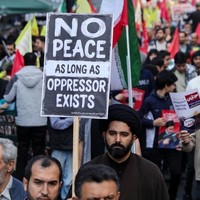
A man holds a placard reading “No peace as long as oppressor exists” during a state-organised rally in Tehran marking the anniversary of the 1979 seizure of the US embassy, November 4, 2026
The prospect of another war with Israel and the United States continues to dominate debate in Tehran despite a stinging electoral rebuke to President Donald Trump, driven in part by his military campaign against Iran.
On Iranian state television and in state-aligned media, commentators are debating how to make Tehran's threats of retaliation more credible, with proposals ranging from devastating attacks on military and energy infrastructure to changes in Iran's nuclear posture.
Speaking on the state television programme Be Vaght-e Iran (Iran Time) on Tuesday, international relations analyst Mostafa Najafi argued that Iran's previous military responses had failed to convince Israel that another conflict would carry sufficiently high costs.
Najafi said Israelis had experienced the impact of Iranian missile attacks during the second week of the 12-day war, but that the damage had been less significant during the subsequent 40-day war.
He cited Israeli polling that he said showed 60% of Israelis continued to support military action against Iran, potentially encouraging Israel to launch another operation.
"Any new deterrence equation must credibly convey to the Israeli enemy that if another confrontation occurs, the consequences will go beyond those of the 12-day war, the 40-day war, and the subsequent True Promise 1 and True Promise 2 operations," he said.
Najafi claimed that Iranian decision-makers had resolved to inflict considerably greater damage on Israel in any future confrontation. He argued that Tehran should demonstrate its ability to retaliate within minutes of an attack, sending credible signals before hostilities begin rather than waiting for another war.
Another panellist, Vahid Khazab, argued that Tehran should warn Washington that any new conflict would involve attacks on energy infrastructure.
He cited the attack on Qatar's Ras Laffan energy complex as an example of the damage Iran could inflict, claiming that it had not yet returned to production, unlike Saudi Arabia's East-West Pipeline, which Riyadh had restored after an attack.
Khazab said Israel should also be warned that Iranian retaliation would target its infrastructure.
The discussion has continued even as the war's political consequences become increasingly apparent in Washington. Democrats won control of both chambers of Congress in Tuesday's midterm elections, with Trump acknowledging that the Iran war contributed to Republican losses. Vice President JD Vance went further, identifying the conflict as the principal reason for the defeat.
European targets enter the discussion
The debate comes amid increasingly expansive threats in Iranian state-aligned media about the geographical scope of any future conflict.
Referring to a recently reported meeting between Supreme Leader Mojtaba Khamenei and senior military commanders, Najafi said Tehran had previously warned that another war would become a regional conflict.
He argued that Khamenei's reported instruction to respond to attacks "without any geographical limitations" should now be treated as a credible threat by Iran's adversaries.
On Tuesday, Tehran Municipality-affiliated Hamshahri newspaper published a map of Europe and reported that Iran's armed forces were updating their list of potential targets "without geographical limitations."
The newspaper suggested that US air and naval bases, logistical facilities and other military infrastructure in Europe could be targeted if Washington and Israel attacked Iran's strategic infrastructure.
It also raised the possibility of extending the range of Iranian ballistic missiles, potentially bringing US bases in Europe within reach.
Nuclear doctrine and the NPT
The discussion has also extended to whether Iran should reconsider its nuclear doctrine and its commitments under the Nuclear Non-Proliferation Treaty (NPT).
Najafi criticised Tehran for repeatedly threatening to change its nuclear doctrine before the 12-day and 40-day wars without following through, arguing that this had weakened its deterrence.
He said Iran needed to make a clear decision before another confrontation and communicate it through official channels, backed by a broader national consensus.
"Before the war, the message must be conveyed in every possible way to the other side and to all other parties, including hostile parties and allies who, in one way or another, play a role in our nuclear file," he said.
Najafi argued that changing Iran's nuclear doctrine would not necessarily require withdrawal from the NPT. He suggested Tehran could instead reduce its commitments under the treaty, while warning that withdrawal without a corresponding change in deterrence capabilities could expose Iran to additional threats.
"If you are going to make a change, and that change necessarily involves withdrawing from the NPT, without translating it into nuclear deterrence, I don't think it will create deterrence. It could even create additional threats against the country," he said.
Khazab offered a different approach, claiming he had received reliable information that Iranian decision-makers were considering using the threat of NPT withdrawal as a bargaining chip.
He suggested Tehran could seek concessions, including sanctions relief, in exchange for remaining in the treaty.
Khazab added that any such move would depend on Washington first meeting Iran's seven conditions for ending the war.
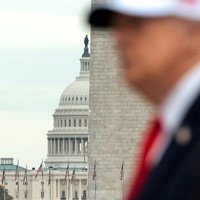
The US Capitol looms in the distance as US President Donald Trump departs following his remarks ahead of the midterm elections at the National Mall in Washington, DC, US, November 2, 2026.
Democrats' victory in both chambers of Congress could strengthen oversight of Donald Trump's war with Iran, but some analysts say the electoral setback may encourage the US president to intensify military operations before the new Congress takes office in January.
The Democratic takeover gives opponents of the war greater influence over military spending, congressional investigations and legislation restricting presidential authority. Yet it also creates a nearly two-month period in which Trump can pursue military objectives before lawmakers assume their new positions on January 3.
The possibility that electoral defeat could encourage further military action emerged in assessments by foreign policy specialists and analysts interviewed by Iran International on Tuesday.
"We can expect Trump to carry out a major military operation, perhaps even more intense than what he would have undertaken had he retained control of Congress," international relations analyst Fereshteh Pezeshk told Iran International.
Pezeshk argued that Trump could seek to demonstrate his authority and influence the media narrative following Republican losses. She said the incoming Congress might delay military funding or create other obstacles, but would have limited power to restrain the president, who would remain commander-in-chief after January 3.
Trump acknowledged the economic impact of the Iran war after the Republican defeat but rejected the suggestion that voters opposed the military campaign itself.
"I don't think it's the war. I think it's a gasoline price. People agree with what I'm doing on Iran, but they really probably weren't willing to do the short-term consequence of paying more for gasoline," Trump told Fox News.
The president nevertheless defended his Iran policy.
"I am totally convinced that my decision on Iran for the long term good of our country and even the world was absolutely the correct one and it continues to be," Trump told Politico.
Could defeat encourage a bigger offensive?
The administration was preparing a major new offensive against Iran before the midterms, and the election result could strengthen Trump's incentive to proceed during the transition period, Barbara Slavin, a distinguished fellow at the Stimson Center, wrote on November 2.
Slavin identified reopening the Strait of Hormuz and securing Iran's stockpile of highly enriched uranium as possible objectives.
But she said that renewed attacks could expose American allies in the Persian Gulf to further Iranian retaliation, increase energy costs and cause extensive destruction without achieving Washington's goals.
A military escalation could also offer Trump a way to seek a decisive outcome before Democrats acquire greater oversight powers.
Trump's calculations differ from those of conventional presidents because he places considerable weight on his personal political achievements, journalist and political analyst Omid Memarian told Iran International.
A person walks near the US Capitol building during the US midterm elections, in Washington, DC, US, November 3, 2026.
"Trump is an unconventional president whose calculations of costs and benefits are very different from those of other politicians and former presidents," Memarian said.
He argued that the president could use the period before January to launch a concentrated military operation, weaken Iran's military or nuclear capabilities, declare victory and then seek negotiations or reduce American involvement.
"I think it may even have increased the likelihood of an attack," Memarian said.
A Democratic Congress would make managing the war more difficult through investigations, committee hearings and scrutiny of military decisions, Memarian said. That could increase Trump's incentive to seek a faster conclusion rather than simply abandon military options.
The possibility has a historical parallel. After Republicans lost the 2006 midterm elections, President George W. Bush increased US troop deployments to Iraq the following year despite mounting public opposition to the conflict.
That precedent does not establish what Trump will do, but it illustrates why an electoral defeat need not produce an immediate reduction in military operations.
How much power will Democrats have?
Control of Congress gives Democrats substantial legislative and budgetary authority, but the president remains commander-in-chief.
Congress can investigate the administration, restrict appropriations and pass legislation addressing military operations. Trump, however, can veto restrictive legislation, requiring two-thirds majorities in both chambers to override him.
"Even if Democrats hold a majority in both houses, their influence will be limited to the legislative and political tools of Congress," former national security adviser John Bolton told Deutsche Welle.
Democrats have already sought to use Congress's financial authority against the war.
Senator Tim Kaine, who has repeatedly challenged Trump's military operations without congressional authorization, pledged in August to continue efforts to cut off funding.
"I'm going to keep doing all that I can to cut off funding for what will go down in history as one of America's most foolish foreign policy catastrophes of all time," Kaine said in an official statement.
Other Democrats, including Senator Chris Coons, have distinguished between replenishing American military stockpiles and financing operations that would effectively extend the conflict.
Yet restricting funding may become politically harder if Trump orders a major offensive before January.
Democrats could inherit responsibility for decisions about supplying American troops already engaged in combat, political analyst Morad Veisi said. Opposing the war would not necessarily make lawmakers willing to withhold resources from deployed forces.
Could Trump pursue the Islamic Republic's downfall?
The possible objectives of further military action remain a major point of disagreement among analysts interviewed by Iran International.
Trump could regard the remainder of his presidency as an opportunity to secure a historic legacy, potentially including military action contributing to the Islamic Republic's downfall, Veisi said.
"I think Trump could leave behind a political legacy by helping bring about the downfall of the Islamic Republic. I'm not saying he will definitely do it, but it would be consistent with his character, and he has 60 days," Veisi said.
Veisi linked that possibility to what he described as Israel's increasingly explicit pursuit of the Islamic Republic's removal. He argued that Trump might support a broader campaign if he believed it could deliver a defining political achievement.
The analyst also suggested that an expanded conflict launched before January could leave incoming Democrats confronting military commitments they would find difficult to reverse.
Pezeshk offered a different assessment, distinguishing between forcing the Islamic Republic to submit to American demands and deliberately seeking its overthrow.
"We still do not see evidence that Trump is taking steps that would lead us to conclude he intends to overthrow the Islamic Republic rather than force it to submit," Pezeshk told Iran International.
She argued that Trump appeared more attracted to a Venezuela-style approach than an Iraq-style intervention involving prolonged American responsibility for political reconstruction.
She also questioned whether Washington had a clear plan for replacing Iran's governing institutions.
Could Tehran misread the election?
Iranian parliament speaker Mohammad Bagher Ghalibaf portrayed the election result as a rejection of the war and warned Washington against disregarding what he described as the will of American voters.
"Conscience or the cost of living, Americans said NO TO WAR, and we endorse this message," Ghalibaf wrote on X.
"If the US govt betrays their public will to serve international paymasters and blackmailers, it will learn our NO comes with a Nightmare," he added.
Ghalibaf's message combined his interpretation of the election with a warning of consequences if Washington continued its military campaign.
But the shift in congressional control does not necessarily signal a corresponding change in Washington's strategic objectives.
Iranian leaders should not mistake political divisions in Washington for a weakening of American power, Washington-based national security specialist Amir Hamidi told Iran International.
"President Trump may lose his congressional majority, but he has not lost his presidential authority. An electoral defeat for one party is not a defeat of America's national power," Hamidi said.
Hamidi added that the Islamic Republic could pay a heavy price for misreading the election result, arguing that the US president remains commander-in-chief and retains significant authority over diplomacy and crisis management.
Congressional oversight of military operations and war spending could increase under Democratic control, but that would not necessarily diminish US deterrence or its longstanding security commitments, Hamidi said.
A narrowing window before January
The Democratic victory may have changed the political timetable for the Iran war without changing who controls its immediate course.
Until the new Congress takes office on January 3, Trump retains the authority to make military decisions that could shape the conflict well beyond the transition period. A major offensive during those weeks could leave incoming lawmakers confronting decisions already made and military commitments difficult to reverse.
The election result also presents a question for the Islamic Republic: whether Washington's domestic political divisions will translate into restraint or whether an approaching deadline could encourage further military action.
The coming weeks may therefore matter more than the new balance of power in Congress. A vote intended to change the direction of American politics could precede a decisive turn in a war that the incoming lawmakers have yet to gain the power to influence.
A satellite view shows tunnel entrances at Pickaxe Mountain, of the Natanz nuclear facility, near Natanz, Iran, June 30, 2026. Vantor Handout via REUTERS
Iranian commentators are questioning whether Donald Trump can end the conflict with a short military operation, arguing that the unresolved confrontation over Hormuz and the threat of economic retaliation could frustrate an attempt to strike Iran and declare victory.
Vahid Khazab, a regular commentator on the state television program Be Vaght-e Iran (Iran Time), argued Monday night that the circumstances that allowed the 12-day war to end no longer applied.
He recalled that Trump declared that conflict over after the United States struck Iran’s Fordow nuclear facility and Tehran retaliated against the Al Udeid air base in Qatar. This time, he said, a strike would leave the question of shipping through the Strait of Hormuz unresolved.
“Suppose he attacks Kuh-e Kolang (Pickaxe Mountain) and then says, ‘That’s it, it’s over.’ Well, what happens to the Strait of Hormuz?” Khazab asked.
“This means the war has not ended. That is why a symbolic move like the one during the 12-day war is not possible,” he added.
Khazab argued that Trump needed to end the conflict either through military action or an agreement, while portraying Iran as unwilling to make concessions in negotiations.
He urged Tehran to convey a warning that renewed attacks would provoke retaliation carrying lasting economic and political costs for Washington.
“Trump must understand this. It is very important that this message be conveyed to him — publicly, officially, secretly, in any way — that if you attack again, Iran will respond in a way that will seriously jeopardize the next two years of your future and America’s future, particularly by causing economic problems, including a recession,” he said.
“This would make him refrain from taking risks, including launching even a short war, regardless of the electoral outcome, in order to protect his legacy.”
Nima Akbarkhani, another regular panelist introduced on the program as a military expert, discussed the possibility of Trump staging a “major, spectacular Hollywood-style operation” to declare victory and end the war.
He argued that even such an operation would leave Trump in a difficult political position if Democrats won the midterm congressional elections.
Mehdi Abbasi, a guest introduced as a US affairs expert, speculated that a Democratic victory could prompt Trump to attack Iran during the roughly two months before the new Congress takes office in January.
Limited strikes and plans for further attacks
The discussion came amid limited US military action and reports of preparations for a potentially broader confrontation.
The United States struck Iran’s Qeshm Island on Monday as part of a series of limited attacks in recent weeks, The Wall Street Journal reported, citing US officials.
Trump said Tuesday that US forces had destroyed an Iranian anti-aircraft installation that he said had taken about two months to build.
The New York Times separately reported Tuesday, citing US officials, that US Central Command had a plan to begin strikes against Iran as early as Wednesday, after the midterm elections. The reported plan did not establish that Trump had ordered an attack.
Responding to the Qeshm strike, Deputy Foreign Minister Kazem Gharibabadi said Tuesday that Iran remained in a state of war and retained the right to defend itself until military aggression against it had ended completely and permanently.
Russian Foreign Ministry spokeswoman Maria Zakharova said Monday that reports of plans for further military action against Iran were deeply concerning and urged renewed diplomatic efforts.
Tehran holds to its demands
Tehran and Washington continue to exchange messages through intermediaries, including Qatar. Trump and Vice President JD Vance have expressed optimism about diplomacy, while Iranian officials insist Washington must meet Tehran’s conditions.
Mohsen Rezaei, secretary of Iran’s Supreme National Security Council, said Tuesday that Washington’s response to Tehran’s demands was unconvincing. He said the Strait of Hormuz would reopen only after the United States explicitly addressed and implemented Iran’s seven conditions.
Vance sent Rezaei a letter through Qatar several days earlier. Rezaei did not specify whether his Tuesday remarks referred to that letter or another message conveyed through intermediaries.
Parliament Speaker and chief negotiator Mohammad-Bagher Ghalibaf also warned Tuesday that Tehran’s response to a possible US attack would be unpredictable.
President Masoud Pezeshkian, meanwhile, reiterated that Supreme Leader Mojtaba Khamenei had granted his government additional powers to pursue negotiations.
Pezeshkian said his administration would seek to resolve the conflict through diplomacy but did not specify the scope of that authority.
His emphasis on negotiations drew criticism from hardline commentator and university professor Foad Izadi, who argued that such statements could help Washington choose the timing of another attack.
In a post responding to Pezeshkian, Izadi cited Trump’s remarks that oil prices were falling because people believed there would be no war with Iran and that Tehran wanted an agreement quickly.
Izadi accused Pezeshkian of helping Trump lower public expectations of war and manage oil prices by repeatedly emphasizing negotiations. He warned that Washington could attack again in the middle of diplomatic exchanges, at a time of its own choosing.
Speculation over nuclear weapons
Some Iranian commentary has also raised the possibility of nuclear weapons being used in a renewed confrontation, although Gharibabadi said Tuesday that Washington had not announced an official position on using such weapons against Iran.
Hossein Ajorlou, an international relations academic, told Fararu that a broad but short operation using powerful conventional weapons remained the most likely scenario.
He nevertheless speculated that Washington could consider tactical nuclear weapons if it failed to secure a quick result and reached a military stalemate.
Ajorlou emphasized that he considered conventional weapons, including bunker-busting bombs and precision-guided munitions, the likelier option.
Limits of a change in Congress
Several Iranian commentators have cautioned that a shift toward Democrats in Congress would not necessarily prevent another military confrontation.
Ali Hassan Heydari, an international affairs analyst writing for the hardline Siraj24 website, argued that victory for either party should not be interpreted as a fundamental change in Washington’s strategic approach.
A Democratic victory could nevertheless raise the political and financial costs of continuing the war and restrict Trump’s freedom of action, he wrote.
“This matters for Iran’s calculations, but it should not lead to a strategic miscalculation, because the outcome of the war and the question of the Strait of Hormuz will not be determined solely by the composition of Congress,” Heydari wrote.
“The elections may change the rules of Trump’s game, but resolving the confrontation with Iran requires decisions and agreements that go beyond the US ballot box.”
Amirali Abolfath, a US affairs expert, similarly cautioned against expecting a change in congressional control to end the conflict.
“We should not place too much hope in the idea that a change in the composition of Congress alone will bring the war to a halt, although these changes are not without effect and should not be viewed in absolute, black-and-white terms,” he told ISNA.
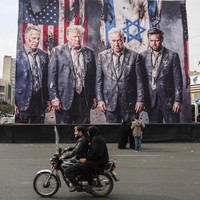
A mural in Tehran showing US President Donald Trump, Israeli Prime Minister Benjamin Netanyahu, US Vice President JD Vance and US envoy Steve Witkoff.
Tehran’s newspapers agree across factions that negotiating with the United States is legitimate, but are deeply divided over whether diplomacy can still prevent war, as Qatar said on Tuesday that both sides were reviewing its proposals.
While reformist and moderate newspapers, including Etemad, Shargh and Arman Melli, explore ways to reach an agreement, hardline outlets such as Hamshahri and Kayhan appear to be preparing the public for conflict.
Iranian negotiators left Doha on Sunday after three days of talks with Qatari mediators, and a Qatari team traveled to Tehran on Monday night before returning to Doha.
“Both parties are reviewing suggestions we as mediators proposed,” Qatar’s Foreign Ministry spokesperson said on Tuesday, adding that differences remained but talks were continuing. A senior Iranian official told Reuters the same day that Tehran and Washington were still far from a deal, and that Iran would not accept what he called Washington’s “excessive demands.”
Tehran says negotiations should be based on its seven-step September plan to reopen the Strait of Hormuz and end the US naval blockade, on a faster timetable proposed by Qatar. Foreign Minister Abbas Araghchi has suggested reopening the strait within two days of an agreement, leaving nuclear issues for a second phase.
President Donald Trump has said there will be no further strikes before Tuesday’s midterm elections, but has not ruled out military action afterward. Secretary of State Marco Rubio says no decision has been made. US allies in the Persian Gulf have reportedly been told to prepare for possible strikes after November 4. Supreme Leader Mojtaba Khamenei has ordered Iran’s armed forces to prepare for war across an extended front.
The immediate focus in Tehran is a letter from US Vice President JD Vance to Mohsen Rezaei, secretary of the Supreme National Security Council. After a week of confusion over who was leading negotiations, Foreign Ministry spokesman Esmail Baghaei said on Monday that Parliament Speaker Mohammad Bagher Ghalibaf remained in charge, but that Rezaei would answer Vance because the letter had been sent to him. Ghalibaf has not spoken publicly about a nuclear agreement for weeks.
Agreement on talks, not on terms
In a report headlined “We Must Negotiate,” the reformist daily Etemad set out three positions. Hossein Nourani-Nejad, deputy head of the reformist Ettehad-e Mellat party, described Iran’s choices as surrender, warmongering or de-escalation. He backed President Masoud Pezeshkian’s “smart management of hostility” and criticized hardliners and the state broadcaster for raising the idea of withdrawing from the Nuclear Non-Proliferation Treaty.
Asadollah Badamchian, a conservative politician of the Motalefeh party, argued that negotiation was a tool, not a principle, and was acceptable if it served national interests. He read Vance’s letter as evidence that Washington’s pressure strategy had failed, but warned against “naive optimism.” The final decision, he said, rested with the Supreme National Security Council and the Supreme Leader.
Ali Sufi, a reformist politician, was more hopeful. He identified five elements in Vance’s letter, including direct talks, lifting the blockade and reopening Hormuz, and argued that Iran was approaching a turning point, with both the Supreme Leader and Rezaei calling for an end to “neither war nor peace.” Including the nuclear issue could complicate negotiations, he cautioned, but would probably be unavoidable.
Hardline newspapers largely ignored the letter. Kayhan read his latest orders to military commanders as ending America’s ability to launch limited strikes and then withdraw. It dismissed US threats as psychological warfare, insisting Iran did not seek war but did not fear it.
Javan, a daily close to the Revolutionary Guards, called the threats a “psychological bombardment of the negotiating table” and said Tehran had rejected Qatar’s five-day confidence-building proposal.
The reformist outlet Eslahat News quoted lawmaker Fada-Hossein Maleki, who called the decision to send the letter to Rezaei a US conspiracy to divide Iranian officials.
‘War is certain’
Heshmatollah Falahatpisheh, a former chairman of parliament’s National Security and Foreign Policy Committee, offered a darker assessment in Shargh. Intensive Qatari mediation, he argued, reflected alarm rather than progress: the mediators had, he said, glimpsed both sides’ plans for a new war.
He described Vance’s approach as Trump’s attempt to secure a diplomatic success before the election, but said Washington’s proposed concessions were too limited to overcome mistrust. Pointing to military deployments, he declared war “certain.”
The only way out, Falahatpisheh said, was a regional agreement involving the United States and guaranteed by China. Russia, he argued, sees the region through the prism of the Ukraine war and is a spoiler rather than a credible guarantor.
China has around $480 billion in economic ties with the region, imports six to eight million barrels of Persian Gulf oil a day and has major investments in Qatar’s side of the gas field it shares with Iran. Falahatpisheh argued that rivalry with Washington gave Beijing both the interest and the influence to guarantee an agreement, despite suggestions that China might prefer to keep America occupied in the Middle East rather than focused on Taiwan.
Iranian observers have often argued that China puts its own interests ahead of Iran’s. Javan reported that a Chinese special envoy would visit Iran and the region soon, and cited a joint call by China and Oman for a return to the Islamabad memorandum.
The economic cost
In Arman Melli, the economist Mahmoud Jamsaz warned that Tehran was misreading Washington. Officials who assume America’s economic problems leave Trump no choice but to accept Iran’s conditions, he said, risk wasting the mediators’ last opportunity. Trump might instead decide that war is preferable to the status quo.
During the closure of Hormuz, Jamsaz noted, China drew on its strategic reserves and cut imports, countering forecasts of oil at $200 to $300 a barrel and weakening Iran’s leverage.
A prolonged confrontation, he warned, would bring foreign-currency shortages, a falling rial, runaway inflation and the destruction of the middle class, weakening society’s ability to withstand the crisis. Iran’s distorted state capitalism, he argued, fails the test of a “resistance economy”; budget deficits and the misery index show little economic resilience.
Neither war, a prolonged frozen conflict nor a Korean-style armistice serves Iran’s national interests, Jamsaz concluded. Only negotiations aimed at ending the confrontation offer a way forward.
Iranian parliament speaker and chief negotiator Mohammad-Bagher Ghalibaf and secretary of the Supreme National Security Council Mohsen Rezaei. File photo.
US Vice President JD Vance’s letter to Iran’s national security chief, Mohsen Rezaei, has fueled speculation that Mohammad-Bagher Ghalibaf is being sidelined as Tehran’s chief negotiator, while officials deny any change in the negotiating structure.
Ghalibaf, who also serves as parliament speaker, has in recent months been identified as the head of Iran’s negotiating delegation. However, following the delivery of Vance’s letter to the secretary of Iran’s Supreme National Security Council, ultra-hardline media outlets said that Rezaei had replaced him in negotiations with Washington.
The speculation intensified after Ghalibaf was absent from an unprecedented meeting last week involving the Pakistani army chief, Saudi Arabia’s defense minister and the head of Turkey’s intelligence service (MIT), representing three members of the Mecca Pact. Rezaei and Foreign Minister Abbas Araghchi attended.
Ghalibaf’s supporters have argued that the so-called Tehran Summit was unrelated to negotiations with the United States and instead concerned Iran’s possible accession to the Mecca Pact.
Similar rumors that Ghalibaf was being removed from Iran’s negotiating team emerged in May before being officially dismissed.
Officials insist Ghalibaf remains in charge
Iranian officials have maintained that Ghalibaf continues to lead the country’s negotiating team.
Araghchi told Al Jazeera on Saturday, October 31, that Tehran still regarded Ghalibaf as its chief negotiator and that Rezaei fully supported this arrangement.
Describing the American initiative to establish contact, the foreign minister said: “The American side’s attempt to open the door to dialogue and understanding more broadly is a positive step.”
However, he warned: “If Washington’s goal in sending this letter is to stir up discord, it would be yet another mistake to add to its previous ones.”
Foreign Ministry spokesman Esmail Baghaei said Monday that Ghalibaf remained Iran’s chief negotiator and that the country's diplomatic process was managed through the Supreme National Security Council.
Manouchehr Mottaki, a member of parliament’s National Security Commission who is aligned with conservative hardliners, also dismissed reports that Ghalibaf had been excluded from decision-making.
Speaking to the reformist Ensaf News website on Monday, he said: “Ghalibaf’s significant role in decision-making after Rezaei’s appointment demonstrates that he continues to play an effective part in this process.”
Hardliners welcome Rezaei’s growing role
Despite official assurances, Vance’s letter has prompted some hardline outlets and supporters of the Paydari Front to welcome Rezaei’s growing role and the prospect of diminished influence for Ghalibaf.
Raja News, a website close to the Paydari Party, wrote on October 29 that recent developments demonstrated that “the center of gravity of foreign policy during wartime has shifted from the negotiating team to the secretariat of the Supreme National Security Council”.
The website also drew a distinction between two recent meetings with Iran’s Supreme Leader, Mojtaba Khamenei. It said that during his meeting with Ghalibaf, Khamenei had emphasized resolving people’s livelihood problems through parliament and the government, as well as advancing relations with strategic partners. By contrast, it said, discussions with Rezaei had focused on “fulfilling Iran’s seven new conditions” in negotiations with Washington.
Nobonyad, another news website associated with radical conservatives, reported on October 30 that the media committee for the Islamabad negotiations, which consisted of associates and advisers of the parliament speaker, had been dissolved on the orders of a “senior security official”.
Raja News subsequently published an article titled “Why Does Support for Rezaei Anger Ghalibaf’s Supporters?”, accusing Ghalibaf’s supporters of portraying backing for Rezaei as a political maneuver motivated by satisfaction among his rivals over Ghalibaf’s diminishing role in wartime diplomacy.
The website also leveled a series of accusations against the parliament speaker. It alleged that he had accepted a ceasefire without the Supreme Leader’s authorization, falsely claimed in a Supreme National Security Council statement that the United States had fully accepted Iran’s conditions, entered nuclear negotiations in Islamabad contrary to the Supreme Leader’s instructions, and used the issue of Lebanon’s rescue as a pretext for traveling to Switzerland and continuing direct negotiations with representatives of US President Donald Trump.
Raja News wrote that Ghalibaf and his political allies could have enjoyed the same support from revolutionary forces as Rezaei, particularly under wartime conditions. However, it said they had chosen to place their personal views above the Supreme Leader’s principles and consequently became the target of what it described as “one of the harshest reprimands in the history of the Islamic Republic,” referring to Mojtaba Khamenei’s June 18 message in which he said he had held a different view on the agreement with the United States but authorized it after the president, on behalf of himself and other members of the Supreme National Security Council, gave assurances and accepted responsibility for it.
The website also criticized Araghchi’s recent statement that Tehran was still giving diplomacy an opportunity to succeed.
It described the foreign minister’s remarks as a “special gift to Trump on the eve of his electoral defeat” and a “direct signal of military weakness to the Pentagon and Tel Aviv operations rooms”.
“It is regrettable that Seyed Abbas Araghchi’s behavior at this critical juncture is exactly like that of someone who enters the scene whenever the enemy is on the verge of collapse and facing danger, in order to protect its interests,” it wrote.
Moderates reject claims of a power struggle
Ghalibaf and his close associates have not directly commented on the issue. However, the moderate conservative website Khabar Online described Raja News’s support for Rezaei as “superficial”, arguing that the website was using its support for Rezaei’s positions as a means of undermining and weakening Ghalibaf.
In a commentary published on Monday under the headline “The Duality That Never Materialized: Ghalibaf and Rezaei on the Same Side”, the moderate Asr-e Iran website argued that if the American letter had been intended to create divisions within Iran’s decision-making structure, that objective had effectively failed.
It added that even if Washington had no such intention, some domestic political factions had attempted to exploit the development to manufacture a rivalry between the two officials, despite their public rejection of such a division.
According to Asr-e Iran, Rezaei’s message in a television interview on Saturday was clear: an expanded role for the Supreme National Security Council, or the decision to address its secretary directly, did not mean that he was competing with the head of the negotiating team.
The website argued that although foreign governments could choose whom to address in their correspondence, they could not dictate Iran’s internal decision-making structure.
“The Vance letter could have become an issue for polarization. Some domestic factions also tried to create this duality. But the coordinated positions of Rezaei, Araghchi and Baghaei demonstrated that attempts to manufacture divisions among officials, at least in this case, face a serious obstacle: a division of responsibilities is possible, and differences in language are natural, but Iran’s final decision is one,” Asr-e Iran wrote.
File photo shows different generations of centrifuges displayed in an exhibition in Iran
Calls to revise Iran’s nuclear doctrine and build an atomic bomb are gaining prominence on official platforms after gathering momentum in hardline circles, although the country’s top security official says no policy change has been approved.
Mohsen Rezaei, secretary of Iran’s Supreme National Security Council, said on Saturday, October 31, that neither the government nor the broader establishment had made a new decision on changing the country’s nuclear doctrine. However, he acknowledged discussion of whether Iran should retain its existing policy if war resumes.
Rezaei said attacks on Iran’s nuclear facilities had prompted public demands for reconsidering the policy. He argued that Iran had cooperated fully with International Atomic Energy Agency inspections.
“When people see this, they ask us why we should continue with this situation,” he said.
On September 19, Rezaei had also said that US and Israeli actions gave Iran grounds to withdraw from the Nuclear Non-Proliferation Treaty (NPT).
In recent days, hardliners have increasingly called on Mojtaba Khamenei to overturn his father Ali Khamenei’s religious decree prohibiting the production of nuclear weapons and declare their manufacture permissible.
Ahmad Naderi, a hardline member of parliament, told Khaneh Eqtesad in October that circumstances had changed and Ali Khamenei’s decree on nuclear weapons could be reconsidered.
“From Mojtaba Khamenei’s behavior, my understanding is that his fatwa will be different,” Naderi said.
Tasnim news agency reported on Saturday that Mojtaba Khamenei had instructed senior military commanders during a meeting to respond to any threat immediately and effectively, and “without geographical limitations”.
Before details of the meeting were published, hardliners on social media had expressed hope that he had ordered the development of nuclear weapons. The published account did not announce such an order.
Supporters of developing nuclear weapons have also cited remarks Ali Khamenei made during a meeting with students in November 2024. At the time, students called for a change in Iran’s nuclear doctrine. Responding to their demands, Khamenei said that whatever was necessary to confront the enemy would certainly be done.
An analysis published on Saturday by Khorasan newspaper, which is close to parliament speaker Mohammad-Bagher Ghalibaf, argued that changing the nuclear doctrine would not contradict the late leader’s guidance.
“Contrary to what some people are saying from certain platforms, changing the nuclear doctrine not only does not conflict with the wisdom and leadership of the martyred leader, but is actually a move along the path that he himself had laid out,” it said.
A commentary published by the Revolutionary Guards-affiliated Tasnim on Saturday raised another possibility besides a complete change of nuclear doctrine.
It argued that, with the leader’s approval, Iran could instead deepen its existing doctrine without formally changing it. This would involve enriching uranium to levels suitable for producing a nuclear weapon while stopping short of manufacturing one.
Calls for a nuclear bomb from official platforms
The demand for a change in nuclear policy has increasingly featured in official speeches and Friday prayer sermons.
Mohammad-Javad Haj Ali-Akbari, Tehran’s interim Friday prayer leader, said on Friday that calls to review the country’s nuclear doctrine reflected national awareness rather than a hasty or emotional reaction to American bad faith.
Ahmad Alamolhoda, the influential representative of the supreme leader in Razavi Khorasan province, has gone further, saying that anything necessary to intimidate the enemy, including possessing nuclear weapons, is religiously “obligatory”, according to Khorasan newspaper.
Citing statements by Tehran’s Friday prayer leader, Alamolhoda and the late Ali Khamenei, Khorasan argued that Iran’s security circumstances had changed and that acquiring nuclear weapons had become a demand aimed at strengthening deterrence.
Mohammad-Taghi Naghdali, an MP representing Khomeini Shahr, said on Sunday that the slogan among pro-government demonstrators had changed from “Nuclear energy is our indisputable right” to “Nuclear warhead is our indisputable right.”
Speaking to ChandSanieh news website, Ahmad Bakhshayesh, a member of parliament’s National Security and Foreign Policy Committee, said that if Iran decided to change its nuclear doctrine, it should first build a bomb and then withdraw from the NPT.
“Withdrawing without building a bomb would eliminate the [current] benefits of IAEA oversight,” he said.
Claims of public support
Proponents of revising Iran’s nuclear doctrine have presented the proposal as a popular demand. Haj Ali-Akbari said on Friday that unspecified polls had shown more than 70% of Iranians supported reconsidering the doctrine. The report of his remarks did not provide details of those polls or their methodology.
Mahmoud Nabavian, a hardline member of parliament, said in a post on X on October 29 that he had called on the supreme leader to authorize the production of an atomic bomb during a pro-government gathering in Qom. He said the crowd welcomed his request.
Such gatherings have continued in different parts of the country since the outbreak of the recent war.
IRGC-affiliated media outlets, particularly Fars and Tasnim, have also extensively covered calls for nuclear weapons in recent days, prominently highlighting them as popular demands.
Fars has promoted calls on its My Fars online platform for Iran to build nuclear weapons and increase the range of its missiles to 13,000 kilometers.
Opponents of the proposal, including reformist politician Mostafa Hashemitaba and social media users, have challenged claims of widespread public support and called for a referendum.
In September, Hashemitaba said that if media outlets such as Kayhan believed their position enjoyed popular support, they should endorse holding a referendum.
Warnings against political pressure
The campaign has also prompted warnings against putting political pressure on nuclear decision-making.
Nour News, a website close to Iran’s Supreme National Security Council, published an article on Saturday titled “Reviewing the Nuclear Doctrine: How and Through Which Path?” warning against reducing the complex implications of changing the doctrine to a simple division between supporters and opponents.
Referring to the issue being raised in Friday prayer sermons and at nightly pro-government gatherings, the article argued that decision-makers should be able to examine all available options without political pressure, temporary emotions or expectations that had already been created.
“People’s voices should be heard, but the voices of crowds should not be turned into a substitute for expert assessment and national decision-making,” Nour News wrote.
The issue has also received extensive coverage in reformist and moderate media, which have warned about the consequences of giving prominence to calls for nuclear weapons.
The moderate conservative website Asr-e Iran accused hardliners of using provocative issues to maintain cohesion within their own ranks and control the domestic political atmosphere. It warned that raising the prospect of building an atomic bomb could have serious consequences for Iran’s international standing.
“This will only become an excuse to legitimize the war-mongering scenarios of Iran’s enemies and seriously undermine the country’s peaceful image, which it has spent years trying to establish,” the website said.
Javad Emam, spokesman for the Reformist Front, also responded to the Tehran Friday prayer leader’s remarks in a post, warning that the issue went far beyond political slogans.
“Changing the nuclear doctrine and raising the issue of building an atomic bomb is not a simple decision that can be reduced to slogans. The country’s security, economy, national interests and future are at stake,” he wrote, adding: “Can one speak on behalf of the nation without evidence and impose the costs of such a decision on the people?”