Iran’s wartime messaging targets its own citizens

Behrouz Turani
Iran International
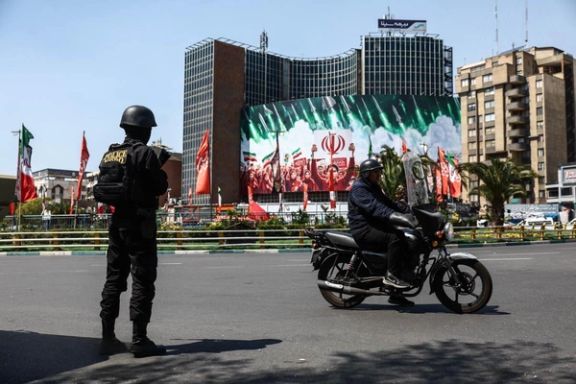
Iran’s state broadcaster has adopted a noticeably harsher tone toward dissent, increasingly framing domestic protests as part of a war waged by “enemies.”
Iran International
Iran’s state broadcaster has adopted a noticeably harsher tone toward dissent, increasingly framing domestic protests as part of a war waged by “enemies.”
One of the clearest examples came on March 10, when Police Commander Ahmad-Reza Radan addressed the possibility of protests during the conflict.
Speaking on state television, he warned that anyone who took to the streets “at the will of the enemy” would no longer be treated as a protester but as an “enemy combatant.”
The wording marked a significant escalation. By invoking the language of combat, the state effectively framed domestic dissent as participation in the war itself.
Such framing has appeared repeatedly in recent broadcasts. Commentators and officials frequently describe protests not as political grievances but as extensions of foreign military pressure.
The same rhetorical shift is evident in the way foreign adversaries are described. Television hosts increasingly employ dehumanizing metaphors to portray Western and Israeli leaders.
Israeli officials have been repeatedly referred to as “rabid dogs” on talk shows, imagery that casts them as biological threats rather than political opponents.
Foreign-based Persian-language media outlets are portrayed in similarly extreme terms. Iran International TV, for example, has been described on state television as a “satanic network,” while presenters have warned that its regional offices could be considered legitimate targets.
The tone is often even more unrestrained online, where state television presenters engage in public taunts and insults with Israeli officials and journalists on social media.
The language echoes wartime propaganda seen in many conflicts, where demonization of the enemy is used to mobilize domestic support. But the Iranian broadcasts go further by combining this rhetoric with arguments that dismiss international norms governing warfare.
On several television panel discussions in March, state-aligned analysts suggested that international humanitarian law and institutions such as the United Nations serve merely as tools of Western power.
Some commentators declared bluntly that “the age of diplomacy is dead” and that the West understands only “the language of missiles.”
In this atmosphere, messaging increasingly serves not only to condemn foreign adversaries but also to warn domestic audiences about the consequences of dissent.
When protests are described as actions carried out “at the will of the enemy,” the implication is that political opposition itself becomes a form of collaboration with hostile powers.
Wars have always reshaped political language. Governments under military pressure tend to simplify narratives, divide the world into allies and enemies, and suppress ambiguity. Iran’s state television now appears to be moving decisively in that direction.
When state television begins speaking about its own citizens in the language of the battlefield, it signals that the war is no longer being presented as something happening only beyond the country’s borders.



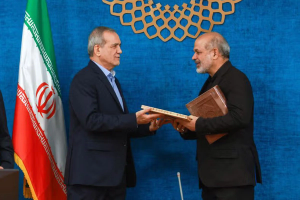
In a phone call on Tuesday with European Council President Antonio Costa, Pezeshkian said Iran has the “necessary will” to bring the conflict to an end - provided that “essential conditions, especially guarantees to prevent renewed aggression, are met.”
Following Pezeshkian’s remarks, US President Donald Trump wrote on Truth Social that the “president of the new Iranian regime” had requested a ceasefire. Oil prices dipped slightly after the comments.
Iranian officials swiftly rejected Trump’s characterization. Mehdi Tabatabaei, the deputy for communications and information at the president’s office, responded on X:
“The position of the Islamic Republic of Iran regarding the defense of the nation against the aggression of evildoers and the conditions for ending the imposed war has not changed, and there is no regard for the delusions and lies of criminals.”
In a letter addressed to the American public published on Wednesday, Pezeshkian reiterated that Iran’s military actions were “purely a response and defense, not the initiation of war and aggression.” He described continued confrontation as “costly and fruitless,” signaling a more pragmatic tone from parts of the political establishment.
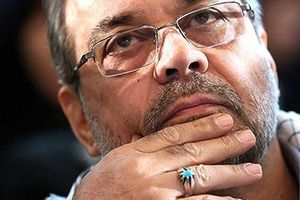
Hardliners and figures aligned with the security establishment have set stricter conditions for ending the war. Mohsen Rezaei, now a military adviser to Mojtaba Khamenei, has said the conflict should only end with reparations and guarantees, including the removal of US bases from the region.
Hardliner backlash intensifies
Pezeshkian’s comments triggered strong criticism from conservative and hardline figures. Lawmaker Hamid Rasaei described the remarks as evidence of a “wavering personality” and “passivity in the face of the enemy,” arguing that such positions could embolden further attacks.
Rasaei has previously compared Pezeshkian to Iran’s first president, Abolhassan Banisadr, who was removed from office by parliament for “political incompetence”. Similar comparisons have circulated widely on social media in recent days.
Some critics framed the conflict as a struggle between “truth and falsehood” and opposed any negotiated settlement short of total victory.
Calls for deterrence over diplomacy
In an open letter published on X, hardline activist Mohammad Shirakvand criticized Pezeshkian’s appeal for European guarantees, writing: “When you yourself state that the United States does not believe in diplomacy, what does speaking of guarantees for ending the war mean other than repeating a costly mistake?”
“This war is a battle of truth against falsehood and an arena of clashing wills. The government must play on this field, not on promises that have repeatedly proven unreliable,” he added.
Shirakvand argued that “real guarantees are not built through diplomacy, but through power and deterrence on the battlefield.”
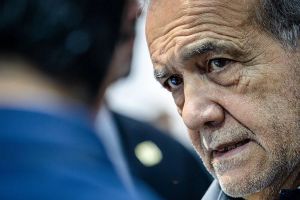
Another widely shared post by a conservative account, Rah-e Dialameh, described Pezeshkian’s remarks as “sending a signal of weakness to the enemy,” linking them to the drop in oil prices and warning that such a strategy “must be stopped before it causes further damage.”
Some hardline users accused Pezeshkian of “sending ceasefire signals” and weakening Iran’s military posture, demanding that security authorities “control” him.
One user appeared to issue an implicit threat, suggesting authorities should restrict his public appearances “to protect his life,” claiming the country “is better managed on autopilot.”
Son defends the president’s stance
Amid escalating criticism, Pezeshkian’s son and adviser, Yousef Pezeshkian, publicly defended his father. He challenged critics’ logic, asking: “I do not understand the meaning of these criticisms; are we not seeking to meet conditions and obtain guarantees? Or are we seeking war until the complete destruction of America and Israel?”
He framed the president’s position as a realistic attempt at conditional de-escalation, contrasting it with what he implied were unrealistic or maximalist goals.
He also defended his father’s earlier apology to neighboring countries affected by Iranian strikes, calling it an “ethical duty” and highlighting efforts to maintain regional relations despite the conflict.
For many ordinary citizens, the psychological toll of constant airstrikes is profound. In the absence of an effective warning system, a near-permanent sense of insecurity dominates daily life.
Families—especially those with children or vulnerable members requiring medical care—have fled heavily targeted cities such as Tehran. Some of them have sought refuge in smaller towns and rural areas considered relatively safer from the repeated strikes that occur both day and night.
Those who have remained in their homes describe a life defined by constant anticipation of attacks.
Golshan, a woman living in Tehran with her two dogs, writes daily about her experiences on X. “Night is no longer a time for sleep—it is a field of waiting,” she wrote. “Waiting for a sound you don’t know where it will come from, but you are certain that when it does, something inside you will break.”
She added that she avoids using the elevator, fearing a sudden power outage could trap her and her pets during an attack.
Another user, Marzieh, described how even basic activities have become stressful. “Taking a shower has become anxiety-inducing for many,” she wrote, explaining that people fear being trapped mid-attack or losing water if the electricity is cut. “Every moment of their lives is filled with fear and worry.”
The International Committee of the Red Cross recently shared the account of a mother named Golnaz on X, describing the aftermath of an airstrike that cut off electricity and blew doors and windows off their hinges.
“After that, our home was no longer a safe place,” she said. She added that they had to move to her brother’s house, but even there her sons do not feel safe, so she is considering taking them somewhere far from the noise of war to recover from the shock.
Despite these conditions, some citizens say they are trying to preserve a sense of normalcy. They continue to visit cafés, walk in parks, and exercise outdoors whenever possible, attempting to maintain fragments of everyday life amid the uncertainty.
Reactions to the war’s broader implications remain deeply divided.
Supporters of the government describe the conflict as a “holy war” and insist it must continue until what they call “final victory.” Despite nightly bombardments, including during rainstorms, men and women who back the authorities continue to gather in city squares, chanting slogans and attending funerals for officials killed in the strikes.
Their presence is not limited to such rallies. According to social media reports, groups of pro-government men, alongside members of the Basij militia—sometimes including teenagers—patrol neighborhoods at night on motorcycles and pickup trucks.
They broadcast slogans over loudspeakers or play religious mourning songs late into the evening, adding to the strain of already sleepless nights for many residents.
Some Iranians express hope that continued strikes and the killing of government officials could lead to the collapse of the current system. One user wrote that relatives in Tehran become anxious when attacks appear to decrease, fearing that the war might end and “they”—meaning the Islamic Republic—might survive.
A user, Elham, shared the words of an acquaintance: “When there are no attacks, I get stressed that we’re still here and these savages are still in power."
"When the strikes happen, I’m so afraid I can only cry and wish for it to end quickly. I don’t even know what I want anymore. I just want them gone—and the war gone too," she added. “This is not a life anyone deserves. We wanted nothing more than an ordinary life.”
Those who share this view warn that an inconclusive end to the war could bring severe consequences: intensified repression of dissent, continued sanctions, widespread unemployment, the collapse of businesses, rising inflation—particularly in food prices—and potential shortages of electricity, water, and essential goods such as medicine.
Yet there is also a third group—neither aligned with government supporters nor hopeful that war will bring political change. These individuals simply call for an immediate end to the conflict.
A woman named Somayeh, opposing the continuation of the war, addressed both sides in a post: “Do you know what it feels like to hang a whistle around your neck and your child’s before going to sleep at night? If you don’t, then don’t tell me that war is the best thing for me.”
Hatami was among a group of detainees held responsible for the events at the “185 Mahmoud Kaveh” Basij base on January 8. Families of the detainees told Iran International that Hatami and others were pushed into the building by unidentified armed individuals, after which the base caught fire. Witnesses said the protesters were trapped inside, with the blaze putting their lives at risk.
Mizan, the judiciary news outlet, wrote that Hatami was “convicted of actions that targeted national security and involved attempting to access weapons and ammunition in a classified military site” and that his trial followed the presentation of confessions and investigative reports. The outlet added that the Supreme Court had reviewed and upheld the ruling.
The other detainees named in the report were Mohammadamin Biglari, Shahin Vahedparast, Abolfazl Salehi and Ali Fahim.
Their case was heard at Branch 15 of Tehran’s Revolutionary Court, presided over by Judge Abolqasem Salavati, and death sentences were issued in February, according to the report.
Court documents cited in the report said Hatami’s presence at the base coincided with efforts to breach military restrictions, although family accounts and independent reporting suggest he did not set the fire nor voluntarily enter the premises.
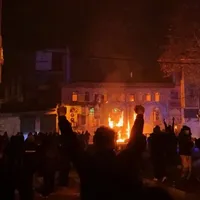
Eyewitnesses told Iran International that a large crowd had gathered outside the base on the evening of January 8 during nationwide protests, and several motorbikes in the street were set on fire. Some armed and unidentified individuals pushed protesters into the base and locked the doors, filling the building with smoke and putting those inside at immediate risk.
Detainees caught in prearranged scenario
Based on witnesses’ reports, the seven detainees were victims of a prearranged scenario by security and Basij forces intended to make them appear culpable for the fire. After the plan failed, five of them were referred for execution on charges including “enmity against God, corruption on earth, and conspiracy against national security.”
Hatami was one of five prisoners removed from Ghezalhesar prison for execution on Tuesday. Families reported that detainees, including Hatami, were transferred to undisclosed locations shortly before the execution. The prisoners, aged between 19 and 25, had limited access to legal counsel during a trial concluded within 30 days of their arrest.
Iran’s judiciary also announced that other political prisoners, including Pouya Ghobadi Bistouni and Babak Alipour, were executed earlier this week, along with Akbar (Shahrokh) Daneshvarkar and Mohammad Taghavi Sangdehi. Two additional prisoners, Vahid Baniamrian and Abolhassan Montazer, had been sentenced to death in December 2024.
Human rights groups warn of rushed executions
Families and human rights groups have repeatedly warned against executing prisoners under such circumstances and called for an immediate halt to the sentences. The cases have drawn international attention, highlighting the dangers of issuing death penalties without guaranteeing basic legal rights.
Amid heightened security tensions and restricted internet access, the rapid pace of executions in politically sensitive cases has increased, leaving detainees exposed to unpredictable and direct threats to their lives. Human rights organizations have warned that the acceleration of these executions could lead to a humanitarian crisis.