Witnesses in Rasht say protesters were driven into narrow market passages, trapped as fire spread and fired upon by security forces during January’s unrest, according to accounts gathered by Iran International.
The accounts are part of an Iran International public documentation campaign seeking to establish how many people were killed in Rasht, how the market fire unfolded and what happened to victims’ bodies and families in the days that followed.
The campaign is collecting and verifying accounts, images and videos from witnesses and families of those killed in Rasht, one of several cities where the January protests were met with severe force.
Parts of Rasht’s old market, including the booksellers’ market, the arched bazaar and the coppersmiths’ market, caught fire during the protests.
One eyewitness said security forces drove protesters toward areas with limited entry and exit points. After those areas were surrounded, fires broke out in the same sections.
The aftermath of the fire in Rasht bazaar
Trapped as fire spread
A witness described the smell of smoke, fire and burning as so strong that parts of Rasht remained hazy until near dawn.
The protests in Rasht began on Wednesday, January 7, when people gathered in the market and called on shopkeepers to close their stores. The crowd later moved toward Municipality Square. After Basij forces arrived, protesters dispersed for a time, but gatherings formed again around sunset in Sabzeh Meydan and near Bistoon Street.
One eyewitness said the crowd in Sabzeh Meydan initially numbered between 1,000 and 2,000 people, but grew over time.
Basij forces at first appeared confused, the witness said, because protesters were gathering in scattered groups across the city. When security forces moved toward one location, another gathering formed elsewhere.
The aftermath of the fire in Rasht bazaar
Crowds across the city
Protests on January 8 formed simultaneously in several parts of Rasht and later connected in central streets.
One witness described large crowds filling the streets from the Toutounkaran intersection to Municipality Square.
The witness said tens of thousands of people were on Imam Street and around Municipality Square, and that the protests were not limited to main roads but had spread into neighborhoods and side streets.
As the crowd grew and protesters gained control of parts of the city, security forces responded with tear gas and live ammunition, witnesses said.
Security forces blocked retreat routes from several directions, entered through nearby alleys and fired at protesters, according to the accounts.
Shooting at protesters was reported in Falakeh Gaz, Moallem Street, Municipality Square, Sabzeh Meydan, Shariati Street and routes around the market.
The aftermath of the fire in Rasht bazaar
'They came to hunt'
Witnesses said the crackdown intensified after about 10:30 p.m., when Revolutionary Guards forces entered the streets and direct fire with military weapons began.
One person who attended the January 8 protest in Rasht described the scene this way: “In the early hours, the crackdown was mostly carried out by the Basij. But from around 10:30 p.m., the IRGC came in. They came with AK-47s. The first person drove the motorbike and the person behind aimed and fired. It was as if they had come to hunt. Most of Rasht’s deaths began from that hour.”
The witness said security forces especially targeted teenage boys and young men. In some cases, they fired at car windows to force drivers to cross street barriers and clear the way for security forces.
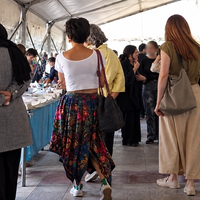
People walking at Rasht bazaar the day after the fire in January
When fire reached the market
The fire in Rasht’s market began while security forces were suppressing protesters in different parts of the city.
The fire started near Shariati Street and the Haj Mojtahed Mosque area, witnesses said. Because of the market’s dense layout, it spread quickly to other sections.
Some people trying to escape gunfire and security attacks were pushed toward Rasht’s market, a maze of narrow passages with limited exits.
Witnesses said security forces blocked the market’s exits from both sides. After that, parts of the market caught fire.
Protesters and other people trapped inside the market faced two deadly choices: remain amid smoke and flames, or try to leave and risk being shot by armed forces.
Some of those who died around the market were shot while trying to escape, witnesses said, while others were trapped by smoke and fire.
Some of the dead in the market area were shopkeepers who had gone inside to remove goods and save their property but were caught in the fire and blocked passageways.
One eyewitness said that around 2:30 a.m., after phone lines were reconnected, word spread that the market was burning.
“I and a few others went toward the market and saw several old caravanserais burning,” the witness said. “People were trying to pull goods out of shops that the fire was approaching.”
Describing the scene, the witness added: “Everyone was either helping or crying. One shopkeeper whose store and all his goods had burned was shouting, ‘My whole life is gone.’ Right there, several people began chanting against Khamenei.”
People walking at Rasht bazaar the day after the fire in January
Delayed firefighting
Fire engines were initially unable to fully enter the market area, and the first vehicles arrived after several hours of delay, according to accounts gathered by Iran International.
One witness said people were banging on the side of a fire truck and pleading with the driver to move farther into the market to control the fire. The driver, who had stopped near the shops, said: “I have orders only to come this far. They won’t let me go any farther. My mission ends here.”
Iran International also received accounts saying security bodies, including the Intelligence Ministry and the IRGC Intelligence Organization, had instructed firefighters not to begin full firefighting operations at that stage.
Some protesters were shot while fleeing the market area, witnesses said, while others were trapped in smoke and flames.
By early Friday morning, security forces had closed off part of Municipality Square near the start of Sa’di Street.
The bodies of several protesters were gathered there and then taken away in Nissan pickup trucks, according to accounts received by Iran International.
Direct fire in the streets
On the evening of Friday, January 9, the violence by security forces grew more intense. Fewer people were in the streets, witnesses said, and security forces fired without warning at even small gatherings.
Motahari Street, Moallem Street and nearby alleys were among the areas where witnesses reported blood on the asphalt and direct gunfire.
One witness said: “There was no warning anymore, no tear gas, no batons. Just direct fire with military weapons. Even inside the alleys, the asphalt was bloody.”
After the crackdown, Rasht was filled with reports of killed and wounded protesters.
In the following days, people shared news of deaths with one another in shops and on the streets.
One witness said that on Sunday, January 11, large crowds had gathered around the Bagh-e Rezvan cemetery in Rasht, with roads packed with cars for several kilometers.
The witness said an acquaintance who had gone to Bagh-e Rezvan for a relative’s burial reported that hundreds of bodies had been transferred there that day for identification.
Pressure on families
Families said the bodies of some of those killed were handed over only after relatives were forced to sign written undertakings.
Some families were pressured to accept the official narrative that their loved ones had been killed by “Israeli and American agents,” according to accounts received by Iran International.
The accounts from Rasht suggest that January’s events in the city went beyond a street crackdown.
The full scale remains unclear, including the number of people killed, who ordered the response and why families say they were pressured afterward.
Iran International’s public campaign aims to document the names, stories and evidence of those killed in Rasht, before their deaths are buried in silence or overwritten by official denial.