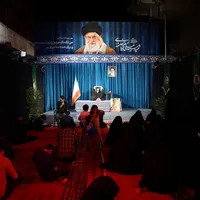
What appears, at first glance, as a dynastic shift is in fact the continuation of an ideological and institutional project: the consolidation and reproduction of Khameneism.
The central argument is straightforward: Mojtaba Khamenei does not represent a new phase in the Islamic Republic. He represents the success of a long-term process of “rail-laying”—a deliberate restructuring of power that ensures continuity regardless of who formally occupies the position of Supreme Leader. In this sense, the system no longer depends on individual authority; it reproduces a predefined ideological and political logic.
This transformation was made possible by the way Ali Khamenei maximized the latent capacities of the Islamic Republic’s constitutional framework. The constitution already concentrates extraordinary power in the office of the Supreme Leader. However, Khamenei did not merely operate within these limits—he expanded and operationalized them. Over 37 years, he systematically turned flexible or ambiguous mechanisms into rigid and enforceable structures, embedding his ideological preferences into the institutional fabric of the state.
One of the clearest examples of this process is the evolution of the Supreme Council of the Cultural Revolution. This body, notably absent from the constitution, was gradually transformed under Khamenei into a central pillar of ideological control. What began as a mechanism for purging universities in the early years of the revolution became a highly structured institution with dozens of sub-councils, extending its reach across education, culture, media, and social policy. It evolved into a powerful instrument for shaping and policing societal norms—without ever requiring formal constitutional legitimacy. This is Khameneism in practice: the ability to formalize control without formal law.
A similar trajectory can be observed in the transformation of the Guardian Council. Originally conceived as a supervisory body overseeing legislation and elections, it was reengineered into a decisive mechanism for controlling political outcomes. Through expanded vetting powers and systematic disqualification of candidates, the council moved from oversight to orchestration. Over time, it became capable not only of influencing elections but effectively determining their results in advance. This shift—from supervision to engineering—was not incidental; it was a key step in institutionalizing Khameneism.
These developments were not isolated. They formed part of a broader strategy to eliminate unpredictability from the system. Independent political actors were sidelined, reformist currents neutralized, and institutional autonomy steadily eroded. What emerged was a tightly controlled ecosystem in which all meaningful levers of power—political, judicial, cultural, and economic—were aligned with a single ideological framework.
Within this context, the emergence of Mojtaba Khamenei as a central figure becomes comprehensible. His lack of traditional religious credentials or broad political legitimacy is not a contradiction—it is a consequence of the system’s evolution. Years of institutional engineering, including the careful management of the Assembly of Experts and the systematic removal of potential obstacles, made such a transition possible. The “selection” process itself reflects the culmination of Khamenei’s long-term restructuring: a system in which outcomes are preconfigured rather than contested.
More importantly, Mojtaba’s rise demonstrates that Khameneism has achieved a critical threshold—it can now sustain itself without its original architect. The ideology has been embedded so deeply within the system that any successor, regardless of personal inclination, is compelled to operate within its parameters. The structure dictates the outcome.
This is why the question of leadership succession is, in many ways, secondary. Whether it is Mojtaba Khamenei or another figure, the current institutional configuration leaves little room for deviation. The mechanisms of control, the networks of power, and the ideological priorities—particularly the emphasis on regime preservation, anti-Western positioning, and hostility toward Israel even at significant national cost—are all structurally entrenched.
Khameneism, therefore, is no longer simply an ideology associated with one leader. It is a system of governance—self-reinforcing, expansive, and resistant to change. The Islamic Republic has, through decades of deliberate restructuring, lost its capacity to generate alternative political paths from within.
In this sense, Mojtaba Khamenei is not the beginning of a new chapter. He is the continuation of a trajectory that has been decades in the making.
And perhaps more significantly, this continuity underscores a deeper reality: the Islamic Republic has reached a point where change from within has become structurally improbable. The very mechanisms designed to preserve the system have also eliminated its flexibility.
Khameneism, as both ideology and structure, may ultimately define not only how the system survives—but how it ends. It sustains the Islamic Republic by centralizing power, eliminating dissent, and enforcing ideological conformity across all institutions. Yet those same mechanisms steadily erode the foundations of long-term stability: public trust, institutional adaptability, and economic resilience. A system built to prevent deviation becomes incapable of reform; a state designed to suppress a crisis becomes dependent on perpetual coercion to manage it.
In this sense, Khameneism transforms survival into a self-consuming process. Each cycle of repression narrows the regime’s options further, raises the cost of governance, and deepens the gap between state and society. The tools that once ensured control—security dominance, ideological rigidity, and exclusion of alternative voices—gradually become liabilities, locking the system into a path where it can neither evolve nor retreat.
As a result, Khameneism may determine not only the durability of the Islamic Republic, but also the form of its eventual breakdown: not a sudden collapse, but an accumulated exhaustion. A system that endures by sacrificing its capacity to renew itself ultimately reaches a point where continuation itself becomes unsustainable.