• العربية
  • فارسی
BrandBrand
  • Iran Insight
  • Politics
  • Economy
  • Analysis
  • Special Report
  • Opinion
  • Podcast
  • Live TV
  • Iran Insight
  • Politics
  • Economy
  • Analysis
  • Special Report
  • Opinion
  • Podcast
  • Live TV
  • Theme
  • Language
    • العربية
    • فارسی
  • Iran Insight
  • Politics
  • Economy
  • Analysis
  • Special Report
  • Opinion
  • Podcast
  • Live TV
All rights reserved for Volant Media UK Limited
volant media logo
INSIGHT

New video reveals where Iran clerics chose Mojtaba Khamenei as supreme leader

Khosro Isfahani
Khosro Isfahani

Senior Research Analyst, NUFDI

Nov 23, 2026, 21:47 GMT+0
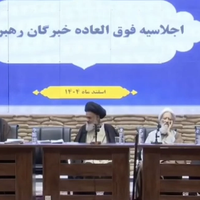
A screengrab from the March 2026 meeting of the Assembly of Experts where Mojtaba Khamenei was chosen as Iran's Supreme Leader.

Iranian state media left the location unnamed when they released footage of a March meeting where clerics chose Mojtaba Khamenei to succeed his father. However, a detail at the front of the room helped identify it.

The Assembly of Experts, the clerical body tasked under Article 107 of Iran’s constitution with choosing the supreme leader, met after Ali Khamenei was killed in US-Israeli strikes on February 28.

Two members date the meeting to March 8. The Assembly publicly named his son as his successor shortly after midnight the following day, Tehran time.

Iranian state media released the 53-second video on November 22, more than eight months after the succession. An unidentified man announces that Mojtaba Khamenei received more than two-thirds of the vote. Assembly members respond with chants of “Allah Akbar” (God is greatest).

Khamenei himself does not appear. No independently verified photograph, video or audio recording of Khamenei from his time in office has surfaced. His directives have reached the public through undated statements and officials who relay his words. His absence has raised questions about whether he is alive and how much authority he exercises relative to the Islamic Revolutionary Guard Corps (IRGC).

The footage offers a rare look at how the clerics received the announcement. In interviews intercut with the meeting, members describe their fear of assassination and the security arrangements for getting them to the hall.

Mohsen Qomi, a member of the Assembly’s presiding board, credited the Revolutionary Guards with making the meeting possible.

The video was circulated on Instagram with a caption describing it as the first footage of the announcement. A banner on screen makes the same claim. Neither identifies the venue or gives the day of the meeting.

Iran International had reported on March 5 that a session planned for that day would be held largely online and that at least eight members would stay away. The footage shows clerics gathered in person for the announcement.

How the hall was identified

At the front of the hall, a wall of decorative sandbags runs beneath a large screen. A wooden desk with three horizontal slots stands in front of it.

The same wall and desk appear in photographs of a provincial council meeting held in Qom six months later.

100%
Figure 1. The dais. The sandbag wall in front of the LED screen (Red 1) and the wooden desk with three horizontal slits (Yellow 1) appear in both.

Defa Press published the photographs on September 22. Taken by Zeinab Zamani, they show Qom’s governor chairing the fifth session of the provincial administrative council the previous evening. The caption names the Isar Conference Hall at Qom’s Cultural Center and Museum of the Islamic Revolution and Holy Defense.

100%
Figure 2. The seating. The five chairs on the right aisle (Green), the center block with distinct front-row seats (Yellow 2) and the portable table before the front row (Red 2) appear in both.

The seating provides a second match. Both sets of images show five chairs of the same type along the right aisle, a distinctive front row in the center block and a small table in front of it.

The annotations below mark the corresponding features.

How members dated the meeting

The screen behind the speakers reads “Special Meeting of the Assembly of Experts, Esfand 1404.” That month of the Iranian calendar ran from February 20 to March 20. The meeting took place after Ali Khamenei’s death on February 28 and before the Assembly announced his successor. Mehr News Agency carried the announcement at 3:17 a.m. on March 9 in Tehran, still March 8 GMT.

On March 9, Mehr quoted Assembly member Ahmad Khatami as saying the clerics had met in person in Qom the previous evening, the first of the Nights of Qadr, the holiest nights of Ramadan.

Qomi also dated the session to Sunday, March 8, in a statement carried by the state news agency IRNA. He said 59 of the Assembly’s 84 members attended and that the result was announced immediately. He estimated that Khamenei received about three-quarters of the vote.

A third member, Mostafa Hasanati, the Friday prayer leader of Najafabad, described an earlier attempt to vote individually. In a video published by Entekhab on November 23, he said members initially cast ballots one by one using sealed envelopes. Fearing the procedure would cast doubt on the result, they wrote that they wanted to meet in person “even if we are torn to pieces.”

Hasanati said it took three or four days to bring the clerics together on a Night of Qadr. Of the three possible evenings, only March 8 preceded the public announcement. The other two fell on March 10 and 12.

Like Qomi, Hasanati put attendance at 59. He said 49 voted for Khamenei, or 83% of those present. His tally and Qomi’s estimate both fit the description heard in the video, “more than two thirds.” The footage does not establish the exact count.

Hasanati said members had first tried to gather at the Fatima Masumeh Shrine in Qom, but called off the meeting when fighter jets flew overhead. Iran International reported on March 5 that the session planned for that day was to be run from a building next to the shrine.

Tasnim news agency reported that the Assembly’s seat in Tehran was struck on the night of March 2 and its secretariat in Qom the following day. Tasnim said the Qom building was empty at the time.

Qom’s deputy governor for political and security affairs later put the toll in the city’s Resalat Square at six killed and 30 wounded. The Assembly’s secretariat said three of its employees had been killed.

Neither account specified whether anyone was inside the secretariat when it was hit. Qomi referred to strikes on two Assembly buildings in Qom. The visual evidence places the succession meeting at the museum.

100%
[@portabletext/react] Unknown block type "table", specify a component for it in the `components.types` prop

What the clerics recalled

The interviews give a sense of the precautions surrounding the vote and how little time the members spent together.

Reza Ramezani Gilani recalled being driven around for up to two hours. Mohammad Baqer Mohammadi Laeini said only Assembly members were present when they reached the venue.

Ali Abbasi put the time between arrival and departure at no more than 40 to 45 minutes. He did not say how much of that time the members spent deliberating.

Mohsen Mohammadi Araki said all members were targets for assassination. Hashem Hosseini Bushehri described the difficulty of making a decision during wartime.

The video also includes Rahim Tavakol saying, “We stand by our word.” The excerpt gives little context for the remark.

100%
[@portabletext/react] Unknown block type "table", specify a component for it in the `components.types` prop

At the front of the hall, an unidentified man reads out the result.

“His Holiness Ayatollah Sayyed Mojtaba Khamenei with a majority of more than two thirds of the vote was introduced as the next Supreme Leader.”

The members respond with chants of “Allah Akbar.”

100%
Figure 3. Google Maps satellite view of the Museum of Holy Defense on Avini North Boulevard, Qom (Plus Code: JV22+3XR), where the meeting was held.

Most Viewed

Truck drivers strike across Iran over economic hardship
1

Truck drivers strike across Iran over economic hardship

2

Trump threatens Iran strikes in new year, says blockade runners will be sunk

3

Tehran's subsidence zone expands 20% in two years

4

Inside Iran's online gun market, where a few messages can start a deal

5

'Happy Ending' pushes the limits of Iran's underground cinema

Banner

Spotlight

  • New video reveals where Iran clerics chose Mojtaba Khamenei as supreme leader
    INSIGHT

    New video reveals where Iran clerics chose Mojtaba Khamenei as supreme leader

  • Iran's housing crisis keeps divorced couples under one roof

    Iran's housing crisis keeps divorced couples under one roof

  • 'Happy Ending' pushes the limits of Iran's underground cinema

    'Happy Ending' pushes the limits of Iran's underground cinema

  • Power cuts return across Iran, threatening over one million jobs
    VOICES FROM IRAN

    Power cuts return across Iran, threatening over one million jobs

  • Inside Iran's online gun market, where a few messages can start a deal

    Inside Iran's online gun market, where a few messages can start a deal

  • ‘The city smelled of blood’: Witness recalls Iran protest crackdown

    ‘The city smelled of blood’: Witness recalls Iran protest crackdown

Banner
Banner
Banner
Banner
Banner
Banner
•
•
•

More Stories

Dispute over convicted hardline MP’s voting tablet divides Iran’s parliament

Nov 23, 2026, 18:08 GMT+0
100%
A photo released by Fars News Agency in November 2025 shows hardline Iranian lawmaker Hamid Rasaei browsing his Telegram account on his tablet during a parliamentary session.

A dispute over a convicted lawmaker’s voting tablet has divided Iran’s parliament, with a news agency accusing ultraconservatives on Monday of forcing the cancellation of Sunday’s session and allowing a factional feud to halt the work of the legislature.

The dispute centered on Hamid Rasaei, a hardline Tehran MP and outspoken critic of Parliament Speaker Mohammad Bagher Ghalibaf. Rasaei had been granted temporary leave from Evin Prison, where he began serving a 10-month sentence in September over an article accusing Ghalibaf of tampering with parliamentary documents.

Rasaei arrived at parliament on Sunday to find his access to the tablet system lawmakers use to participate and vote remotely still blocked.

Several allies, including Tehran MPs Mehdi Kouchakzadeh and Ali Khezrian, demanded that his access be restored and threatened to disrupt proceedings once the session opened, ILNA reported.

Enough lawmakers were present in person or online for a quorum. After about 90 minutes of efforts to resolve the dispute, the parliamentary leadership, chaired that day by Deputy Speaker Ali Nikzad, canceled the sitting.

Rasaei gave a different account, accusing Ghalibaf of refusing to restore his access and saying the leadership called off the session because it feared what he might say on the floor.

Parliament’s media office said Rasaei was still serving his sentence and his leave had expired. Lawmakers had raised the issue the previous Wednesday, when Deputy Speaker Hamidreza Haji-Babaei said parliament had asked the judiciary whether Rasaei could exercise his parliamentary duties while on leave. By Sunday, it had received no reply.

In its Monday analysis, ILNA said Rasaei and his allies had grounds to seek a ruling on his voting rights. But by threatening to disrupt the sitting, lawmakers close to the ultraconservative Paydari Front had turned a legal question into a show of factional strength. The agency also faulted the leadership for giving a handful of MPs an effective veto over whether the rest could meet.

“Parliament must not be held hostage to factional sensitivities,” ILNA wrote. “Not today, not tomorrow, not over a tablet or anything else.”

Iran’s internet bill targets anonymity by tying accounts to real identities

Nov 21, 2026, 11:16 GMT+0
•
Hooman Abedi
100%
A woman checks her smartphone on a street in Iran at night.

A bill before Iran’s parliament would require online service providers to verify their users’ identities, making it easier for the state to trace anonymous accounts in a country where social media posts have led to prison terms and even death sentences.

Under the Cyberspace Regulation Bill, which is still under review by lawmakers, providing a digital service to anyone whose identity has not been verified would become a violation.

Users would not have to show their real names in public. But accounts run under pseudonyms could be linked to real people through the data providers collect, and handed to regulators on request.

For Iranians who write under pseudonyms, the difference is between being anonymous to the public and being anonymous to the state. The bill would remove the second.

What the bill would change

Companies that offer services before verifying users would face penalties including advertising bans, a ban on registering new users, fines of up to 10 percent of annual revenue, and suspension or loss of their licenses, according to details published by the Shargh daily in late August.

Failing to hand over information requested by regulators would also count as a violation.

The bill would also strengthen the Supreme Council of Cyberspace, Iran’s highest internet policymaking body, and its executive arm, the National Cyberspace Center.

The latest draft drops an earlier clause that would have made using a VPN a crime, though the state’s powers to block content remain.

‘James the Faithless’

The case of Amirhossein Mousavi shows what can happen once the state puts a name to an account.

  • Iran sentences activist to death over X posts, lawyer says

    Iran sentences activist to death over X posts, lawyer says

Mousavi ran an account on X called James Bidin, a play on the name of the American actor James Dean. In Persian, “bidin” means “faithless” or “without religion.”

A Revolutionary Court sentenced him to death for “corruption on earth” over his online activity, his lawyer, Reza Shafakhah, said on November 4. He also received five years in prison for insulting religious sanctities.

Mousavi, held since December 2024, faced several charges over posts attributed to his account, including national security offenses and alleged cooperation with Israel.

In a letter from Tehran’s Evin prison, he rejected the charges and said his televised confessions had been extracted under pressure from interrogators.

The new bill played no part in his case. It would make the first step, identifying the person behind the account, routine.

100%
Two men use their smartphones on a street in Iran.

A long line of controls

  • Iran withdraws cyber bill after outcry over free speech

    Iran withdraws cyber bill after outcry over free speech

  • Iran restores internet after 88-day blackout, keeps social media blocked

    Iran restores internet after 88-day blackout, keeps social media blocked

  • Iranians report SIM cards blocked over political posts and likes

    Iranians report SIM cards blocked over political posts and likes

  • Iranians told to post pro-government content to regain internet access

    Iranians told to post pro-government content to regain internet access

The bill follows earlier attempts to tighten state control of the internet. The Internet Protection Bill, known in Iran as the Sianat plan, sought more control over foreign platforms and online communications but stalled after widespread opposition.

The government of President Masoud Pezeshkian withdrew a separate bill on “combating the dissemination of false content in cyberspace” in July 2025 after criticism.

Iran has repeatedly cut off the internet during unrest and war, including during the January massacre and for 88 days after the US and Israel launched their war on Iran on February 28, cutting millions of Iranians off from independent news and from the outside world.

Major international platforms remain blocked, and many Iranians rely on VPNs to get online.

Iran International has documented cases of people whose SIM cards were blocked after political posts or interactions on social media.

Some who tried to have their service restored were asked for personal details, home addresses and the names of their social media accounts.

Who gets to be a journalist? Iran seeks greater control over press

Nov 21, 2026, 06:01 GMT+0
•
Behrouz Turani
100%
File photo: A man browses newspapers at a newsstand in Iran.

Iran is moving to tighten controls on journalists at home while threatening to pursue exiled media figures abroad, as lawmakers revive a controversial licensing proposal and the judiciary seeks to enlist Interpol in its crackdown on dissidents.

The proposed legislation would require journalists to obtain government-approved licenses to work, potentially placing their professional credentials under direct state oversight.

The proposal, first introduced in 2014, was shelved following strong opposition from journalists and media professionals. Hardliners in parliament revived it last week.

Babak Negahdari, head of the Majles Research Center, was quoted by the hardline news outlet Young Journalists Club as saying the proposal "has been finalized as a bill" and would be brought to a parliamentary vote within the next three months.

The legislation calls for the creation of a "Journalism Organization" modelled on the Iranian Medical Council, which regulates the licensing and professional practice of physicians.

Critics argue that the proposed body would undermine press freedom by placing journalists' professional credentials under state control.

Media lawyer Kambiz Nowrouzi said this week that the bill remains "the same 2014 draft with the same serious problems and fundamental flaws."

In an editorial in the moderate daily Shargh, he argued that the proposed Journalism Organization would effectively function as a government body, creating "a double filter for greater control over professional press organisations."

When introduced in 2014, the proposal was described as "abnormal" and "catastrophic" by journalism professor Hassan Namakdust, who warned it would leave "nothing of journalists' independence, status, and dignity."

Public reaction to its revival has so far been muted, possibly because of the intense security pressures facing journalists today.

The political environment has also changed. Parliament is dominated by hardliners, and the latest proposal originates from lawmakers rather than a government ministry.

Chasing exiled dissidents

Meanwhile, Iran's judiciary has announced efforts to pursue the arrest and extradition of dissidents and media figures living abroad through Interpol, alongside the confiscation of their assets inside Iran.

At a November 17 press briefing, Judiciary Spokesman Asghar Jahangir said authorities had confiscated assets belonging to a number of Iranians living abroad whom Tehran accuses of "treason" and other offences.

He said the judiciary was working through Interpol and its International Affairs Department to secure their arrest and extradition.

Although Jahangir did not release a full list of names, state television and affiliated outlets have repeatedly singled out exiled journalists working for Persian-language broadcasters such as Iran International, BBC Persian and VOA Persian when threatening asset confiscation, consular restrictions and Interpol Red Notices.

However, Article 3 of Interpol's Constitution prohibits the organisation from undertaking activities of a political, military, religious or racial character.

An Interpol Red Notice is also not an international arrest warrant, and Western host countries routinely reject extradition requests based on political or speech-related charges.

Nevertheless, the announcement has heightened concerns among Iranian journalists in Europe and the United States, some of whom fear questioning or delays at border crossings and airports when travelling internationally.

Other restrictive bills

The revived Journalism Organization Bill is the third in a series of legislative initiatives that critics say are intended to restrict freedom of expression and tighten state control over information.

The first two were the Foreign Influence Bill and the Bill to Organise Cyberspace.

The Foreign Influence Bill, which would criminalize interviews and other forms of contact with foreign-based media outlets, received initial parliamentary approval on August 16 by 183 votes to four, with five abstentions.

President Masoud Pezeshkian's cabinet formally opposed the legislation on August 23, but the government has no veto over parliamentary bills. The measure still requires a final parliamentary vote and Guardian Council approval.

The Bill to Organise Cyberspace, also known as the Protection (Sianat) Bill, was submitted to parliament on August 26.

Critics have described it as a rebranded version of the previously shelved Sianat internet bill. Among other measures, it would require internet service providers to identify and verify their users.

The legislation must undergo review by parliament's Social Commission before a floor vote and final consideration by the Guardian Council.

Together, the three proposals would expand state oversight of traditional and digital media, while the judiciary's latest announcement signals continued pressure on Iranian journalists abroad. Whether the revived licensing bill becomes law remains uncertain, but it is now being considered by a hardline-dominated parliament alongside other measures aimed at tightening controls on information.

Iran hardliners push tanker convoy to defy US blockade

Nov 21, 2026, 02:29 GMT+0
•
Maryam Sinaiee
100%
An illustration published by the Revolutionary Guards-affiliated Fars News Agency depicts the mythical Persian hero Fereydoun leading a convoy of Iranian oil tankers escorted by warships

Iranian hardliners are calling for a convoy of oil tankers to challenge the US naval blockade, threatening military retaliation against regional energy infrastructure if Washington attempts to stop the vessels.

The proposal, published Thursday by the Revolutionary Guards-affiliated Fars News Agency, calls for tankers to sail to China and threatens strikes on oil facilities in the United Arab Emirates, Saudi Arabia and Qatar if the US intervenes. It emerged shortly after reports that an unsanctioned tanker had been loaded at Iran's Kharg Island oil terminal.

Fars dubbed the plan “Operation Fereydoun,” after a legendary hero in the Persian epic Shahnameh.

No official plans for a convoy have been announced, although Foreign Minister Abbas Araghchi said Friday that Iran would break the blockade.

“A blockade is a military action. A military action also has a military response,” political and military analyst Nima Akbarkhani said during a Thursday night discussion on Iranian state television.

Akbarkhani described a previously discussed scenario in which Iranian tankers would sail individually with their Automatic Identification System (AIS) signals switched on and Iranian flags displayed, while Tehran announced in advance which regional facilities it would target if any vessel were attacked.

During the Be Vaght-e Iran program, host Ruhollah Razavi suggested placing media teams, members of the public and international anti-war activists aboard the tankers to increase the political and media costs of any US intervention.

Akbarkhani endorsed the idea, arguing that unlike vessels sent to Gaza, which Israel prevented from reaching their destination despite extensive media coverage, Iran could deter attacks on blockade-breaking tankers by threatening military retaliation.

Support for confrontation grows

Political analyst Mostafa Najafi, recently described in Iranian media as an adviser to Supreme National Security Council Secretary Mohsen Rezaei, wrote on X that Supreme Leader Mojtaba Khamenei had ordered an end to the “neither war nor peace” situation some time ago.

Najafi suggested that the effort extended beyond diplomacy, with military options also under consideration.

“Apparently, Tehran no longer wants to sit back and watch the blockade and threats,” he wrote.

Majid-Reza Hariri, president of the Iran-China Chamber of Commerce, called on Iranians across the political spectrum to support efforts to break the blockade.

“After months of pursuing negotiations in various ways, every Iranian patriot, regardless of political outlook, should support the government in breaking the naval blockade imposed by the aggressive United States by any means possible,” he wrote Friday.

Media analyst Alireza Shiva argued that Iran was signaling that energy security in the Persian Gulf could not be defined unilaterally.

“You cannot target Iran's oil exports while expecting the energy exports of others to continue in complete security,” he wrote on X.

A high-risk strategy

Hardline journalist Parisa Nasr argued that Iran had made a strategic mistake by treating the blockade as a negotiating issue rather than a wartime measure intended to weaken the country and force its surrender.

She advocated a strategy of “bringing the crisis to the brink” to pressure Washington into easing the blockade while strengthening Iran's deterrence against attacks on its tankers.

Energy analyst Abdullah Babakhani offered a more cautious assessment, suggesting that US forces might initially allow some Iranian tankers through before pursuing and potentially seizing them in international waters.

He compared the scenario to operations involving the pursuit and seizure of tankers linked to Venezuela last year, saying Iran's response to such an eventuality remained unpredictable.

China, Iran's largest oil buyer before the blockade, has been identified as the intended destination for the proposed convoy. Whether Beijing would accept the shipments remains unclear.

The proposal therefore presents Tehran with a potentially consequential choice: continue seeking a negotiated end to the blockade or test Washington's willingness to enforce it at the risk of a wider military confrontation.

Ideology or history? Analysts clash over the roots of Iran’s enmity with the US

Nov 20, 2026, 09:35 GMT+0
•
Maryam Sinaiee
100%
A screenshot from the debate between Shahram Ettefagh and Jafar Shiralinia, published by Azad on November 18, 2026.

Is Iran’s four-decade confrontation with the United States a product of the Islamic Republic’s ideology, or of an older conflict over Iran’s place in the world? Two Iranian analysts clashed over the question in a debate published online on Wednesday.

Political researcher Shahram Ettefagh, whose views are close to liberalism and free-market economics, argued that the hostility is rooted in the ideology of the state founded after the 1979 revolution.

Historian Jafar Shiralinia, who studies Iran’s contemporary history, said it reflects a longer struggle between Iran and Western powers that began well before 1979. The prerecorded debate was released on the YouTube channel of Azad, a popular online political debate and talk show.

‘A system of beliefs’

Anti-Americanism became inseparable from the Islamic Republic’s political ideology after the revolution, Ettefagh said, first shaped by leftist ideas and then built into the state’s founding paradigm.

He pointed to the attacks on the United States, Israel and Arab governments in the revolution’s first months, the creation of an annual Quds Day for Jerusalem, calls for people across the region to rise against their rulers, and the seizure of the US Embassy in Tehran, where diplomats were held hostage for 444 days.

That framework would block any real change in relations with the West, he said, even if the two sides reached a deal to end the current war.

“Any reflection on the present moment in Iran, or on Iran’s future, is undoubtedly dependent on this paradigm, this system of beliefs and ideas that still governs the Islamic Republic,” he said.

The ideology was also an obstacle to Iran’s development, Ettefagh said. Iran had worked with the West at various points in its history, and its troubles with Western countries should not be blamed on a permanent hostility toward Iran.

‘An issue involving Iran, not the Iranian government’

Shiralinia rejected the idea that the conflict should be read mainly through the events of 1979. “I see this as an issue involving Iran, not the Iranian government,” he said.

Iran’s efforts to industrialize, build national power and develop strategic technologies had long met resistance from major powers, including the United States, he said, rooted in a strategic and civilizational outlook toward non-Western societies rather than in disagreement with any one government’s policies.

He cited moments when Tehran had sought to ease tensions and relations soured anyway: Iran’s cooperation with the United States in Afghanistan after the September 11 attacks, which was followed months later by President George W. Bush naming Iran part of an “axis of evil,” and the outreach of President Mohammad Khatami’s government.

Iran’s own mistakes, including the embassy seizure, should not be defended, Shiralinia said, but they had to be weighed alongside Washington’s military, political and economic policies, which he said many analyses overlook.

The 1953 coup

The sharpest disagreement was over 1953, when Prime Minister Mohammad Mossadegh, who had nationalized Iran’s oil industry, was removed from power.

Shiralinia called the US-backed coup a turning point that turned clerics, leftists and nationalists alike against Washington. “Before the coup, public opinion and even intellectuals did not view America as negatively as they did afterward,” he said.

Ettefagh rejected that account. “I do not accept the idea that America came and carried out a coup in Iran,” he said.

“The coup that took place was Mossadegh’s coup against the Shah, and the Shah, as the higher authority, had the right under the constitutional monarchy to dismiss him.”

The Shah did issue a decree dismissing Mossadegh in August 1953. The operation to remove him was organized by American and British intelligence, a role the CIA acknowledged in documents declassified in 2013.

The debate left the two men divided on whether the confrontation would outlast the Islamic Republic. For Ettefagh, it is the product of the state’s ideological choices. For Shiralinia, it is a conflict involving Iran as a country, one that could survive a change of government.