A few photographs, a price and an exchange of messages can be enough to initiate a gun deal in Iran, where sellers advertise everything from handguns and Kalashnikovs to weapons made with 3D printers.
An investigation by Iran International found dealers offering firearms through social media and messaging platforms, with some claiming they could deliver weapons anywhere in the country within two weeks.
The sellers describe a market shaped by financial hardship, fears of insecurity and demand from people seeking weapons to threaten or intimidate others.
But the scale of the trade remains unclear, as does how many advertised weapons actually change hands.
Who buys and sells guns in Iran?
One arms dealer told Iran International that some of his suppliers were livestock farmers, nomads and villagers who had owned rifles for years, including Brno, M1 and various shotguns.
Some legally possessed their weapons but had decided to sell them because of financial difficulties and rising living costs, he said.
Others owned unlicensed firearms, particularly military-style weapons, and feared their children or other family members might use them.
The dealer said he purchased weapons from their owners and resold them at a profit.
One seller said concerns about theft and personal security had prompted some wealthy Iranians to purchase firearms to protect themselves and their property.
Other customers, he claimed, were involved in illegal economic activities and sought weapons to collect debts, intimidate others or settle financial disputes.
From handguns to Kalashnikovs
Prices vary widely depending on the type, condition and country of manufacture of a weapon.
According to sellers interviewed by Iran International, prices for licensed Iranian-made firearms start at around 300 million tomans.
Handguns described as Turkish or Pakistani start at approximately 500 million rials, while weapons advertised as Beretta or Glock models can cost as much as $5,000.
One dealer quoted around 2 billion rials for a secondhand Chinese-made Kalashnikov, compared with as much as 8 billion rials for a Russian-made equivalent.
Ammunition is sold separately, with dealers quoting approximately 4,000,000 rials for a Kalashnikov cartridge and 8,000,000 rials for a Brno rifle cartridge.
These are asking prices rather than independently verified completed transactions.
Delivery across Iran
Social media advertisements examined by Iran International featured photographs and videos of firearms, accompanied by model names and prices.
One dealer claimed he could deliver weapons to different parts of Iran in less than 15 days. Another confirmed that delivery to Tehran was possible.
Some sellers demanded full payment before shipment, while others accepted deposits and the balance upon delivery.
One dealer claimed to have contacts with wholesale arms suppliers in Iraq's Kurdistan Region, allowing him to obtain different models from across the border. He promised refunds if a weapon could not be delivered.
Another seller said neither a buyer's identity nor the intended use of a weapon mattered to him. Once payment was received, he said, the firearm would be dispatched.
A market vulnerable to fraud
The proliferation of online gun advertisements has raised questions about how many sellers are genuine.
In a separate investigation conducted last year, reporters contacted five sellers advertising firearms through Telegram channels, but none provided a way to verify that they possessed the weapons on offer.
Two sent identical responses and price lists, raising questions about whether some advertisements were fraudulent or relied on common promotional templates.
Iranian police have reported operations against networks advertising and selling firearms online.
In early November, police announced that they had identified an online firearms distribution channel and seized two military-style handguns during an operation against suspects.
3D-printed guns enter the picture
The investigation also identified advertisements offering small, single-shot firearms described as having been manufactured using 3D printers.
Some have plastic bodies and unconventional shapes that can make them resemble toys, while their manufacture does not necessarily require industrial production facilities or the importation of complete firearms.
However, there is no reliable information about the number of producers in Iran, the volume of sales or the performance of the advertised models.
The emergence of such weapons has raised concerns internationally, with European researchers reporting increasingly sophisticated 3D-printed firearms and growing numbers of seizures.
Scale remains unknown
Official figures show thousands of illegal firearms being seized across Iran, although they offer only a partial picture of the market.
Police spokesman Saeed Montazerolmahdi said in November that firearms seizures had increased by 14% through the end of the Iranian month of Mehr, compared with the corresponding period a year earlier.
He said military-style weapons accounted for 31% of the firearms seized, with seizures in that category rising by 9%.
A review of police and judicial announcements across several provinces, alongside border enforcement reports, produced a combined total exceeding 12,300 firearms.
The figures cover different reporting periods and may overlap, meaning the total does not necessarily represent 12,300 separate weapons.
Iran's mission to the United Nations previously reported that more than 60,000 illegal firearms had been seized and collected during 2022 and 2023.
The Small Arms Survey estimated that Iranian civilians possessed approximately 5.89 million firearms in 2017, equivalent to 7.3 weapons per 100 people.
The estimate included both legally and illegally held weapons. No similarly comprehensive, more recent estimate is available.
The human cost
According to police figures, 1,163 shooting incidents were recorded in Khuzestan during the first six months of the current Iranian year, ranging from armed disputes to gunfire at public celebrations.
In October, two shootings involving family disputes in Dehloran and western Tehran left seven people dead. The perpetrators of both attacks also died by suicide.
The same month, lawyer Taher Ahmadi was killed after encountering an armed confrontation in Shush.
Gunfire at wedding celebrations has also claimed lives. Five-year-old Mohammad Chakeri was killed in Fanouj in August, while 12-year-old Mohammad Omar Tarek died in Dashtiari in September.
These incidents illustrate the consequences of firearm use, but no comprehensive, recent nationwide figures are available for deaths and injuries caused by guns.
Despite increased seizures and tighter laws, the true size of Iran's illegal firearms market remains unknown.
What begins with a photograph, a price and a promise of delivery can end with a weapon in the hands of someone whose intentions the seller never questioned.
A patient receives treatment in a hospital intensive care unit in Iran. (File photo)
The number of people poisoned by bootleg alcohol in the northeastern Iranian city of Neyshabur has risen to 120, with four dead, health officials said late on Sunday, and police said they had arrested 12 people over its production and sale.
The toll has climbed fast. On Saturday, officials reported 66 people poisoned, and by midday Sunday, 72.
By Sunday night, 120 people had been admitted to hospitals, Seyed Milad Taghdisi Heydarian, acting deputy for treatment at Neyshabur University of Medical Sciences, told the Mehr news agency.
Eleven patients were on ventilators and one had been declared brain dead, he said.
All of the dead and the brain-dead patient were men. Eighteen patients have been sent to hospitals in Mashhad, the provincial capital, about 120 kilometers to the west, and 16 have been discharged.
Police first arrested eight suspects, then three men and a woman they described as the main producers and distributors, Neyshabur's police chief, Mojtaba Mohebbati, said. The investigation was continuing, he said.
Officials have not said what caused the poisonings. Methanol, an industrial alcohol often found in counterfeit drinks, causes blindness, kidney failure and death, and dialysis is one of the main treatments for it.
A banned drink, a deadly market
Alcohol is banned in Iran for Muslims, who face flogging if caught drinking. Only recognized religious minorities are allowed to make it for private use. The ban has created a large black market in which homemade and counterfeit drinks, often made with cheap industrial alcohol, have repeatedly caused mass poisonings.
The worst came in early 2020, when hundreds of people died after drinking methanol in the false belief that it would protect them from COVID-19.
In July 2025, 31 people sought hospital treatment after drinking counterfeit alcohol in Dezful, in the southwest. One died and five were admitted to intensive care. In November 2025, eight people died of alcohol poisoning in Iranshahr and Bampur, in the southeast. One lost their sight.
The real number of alcohol poisonings in Iran could be up to 10 times what emergency departments record, Deputy Health Minister Alireza Raisi said in October 2025. Many people who fall ill avoid hospitals for fear of prosecution.
In September 2025, Raisi called Iran's per capita alcohol consumption a public health challenge and urged more treatment centers. Admissions for alcohol dependence at addiction treatment centers had risen by as much as 50 percent over the previous five years, the Rouydad24 news site reported that month.
Medical personnel in Iran attend to a patient on a stretcher in a hospital emergency ward. (File photo)
A 16-year-old Iranian girl whose death has prompted a criminal investigation was beaten by her father at school and later thrown from a fifth-floor window after the principal accused her of having a boyfriend, a person close to the family told Iran International.
Sogand Sayyadi died on November 14 in the western city of Kermanshah. Her father, Keyumars Sayyadi, has been detained on suspicion of assault and murder, while the school's principal has been arrested on suspicion of negligence.
The account, provided to Iran International by a person familiar with the family, describes years of domestic violence and threats against the teenager, who had hoped to attend university, become a dentist and build a life independent of her father.
The allegations have not been independently verified. Sogand's father denies killing her, and judicial authorities say they are investigating the circumstances of her death, including the possibility of suicide.
Hamidreza Karimi, Kermanshah's prosecutor, told the judiciary-affiliated Mizan news agency that the father was under investigation on charges including assault and murder.
A childhood marked by violence
Sogand was originally from Alirezavandi, a village in Gilan-e Gharb county in western Iran, but lived in the provincial capital, Kermanshah.
Her parents, Keyumars and Tayebeh, separated when she was four. Their divorce proceedings lasted several years, after which her father was awarded custody.
Despite that arrangement, Sogand lived with her paternal aunt, Rakhshandeh, until a few months before her death.
The person close to the family described her as a quiet, reserved girl who worked hard at school and looked forward to becoming financially independent. Neither parent, the source said, provided her with sufficient emotional support.
The source alleged that Sogand had repeatedly been beaten by her father, who objected to her friendship with a female classmate because of the girl's appearance and makeup.
He had threatened to kill Sogand unless she ended the friendship, the source said, adding that the relationship was not romantic.
A private diary reaches the principal
Several days before Sogand's death, photographs of pages from her private diary were reportedly passed to the school's principal, Ghamarnaz Amiri, by someone connected to the family.
The pages apparently contained remarks that displeased Amiri, who, according to the source, already had a strained relationship with the teenager.
After receiving the photographs, Amiri allegedly telephoned Sogand's father, told him his daughter had a boyfriend and instructed him to come to the school to address the situation.
The Iranian news outlet Rokna previously reported that school officials had informed Sogand's father about a matter concerning her private life. It said he subsequently visited the school and took his daughter home.
From the classroom to a fifth-floor window
On November 14, Sogand's father received a call about his daughter, according to the family acquaintance. He went to her school, where he allegedly beat her in front of staff and other students.
The source said he then collected Sogand's school records, took her home by force and continued assaulting her before allegedly throwing her from a window of their fifth-floor apartment.
The human rights news agency HRANA, citing local sources, also reported that Sogand's father threw her from a fifth-floor window following an altercation at home.
According to the family acquaintance, the father prevented people at the scene from calling an ambulance and instead demanded that municipal workers come to collect and bury his daughter's body.
The newspaper Haft Sobh reported that he told investigators, "I am not my daughter's killer," and maintained that her fall from the fifth floor was accidental.
Questions over evidence and the funeral
According to the source, a family member gathered the teenager's personal belongings, including her diary, packed them and removed them from the house.
The source believed the removal of those items was an attempt to destroy evidence of longstanding abuse, particularly because members of the family had initially sought to portray her death as suicide.
That allegation has not been independently substantiated.
The source also said people who attended the washing of Sogand's body before burial had reported seeing fractures to her arms, legs, neck and skull.
Kermanshah's forensic authorities determined that she died from multiple injuries caused by a fall from a height.
According to the source, Sogand's father initially wanted to bury her in the courtyard of his village home, but senior family members objected. She was eventually buried in the cemetery of Dartut Sayyadi village.
Conflicting accounts have emerged about whether her father attended the funeral.
The family acquaintance said relatively few members of his side of the family attended and that some younger relatives stayed away because of his presence.
Judicial investigations into the circumstances of Sogand's death and the school principal's alleged negligence remain underway.
Shadi Kheyri, 22, was an engineering student at Tehran's prestigious Sharif University of Technology
A 22-year-old student at Iran's prestigious Sharif University of Technology has died by suicide after reportedly experiencing severe psychological distress, according to a student news outlet.
Shadi Kheiri, a final-year chemical engineering student, died Friday night at the university's Tarasht women's dormitory in Tehran, United Students reported Saturday, citing accounts it had received.
The circumstances surrounding her death could not be independently verified.
Kheiri, who graduated from Farzanegan High School in the western city of Malayer, had enrolled at Sharif University in 2023.
In a message posted to her personal channel before her death, she had condemned the killing of Sogand Sayyadi, a 16-year-old girl in the western city of Kermanshah whose death has sparked outrage over violence against women and failures in child protection.
"How many more lives must be sacrificed before we finally break our silence?" Kheiri wrote. "Sometimes tragedy is not merely the result of a killer's hand. It is also the result of closed mouths and silent consciences that have stood by watching for years."
Sayyadi's father was arrested on charges including assault and provisionally murder, while her school principal was detained on suspicion of negligence, Kermanshah prosecutor Hamidreza Karimi said on November 17.
Accounts of the case suggested that Sayyadi had warned school officials she might not survive if she was sent home, prompting questions about whether authorities had failed to act on signs that she was in danger.
Forensic authorities said Sayyadi died from injuries sustained in a fall from a height.
Women's rights advocates criticized what they described as broader institutional failures to protect girls facing violence at home.
The case has renewed scrutiny of legislation intended to protect women against violence, which remains unapproved after more than 15 years of disputes between Iranian authorities.
At least 84 women and girls were killed in Iran between late March and October 13, including 12 minors, according to figures published by the Emtedad website on November 16. The figures, compiled from media reports, may not capture the full extent of such killings.
Young Iranians socialize at a café, reflecting a generation navigating personal relationships and social expectations in a country where family attitudes toward dating and intimacy can differ sharply.
Some young Iranian women are leading private lives their families know little about, hiding relationships, sex and personal choices from parents, while an economy that keeps them at home and laws that punish private life leave them nowhere else to go.
Ladan’s mother knows she has a boyfriend. Her father doesn’t.
When the 21-year-old leaves home to meet him, her mother sometimes tells her father that she is going out with university friends.
It is a secret mother and daughter share. But there is another secret Ladan keeps from both parents.
She wants to have sex with her boyfriend before marriage.
“My mother knows I have a boyfriend, but if she found out I wanted to have sex with him, she would probably react very differently. My family doesn’t understand why I should wait for something that might never happen,” Ladan said.
In Ladan’s family, a boyfriend is something her mother can quietly tolerate, as long as her father doesn’t know. Sex is another matter. In families like hers, she said, a daughter’s virginity is still tied to the family’s honor, and a relationship parents might reluctantly accept can become a source of conflict if they believe it involves sex.
Many of her friends no longer see virginity as a measure of a woman’s worth, she said. They regard sex as a personal decision, not something that must wait until marriage.
The state does not. Under the Islamic Republic’s penal code, sex outside marriage is a crime. And Ladan worries about contraception and unintended pregnancy in a country that has made both harder to manage: a 2021 law meant to raise the birth rate ended the free distribution of contraceptives through public health services and tightened the already strict limits on abortion.
She also worries about what would happen if her family discovered her plans. Her mother has accepted one part of her private life and helps hide it from her father. Ladan fears that revealing the rest could cost her that support.
Ladan is one of five young women in Tehran who told Iran International about the parts of their lives they hide from their families. They spoke on condition that their identities be protected. Their names and some personal details have been changed.
Their secrets differ. But all five are hiding from the same two things: their families’ expectations, and a state that writes those expectations into law and has left them too poor to live anywhere else.
Two young people embrace during a nighttime gathering in Tehran.
Yasaman is 24. She works and earns her own money, but still cannot afford to move out of her parents’ home.
Her mother wants to know why she has not married. Yasaman’s answer is simple: she cannot afford it.
But there is another question nobody asks at home. What is she supposed to do about wanting emotional and sexual intimacy before marriage?
“I also need to have an emotional relationship with someone and feel close to him. But I’m not in a position to get married, and I don’t have a private space where I can spend time with someone I love without worrying,” Yasaman told Iran International.
In Iran, unmarried young adults commonly live with their parents. For many women, that reflects family expectations, but also the cost of living alone. With inflation near 89 percent and rents rising with it, a salary like Yasaman’s does not stretch to a home of her own. Moving out before marriage can also raise questions in more traditional families.
The state’s answer is marriage. It offers young couples marriage loans and urges them to have children. But Yasaman does not want to marry simply to have sex, and she does not have the money to set up a household.
She wants intimacy without being pushed into a marriage she is not ready for.
Yet she cannot afford the privacy that would let her have a relationship on her own terms.
For another of the women, the problem goes beyond finding somewhere private to meet a partner.
She cannot even tell her family whom she loves.
A young man and woman stand together outside a café in Iran at night.
More than a friend
Bahar’s family knows her closest female friend. She visits their home regularly and is one of the most important people in Bahar’s life.
What her parents don’t know is that the two women are in a romantic and sexual relationship.
Bahar is 27, and her family still asks why she has no plans to get married.
“My mother is always asking why I don’t have a boyfriend. I can’t tell her I have a girlfriend. I want to fall in love and live with someone I love, too. But the person I love is a woman,” Bahar said.
Her parents imagine a future in which she meets a man and marries him. Bahar wants to build a life with a woman they already know.
She was reluctant to speak at first, and agreed only after discussing how her identity would be protected.
Both Bahar and her partner live with their families. Neither can afford to rent a home of her own. Even a few hours together without worrying about who might walk in are hard to find.
The law offers them nothing and threatens them with a great deal. Under Iran’s penal code, sexual relations between women are punishable by flogging, and by death after a fourth conviction. Same-sex marriage is not recognized.
Two young women embrace on a street in Iran, where same-sex relationships remain socially sensitive and subject to legal restrictions.
For Bahar, revealing her relationship could mean facing her family’s expectations without the money to leave home.
“If I earned enough to have my own place, maybe I wouldn’t have to hide everything. But right now, if my family finds out, I don’t even know where I would go,” Bahar said.
The woman Bahar wants to share her future with can visit her family home. But in the eyes of Bahar’s parents, she must remain just a friend.
A secret too big to tell
Taraneh, 25, has a job. Last year, when her period was late, she took a pregnancy test.
The result was positive.
She was unmarried, and her boyfriend did not have a steady job. Neither was ready to have a child.
But before she could think about the pregnancy itself, she thought about her father.
“When I saw the test result, the first thing that came into my mind was what would happen if my father found out. Then I started thinking about where I could get the money to end the pregnancy,” Taraneh told Iran International.
She decided to end the pregnancy without telling her family. She did not have enough money to cover the cost, so she borrowed it from a friend.
In Iran, abortion is legal only in narrow cases, such as a serious threat to the mother’s life or a severe fetal abnormality, and only with official approval. The 2021 population law made even those harder to obtain. Women in Taraneh’s position are left with unlicensed clinics or pills bought on the black market, with no one to turn to if something goes wrong.
For an unmarried woman, seeking help with an unintended pregnancy can also mean revealing a sexual relationship her family knows nothing about, and one the law punishes.
Taraneh ended the pregnancy in secret.
Afterward, she worried about her health for some time. But she still could not bring herself to tell her mother.
Her mother had always told her she could come to her with any problem.
This time, asking for help would mean revealing the relationship, the pregnancy and the abortion.
“If I could have talked to my mother, maybe I wouldn’t have felt so alone. But at that moment, all I wanted was for nobody to find out,” Taraneh said.
Her family never found out, even when she was worried about her health.
Young women walk along a shopping promenade in Iran.
The forbidden drawer
Not every secret carries consequences as serious as Taraneh’s.
For Sara, 20, secrecy begins with something much smaller: underwear.
She lives with her family and likes decorative lingerie. She says it is a matter of personal taste and does not necessarily have anything to do with having a sexual partner.
Her mother sees it differently.
Two young women walk together through a shopping mall in Iran.
“I even have to be careful about buying something I wear underneath my clothes. My mother thinks that kind of underwear is only for married women, but I want to decide for myself what I wear,” Sara said.
Her mother sometimes looks through her drawers and wardrobe while tidying her room. So Sara keeps some of her things where her mother is unlikely to look.
She is not hiding a relationship or a pregnancy. She simply wants to choose what she wears without having to justify it.
In a country where the state decides what women must wear in public, Sara is fighting for the last place it does not reach: a drawer that nobody opens without permission.
The weight of silence
In these homes, everyday life goes on. Parents ask their daughters where they are going, when they will marry and what they plan to do with their futures.
The daughters answer, but not always with the whole truth.
For some, the silence protects a relationship. For others, it hides a decision about sex, a medical experience or even an item of clothing.
Since the Woman, Life, Freedom protests of 2022, many young Iranian women have openly defied the state’s rules on how they dress and live. At home, the struggle is quieter. Some mothers have already crossed over, covering for their daughters, keeping their secrets, promising they can come to them with anything.
But each of these five women still has to decide how much of her private life she can share with the people she lives with.
And sometimes, the person she most needs to talk to is the one she cannot tell the truth to.
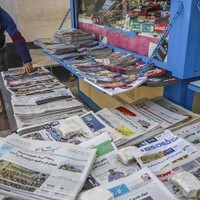
File photo: A man browses newspapers at a newsstand in Iran.
Iran is moving to tighten controls on journalists at home while threatening to pursue exiled media figures abroad, as lawmakers revive a controversial licensing proposal and the judiciary seeks to enlist Interpol in its crackdown on dissidents.
The proposed legislation would require journalists to obtain government-approved licenses to work, potentially placing their professional credentials under direct state oversight.
The proposal, first introduced in 2014, was shelved following strong opposition from journalists and media professionals. Hardliners in parliament revived it last week.
Babak Negahdari, head of the Majles Research Center, was quoted by the hardline news outlet Young Journalists Club as saying the proposal "has been finalized as a bill" and would be brought to a parliamentary vote within the next three months.
The legislation calls for the creation of a "Journalism Organization" modelled on the Iranian Medical Council, which regulates the licensing and professional practice of physicians.
Critics argue that the proposed body would undermine press freedom by placing journalists' professional credentials under state control.
Media lawyer Kambiz Nowrouzi said this week that the bill remains "the same 2014 draft with the same serious problems and fundamental flaws."
In an editorial in the moderate daily Shargh, he argued that the proposed Journalism Organization would effectively function as a government body, creating "a double filter for greater control over professional press organisations."
When introduced in 2014, the proposal was described as "abnormal" and "catastrophic" by journalism professor Hassan Namakdust, who warned it would leave "nothing of journalists' independence, status, and dignity."
Public reaction to its revival has so far been muted, possibly because of the intense security pressures facing journalists today.
The political environment has also changed. Parliament is dominated by hardliners, and the latest proposal originates from lawmakers rather than a government ministry.
Chasing exiled dissidents
Meanwhile, Iran's judiciary has announced efforts to pursue the arrest and extradition of dissidents and media figures living abroad through Interpol, alongside the confiscation of their assets inside Iran.
At a November 17 press briefing, Judiciary Spokesman Asghar Jahangir said authorities had confiscated assets belonging to a number of Iranians living abroad whom Tehran accuses of "treason" and other offences.
He said the judiciary was working through Interpol and its International Affairs Department to secure their arrest and extradition.
Although Jahangir did not release a full list of names, state television and affiliated outlets have repeatedly singled out exiled journalists working for Persian-language broadcasters such as Iran International, BBC Persian and VOA Persian when threatening asset confiscation, consular restrictions and Interpol Red Notices.
However, Article 3 of Interpol's Constitution prohibits the organisation from undertaking activities of a political, military, religious or racial character.
An Interpol Red Notice is also not an international arrest warrant, and Western host countries routinely reject extradition requests based on political or speech-related charges.
Nevertheless, the announcement has heightened concerns among Iranian journalists in Europe and the United States, some of whom fear questioning or delays at border crossings and airports when travelling internationally.
Other restrictive bills
The revived Journalism Organization Bill is the third in a series of legislative initiatives that critics say are intended to restrict freedom of expression and tighten state control over information.
The first two were the Foreign Influence Bill and the Bill to Organise Cyberspace.
The Foreign Influence Bill, which would criminalize interviews and other forms of contact with foreign-based media outlets, received initial parliamentary approval on August 16 by 183 votes to four, with five abstentions.
President Masoud Pezeshkian's cabinet formally opposed the legislation on August 23, but the government has no veto over parliamentary bills. The measure still requires a final parliamentary vote and Guardian Council approval.
The Bill to Organise Cyberspace, also known as the Protection (Sianat) Bill, was submitted to parliament on August 26.
Critics have described it as a rebranded version of the previously shelved Sianat internet bill. Among other measures, it would require internet service providers to identify and verify their users.
The legislation must undergo review by parliament's Social Commission before a floor vote and final consideration by the Guardian Council.
Together, the three proposals would expand state oversight of traditional and digital media, while the judiciary's latest announcement signals continued pressure on Iranian journalists abroad. Whether the revived licensing bill becomes law remains uncertain, but it is now being considered by a hardline-dominated parliament alongside other measures aimed at tightening controls on information.