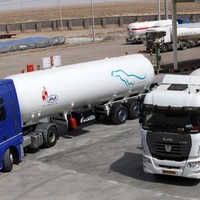
File photo: LPG tanker trucks at a Fergas International facility in Iran.
Iran's LPG exports have collapsed since the US naval blockade began in mid-July, leaving Tehran to find domestic uses for millions of tons of propane and butane that would normally be sold abroad.
Iran has shipped only 4.1 million barrels of LPG, equivalent to around 350,000 tons, since the blockade began, Reuters reported, citing informed sources and shipping data.
Data from Kpler and Vortexa obtained by Iran International show the figure was around 30 million barrels, or 2.6 million tons, over the same period last year.
Vortexa and Kpler estimate Iran's LPG exports in 2025 at between 10.5 million and 11 million tons, worth more than $5 billion.
Iranian Chamber of Commerce data show exports of 9 million tons of propane and butane worth $4.35 billion during the Iranian financial year that ended on March 20, 2026.
The figures cover different periods and may also reflect differences in methodology, but both point to the scale of Iran's LPG exports before the war.
War impact
A document from Iran's National Iranian Oil Products Distribution Company obtained by Iran International last year shows that the country's oil refineries produced around 2.4 million tons of LPG, half of which was consumed domestically and the remainder exported.
The South Pars gas processing facilities, serving Iran's largest gas field, produced around 7 million tons, with the rest coming from other gas facilities and petrochemical plants, mainly in Assaluyeh and Mahshahr.
In total, Iran produced around 13 million tons of LPG last year, about 80% of which was exported. Under normal conditions, domestic demand is below 2 million tons annually.
Iran has cut crude oil production since the halt in oil exports. According to OPEC estimates, daily output fell from around 3.26 million barrels in 2025 to 1.96 million barrels in September, a decline of about 40%.
The war has also affected Iran's other major sources of LPG. Israel targeted gas processing units at South Pars as well as petrochemical plants in Assaluyeh and Mahshahr.
Iranian officials say the initial loss of 230 million cubic meters of South Pars gas production has since narrowed to around 100–130 million cubic meters as damaged units returned to operation.
The head of Iran's National Petrochemical Company says around 60% of damaged petrochemical units have also been rebuilt and returned to operation.
Based on these figures, Iran's LPG production may have fallen by around 20–25% since the war, bringing annual output to roughly 10 million tons, comparable to 2020 levels.
But production has fallen far less sharply than exports, potentially leaving Iran with millions of tons of surplus LPG.
Lessons from 2020
Iran faced a similar, though less severe, problem at the height of US sanctions in 2020.
Kpler and Vortexa data show LPG exports that year were less than half last year's level, while Iranian official statistics indicate domestic consumption rose about 2.5-fold to around 5 million tons, roughly half of production.
Even then, Iran continued exporting LPG, shipping 4.4 million tons in 2020 and 5.8 million tons in 2021.
With seaborne exports now sharply curtailed, Tehran could again divert more propane and butane to domestic use, including limited injection into the national gas network or use as fuel by industries and power plants equipped to burn LPG.
That could help ease Iran's recurring winter gas shortages and reduce the need to burn fuel oil, or mazut, at power plants and industrial facilities, a major source of air pollution.
There are limits to how much LPG Iran can absorb at home. Substitution depends on technical constraints, available infrastructure and domestic demand.
Even if some of the surplus can be redirected domestically, a prolonged blockade could deprive Iran of an LPG export trade worth around $5 billion annually before the war, compounding the much larger loss of oil export revenue.
A woman waits behind the entrance door of the German branch of the Bank Saderat Iran in the northern German town of Hamburg / File Photo
Germany’s financial regulator BaFin said on Thursday that Bank Saderat Iran’s Hamburg branch had lost its banking license and must be wound up. The branch, which operated in Hamburg and Frankfurt, is no longer allowed to conduct banking business.
BaFin revoked the license on November 5, 2025, citing persistent legal violations that the bank had failed to remedy. A 2023 special audit found serious shortcomings in its business organization, and the bank had been inactive for more than six months.
BaFin also cited sanctions against the institution, saying German banking law therefore presumes its managers to be unreliable, regardless of whether they personally engaged in misconduct.
BaFin orders branch wound up
BaFin ordered the wind-down on June 11, 2026. The liquidation order became final on July 15, according to the regulator. The bank later withdrew legal action against the measure on September 23, and a Hamburg court appointed Berlin-based FUW Treuhand Project Management GmbH as liquidator on September 30.
The withdrawal of the banking license had already become final on December 8, 2025.
The bank mainly handled and financed Iran-related exports, including payment services, letters of credit, lending, guarantees and investments. It had 13 employees and assets of €62.4 million at the end of 2025. Customer deposits total about €200,000.
Deposits remain subject to sanctions restrictions
BaFin said there is currently no deposit compensation event, meaning Germany’s deposit guarantee system has not been triggered. Access to funds is restricted under EU sanctions, however, and the liquidator can make payments only with authorization from the Bundesbank’s Financial Sanctions Service Center.
BaFin said the existing deposits would instead be dealt with as part of the liquidation of the branch.
Iranian banks remain under scrutiny in Germany
The decision comes as Iranian banks operating in Germany face heightened scrutiny under renewed EU sanctions and increased US pressure on Tehran’s overseas financial network.
Bank Melli Iran’s Hamburg branch remains open despite being covered by EU sanctions, Germany’s Foreign Ministry told Iran International in August.
The ministry said at the time that the sanctions applied to Bank Melli and its German branch, but did not say whether Berlin was considering closing the operation.
The issue gained attention after US Treasury Secretary Scott Bessent launched “Operation Economic Outcast” and called for every Bank Melli branch abroad to be shut. Germany said it remained in contact with Washington and other partners over further measures against Iran but gave no indication that a decision had been made on Bank Melli’s Hamburg branch.
Bank Melli and Bank Saderat are separate institutions, and BaFin’s action against Bank Saderat was based on German banking-law requirements as well as the sanctions applying to the bank.
A general view of the Treasury Building on day two of a partial government shutdown in Washington, D.C., U.S., February 1, 2026.
The United States on Wednesday sanctioned a law firm, shipping operators and maritime logistics companies accused of helping Iran evade restrictions on its oil and other exports.
The measures extend Washington's pressure beyond ships carrying Iranian cargo to businesses that register them, manage their operations and provide port services.
The US Treasury said four firms were designated under Operation Economic Outcast, a campaign Secretary Scott Bessent launched in August with a pledge to “sever every economic lifeline” sustaining Tehran.
Central to Wednesday's action was Karnakis and Karnakis, a law firm operating in Panama and Greece.
The Treasury said it registered companies used to move hundreds of millions of dollars' worth of Iranian petroleum, petrochemicals and steel while obscuring the ownership of vessels involved in the trade.
Those companies included previously sanctioned Skyros Maritime and Trading, Corfu Maritime and Trading and Elias Shipping and Trading Group.
The Treasury said Elias Shipping had served as a front for Syria's Al-Qatirji Company, which sold Iranian oil benefiting the Revolutionary Guards' Quds Force and the Houthis.
The Treasury said Karnakis and Karnakis also helped establish companies associated with sanctioned Iranian energy trader Seyed Asadoollah Emamjomeh and acted as corporate agent for Roxette Maritime Shipping and Trading, a Panama- and Greece-based ship operator also sanctioned Wednesday.
Seven Panama-flagged cargo ships associated with Roxette were designated as blocked property. The law firm's two owners and three associates were also sanctioned.
The measures also targeted Singapore-based Amigoz Singapore, which the Treasury accused of assisting Iranian crude shipments and servicing vessels linked to Tehran's shadow fleet, and Dubai-based Whales Shipping Line, accused of facilitating Iranian petrochemical shipments.
Two vessels owned by Whales were also blocked.
Also on Wednesday, the US Financial Crimes Enforcement Network issued an administrative subpoena to advance an investigation into a Greek bank over potential ties to Iran, according to a Treasury statement, which did not name the bank.
FINCEN also issued requests for information to six other banks in Europe over relationships with Iranian financial institutions under US sanctions.
Passengers carry their luggage at Toronto Pearson International Airport, following the end of the Air Canada labour strike, in Mississauga, Ontario, Canada, August 19, 2025.
Canada's Immigration and Refugee Board has ordered the deportation of an Iranian man living in Toronto over his role in a criminal network that helped Iran evade international sanctions, Global News reported Wednesday, citing a 36-page ruling.
Amin Yousefijam, a former Tehran police lieutenant who has lived in Canada since 2016, helped coordinate shipments of restricted equipment from the United States to Iran through the United Arab Emirates, the board found, according to the report.
The shipments included electronics, motors and other dual-use goods with both civilian and military applications. Global News reported that some of the materials could potentially be used in the manufacture of weapons of mass destruction.
The deportation order was issued in July but only released to Global News this week. The board found that Yousefijam played an essential role in an operation that violated Canadian and US sanctions, although his involvement was more limited than that of his brother, Arash Yousefijam, who led the scheme.
Yousefijam was arrested in Toronto in 2021 and extradited to the United States, where he pleaded guilty to sanctions violations, the report said. After returning to Canada, he legally changed his name to Ameen Cohen.
The immigration board found that he intentionally failed to disclose his US conviction when applying for the name change, rejecting his explanation that he had been advised not to report convictions outside Canada.
The Canada Border Services Agency argued that Yousefijam posed a threat to national security. The board found insufficient evidence that he remained a security threat, however, and instead ordered his deportation on the grounds of membership in a criminal organization.
Global News quoted Yousefijam as saying he remained in Canada and was considering his legal options. He declined to say whether he had appealed the deportation order.
The case comes amid a broader Canadian effort to remove people with ties to the Islamic Republic, although Yousefijam's deportation is separate from proceedings targeting senior Iranian government officials.
According to Canada Border Services Agency figures, authorities had identified 40 senior Iranian officials living in Canada as of October 1. Two had been deported, eight had left voluntarily and two more were awaiting removal.
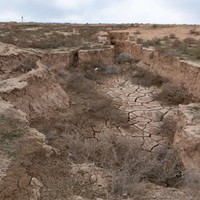
Land in parts of Iran’s southeastern Kerman province is sinking by as much as 40 centimeters a year, with ground fissures advancing toward villages, homes and orchards, according to data cited on Wednesday by the semi-official Mehr news agency.
Mehr, citing Iran’s Geological Survey, said some of the highest rates were recorded across the plains of Rafsanjan, Anar, Zarand and Sirjan, where annual subsidence was estimated at between 30 and 40 centimeters.
Several villages have already been affected, with cracks and fissures reaching areas close to residential buildings and agricultural land, the report said.
Groundwater depletion drives the damage
Excessive extraction of groundwater is the main driver of the subsidence, according to Mehr, with repeated droughts, declining rainfall, water-intensive farming and thousands of deep and semi-deep wells adding to pressure on underground reserves.
As groundwater is removed, underground soil layers compress and the surface sinks. That compaction is often irreversible, meaning the ground may not recover even if aquifers are later replenished.
Climate change and poor water management have added to the problem, the report said.
Ali-Asghar Zakeri Harandi, Kerman province’s deputy governor for development affairs, said continued depletion of groundwater was threatening infrastructure, farmland and settlements and could damage the province’s long-term development prospects without urgent action.
Farms, roads and villages at risk
The effects go beyond falling ground levels.
Subsidence can crack buildings, damage roads and energy pipelines and alter the structure of agricultural soil. Continued degradation can increase salinity and leave farmland less productive or, in some cases, unsuitable for cultivation.
That is particularly significant in southern Kerman, an important agricultural region where millions of tonnes of produce are grown annually.
Mehr said continued subsidence could threaten rural livelihoods and, over time, contribute to migration from affected settlements.
Iran’s Geological Survey said in September that the area affected by land subsidence nationwide had expanded tenfold over eight years, with previously separate subsidence zones beginning to merge in some areas.
A report by parliament’s research center cited earlier this year estimated that around 39 million people, nearly half of Iran’s population, live in areas already affected by subsidence or at risk of its spread.
The report put the affected area at about 185,000 square kilometers, roughly 11% of the country, encompassing more than 380 cities and 9,200 villages.
Tehran also among worst-affected areas
Although Kerman is recording some of the country’s fastest rates of sinking, Tehran province is among the most extensively affected.
Around 1,630 square kilometers of Tehran province, about 12.5% of its area, is experiencing subsidence, according to the parliamentary research cited earlier this year.
The most exposed areas include the Varamin plain, parts of southwestern Tehran and the cities of Eslamshahr, Shahriar and Malard.
The capital’s increasing reliance on groundwater has added to the risk. Parliamentary research found that underground sources now provide a significantly larger share of Tehran’s water than they did at the start of the previous decade.
Deep wells add to pressure
Iranian officials have repeatedly linked the problem to uncontrolled groundwater extraction.
Ali Beitollahi, a researcher at the Road, Housing and Urban Development Research Center, said in July that Iran had 1,450 wells deeper than 300 meters and identified excessive pumping as one of the main factors worsening subsidence.
Recent incidents have illustrated the risks in urban areas. Vehicles have fallen into ground collapses in cities including Neyshabur and Isfahan, while officials have also raised concerns about damage to roads, railways, utility networks and historic sites.
Officials call for lower groundwater use
Mehr said curbing groundwater extraction was the most immediate step needed to slow the crisis.
The measures it cited included closing illegal wells, enforcing limits on pumping, shifting agriculture toward less water-intensive crops, expanding greenhouse farming and improving irrigation efficiency.
Reusing treated wastewater and, over the longer term, desalinating seawater have also been proposed as ways to reduce pressure on freshwater reserves.
But because much of the underground compaction is irreversible, experts say slowing further subsidence is more realistic than restoring land that has already sunk.
Pakistan's Chief of Army Staff Field Marshal Asim Munir is welcomed by Iran's Interior Minister Eskandar Momeni in Tehran.
Pakistan’s army chief Asim Munir left Tehran on Tuesday after Iranian leaders reiterated their conditions for negotiations with Washington and ruled out transferring enriched nuclear material abroad, as regional mediators continue efforts to ease the standoff.
Iranian state media reported that a Qatari delegation also visited Tehran after Munir’s departure, extending a flurry of regional visits that included Russian Foreign Minister Sergei Lavrov’s talks in Tehran and US War Secretary Pete Hegseth’s unannounced trip to Israel.
Qatar and Pakistan have played key roles in mediating Iran-US negotiations in recent months. Munir helped broker talks that led to a memorandum of understanding in June.
Iran reiterates conditions
President Masoud Pezeshkian told Munir that Washington must lift pressure, threats and sanctions before any negotiations, according to Iranian state media.
“Our nation does not trust America today and believes that if we negotiate, they will attack us again,” Pezeshkian said, referring to US attacks during earlier negotiations.
He thanked Pakistan for its diplomatic efforts while warning that another war would bring destruction and losses across the region.
Parliament Speaker Mohammad Bagher Ghalibaf separately told Munir that Iran had nothing new to tell Washington, which must fulfill Tehran’s seven conditions presented in New York to regain its trust.
Ghalibaf accused the Trump administration of violating the Islamabad memorandum and said military threats would not change Iran’s strategic decisions.
Supreme National Security Council Secretary Mohsen Rezaei also ruled out sending Iran’s enriched nuclear material abroad.
“Not even a particle of enriched nuclear material will leave Iran,” he told Munir, describing the stockpile as a national asset intended for domestic use.
Rezaei also said negotiations would not begin until Washington took steps to build trust, starting with fulfilling Iran’s conditions.
Mediation efforts continue
Al-Araby Al-Jadeed reported Tuesday that Qatar and Pakistan had proposed giving Iran interest on $6 billion in frozen assets held in Qatari banks in exchange for access to its nuclear facilities.
The outlet’s sources said Washington had approved the proposal and Iran had responded positively, with Munir conveying it during his visit.
Earlier Tuesday, a spokesman for Iran’s parliamentary national security committee had described Munir’s trip as solely focused on bilateral relations and border cooperation, denying it involved a new mediation initiative.
Regional visits amid military pressure
Munir’s visit followed Lavrov’s meetings with Pezeshkian and Foreign Minister Abbas Araghchi on Monday. Pezeshkian said Iran remained ready to resolve regional disputes through dialogue while rejecting attempts to impose terms by force.
Hegseth also met Israeli Prime Minister Benjamin Netanyahu on Monday at Uvda air base in southern Israel.
Netanyahu’s spokesman Doron Spielman told Reuters they discussed regional threats and US-Israeli cooperation in responding offensively and defensively. Hegseth later said he had visited US forces serving under Central Command.
Fox News reported Tuesday, citing two US officials, that a third US aircraft carrier and about 10,000 military personnel were heading to the Middle East, with arrival expected by the end of November.
The diplomatic contacts and military movements come amid mixed signals from President Donald Trump, who told a campaign rally in Kansas on Monday that the United States could already leave the war.
“Somebody said you could leave right now. It’s true. We could leave right now,” Trump said, adding that Iran would not obtain a nuclear weapon.