German regulator orders liquidation of Bank Saderat Iran’s Hamburg branch
A woman waits behind the entrance door of the German branch of the Bank Saderat Iran in the northern German town of Hamburg / File Photo
Germany’s financial regulator BaFin said on Thursday that Bank Saderat Iran’s Hamburg branch had lost its banking license and must be wound up. The branch, which operated in Hamburg and Frankfurt, is no longer allowed to conduct banking business.
BaFin revoked the license on November 5, 2025, citing persistent legal violations that the bank had failed to remedy. A 2023 special audit found serious shortcomings in its business organization, and the bank had been inactive for more than six months.
BaFin also cited sanctions against the institution, saying German banking law therefore presumes its managers to be unreliable, regardless of whether they personally engaged in misconduct.
BaFin orders branch wound up
BaFin ordered the wind-down on June 11, 2026. The liquidation order became final on July 15, according to the regulator. The bank later withdrew legal action against the measure on September 23, and a Hamburg court appointed Berlin-based FUW Treuhand Project Management GmbH as liquidator on September 30.
The withdrawal of the banking license had already become final on December 8, 2025.
The bank mainly handled and financed Iran-related exports, including payment services, letters of credit, lending, guarantees and investments. It had 13 employees and assets of €62.4 million at the end of 2025. Customer deposits total about €200,000.
Deposits remain subject to sanctions restrictions
BaFin said there is currently no deposit compensation event, meaning Germany’s deposit guarantee system has not been triggered. Access to funds is restricted under EU sanctions, however, and the liquidator can make payments only with authorization from the Bundesbank’s Financial Sanctions Service Center.
BaFin said the existing deposits would instead be dealt with as part of the liquidation of the branch.
Iranian banks remain under scrutiny in Germany
The decision comes as Iranian banks operating in Germany face heightened scrutiny under renewed EU sanctions and increased US pressure on Tehran’s overseas financial network.
Bank Melli Iran’s Hamburg branch remains open despite being covered by EU sanctions, Germany’s Foreign Ministry told Iran International in August.
The ministry said at the time that the sanctions applied to Bank Melli and its German branch, but did not say whether Berlin was considering closing the operation.
The issue gained attention after US Treasury Secretary Scott Bessent launched “Operation Economic Outcast” and called for every Bank Melli branch abroad to be shut. Germany said it remained in contact with Washington and other partners over further measures against Iran but gave no indication that a decision had been made on Bank Melli’s Hamburg branch.
Bank Melli and Bank Saderat are separate institutions, and BaFin’s action against Bank Saderat was based on German banking-law requirements as well as the sanctions applying to the bank.
Israel has barred a United Airlines pilot of Iranian descent from serving on flights to the country over unverified social media allegations that he supported Iran's government, the Revolutionary Guards and Hezbollah, Ynet reported Wednesday.
Israel's Diaspora Affairs and Combating Antisemitism Ministry alerted security and transportation officials on October 19 to allegations circulating on X about the pilot, Sina Amjadian, according to a ministry letter obtained by Ynet.
The letter included two posts from X. One alleged that Amjadian, who was said to have previously worked for flydubai, had shared content supporting Iran's government, including a video in which he purportedly kissed and saluted its emblem.
The other alleged that he had expressed support for the Islamic Revolutionary Guard Corps and Hezbollah and called on United Airlines to investigate his conduct.
Ynet said it could not independently verify the allegations and that the material submitted to Israeli authorities did not include original statements or social media posts by Amjadian.
The allegations nevertheless prompted a security review and a decision to prohibit Amjadian from serving as a crew member on flights to Israel, senior Transportation Ministry officials told Ynet.
Security review follows flydubai incident
The Diaspora Affairs Ministry said the warning followed an attempted attack aboard a flydubai flight bound for Israel in late September, during which a co-pilot attacked the captain and attempted to seize control of the aircraft.
The incident prompted Israel's National Command and Control Center for Combating Antisemitism to expand its monitoring to people who might pose a threat to aviation security, according to the ministry.
It said the allegations concerning Amjadian warranted security scrutiny because of the responsibilities of an international airline pilot and the potential risks to passengers and crew.
Transportation Ministry officials told Ynet that the ministry did not independently monitor social media or gather intelligence but coordinated with security agencies when information raised aviation safety concerns.
They said preventing a pilot from operating flights to Israel was separate from denying the individual entry to the country, which falls under the authority of border control officials.
Ynet said it remained unclear whether Amjadian had previously flown to Israel, had been scheduled to operate a flight to Ben Gurion Airport or was qualified to fly aircraft used by United Airlines on its Israel routes.
There was no indication that any flight had been canceled or prevented from reaching Israel because of the restriction.
Iraqi security forces stand at the Shalamcheh border crossing with Iran after Iraq closed the crossing following airstrikes on the Iranian side that security sources said killed an Iraqi citizen, Iraq, April 4, 2026.
Conflicting accounts emerged Wednesday over Iraq's plans for its border with Iran, as Baghdad attributed the closure of one major crossing to technical shortcomings while reports said more could be shut amid US pressure to restrict trade routes with Tehran.
Iraqi government spokesperson Haider al-Aboudi said the Sheeb crossing, known as Chazabeh in Iran, was closed because it lacked sufficient technical, technological and developmental readiness, according to the official Iraqi News Agency.
He said trade was proceeding normally through several other crossings with Iran.
But Al Jazeera cited an Iraqi government official on Tuesday as saying Prime Minister Ali al-Zaidi had ordered Sheeb closed indefinitely and several other crossings gradually shut in the coming days. No reason was given for the planned closures.
Separately, AFP reported Wednesday, citing two Iraqi political sources, that Washington was pressing Baghdad to close crossings with Iran as part of efforts to increase economic pressure on Tehran.
One source said the US Treasury Department raised the issue with Zaidi during his visit to New York for the UN General Assembly last month and that the proposed restrictions would leave only two crossings open, one in federal Iraq and another in the Kurdistan region.
The second source said Washington had asked other countries bordering Iran to take similar measures.
Reuters reported that Sheeb had been closed to passengers, vehicles and commercial trucks. An Iraqi border official told the agency the closure would allow security arrangements to be reviewed and detection equipment installed to prevent the smuggling of prohibited materials.
Tehran seeks reopening
Iranian officials said they had received no advance warning of the closure.
Valiollah Hayati, a security official in Iran's southwestern Khuzestan province, said consultations were under way with Iraqi authorities to reopen Sheeb and advised passengers and commercial trucks to use the nearby Shalamcheh crossing.
Iranian Interior Ministry spokesperson Ali Zeinivand said Iraq was required to notify Tehran of extended border closures but had not done so.
Foreign Minister Abbas Araghchi also criticized disruptions at Iran's borders on Wednesday, saying they had become places where traffic was held up rather than allowed to pass. He said the Foreign Ministry would seek to resolve obstacles originating in neighboring countries.
The uncertainty comes days after Pakistan suspended commercial activity at two major crossings with Iran, Taftan-Mirjaveh and Gabd-Rimdan, on October 17.
Iranian authorities said the border reopened on Tuesday, although the resumption of normal commercial traffic at both crossings has not been independently confirmed.
Iran and Iraq share a border of more than 1,400 kilometers (870 miles) and have extensive political, religious and economic ties.
A general view of the Treasury Building on day two of a partial government shutdown in Washington, D.C., U.S., February 1, 2026.
The United States on Wednesday sanctioned a law firm, shipping operators and maritime logistics companies accused of helping Iran evade restrictions on its oil and other exports.
The measures extend Washington's pressure beyond ships carrying Iranian cargo to businesses that register them, manage their operations and provide port services.
The US Treasury said four firms were designated under Operation Economic Outcast, a campaign Secretary Scott Bessent launched in August with a pledge to “sever every economic lifeline” sustaining Tehran.
Central to Wednesday's action was Karnakis and Karnakis, a law firm operating in Panama and Greece.
The Treasury said it registered companies used to move hundreds of millions of dollars' worth of Iranian petroleum, petrochemicals and steel while obscuring the ownership of vessels involved in the trade.
Those companies included previously sanctioned Skyros Maritime and Trading, Corfu Maritime and Trading and Elias Shipping and Trading Group.
The Treasury said Elias Shipping had served as a front for Syria's Al-Qatirji Company, which sold Iranian oil benefiting the Revolutionary Guards' Quds Force and the Houthis.
The Treasury said Karnakis and Karnakis also helped establish companies associated with sanctioned Iranian energy trader Seyed Asadoollah Emamjomeh and acted as corporate agent for Roxette Maritime Shipping and Trading, a Panama- and Greece-based ship operator also sanctioned Wednesday.
Seven Panama-flagged cargo ships associated with Roxette were designated as blocked property. The law firm's two owners and three associates were also sanctioned.
The measures also targeted Singapore-based Amigoz Singapore, which the Treasury accused of assisting Iranian crude shipments and servicing vessels linked to Tehran's shadow fleet, and Dubai-based Whales Shipping Line, accused of facilitating Iranian petrochemical shipments.
Two vessels owned by Whales were also blocked.
Also on Wednesday, the US Financial Crimes Enforcement Network issued an administrative subpoena to advance an investigation into a Greek bank over potential ties to Iran, according to a Treasury statement, which did not name the bank.
FINCEN also issued requests for information to six other banks in Europe over relationships with Iranian financial institutions under US sanctions.
Passengers carry their luggage at Toronto Pearson International Airport, following the end of the Air Canada labour strike, in Mississauga, Ontario, Canada, August 19, 2025.
Canada's Immigration and Refugee Board has ordered the deportation of an Iranian man living in Toronto over his role in a criminal network that helped Iran evade international sanctions, Global News reported Wednesday, citing a 36-page ruling.
Amin Yousefijam, a former Tehran police lieutenant who has lived in Canada since 2016, helped coordinate shipments of restricted equipment from the United States to Iran through the United Arab Emirates, the board found, according to the report.
The shipments included electronics, motors and other dual-use goods with both civilian and military applications. Global News reported that some of the materials could potentially be used in the manufacture of weapons of mass destruction.
The deportation order was issued in July but only released to Global News this week. The board found that Yousefijam played an essential role in an operation that violated Canadian and US sanctions, although his involvement was more limited than that of his brother, Arash Yousefijam, who led the scheme.
Yousefijam was arrested in Toronto in 2021 and extradited to the United States, where he pleaded guilty to sanctions violations, the report said. After returning to Canada, he legally changed his name to Ameen Cohen.
The immigration board found that he intentionally failed to disclose his US conviction when applying for the name change, rejecting his explanation that he had been advised not to report convictions outside Canada.
The Canada Border Services Agency argued that Yousefijam posed a threat to national security. The board found insufficient evidence that he remained a security threat, however, and instead ordered his deportation on the grounds of membership in a criminal organization.
Global News quoted Yousefijam as saying he remained in Canada and was considering his legal options. He declined to say whether he had appealed the deportation order.
The case comes amid a broader Canadian effort to remove people with ties to the Islamic Republic, although Yousefijam's deportation is separate from proceedings targeting senior Iranian government officials.
According to Canada Border Services Agency figures, authorities had identified 40 senior Iranian officials living in Canada as of October 1. Two had been deported, eight had left voluntarily and two more were awaiting removal.
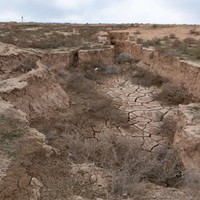
Land in parts of Iran’s southeastern Kerman province is sinking by as much as 40 centimeters a year, with ground fissures advancing toward villages, homes and orchards, according to data cited on Wednesday by the semi-official Mehr news agency.
Mehr, citing Iran’s Geological Survey, said some of the highest rates were recorded across the plains of Rafsanjan, Anar, Zarand and Sirjan, where annual subsidence was estimated at between 30 and 40 centimeters.
Several villages have already been affected, with cracks and fissures reaching areas close to residential buildings and agricultural land, the report said.
Groundwater depletion drives the damage
Excessive extraction of groundwater is the main driver of the subsidence, according to Mehr, with repeated droughts, declining rainfall, water-intensive farming and thousands of deep and semi-deep wells adding to pressure on underground reserves.
As groundwater is removed, underground soil layers compress and the surface sinks. That compaction is often irreversible, meaning the ground may not recover even if aquifers are later replenished.
Climate change and poor water management have added to the problem, the report said.
Ali-Asghar Zakeri Harandi, Kerman province’s deputy governor for development affairs, said continued depletion of groundwater was threatening infrastructure, farmland and settlements and could damage the province’s long-term development prospects without urgent action.
Farms, roads and villages at risk
The effects go beyond falling ground levels.
Subsidence can crack buildings, damage roads and energy pipelines and alter the structure of agricultural soil. Continued degradation can increase salinity and leave farmland less productive or, in some cases, unsuitable for cultivation.
That is particularly significant in southern Kerman, an important agricultural region where millions of tonnes of produce are grown annually.
Mehr said continued subsidence could threaten rural livelihoods and, over time, contribute to migration from affected settlements.
Iran’s Geological Survey said in September that the area affected by land subsidence nationwide had expanded tenfold over eight years, with previously separate subsidence zones beginning to merge in some areas.
A report by parliament’s research center cited earlier this year estimated that around 39 million people, nearly half of Iran’s population, live in areas already affected by subsidence or at risk of its spread.
The report put the affected area at about 185,000 square kilometers, roughly 11% of the country, encompassing more than 380 cities and 9,200 villages.
Tehran also among worst-affected areas
Although Kerman is recording some of the country’s fastest rates of sinking, Tehran province is among the most extensively affected.
Around 1,630 square kilometers of Tehran province, about 12.5% of its area, is experiencing subsidence, according to the parliamentary research cited earlier this year.
The most exposed areas include the Varamin plain, parts of southwestern Tehran and the cities of Eslamshahr, Shahriar and Malard.
The capital’s increasing reliance on groundwater has added to the risk. Parliamentary research found that underground sources now provide a significantly larger share of Tehran’s water than they did at the start of the previous decade.
Deep wells add to pressure
Iranian officials have repeatedly linked the problem to uncontrolled groundwater extraction.
Ali Beitollahi, a researcher at the Road, Housing and Urban Development Research Center, said in July that Iran had 1,450 wells deeper than 300 meters and identified excessive pumping as one of the main factors worsening subsidence.
Recent incidents have illustrated the risks in urban areas. Vehicles have fallen into ground collapses in cities including Neyshabur and Isfahan, while officials have also raised concerns about damage to roads, railways, utility networks and historic sites.
Officials call for lower groundwater use
Mehr said curbing groundwater extraction was the most immediate step needed to slow the crisis.
The measures it cited included closing illegal wells, enforcing limits on pumping, shifting agriculture toward less water-intensive crops, expanding greenhouse farming and improving irrigation efficiency.
Reusing treated wastewater and, over the longer term, desalinating seawater have also been proposed as ways to reduce pressure on freshwater reserves.
But because much of the underground compaction is irreversible, experts say slowing further subsidence is more realistic than restoring land that has already sunk.