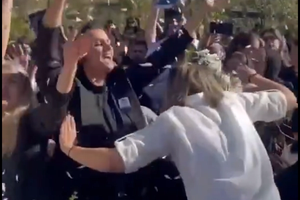
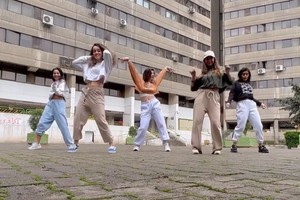
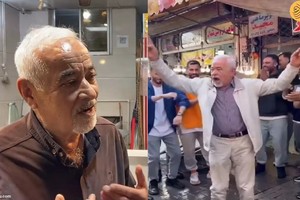
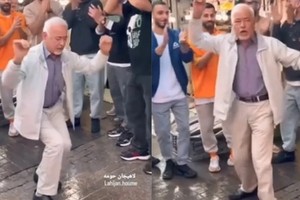
The format barely varies. A person holds up what they bought and names what it cost. Four eggs and a single sausage, 5 million rials, about $2.30. A soda and a packet of crisps, 3.5 million rials. Three small bags of shopping, 75 million rials, roughly $34, which is close to half a month at Iran's minimum wage of about $75. Then the line, in one version or another: I am very happy, because if I were not, they would execute me. And then they dance.
One man films his phone showing a bank balance of 2 million rials, under a dollar, and dances through the list of what it will not cover: the bounced cheques, the unpaid shop rent, the apartment rent, his wife's clothes.
A veiled woman holds up a few tomatoes, onions and potatoes and explains that she can no longer buy by the kilo, only a handful at a time, "but I am happy, because otherwise they call me a rioter or a traitor." She thanks the authorities and signs off warmly. Another woman does the same with six eggs and a tin of tuna.
Another man dances while captions scroll over him: the dollar at 200,000 tomans, no electricity, deep in debt, and a signed undertaking to the authorities not to engage in politics. The threat varies with the week's official vocabulary: some dancers say they would otherwise be branded a mercenary, a traitor, or a Mossad agent.
It reads, at first, as one more instance of a familiar thing, humor as a pressure valve under repression. That reading is not wrong, but it is not what is new here, and it misses what the videos are actually doing.
Painting things white
The Islamic Republic has a specific charge for describing the country's problems: siah-namai, "painting things black." It is used against journalists, economists and ordinary complainers to mean the deliberate darkening of a reality that is, officials insist, fine. The dance videos answer it precisely. They paint things white, so luridly that the whiteness itself becomes the accusation.
A man delighted by four eggs is not praising the government. He is holding its own demand up to the light.
To see why this is a break rather than a joke, it helps to recall Vaclav Havel's greengrocer, the shopkeeper in communist Czechoslovakia who puts the slogan "Workers of the world, unite!" in his window. He does not believe it. What the sign really says, Havel wrote, is: I am obedient and therefore have the right to be left in peace. The system did not need people to believe. It needed each of them to see everyone else pretending, so that pretending felt like the only choice. Its one requirement was silence about what the pretending was for.
The Iranian dancer is Havel's greengrocer saying the quiet part aloud while still holding up the sign. The compliance is performed, the smile is wide, the gratitude is offered. And in the same breath the coercion behind it is named: I am doing this because the alternative is a noose.
Coerced performance works only while the coercion stays deniable. Havel's greengrocer kept the system standing by leaving the reason unsaid. The dancer says the reason into the camera, and the sign in the window stops working.
A state that can no longer read its own people
Follow that to its end and the videos are doing something sharper than mockery. They are exposing a problem the state has made for itself.
When a government criminalizes complaint, it also empties praise of meaning. If unhappiness can be prosecuted, a happy citizen and a frightened one become impossible to tell apart.
The dancers are demonstrating this to the state's face: you can no longer know whether we are content, because you have made discontent a crime, and so our contentment tells you nothing.
This is the deeper significance of a format built entirely from the state's own words. Every accusation the dancers voice, siah-namai, rioter, mercenary, Mossad agent, traitor, is lifted from official language. The videos are assembled from nothing but the vocabulary the government uses to police speech, and turned into an instrument of it.
Linguists distinguish the message from the metamessage: what a statement says, and what it conveys about the relationship between the people speaking. Every one of these videos carries the same metamessage. I cannot tell you the truth, you know I cannot, and I know that you know.
The gap between "I am delighted" and "I am forbidden to say otherwise" is the entire content. Iranians read it without effort. The state pretends to read only the surface.
From refusing the frame to hollowing the words
The videos are the latest move in a shift that has been accelerating, and each stage has done something different to the relationship between a sign and its meaning.
During the January protests, demonstrators in the western town of Abdanan scattered rice into the air, pouring away a staple that had grown scarce and dear. The gesture refused the frame the state wanted to impose on the unrest.
By throwing away the very thing they could barely afford, protesters were saying the anger was never really about the price of rice. The economy had triggered something larger: a rejection of the whole arrangement.
Then came the funerals. After the January massacre, families burying the dead replaced the state's mourning language, the Quranic recitation, the lamentation, the word shahid, "martyr," with another vocabulary entirely: wedding music, folk dance, verses from the Shahnameh, and a new word for their dead, javid-nam, "whose name will endure."
That was an act of authorship. The grief was real, and out of it people built a rival ritual language, deliberately cleansed of the religious symbolism the state relies on.
The price videos are the third move, and they are not the same as the funeral dances, even though both use the body and both use music. The funeral dance builds; it replaces the state's grammar with a sincere one of its own. The price video hollows; it takes the state's grammar and performs it as a corpse. One is about the dead and constructs a new language. The other is about the living and empties an existing one. A society that first refused the state's frame, and then authored its own, is now wearing the state's words as a mask.
It is worth remembering how far this has travelled. Dance is not merely frowned upon in Iran; it is effectively illegal, and the word itself is so freighted that the state, when staging its own approved versions, avoids it and reaches instead for the bloodless euphemism harakat-e mozoun, "rhythmic movements," a coinage that was itself widely mocked when it appeared.
During the 2022 Woman, Life, Freedom protests, teenage girls were detained and pushed into filmed confessions for dancing in a Tehran neighborhood. The same act now circulates in its hundreds, filmed openly by people using their own names and faces, among them veiled women from households where dancing would once have been unthinkable on its own terms, never mind the law's. That is its own measure of how fast the ground is moving.
The trigger, as ever, is money. The rial has been setting records, passing 2,200,000 to the dollar, and on August 31 the judiciary chief Gholamhossein Mohseni-Ejei called protesters "mercenaries" and promised a firmer hand. But the videos are not really about eggs, any more than the rice was about rice.
They are about a population that has run out of permitted ways to say no, and has started saying yes in a way that unmistakably means it.
The phenomenon has acquired a name, taken from the line the dancers keep repeating: "If I'm not happy, they'll execute me." It is a joke a foreign viewer can laugh at and an Iranian cannot, quite. The Islamic Republic built a machine designed to hear only yes. It is now discovering that yes is what no has learned to sound like.