• العربية
  • فارسی
Brand
  • Iran Insight
  • Politics
  • Economy
  • Analysis
  • Special Report
  • Opinion
  • Podcast
  • Live TV
  • Iran Insight
  • Politics
  • Economy
  • Analysis
  • Special Report
  • Opinion
  • Podcast
  • Live TV
  • Theme
  • Language
    • العربية
    • فارسی
  • Iran Insight
  • Politics
  • Economy
  • Analysis
  • Special Report
  • Opinion
  • Podcast
  • Live TV
All rights reserved for Volant Media UK Limited
volant media logo
ANALYSIS

'If I'm not happy, they'll execute me': Iran's new grammar of dissent

Arash Sohrabi
Arash Sohrabi

Iran International

Sep 4, 2026, 14:35 GMT+1
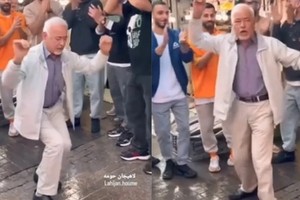
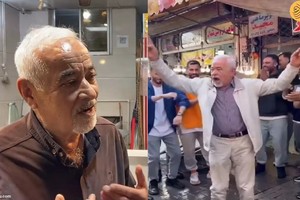
An AI-enhanced and reframed screengrab from a video shows a man dancing while holding a bag of chips and a bottle of soda.

Iranians have found a way to complain about prices that no prosecutor can touch: they film themselves dancing beside the groceries, insist they are delighted, and explain that if they were not, they would be executed.

The format barely varies. A person holds up what they bought and names what it cost. Four eggs and a single sausage, 5 million rials, about $2.30. A soda and a packet of crisps, 3.5 million rials. Three small bags of shopping, 75 million rials, roughly $34, which is close to half a month at Iran's minimum wage of about $75. Then the line, in one version or another: I am very happy, because if I were not, they would execute me. And then they dance.

One man films his phone showing a bank balance of 2 million rials, under a dollar, and dances through the list of what it will not cover: the bounced cheques, the unpaid shop rent, the apartment rent, his wife's clothes.

A veiled woman holds up a few tomatoes, onions and potatoes and explains that she can no longer buy by the kilo, only a handful at a time, "but I am happy, because otherwise they call me a rioter or a traitor." She thanks the authorities and signs off warmly. Another woman does the same with six eggs and a tin of tuna.

Another man dances while captions scroll over him: the dollar at 200,000 tomans, no electricity, deep in debt, and a signed undertaking to the authorities not to engage in politics. The threat varies with the week's official vocabulary: some dancers say they would otherwise be branded a mercenary, a traitor, or a Mossad agent.

It reads, at first, as one more instance of a familiar thing, humor as a pressure valve under repression. That reading is not wrong, but it is not what is new here, and it misses what the videos are actually doing.

Painting things white

The Islamic Republic has a specific charge for describing the country's problems: siah-namai, "painting things black." It is used against journalists, economists and ordinary complainers to mean the deliberate darkening of a reality that is, officials insist, fine. The dance videos answer it precisely. They paint things white, so luridly that the whiteness itself becomes the accusation.

A man delighted by four eggs is not praising the government. He is holding its own demand up to the light.

To see why this is a break rather than a joke, it helps to recall Vaclav Havel's greengrocer, the shopkeeper in communist Czechoslovakia who puts the slogan "Workers of the world, unite!" in his window. He does not believe it. What the sign really says, Havel wrote, is: I am obedient and therefore have the right to be left in peace. The system did not need people to believe. It needed each of them to see everyone else pretending, so that pretending felt like the only choice. Its one requirement was silence about what the pretending was for.

The Iranian dancer is Havel's greengrocer saying the quiet part aloud while still holding up the sign. The compliance is performed, the smile is wide, the gratitude is offered. And in the same breath the coercion behind it is named: I am doing this because the alternative is a noose.

Coerced performance works only while the coercion stays deniable. Havel's greengrocer kept the system standing by leaving the reason unsaid. The dancer says the reason into the camera, and the sign in the window stops working.

A state that can no longer read its own people

Follow that to its end and the videos are doing something sharper than mockery. They are exposing a problem the state has made for itself.

When a government criminalizes complaint, it also empties praise of meaning. If unhappiness can be prosecuted, a happy citizen and a frightened one become impossible to tell apart.

The dancers are demonstrating this to the state's face: you can no longer know whether we are content, because you have made discontent a crime, and so our contentment tells you nothing.

This is the deeper significance of a format built entirely from the state's own words. Every accusation the dancers voice, siah-namai, rioter, mercenary, Mossad agent, traitor, is lifted from official language. The videos are assembled from nothing but the vocabulary the government uses to police speech, and turned into an instrument of it.

Linguists distinguish the message from the metamessage: what a statement says, and what it conveys about the relationship between the people speaking. Every one of these videos carries the same metamessage. I cannot tell you the truth, you know I cannot, and I know that you know.

The gap between "I am delighted" and "I am forbidden to say otherwise" is the entire content. Iranians read it without effort. The state pretends to read only the surface.

From refusing the frame to hollowing the words

The videos are the latest move in a shift that has been accelerating, and each stage has done something different to the relationship between a sign and its meaning.

During the January protests, demonstrators in the western town of Abdanan scattered rice into the air, pouring away a staple that had grown scarce and dear. The gesture refused the frame the state wanted to impose on the unrest.

By throwing away the very thing they could barely afford, protesters were saying the anger was never really about the price of rice. The economy had triggered something larger: a rejection of the whole arrangement.

Then came the funerals. After the January massacre, families burying the dead replaced the state's mourning language, the Quranic recitation, the lamentation, the word shahid, "martyr," with another vocabulary entirely: wedding music, folk dance, verses from the Shahnameh, and a new word for their dead, javid-nam, "whose name will endure."

That was an act of authorship. The grief was real, and out of it people built a rival ritual language, deliberately cleansed of the religious symbolism the state relies on.

The price videos are the third move, and they are not the same as the funeral dances, even though both use the body and both use music. The funeral dance builds; it replaces the state's grammar with a sincere one of its own. The price video hollows; it takes the state's grammar and performs it as a corpse. One is about the dead and constructs a new language. The other is about the living and empties an existing one. A society that first refused the state's frame, and then authored its own, is now wearing the state's words as a mask.

It is worth remembering how far this has travelled. Dance is not merely frowned upon in Iran; it is effectively illegal, and the word itself is so freighted that the state, when staging its own approved versions, avoids it and reaches instead for the bloodless euphemism harakat-e mozoun, "rhythmic movements," a coinage that was itself widely mocked when it appeared.

During the 2022 Woman, Life, Freedom protests, teenage girls were detained and pushed into filmed confessions for dancing in a Tehran neighborhood. The same act now circulates in its hundreds, filmed openly by people using their own names and faces, among them veiled women from households where dancing would once have been unthinkable on its own terms, never mind the law's. That is its own measure of how fast the ground is moving.

The trigger, as ever, is money. The rial has been setting records, passing 2,200,000 to the dollar, and on August 31 the judiciary chief Gholamhossein Mohseni-Ejei called protesters "mercenaries" and promised a firmer hand. But the videos are not really about eggs, any more than the rice was about rice.

They are about a population that has run out of permitted ways to say no, and has started saying yes in a way that unmistakably means it.

The phenomenon has acquired a name, taken from the line the dancers keep repeating: "If I'm not happy, they'll execute me." It is a joke a foreign viewer can laugh at and an Iranian cannot, quite. The Islamic Republic built a machine designed to hear only yes. It is now discovering that yes is what no has learned to sound like.

Most Viewed

Iran’s economy is a powder keg. Tehran is preparing for the spark
1
ANALYSIS

Iran’s economy is a powder keg. Tehran is preparing for the spark

2
INSIGHT

Xi snub reignites Iran’s doubts about China

3
INSIGHT

Five years ago, Iran’s planners put today’s crisis on paper

4

Iran drug shortages hit 800 medicines as costs could triple

5
ANALYSIS

Women footballers came home under pressure. Now Iran wants them on camera

Banner
Banner

Spotlight

  • If Britain backs US plan, Iran's London bank shuts down on October 22
    ANALYSIS

    If Britain backs US plan, Iran's London bank shuts down on October 22

  • US strikes deepen Tehran debate over compromise or confrontation
    INSIGHT

    US strikes deepen Tehran debate over compromise or confrontation

  • Xi snub reignites Iran’s doubts about China
    INSIGHT

    Xi snub reignites Iran’s doubts about China

  • Trump’s call for an Iranian uprising runs into a trust problem
    ANALYSIS

    Trump’s call for an Iranian uprising runs into a trust problem

  • Five years ago, Iran’s planners put today’s crisis on paper
    INSIGHT

    Five years ago, Iran’s planners put today’s crisis on paper

  • Women footballers came home under pressure. Now Iran wants them on camera
    ANALYSIS

    Women footballers came home under pressure. Now Iran wants them on camera

Banner
  • Iran’s economy is a powder keg. Tehran is preparing for the spark

    Iran’s economy is a powder keg. Tehran is preparing for the spark

  • A grain too far: Iranian rice becomes too dear for many

    A grain too far: Iranian rice becomes too dear for many

  • Dancing Is The New Protest In Iran

    Dancing Is The New Protest In Iran

  • Iran’s Crackdown On ‘Happiness’ Draws More Criticism

    Iran’s Crackdown On ‘Happiness’ Draws More Criticism

  • Iranians Dance In Streets As Civil Disobedience To Clerical Rule

    Iranians Dance In Streets As Civil Disobedience To Clerical Rule

  • Iran’s 40-day memorials for protesters spill beyond cemeteries into streets

    Iran’s 40-day memorials for protesters spill beyond cemeteries into streets

  • Iranians burying slain protest youths mourn with dancing and defiance

    Iranians burying slain protest youths mourn with dancing and defiance

  • Dancing for the dead: How protest massacre is rewriting Iran’s mourning rituals

    Dancing for the dead: How protest massacre is rewriting Iran’s mourning rituals

•
•
•

More Stories

US strikes deepen Tehran debate over compromise or confrontation

Sep 4, 2026, 08:09 GMT+1
•
Behrouz Turani
100%
Supporters of the Islamic Republic attend a state-organized event celebrating the birthday of the Prophet Mohammed in Tehran, holding Iranian flags and portraits of former Supreme Leader Ali Khamenei, August 30, 2026

The latest round of US and Iranian attacks has shifted the debate in Tehran from whether the country is in crisis to a more fundamental question: what does survival now require—compromise or continued confrontation?

The argument comes after six months of war, intermittent diplomacy and repeated attempts at mediation have failed to produce a durable settlement.

US strikes and economic pressure have continued, Iran has retaliated across the region, and the latest escalation has again brought attacks to southern Iran while traffic through the Strait of Hormuz has fallen close to a standstill.

At home, the rial has pushed past 2.2 million to the dollar, while gas shortages and mounting economic pressure have sharpened the question of how long Iran can sustain the confrontation.

“Iran is now living through one of the most fateful junctures of its confrontation with known adversaries,” the IRGC-linked Javan newspaper wrote Wednesday.

Coming from a publication close to the security establishment, the unusually stark assessment was notable.

Khorasan, aligned with parliament speaker Mohammad-Bagher Ghalibaf, sounded a similarly somber note, describing the crisis as “a moment not yet past but already worth calling history.” Iranians, it said, “have lived through two wars in one year.”

Economy or ideology

For those advocating a diplomatic way out, the increasingly urgent argument is that Iran’s economy cannot withstand indefinite confrontation.

Pro-reform Shargh defended President Masoud Pezeshkian’s call at the Shanghai Cooperation Organization summit in Bishkek for a return to reciprocal diplomacy under the June MoU.

Columnist Ahmad Zeidabadi argued that with the rial above 2 million to the dollar and the country facing severe gas shortages, Iran could no longer afford endless confrontation.

“Pezeshkian’s message in Bishkek reflects the urgent needs of our society: our real economy cannot survive endless isolation,” Zeidabadi wrote. “True national strength lies in protecting citizens’ livelihoods through practical diplomacy, not in clinging to dogmatic slogans.”

The argument echoes concerns raised by Pezeshkian himself, who has identified sanctions, political infighting and the role of quasi-governmental companies among the pressures weighing on Iran’s economy.

But for hardliners, the lesson of the past six months is almost precisely the opposite.

‘Capitulationist current’

Kayhan’s ultraconservative editor Hossein Shariatmadari demanded the “purging of the capitulationist current,” attacking Executive Deputy Jafar Ghaempanah and Yousef Pezeshkian, the president’s son, for questioning whether uranium enrichment was essential to Iran’s survival.

“Questioning enrichment under enemy fire is not pragmatism—it is ideological surrender,” Shariatmadari wrote.

He argued that abandoning enrichment would merely encourage Washington to demand further concessions over Iran’s missiles and coastal defense systems, echoing a longstanding argument made by former Supreme Leader Ali Khamenei.

Shariatmadari portrayed the advisers’ comments as an attempt to prepare public opinion for capitulation to Washington’s D-Day campaign, arguing that pressure over enrichment, missiles and regional support formed part of a single Western effort to strip Iran of its defensive capabilities.

He pointed to the latest US strikes on Larak Island as proof that Washington responds only to uncompromising force.

Those strikes, however, came amid another escalation that brought the human costs of the confrontation back to southern Iran. Attacks were reported on Larak and in several southern cities, including Ahvaz, Bandar Abbas, Qeshm and Chabahar.

Six months of war have therefore produced an unusual point of agreement across Iran’s bitter political divides: the country has reached an extraordinarily dangerous moment.

For advocates of diplomacy, economic exhaustion makes compromise increasingly necessary. For hardliners, the same six months have demonstrated that compromise under pressure would only invite more pressure.

Xi snub reignites Iran’s doubts about China

Sep 4, 2026, 04:23 GMT+1
•
Maryam Sinaiee
100%
Iran's President Masoud Pezeshkian briefly met Chinese President Xi Jinping in Bishkek, Kyrgyzstan, on the sidelines of the Shanghai Cooperation Organisation summit on September 1, 2026.

A fleeting encounter between Iranian President Masoud Pezeshkian and China’s Xi Jinping in Bishkek has reignited an uncomfortable debate in Tehran: just how strategic is Iran’s much-vaunted partnership with Beijing?

The two presidents exchanged only briefly on the sidelines of the Shanghai Cooperation Organization summit on Tuesday, with no dedicated bilateral meeting—an absence seized on by Iranian critics as evidence of Beijing’s reluctance to embrace Tehran more closely.

The optics were particularly sensitive in Tehran, where closer ties with China and Russia have for years been promoted as the cornerstone of a “Look East” strategy intended to reduce Iran’s dependence on the West.

Heshmatollah Falahatpisheh, a former member of parliament’s National Security and Foreign Policy Committee, said Xi’s treatment of Pezeshkian sent a message from China to the United States amid the war.

“Xi's cold reception of Pezeshkian was this Eastern vendor's message to America amid the war,” he wrote on X. “What some in Iran called a strategic partnership was, for China, nothing more than a superficial relationship.”

Prominent moderate politician Davoud Heshmati also pointed to the absence of a bilateral meeting, arguing that it was “rejected by the Chinese side.”

A serious warning

Conservative commentator Mostafa Najafi described the encounter as “a serious warning and negative signal in Iran-China relations,” particularly if Tehran had requested a meeting and Beijing had declined.

He warned that continued ambiguity in the relationship could have significant consequences for Iranian foreign policy at a time when Tehran’s international options are already limited.

The unease over Pezeshkian’s encounter has been amplified by a separate, disputed claim that Beijing has attached conditions to deeper cooperation with Tehran.

Hossein Marashi, secretary-general of the centrist Executives of Construction Party, said in an interview with EcoIran that China had set specific conditions for implementing parts of a 25-year cooperation agreement and for a planned visit to Beijing by parliament speaker Mohammad-Bagher Ghalibaf.

Ghalibaf was appointed Supreme Leader Mojtaba Khamenei’s special envoy for China affairs in May but has yet to travel to China or meet Chinese officials in that capacity.

“The Chinese have told us very clearly: You open the Strait of Hormuz, you do not charge [transit] fees, you resolve your issues with Saudi Arabia and the United States, before Ghalibaf comes to China,” Marashi claimed.

Hardliners hit back

Ghalibaf’s office rejected the attribution of such conditions to China and urged media outlets to refrain from publishing claims that could “affect Iran’s national interests and its foreign relations.”

There is no independent evidence that Beijing imposed the conditions described by Marashi.

Marashi’s comments prompted a fierce response from conservative and hardline media, where questioning the relationship with Beijing was portrayed by some as serving Washington’s interests.

The hardline Kayhan newspaper called Marashi “a facilitator of White House policies” and accused him of seeking to “poison Iran’s strategic relations with its Eastern partners from within.”

A commentary published by the Fars news agency went further, accusing reformists of trying to portray relations with China as unstable and dependent on Washington and calling for Marashi’s prosecution.

The dispute also spilled onto Persian-language social media, where hardline users accused Pezeshkian of placing greater importance on reaching an agreement with the United States than on relations with China.

Others argued that the absence of a bilateral meeting reflected Beijing’s choices rather than the Iranian president’s diplomacy.

The argument exposes a deeper uncertainty over Iran’s “Look East” strategy. Its advocates have presented China as a strategic partner capable of helping Tehran withstand Western pressure, while critics increasingly question whether Beijing sees the relationship in comparable terms.

The brief encounter in Bishkek cannot by itself answer that question. At a moment when Iran’s options are narrowing, it remains unclear how far its most important partner is actually prepared to go.

US probes Iran wedding strike as experts suggest direct hit

Sep 4, 2026, 03:29 GMT+1
100%
A destroyed building in Iran's Sirik on the shore of the Persian Gulf

The United States is investigating whether its forces were responsible for a deadly strike on a wedding in southern Iran, Vice President JD Vance said Thursday, as evidence emerged suggesting the building may have been directly hit by a US munition.

“We’re investigating it because obviously we care. We want to know,” Vance told reporters in Washington.

“If we do make mistakes, again, this is a big difference between us and Iran, when our military makes mistakes, they learn from them to try to get better from them,” he added.

The explosion ripped through a residential building hosting a wedding in the small town of Kuhestak in Sirik County on Tuesday, during a new wave of US strikes along Iran’s Strait of Hormuz coast.

Iranian authorities said at least 68 people were wounded. A four-year-old child was among those reported dead. Foreign Ministry spokesperson Esmaeil Baghaei described the wedding strike as a “war crime.”

CENTCOM said Wednesday it was already looking into reports of the incident but rejected allegations that American forces deliberately target civilians.

“We’re aware of the reports, which originated from Iranian state media, and we are looking into them,” US Navy Captain Tim Hawkins, a CENTCOM spokesperson, told Iran International. “The U.S. military never targets civilians, unlike the IRGC.”

CENTCOM said its forces carried out multiple strikes across southern Iran on Sept. 1, targeting Revolutionary Guard air-defense sites, radar systems, maritime assets and facilities, mine-laying capabilities and communications sites.

On Thursday, Reuters published an analysis by four weapons experts who said the damage was more consistent with a direct hit than a ricochet from another target.

Three assessed that the munition was likely American rather than an errant Iranian air-defense missile. One said a US weapon may simply have missed its intended target.

Those assessments are not definitive, and the US investigation remains ongoing.

Shahin Milani, executive director of the Iran Human Rights Documentation Center, told Iran International that any strike on civilians required proper investigation, while cautioning that restrictions on independent access inside Iran made the full civilian toll difficult to verify.

“Striking civilian targets contravenes international law, and all such incidents must be properly investigated,” Milani told Iran International. “The Iranian government, however, has consistently denied UN mechanisms access to the country. Moreover, given the Iranian government’s long history of disseminating falsehoods, it is very difficult to ascertain the real extent of harms to civilians based on the reports produced by state-run media in Iran.”

Reuters cited a US official, speaking on condition of anonymity, as saying investigators were considering several possible causes, including a US strike, a US munition ricocheting from another target, or an Iranian air-defense missile or interceptor going astray.

The incident has renewed scrutiny of the civilian toll of the US-Iran war, six months after a missile struck a primary school in Minab, killing scores of children and teachers, according to Iranian authorities.

Washington did not publicly accept responsibility for the Minab strike.

Reuters reported in March, however, that an initial internal US military investigation found American forces were likely responsible.

The Pentagon has not publicly released the findings of that investigation.

Trump’s call for an Iranian uprising runs into a trust problem

Sep 4, 2026, 02:17 GMT+1
•
Mojtaba Pourmohsen
100%
US president Donald Trump walks down the stairs of Air Force One

Donald Trump’s renewed call for Iranians to rise up against the Islamic Republic has revived a question among some of those he is urging into the streets: after months of shifting US policy, can they trust Washington to stand by them if they do?

The question came as the United States renewed strikes on Iranian military targets and Trump rejected Tehran’s call for a return to the Islamabad Memorandum, saying an agreement with the Islamic Republic was not “worth the paper it’s written on.”

But responses sent by a number of Iran International viewers raised a different question: if Iranians return to the streets, can they be certain that Washington will continue supporting them?

Some pointed to the experience of the past eight months, during which Trump has moved between encouraging Iranians to challenge the Islamic Republic, launching a war against it, reaching an agreement with Tehran and again escalating military pressure.

That history began with the nationwide anti-government protests in December and January.

Trump repeatedly encouraged Iranians to stay in the streets. On January 13, as the crackdown intensified, he told protesters to “take over your institutions” and declared that “help is on its way.”

The repression that followed was on an extraordinary scale. More than 36,500 people were killed by security forces during the January 8-9 crackdown, according to classified government documents and other evidence, including field reports and accounts from medical staff, witnesses and victims’ families, reviewed by Iran International.

Trump also warned Tehran against executing detained protesters, saying the United States would take “very strong action” if executions went ahead.

Days later, he said he had been informed that more than 800 planned executions had been canceled and suggested that his intervention had helped stop them. Iran’s prosecutor general later denied that such a mass execution plan existed.

Then, on February 28, the United States and Israel launched their war against the Islamic Republic.

Trump again addressed the Iranian public directly. He urged people to stay sheltered while the bombing continued but said that once military operations were over, Iranians should “take over your government.”

For opponents of the Islamic Republic who interpreted his remarks as a commitment to support political change, the months that followed produced a more complicated picture.

The war eventually gave way to negotiations and the Islamabad Memorandum. The agreement dealt primarily with security and geopolitical issues, including the Strait of Hormuz, Iran’s nuclear activities and sanctions. The political rights of Iranians and the government’s repression of protesters were not central elements of the framework.

That did not make Washington an ally of Tehran. The United States has continued imposing severe economic and military pressure on the Islamic Republic, and the agreement itself later unraveled.

But it demonstrated an important limitation to Trump’s earlier rhetoric: Washington’s immediate priorities could shift from political change inside Iran to reaching an arrangement with the government Iranians had been encouraged to confront.

Executions also continued.

Trump has not been completely silent about them. In July, he reacted to the execution of one protester by writing “Savages!!!” and shared material about another case. But those interventions were far more limited than his earlier warnings that executions could trigger strong US action.

This is the context in which Trump is now once again asking Iranians to rise up.

He himself acknowledged on Wednesday why doing so is difficult. Asked about the absence of another uprising, Trump said protesters “get shot,” while arguing that the Islamic Republic was growing weaker and would eventually become less capable of suppressing them.

The scale of the January crackdown makes that explanation difficult to dispute. Taking to the streets against the Islamic Republic can carry an immediate risk of imprisonment, execution or death at the hands of security forces.

But the responses received by Iran International suggest another calculation is also at work for at least some Iranians: what happens if they act on Trump's encouragement and US priorities subsequently change?

There is precedent for Washington placing limits on how far it is prepared to go. During the 12-day Israel-Iran war in June 2025, Trump prevented Ali Khamenei from being assassinated, he later confirmed in a post on Truth Social.

"I SAVED HIM FROM A VERY UGLY AND IGNOMINIOUS DEATH," Trump posted on June 27, 2025.

That episode does not establish that Trump prevented the overthrow of the Islamic Republic, as some of his critics have argued. But it reinforces the distinction between Trump's rhetoric about regime change and the limits Washington may impose when making military and diplomatic decisions.

Trump’s messages to Iranians over the past eight months have therefore contained two different signals.

He has repeatedly encouraged them to challenge the Islamic Republic and, at moments, suggested that American power would help create an opportunity for them to change their government. At other moments, Washington has prioritized a ceasefire, negotiations and specific US security interests.

For people being asked to risk their lives in another confrontation with the Islamic Republic, that distinction is not theoretical.

Trump is asking when Iranians will rise up and fight. The experience of the past several months helps explain why some of them are responding with a question of their own: if they do, how long can they count on his support?

Five years ago, Iran’s planners put today’s crisis on paper

Sep 4, 2026, 00:43 GMT+1
•
Behrouz Turani
100%
Shopkeepers chat in the carpet section of the Bazaar in Iran's northern city of Qazvin, August, 31, 2026

An economic forecast produced by Iran’s own government planners more than five years ago projected where continued sanctions would leave inflation and the national currency by 2026—and the numbers have proved strikingly accurate.

The model projected inflation of 66% and the dollar at 178,000 tomans in the current Iranian year under a scenario in which sanctions remained in place.

The forecast has resurfaced after Iranian economic journalist Marzieh Mahmoudi highlighted it in a widely shared YouTube video, arguing that successive governments disregarded warnings their own planners had put on paper.

The model was produced by economist Mohammad Hossein Rahmati, then head of the Macroeconomics Office at Iran’s Planning and Budget Organization (PBO).

It projected government revenues and spending, economic growth, inflation, exchange rates and other fiscal indicators through the Iranian year 1406, ending in March 2028.

Best case, worst case

Crucially, it offered policymakers two possible futures: one in which sanctions were lifted and another in which they continued.

Under the continued-sanctions scenario, the model projected the dollar reaching 284,000 tomans in 2027. It now stands at 220,000, having exceeded Rahmati’s 178,000.

Under the alternative scenario, in which sanctions were lifted, Rahmati projected a dramatically stronger rial, with the dollar at around 50,000 to 60,000 tomans by the end of the period.

Several of the projections now bear a striking resemblance to Iran’s economic trajectory, although comparisons are complicated by the multiple exchange rates operating in Iran and the extraordinary volatility of the rial during the war.

In a recent episode of the YouTube-based daily news program Hasht-e Shab (8 PM), Mahmoudi displayed the table and argued that what now looks prescient was politically inconvenient when it first appeared.

The numbers were alarming even in 2021. But rather than treating the projections as a constraint around which policy needed to be built, Mahmoudi said, officials largely sought to distance themselves from them.

‘The dollar sage’

The controversy extended to the Planning and Budget Organization itself. After the table was published and debated in the Iranian press in 2021, the PBO issued a formal denial disputing the forecast attributed to it, despite the model having emerged from its own economic planning apparatus.

The table remains available in the archives of the Iranian Parliament’s Research Center and was also published at the time by Iranian news outlets including Tabnak and Khabar Online.

Rahmati subsequently left his position following disagreements over budget formulation. He became known in Iranian media as “the man of the dollar forecast,” while Mahmoudi argues that his warnings about the fiscal and inflationary consequences of continued sanctions were marginalized rather than acted upon.

The significance of the model goes beyond whether Rahmati correctly guessed the future price of the dollar.

Its two scenarios attempted to show how sanctions would shape Iran’s broader fiscal trajectory. Continued sanctions meant weaker revenues and growth alongside mounting inflationary and exchange-rate pressure, while their removal produced a substantially less damaging outlook.

Five years later, Iran has moved much closer to the former scenario.

Everybody knew

The period covered by Rahmati’s projections has spanned three presidencies—those of Hassan Rouhani, Ebrahim Raisi and Masoud Pezeshkian—and the rial has weakened substantially under each.

The market rate stood at roughly 30,000 tomans to the dollar when Rouhani left office in 2021. It weakened to around 60,000 during Raisi’s presidency before depreciating much more sharply under Pezeshkian amid war, sanctions and mounting fiscal pressure.

The official exchange rate, meanwhile, remained politically managed and increasingly detached from the price at which ordinary Iranians and businesses could obtain dollars.

The result is a trajectory remarkably similar in direction to the one Rahmati’s model warned about more than five years ago, even if individual figures cannot be compared precisely with today’s volatile exchange rates.

Mahmoudi’s central argument is therefore less that one economist successfully predicted the price of the dollar than that Iran’s own economic planners had already modeled the consequences of allowing existing pressures to continue.