Netanyahu says Iran’s ruling system ‘will fall in the end’

Israeli Prime Minister Benjamin Netanyahu said Monday night that the foundations of Iran’s ruling system had “cracked” and that it would eventually fall.

Israeli Prime Minister Benjamin Netanyahu said Monday night that the foundations of Iran’s ruling system had “cracked” and that it would eventually fall.
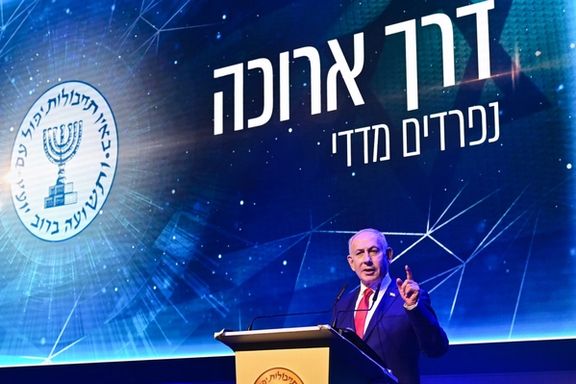
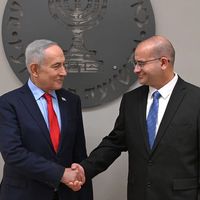
Speaking at a farewell ceremony for outgoing Mossad chief David Barnea, Netanyahu said Iran had already paid a heavy price, according to a statement form the prime minister’s office.
“The foundations of this terrorist regime in Iran have cracked. It will never return to what it was, and I tell you – it will fall in the end,” Netanyahu said.
He also warned that anyone plotting against Israel would fail and pay a heavy price.
“Let anyone who plots evil against Israel know that their schemes will fail. The price they will pay will be heavy indeed,” he said.
Netanyahu praised the Mossad as one of Israel’s major global “brands” and thanked Barnea for 30 years of service, including five years as its director.
Barnea urges regime change in Iran
The outgoing Mossad chief also said Israel should remain committed to toppling Iran’s ruling system.
Barnea said the Islamic Republic was at its weakest after the recent war and that Israel should “complete the job.”
“I believed, and I still believe, that a change in the reality in Iran by virtue of toppling the regime is a possible and achievable goal,” Barnea said.
He said such a goal would require “persistence, a cool head, and commitment to the mission.”
“This mission must remain as our top priority,” he added.

By suspending talks with Washington over Israel's campaign in Lebanon, Tehran has raised the stakes of postwar diplomacy and posed a critical question: is it successfully increasing its leverage, or overplaying its hand?
President Donald Trump announced Monday that Israel and Hezbollah had agreed to halt attacks following a flurry of calls with Israeli Prime Minister Benjamin Netanyahu and intermediaries linked to the Iranian-backed group.
Hours earlier, however, Iran suspended talks with Washington, citing Israel's military operations in Lebanon and threatening to open new fronts in the conflict.
The diplomatic turmoil comes as Israel carries out its deepest military operations in Lebanon in more than two decades.
Tehran argues the operations violate the broader ceasefire framework established after the US-Iran war, while critics counter that Iran helped create the crisis by insisting Lebanon be included in ceasefire discussions and then backing Hezbollah attacks that prompted Israel's response.
Turning Lebanon into leverage
For some analysts, Iran's actions suggest a regime that believes it emerged from the war with more leverage than many expected.
"I fear that the Iranians are doing what they're doing because they feel that they have the upper hand," Yaakov Katz, an Israeli-American journalist and author of While Israel Slept, told Iran International.
Katz said Tehran may see itself as having weathered the conflict relatively well. The regime survived, its military remains intact despite significant losses, its nuclear program remains unresolved and Washington is still negotiating with it.
From that perspective, Iran may believe it can broaden the scope of diplomacy beyond its nuclear program and force the United States to account for developments in Lebanon.
That is precisely what concerns Katz.
"It's a disaster to connect the two," he said.
If Washington accepts Lebanon as part of the negotiating framework, Katz argues, Tehran could repeatedly use Hezbollah's confrontation with Israel as leverage whenever future diplomatic disputes arise.
The concern comes as Trump balances two competing objectives: preventing a wider regional war while preserving a diplomatic path with Tehran.
On Monday, Iranian-linked media warned that Tehran could expand pressure to the Bab el-Mandeb Strait, another vital global shipping route, while tensions remain elevated in the Strait of Hormuz. The threats renewed concerns about global energy supplies and the economic fallout from a broader regional confrontation.
The price of Tehran's red lines
Eric Mandel, founder of the Middle East Political and Information Network, believes the Lebanon crisis, threats to maritime shipping and suspension of talks are all part of a broader Iranian strategy.
"This is a coordinated strategy that they are using," he told Iran International. "The biggest part of it is that they are looking to delay."
Mandel argues Tehran is attempting to stretch out negotiations while increasing economic and geopolitical pressure on Washington.
The goal, he says, is to test whether the Trump administration is willing to sustain a prolonged confrontation or whether concerns over oil prices, shipping disruptions and economic instability will eventually force concessions.
He believes Iran benefits from uncertainty.
"I think what Iran wants overall is to create a global recession," Mandel said.
Danny Citrinowicz of Israel's Institute for National Security Studies and former head of the Iran branch in Israeli military intelligence sees the situation somewhat differently.
While Katz and Mandel largely view Tehran's behavior through the lens of leverage and strategy, Citrinowicz argues that ideology remains a central factor.
He says Iran does not view Hezbollah, its missile arsenal and its enrichment program as bargaining chips that can simply be traded away. Rather, they are core pillars of the Islamic Republic.
"They cannot sit aside and not retaliate. That is their mentality," Citrinowicz told Iran International.
From Tehran's perspective, he argues, failing to respond to Israeli operations in Lebanon would amount to abandoning a strategic commitment to Hezbollah and undermining principles the regime considers fundamental to its survival.
That distinction may prove critical as Washington weighs its next move.
For Katz, Iran is attempting to exploit Trump's desire for a deal by transforming Lebanon into a bargaining chip. For Mandel, Tehran is deliberately prolonging the crisis to increase pressure on the United States. For Citrinowicz, Iran's actions are driven less by tactical calculations than by ideological red lines it believes it cannot abandon.
What all three agree on is that Lebanon is no longer a side issue. It has become a central test of the fragile diplomacy between Washington and Tehran.
If Trump pressures Israel to halt operations, Tehran may claim it forced Washington's hand. If he does not, Iran appears prepared to use Lebanon, Hormuz and potentially other fronts to argue that the ceasefire framework has already collapsed.
Either way, Tehran appears willing to increase the costs associated with both diplomacy and confrontation as it seeks to shape the next phase of negotiations.
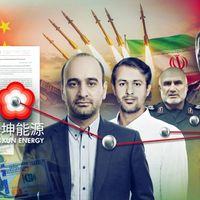
Iran International has obtained documents indicating that a Chinese company, working with firms in Turkey and the United Arab Emirates, helped Iran’s Islamic Revolutionary Guard Corps (IRGC) acquire chemicals used in the production of ballistic missiles.
The documents, obtained by the hacker group Prana and shared with Iran International, suggest Chinese entities also played a role in facilitating the transactions through a network of companies designed to navigate US sanctions.
The documents also link the deadly explosion at Shahid Rajaee Port in Bandar Abbas on April 26, 2025, to a shipment of sodium perchlorate, a chemical used in solid missile fuel production.
According to the documents, the blast and existing sanctions made it increasingly difficult to find vessels willing to transport such cargo to Iran.
Central to the network described in the documents is Haokun Energy, a company that for years acted as an intermediary in the sale of IRGC oil to Chinese refineries and was sanctioned by the United States four years ago for financing the IRGC's Quds Force.
A source familiar with the matter told Iran International that the company still owes the IRGC more than $1 billion in oil revenues.
In one document, Haokun refers to an agreement with a company called Golden Globe Demir Celik (GDCP) concerning the supply of chemical products for special equipment. The document states that, to preserve confidentiality, export-related permits were issued through classified channels.
In another section, Haokun says it established a company called Mosta to obtain bank guarantees. The company is reportedly controlled by GDCP because, for sanctions-related reasons, no Iranian national can serve on its board of directors.
Haokun says that, in coordination with Chinese customs authorities, activities were conducted through confidential channels and requested that its Iranian counterpart prevent any disclosure of information.
Elsewhere, Haokun says it planned to ship 2,000 tons of sodium chlorate and 10,000 tons of sodium perchlorate to Iran through GDCP. The documents indicate that quantity would be sufficient to produce solid fuel for roughly 2,500 ballistic missiles. The shipment was valued at $43 million.
GDCP is registered in Turkey, but leaked emails from the company were signed by an Iranian national, Mohammadreza Sadr. In its correspondence, Haokun identifies GDCP as belonging to the Islamic Republic. One of the leaked emails included a Haokun letter addressed to “Commander Mohammadzadeh.”
The individual appears to be Ahmad Mohammadzadeh, the former deputy coordinator of the IRGC Navy and a former governor of Bushehr under President Mahmoud Ahmadinejad.
Iran International previously reported that he was among the key figures in the Pourjafari Headquarters, an IRGC oil-sales network that used a complex structure to import gold in exchange for oil exports.
The documents also link GDCP to other figures associated with the IRGC’s commercial and procurement networks. According to the documents, the company is responsible for procuring raw materials used in ballistic missile fuel and for selling oil on behalf of the IRGC.
One document shows GDCP preparing to sell two million barrels of oil from Kharg Island to Fortune Company in the United Arab Emirates. Another records a transfer of roughly $3 million in cryptocurrency to GDCP, while a separate document indicates the funds were deposited into an account at the Borj-e Aseman branch of Tourism Bank in Tehran.
According to the documents, a significant portion of oil-sale revenues is being used to purchase sodium perchlorate from China. Haokun, which brokers the transactions, is attempting to repay hundreds of millions of dollars owed to the IRGC through the sale of weapons, missile-fuel materials and other goods.
A year ago, the Iranian Labour News Agency (ILNA) reported that, as part of an oil-for-goods barter arrangement, Haokun sold two Airbus A330 passenger aircraft to the Islamic Republic for $116 million, despite their market value being estimated at roughly $60 million.
Reports of sodium perchlorate shipments from China to Iran have surfaced repeatedly over the past year.
On March 7, The Washington Post reported that two sanctioned vessels linked to the Islamic Republic had departed China's Gelaowan Port bound for Iranian waters carrying sodium perchlorate, a key component in solid missile fuel. On April 3, The Telegraph reported that five ships carrying sodium perchlorate had arrived at Iranian ports.
Neither Beijing nor Tehran has publicly confirmed such shipments. The documents reviewed by Iran International provide what appears to be the clearest documentary evidence to date linking Chinese entities to efforts to supply the IRGC with materials used in ballistic missile fuel production.
On May 12, Israeli Prime Minister Benjamin Netanyahu accused China of assisting the IRGC in acquiring components used in ballistic missiles. China rejected the allegation.
A week later, US President Donald Trump said that China's president had assured him that no weapons would be supplied to Iran.
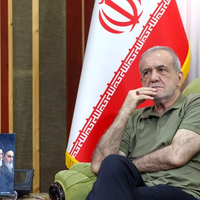
Iranian President Masoud Pezeshkian has submitted an official letter of resignation to the Office of the Supreme Leader, a source familiar with the matter told Iran International.
In the letter sent on Sunday, Pezeshkian stressed that the president and the government have effectively been excluded from major and vital decision-making processes in the country, and that the vacuum created by this situation has enabled hardline factions within the IRGC to take control of affairs, the source said.
Pezeshkian added that under such circumstances he is unable to run the government and carry out his legal responsibilities, and for that reason has requested to step down immediately.
It is not yet clear whether Mojtaba Khamenei will accept the president's resignation, but the contents of the letter point to a deep and unprecedented rift at the highest levels of power.
This comes after months of tensions between the government and the Islamic Republic’s military-security institutions. Iran International previously reported that the IRGC had gradually restricted many presidential powers and effectively taken control of key parts of the government.
According to informed sources, the situation has left Pezeshkian’s administration trapped in a political and executive deadlock, preventing diplomatic negotiations from moving forward and the completion and implementation of desired changes to the cabinet structure.
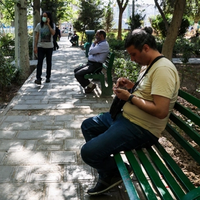
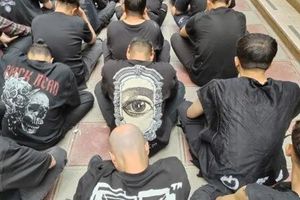
Police in Iran sealed a cafe over accusations that it promoted what authorities called “satanic activities,” state media reported on Sunday.
A video from inside the cafe on Tehran’s Valiasr Street was also released, which appeared to show men and women seated around tables during a live music performance.
In the footage, some audience members could be seen clapping, filming with phones and moving their heads to the music as a performer performed near a microphone and music stand.
The report said Tehran’s public venues police acted after receiving reports about the cafe’s activities.
Authorities accused the cafe of holding Western music events and providing a setting for what officers described as “deviant sects,” involving young men and women.
They also said customers at the cafe had been seen making “strange and unusual movements.”
In May 2024, police arrested over 260 people at an underground rock music festival, branding the event a “satanist gathering.”
The Iran war left the Islamic Republic weaker than it had been in years. The question now is whether Washington will turn that weakness into leverage – or give Tehran room to recover through a new deal.
That debate is becoming increasingly urgent as Washington and Tehran move closer to a potential agreement that could extend the current ceasefire and launch a new phase of negotiations over Iran’s nuclear program.
President Donald Trump has suggested a deal may be within reach, while officials on both sides have signaled progress despite major unresolved disputes.
For supporters of the military campaign, the logic is straightforward: Iran entered the talks weaker than it has been in years. For critics, the concern is that diplomacy could give Tehran breathing room just as years of economic pressure, domestic unrest and military setbacks had left it vulnerable.
Speaking to Eye for Iran, former US Treasury official Miad Maleki and national security expert Thomas Juneau offered different answers to the same question: what exactly did the war achieve?
A Regime under pressure
While the two experts differ on what should happen next, both agree that the Islamic Republic emerged from the conflict significantly weakened.
"They've never been so weak. They've never been so vulnerable that they are today, militarily, politically, economically," Maleki said.
The Islamic Republic, he argued, faces mounting economic pressure at home while struggling to maintain the image of strength it has projected for decades. Tehran’s military infrastructure has suffered significant damage, senior figures have been killed, and the economy was already under strain before the conflict began.
Juneau reached a similar conclusion, though from a different angle.
"The regime was clobbered," he said.
Beyond the military and economic damage, Juneau argued that one of Tehran’s core strategic assumptions collapsed during the conflict.
For decades, Iran invested heavily in Hezbollah, Hamas and other regional allies as part of what officials often described as a forward defense strategy. The idea was that any direct attack on Iran would trigger retaliation across the region, deterring adversaries from striking the country itself.
"That failed," Juneau said.
Maleki argues that the regime's losses go beyond military hardware.
The conflict exposed weaknesses in Iran’s air defenses, damaged key infrastructure and further strained a system already struggling with economic collapse, inflation and public discontent. In his view, Tehran entered negotiations not from a position of strength, but because it had few alternatives.
Victory, leverage or lifeline?
Where the two experts diverge is over what happens next.
For Maleki, the central question is why negotiations are taking place now, at a moment when many observers believe the Islamic Republic is under greater pressure than at any point in recent years.
He pointed to growing frustration among some Iranians who believe the conflict exposed vulnerabilities that could have accelerated political change.
"There's some level of disappointment that the fact that the US is negotiating with this regime is bad for the future of a free Iran," he said.
The concern is not that Iran emerged stronger from the war. Rather, it is that Tehran survived a period of extraordinary pressure and may now receive economic or diplomatic relief before those pressures fully take effect.
Juneau sees a different risk.
While acknowledging that the regime has been weakened, he argues that ordinary Iranians may ultimately bear the greatest cost.
"The Iranian people have been thrown under the bus," he said.
The economy, already battered by sanctions, corruption and years of mismanagement, now faces the additional burden of reconstruction. At the same time, Juneau warns that a weakened regime does not necessarily become a more moderate one.
In fact, he believes future protests could face even harsher repression than previous waves of unrest.
"This is a regime now that will have even less tolerance for any kind of popular protests in the future," he said.
The disagreement reflects a broader uncertainty surrounding the talks themselves.
If the objective of the war was to weaken the Islamic Republic’s military capabilities, there is broad agreement that it succeeded. Iran’s regional posture has been damaged, key infrastructure has been hit and some of its most senior figures are gone.
But if the objective was to fundamentally alter Tehran’s behavior, improve conditions for ordinary Iranians or create a pathway toward meaningful political change, the answer remains far less clear.
Maleki believes the conflict became unavoidable as Iran expanded its missile, drone and regional capabilities.
"The conflict was unavoidable. It was coming sooner or later," he said.
Juneau is more cautious.
Asked whether the war was ultimately worth it, he declined to offer a simple yes-or-no answer.
"The negative implications of the war outweigh the positive implications," he said.
That may ultimately be the central dilemma facing policymakers in Washington and the region.
The war weakened the Islamic Republic. Few dispute that.
The unanswered question is whether the diplomacy now taking shape will build on that weakness or alleviate it.