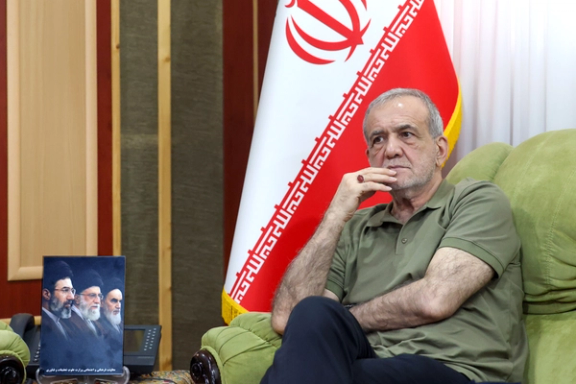
Iranian President Masoud Pezeshkian removed his jacket and appeared in a T-shirt during a water crisis management meeting on May 30, 2026, in a move aimed at encouraging energy conservation.
Iran’s conservative establishment appears to be pushing back against its own ultra-radical fringe after a hardline lawmaker accused President Masoud Pezeshkian of bypassing the Supreme Leader over the April ceasefire with the United States.
Some Iranian hardliners now appear to be distancing themselves from the “extremist” ultraconservatives who have spent recent weeks attacking the president and the nuclear negotiating team.
Two prominent conservative figures with longstanding ties to Iran’s security establishment have publicly condemned hardline MP Kamran Ghazanfari after he accused Pezeshkian of undermining the authority of Supreme Leader Mojtaba Khamenei.
The fallout from these interventions, and from the incident itself, points to a visible fracture inside Iran’s right wing. It highlights the growing fragmentation of the hardline camp and the marginalization of its far-right fringe, a dynamic that may inadvertently provide the embattled president with some political breathing room.
In a video clip that went viral last week, Ghazanfari accused the president of bypassing the Supreme Leader, demanding: “Why did you accept the ceasefire without Khamenei’s permission?”
He claimed that the Leader’s silence in public messages signaled disapproval and alleged that Pezeshkian had similarly accepted an unauthorized ceasefire during a previous 12-day conflict.
Ghazanfari argued that by halting military operations, Pezeshkian had effectively “saved America and Israel from the crushing blows of Iran’s missiles and drones” just as they were facing destruction.
Ghazanfari's remarks were criticized by hardline commentator Abbas Salimi Namin in an interview with the pro-reform Rouydad 24 website, and by Abdollah Ganji in an editorial in the IRGC-linked Javan newspaper.
The reactions represented unusually sharp internal pushback from within the broader conservative, or principlist, spectrum.
Their target is the extreme and destabilizing fringe of their own camp.
Salimi Namin warned that “extremism damages the system from within.” He argued that the presence of ultra-radicals like Ghazanfari in the parliament is a disaster that alienates the public and degrades political discourse. He also accused radical hardliners of weakening the Supreme Leader’s authority rather than defending it.
“The presence of people like Ghazanfari in the Majles is a disaster,” Salimi Namin said, adding that such statements, “before being an accusation against Pezeshkian, are an insult to the leadership and the armed forces.”
Ganji, who previously served as managing editor of Javan before moving to Hamshahri, made a similar argument in an editorial titled “The Reckless Ghazanfar(s).” The headline used “Ghazanfar,” a colloquial Persian term for a clumsy teammate who scores an own goal, as a pointed play on the MP’s name.
Ganji reminded the “rogue” ultraconservative lawmaker that under Article 110 of the Constitution, decisions on war, peace and major strategic shifts rest with the Supreme Leader and the Supreme National Security Council, not the president.
He described Ghazanfari’s outbursts as “a psychological pathology rather than legitimate political criticism.” He also accused him of exploiting parliamentary questioning as a legal loophole to smear opponents with labels such as “spy,” “Bahai” or “secular.”
Ganji urged “revolutionary youth and elites” to break their silence and “push back against these reckless figures who drive people away from the revolution.”
He characterized Ghazanfari’s accusations as “so disgusting, illogical, insulting, and slanderous… that at first, I thought it was generated by artificial intelligence.”
Both articles unequivocally condemned Ghazanfari’s conspiratorial attacks on Pezeshkian. They argued that although Ghazanfari claims to defend the Revolution and the Leader, his logic ultimately insults the Leader by implying that a president could easily bypass his authority on matters such as striking Israel or agreeing to a ceasefire.
Both warned against mistaking such toxic behavior for revolutionary zeal.
Together, these interventions expose a major structural tension in Iranian politics: how the system manages a reformist or moderate president operating within a conservative-dominated state.
Pezeshkian entered office on a platform of consensus-building, direct engagement with the West to ease sanctions, and domestic de-escalation. The recent criticism of Ghazanfari suggests that mainstream institutional conservatives recognize that, for the system to function, the president must retain at least a basic level of legitimacy.
By attacking the president over core security decisions, the ultra-radicals disrupt the carefully calibrated systemic harmony engineered by the leadership.
The fact that high-profile conservatives are publicly rebuking an ultra-hardline MP indicates that, at this moment, the establishment is prioritizing state stability over factional purity.
A mother and child browse children's books at a book fair in Tehran, Iran, May 29, 2026
Despite continued uncertainty over the outcome of the Iran-US talks, signs that some Iranians are positioning for a possible diplomatic breakthrough are emerging in markets, public debate and government-linked circles.
One of the clearest indicators has come from Iran’s real-estate market, traditionally viewed as one of the safest destinations for capital during periods of uncertainty. According to Tehran-based media, a growing number of property listings have been withdrawn in recent days.
Estate agents told local newspapers that many owners have instructed them to pause sales, believing that easing tensions and the possibility of a diplomatic opening could push prices higher. Similar behavior has been reported in parts of the rental market.
Sharq reported that some owners had previously hesitated to sell amid conflicting signals from Washington and uncertainty surrounding President Donald Trump’s statements, fearing renewed volatility.
Financial markets have also responded. Reports from both sides about a possible memorandum of understanding have helped lift sentiment on the Tehran Stock Exchange.
Expectations were further fueled after chief negotiator Mohammad Bagher Ghalibaf, Foreign Minister Abbas Araghchi and Central Bank Governor Abdolnasser Hemmati traveled to Doha, where Tehran hopes to secure access to billions of dollars in frozen assets.
At the same time, some analysts have begun debating the structure of a potential agreement as though its broad outlines are already taking shape.
Former diplomat Kourosh Ahmadi argues that while a deal could benefit Iran, particularly if it results in sanctions relief without major additional nuclear concessions, the two-stage format reportedly under discussion carries significant risks.
He warned that a phased agreement could prolong the uncertainty that has weighed on Iran’s economy for years because the success of an initial understanding would depend on reaching a later nuclear settlement.
Ahmadi said a more effective approach would have been “a single, comprehensive package negotiated over a defined period as a final settlement that ends 25 years of uncertainty for Iran and its people.”
He also contended that the emerging framework suggests Trump’s primary objective remains Iran’s nuclear program rather than broader issues such as missiles or regional alliances.
Whether such assessments prove correct or not, they have contributed to a growing perception that a narrower agreement may be more achievable than previously thought.
The government’s recent decision to lift the 88-day internet blackout has also been interpreted by many activists, technology analysts and political commentators as a sign that officials expect a period of reduced tension.
Some critics argue, however, that the move is intended to ease public frustration at a sensitive political moment, while others see it as preparation for possible concessions in negotiations with Washington.
Still, among many politically engaged Iranians, the restoration of connectivity has been viewed less as a technical decision than as a political signal. In a political environment where even minor policy shifts are closely scrutinized, the move has reinforced perceptions that officials believe the country may be entering a less confrontational phase.
Whether those expectations prove justified remains unclear. What is clear is that many Iranians are increasingly behaving as though a diplomatic opening may be approaching—even if few are ready to assume it is guaranteed.
Iranian President Masoud Pezeshkian has submitted an official letter of resignation to the Office of the Supreme Leader, a source familiar with the matter told Iran International.
In the letter sent on Sunday, Pezeshkian stressed that the president and the government have effectively been excluded from major and vital decision-making processes in the country, and that the vacuum created by this situation has enabled hardline factions within the IRGC to take control of affairs, the source said.
Pezeshkian added that under such circumstances he is unable to run the government and carry out his legal responsibilities, and for that reason has requested to step down immediately.
It is not yet clear whether Mojtaba Khamenei will accept the president's resignation, but the contents of the letter point to a deep and unprecedented rift at the highest levels of power.
This comes after months of tensions between the government and the Islamic Republic’s military-security institutions. Iran International previously reported that the IRGC had gradually restricted many presidential powers and effectively taken control of key parts of the government.
According to informed sources, the situation has left Pezeshkian’s administration trapped in a political and executive deadlock, preventing diplomatic negotiations from moving forward and the completion and implementation of desired changes to the cabinet structure.
Hardline lawmaker Hamid Rassaei and Parliament Speaker Mohammad-Bagher Ghalibaf
Hardline Iranian lawmaker Hamid Rasaei has sparked intense controversy after publishing a social media post that many interpreted as an indirect swipe at Mojtaba Khamenei, drawing sharp criticism from supporters of the Islamic Republic.
The backlash began after Rasaei shared a post titled "Who is Qualified for Leadership?" on his Telegram channel on Thursday. Many observers interpreted the post as a veiled reference to Mojtaba Khamenei, Iran's new Supreme Leader.
In the post, Rasaei highlighted a verse from Surah Hud containing God's direct response to Noah regarding his drowned son. In the verse, God states that the son is not truly part of Noah’s family due to his disbelief and unrighteous conduct, warning Noah against questioning divine matters beyond his knowledge.
Because this religious story is widely known among Iranians, the idiom “Noah’s son” is frequently used in Iranian culture to describe a wicked or rebellious child who falls into bad company despite having pious parents.
Allegations of disrespecting the Leader
Some media outlets, several political figures from various factions, and many social media users said that in this post, he had implicitly characterized Mojtaba Khamenei as an unrighteous, wayward son of his father.
"What is the relevance of bringing up the issue of leadership under the current circumstances—when the late martyr-leader's righteous son has succeeded him, and especially at a time when enemies are manufacturing rumors about this every single day—and then referencing the verse about Noah’s son? What on earth was Rasaei’s motive for spinning such a ridiculous, convoluted narrative?,” Asr-e Iran website wrote.
Ruhollah Jomei, a journalist and official under the Rouhani administration, suggested that Rasaei’s post effectively revealed plans by Saeed Jalili's camp and the Paydari Front to undermine Mojtaba Khamenei's leadership.
Mohammad-Hossein Chavoshi, a conservative political activist, also wrote in a post: "What is the meaning of Mr. Rasaei’s message? No matter how we look at it, it leaves a bad impression," and he demanded accountability from him.
Attacking Ghalibaf despite Khamenei's praise
Rasaei’s post was notably published on the exact same day that Mojtaba Khamenei issued a written message to Parliament. In his statement, Khamenei expressed appreciation for Speaker Mohammad Bagher Ghalibaf’s leadership, while emphasizing the need to avoid factional disputes and maintain national unity.
“Why did he post the note right after the Leader’s message thanking Ghalibaf?” one social media user questioned.
Ghalibaf, recently appointed as the head of Iran's nuclear negotiating team, is widely considered to be Khamenei's right-hand man. Nevertheless, Rasaei—who remains fiercely critical of the parliament speaker—warned him in a separate Saturday post against "repeating the mistakes" of Hassan Rouhani and Mohammad-Javad Zarif by relying on nuclear diplomacy and "pinning hopes on talks."
Who is Hamid Rasaei?
Hamid Rasaei was one of the key members of the Paydari (Steadfastness) Front, but by his own account—left the party because of differences with other members of the party's central council over a decade ago.
By his own admission, however, he feels a strong ideological closeness to the hardline party.
The Paydari Party and like-minded groups, often referred to as “super-revolutionaries”, are vehemently opposed to any negotiation or compromise with the United States, viewing it as a betrayal of the 'ideals of the Islamic Revolution' as well as the viewpoints of Ali Khamenei.
Rasaei’s defense
Rasaei defended himself by publishing another note, saying he had simply reshared an older piece of his writing and that it was published several hours before Mojtaba Khamenei’s message.
He insisted that he was among the very first to vouch for Mojtaba’s personal qualifications for leadership, even introducing him as a suitable option for leadership two days after the news of Ali Khamenei's killing was announced.
Mehdi Ghasemzadeh, a social media activist, wrote that based on the Leader's recommendation, it might be better to accept Rasaei's explanations and avoid fueling disputes.
However, he noted that if someone from another political group had written such a note, it would have triggered protests by Rasaei's like-minded allies at nightly gatherings of government supporters.
As US economic pressure, staggering inflation and negative growth converge, economists warn that Iran faces an increasingly bleak outlook that could push millions more people below the poverty line.
Hojattollah Mirzaei, an economics professor at Allameh Tabataba'i University and former head of the country’s retirement funds, shed light on the compounding crisis at a panel hosted by Donya-e-Eqtesad newspaper.
He said rising exchange rates, import restrictions, higher transportation costs, intensifying inflationary expectations, internet shutdowns and government financial deficits are driving up unemployment and eroding household purchasing power.
According to Mirzaei, an additional 3.5 million to 4.5 million people are expected to fall into poverty this year alone due to the economic fallout from the March war.
The cost-of-living crisis and the inflationary spiral
The macroeconomic pressure is being felt most sharply in household expenses.
The Central Bank of Iran reported an annual inflation rate of more than 50.6% in April. According to the same report, monthly inflation spiked to 67%.
Prices of some goods and services rose by up to 100% during the same period, vastly outpacing stagnant wage growth.
Prominent economist Masoud Nili warned that even if military tensions ease, economic conditions will not easily return to normal.
“The greatest current danger to Iran’s economy is being caught in an escalating inflationary spiral,” Nili said, calling it “a path that becomes increasingly difficult to control the further it goes.”
Market paralysis and the rise of the working poor
The inflationary pressure is coinciding with severe economic contraction.
Mirzaei projected that Iran’s economy will shrink by 8.8% to 10% in the current Iranian year, adding that even the 10% forecast may be optimistic.
The downturn has also frozen the labor market.
Hossein Rajabpour, head of the Saba Research Institute, said job creation has sharply declined, with the industrial sector suffering the heaviest losses following the recent conflict.
The crisis has also changed the profile of poverty in Iran. Social policy researcher Kowsar Yousefi said a significant share of those who are employed still live below the poverty line.
Frozen assets and the limits of a short-term fix
To ease the acute economic pressure, Iran is pushing for the release of roughly $24 billion in assets frozen in foreign banks.
Tehran hopes access to those funds could help stabilize the currency market, lower inflationary expectations and reduce the cost of importing basic goods and raw materials. Iranian officials have said “meaningful negotiations will not begin without the release of these assets.”
But economists warn that such cash injections would offer only temporary relief.
While access to foreign exchange reserves could help exchange rates, inflation and short-term growth, deeper structural problems would remain.
Iran is also hoping that a deal with Washington will end the blockade that has severely restricted its access to oil revenues in recent months, leaving 60 million barrels worth $6 billion stranded on tankers, according to TankerTrackers.
Even if a deal resolves those issues and sanctions are lifted, chronic weakness in domestic and foreign investment would continue to weigh heavily on the economy.
That vulnerability is reflected in global resilience data. According to a business environment resilience index compiled by Factory Mutual Insurance Company, which evaluates how effectively 130 countries withstand and recover from economic shocks, Iran ranks near the bottom at 125th.
The ranking stands in sharp contrast to regional peers such as Qatar and Saudi Arabia, both of which are among the world’s top 50 most resilient economies.
The symbolic chair and a picture of the late Supreme Leader of Iran, Ayatollah Ali Khamenei, are displayed near his office in Tehran, Iran, May 6, 2026.
Names on a memorial poster for four relatives and in-laws of Ali Khamenei offer a rare snapshot of how family ties link Iran’s ruling household to parliament, elite universities and the Supreme Leader’s office.
The poster, announcing a memorial ceremony at the Abdol-Azim shrine in Rey, south of Tehran, lists Zahra Sadat Haddad-Adel, Boshra Hosseini Khamenei, Mesbah al-Hoda Bagheri and Zahra Mohammadi Golpayegani as among the dead.
Each name connects the Khamenei household to one of the families or institutions that have shaped the Islamic Republic’s political, cultural and administrative elite for decades: the parliament, the Supreme Leader’s office, the Supreme Council of the Cultural Revolution, Imam Sadegh University and the network of institutions around the leader’s office.
The ceremony itself is religious and familial. But the names on the poster point to something larger: a closed circle of family relationships through which access, influence and institutional power have long moved inside the Islamic Republic.
The poster of the ceremony
The Haddad-Adel connection
One of the most recognizable names is Zahra Sadat Haddad-Adel, wife of Mojtaba Khamenei and daughter of Gholam-Ali Haddad-Adel.
Haddad-Adel served as speaker of Iran’s seventh parliament from 2004 to 2008 and is known as the first non-clerical speaker of the Islamic Republic’s parliament. He also served as a lawmaker in several parliamentary terms and remains head of the Academy of Persian Language and Literature.
His influence extends beyond parliament. He is a member of the Supreme Council of the Cultural Revolution, an adviser to the slain Supreme Leader and founder of the private Farhang school, which critics have described as one of the symbols of special educational access for families close to the ruling system.
For critics, Haddad-Adel’s presence across political, cultural and educational institutions, combined with his family tie to the Khamenei household, reflects the concentration of power within a limited circle of families close to the state.
His name also appears on the US Treasury Department’s sanctions list.
Imam Sadegh University and the Bagheri Kani family
The name Mesbah al-Hoda Bagheri draws attention to another powerful network: the Bagheri Kani family and the institutions around Imam Sadegh University.
Mesbah al-Hoda Bagheri Kani was the husband of Hoda Khamenei, Ali Khamenei’s daughter, and the son of Mohammad-Bagher Bagheri Kani, an influential cleric who served in the Assembly of Experts and headed Imam Sadegh University.
The same family also includes Ali Bagheri Kani, a senior diplomat who has held key posts in Iran’s foreign policy establishment, including political deputy foreign minister, acting foreign minister, senior nuclear negotiator and senior positions in the Supreme National Security Council.
Their uncle, Mohammad-Reza Mahdavi Kani, was one of the Islamic Republic’s most influential clerics. He served as head of the Assembly of Experts, secretary-general of the Combatant Clergy Association, briefly as prime minister in 1981, and for decades as head of Imam Sadegh University.
Imam Sadegh University expanded after the 1979 revolution and became one of the main training grounds for state managers. Many officials in Iran’s political, security, media and diplomatic institutions are graduates of Imam Sadegh University.
Through these links, the Bagheri Kani family connects the Khamenei household to one of the Islamic Republic’s most important pipelines for training and placing loyal officials in diplomacy, security, politics and state administration.
The Supreme Leader’s office
Another name on the poster, Zahra Mohammadi Golpayegani, points directly to the Supreme Leader’s office.
The 14-month-old child was connected to two of the most influential families in the Islamic Republic. On one side, she was the granddaughter of Mohammad Mohammadi Golpayegani, the longtime head of Ali Khamenei’s office. On the other, she was a granddaughter of Ali Khamenei.
Mohammad Mohammadi Golpayegani headed the Supreme Leader’s office since 1989, the year Khamenei became leader. He is one of the most influential but least publicly visible figures in the Islamic Republic’s power structure.
Because of his position, Golpayegani has played a central role in the messages, decisions and administrative machinery of the leader’s office. The US Treasury sanctioned him in 2019 over his role acting on behalf of that office.
His family link to Khamenei, as reflected in the name of Zahra Mohammadi Golpayegani, shows how the leader’s office is not only an institution but also part of a wider web of personal and familial ties.
Boshra Khamenei
The poster also lists Boshra Hosseini Khamenei, Ali Khamenei’s eldest daughter.
Unlike some other members of the Khamenei family, Boshra Khamenei has rarely appeared in public, and little information has been published about her personal life or activities.
In recent weeks, state media have referred to her as “martyr Boshra Khamenei.” Some reports have mentioned her educational background and interest in literature.
Tabnak, in a report framed as a student’s note for “martyr Boshra Khamenei,” referred to her as “Ms. Hosseini” and described her connection to education and literature.
Her presence on the poster alongside the other names brings the focus back to the Khamenei family itself, a household that has remained mostly shielded from public life while remaining central to the structure of power.
A compressed image of power
The memorial poster is striking because it brings together four names that would otherwise appear in different corners of the Islamic Republic’s elite: the Haddad-Adel family, the Bagheri Kani family, the Mohammadi Golpayegani family and the Khamenei household.
Together, they form a compressed image of how power has been organized around the leader’s family and its closest allies.
For critics of the Islamic Republic, the connections point to a familiar pattern: influence concentrated among a small circle of trusted families whose proximity to the leader’s office can open paths across the state.
The memorial in Rey is therefore more than a family or religious ceremony. It offers a glimpse of how, at the top of the Islamic Republic, family names often double as signs of political access, institutional reach and long-standing power.