Women attend a state-organized memorial ceremony marking 40 days since those killed in the January unrest, holding portraits of individuals described by authorities as “martyrs”, February 17, 2026
Forty days after Iran’s deadly January crackdown, senior officials repeated claims of foreign influence while some insiders—even from the hardline camp—offered sharply different explanations.
The fortieth day after a death carries special significance in Shiite tradition, often marking a moment of collective mourning and reflection.
Families of those killed in the January 8 and 9 crackdown marked the occasion this week with memorial ceremonies across the country, even as authorities maintained a heavy security presence.
On February 17, Supreme Leader Ali Khamenei, President Massoud Pezeshkian and Parliament Speaker Mohammad Bagher Ghalibaf repeated the government’s longstanding assertion that foreign forces played a decisive role in fueling the protests.
At the same time, officials acknowledged that some of those killed were “innocent,” drawing a distinction that appeared intended to preserve the official narrative while recognizing the scale of the bloodshed.
Yet beneath that public consensus, alternative interpretations are emerging—even from figures long associated with the system.
Hassan Beyadi, a hardliner and secretary-general of the Abadgaran (Developers) Party, which helped propel Mahmoud Ahmadinejad to the presidency in 2005, offered a starkly different assessment in an interview with Khabar Online.
“People came to the streets because their dignity was trampled by politicians,” Beyadi said, describing the unrest as a reaction to corruption, discrimination and violations of basic citizenship rights.
Only “essential changes in the structure of the system and its economic policies” could restore public trust, he added.
A more conservative but still revealing analysis came from Abbas Ghaemi, a director at the Social Analysis Center of Imam Sadeq University, an institution closely tied to the Islamic Republic’s political elite.
Ghaemi argued that many participants in the January protests had already been shaped by previous waves of unrest, including the 2009 Green Movement, the 2018 and 2019 economic protests and the 2022 Women, Life, Freedom uprising.
“We are facing a society that has tried many different ways without achieving results,” he said.
Ghaemi emphasized the need for dialogue between society and the political system, an idea that has surfaced periodically within establishment circles but has rarely translated into sustained engagement.
Iran’s Supreme Leader, who holds ultimate authority over state policy, has never granted a media interview during his more than three decades in power.
Analyses published in Iranian media since the crackdown point to broader structural concerns, with some commentators describing a society marked by declining trust, growing anger and widening distance between the state and its citizens.
Former government spokesman Ali Rabiei, writing in the reformist-leaning newspaper Etemad, warned against attempts to channel public anger into state-controlled expressions of mourning.
“Looking at the frosty streets of Iran in Winter 2026,” he wrote, “it is clear that turning angry protesters into mourning protesters and vice versa reflects the inefficiency of a policy that will lead to one crisis after another if the system remains unreformed.”
Such warnings suggest the state may be struggling to fully impose its narrative of the unrest, even within establishment circles.
Image circulating on social media shows mourners gather for the fortieth-day memorial ceremony of those killed in recent protests, in Najafabad, Isfahan province, Iran, Feb. 17, 2026.
Memorial ceremonies marking 40 days since the killing of protesters were held across Iran this week despite a heavy security presence, with mourners gathering at gravesides, performing traditional rituals and often chanting against the country’s rulers.
Families of those killed in the January 8 and 9 crackdown had called for commemorations from Monday through Wednesday. Exiled prince Reza Pahlavi had also urged supporters to attend.
In the days leading up to the memorials, families reported calls from security agencies warning against gatherings. There were reports of cemetery closures in Arak and a heavy security presence at Tehran’s Behesht Zahra cemetery.
Videos sent to Iran International showed military vehicles and motorcycle patrols deployed in cities including Sanandaj in Kurdestan province and Chamestan in Mazandaran province.
Despite the restrictions, mourners gathered in multiple cities, applauding the slain, performing the “dance of grief” and chanting slogans.
In Abdanan in Ilam province, residents gathered in the streets ahead of ceremonies for local victims including Alireza Seidi and Yasin Elahi, chanting anti-government slogans including “Death to Khamenei,” according to videos and local sources.
Internet disruptions were reported in the area.
In Zanjan, attendees at the 40th-day ceremony for 17-year-old Mohammad Mahdi Ganjdanesh stood and applauded at his graveside. He was killed on January 8 after being shot in the head, according to people familiar with the case.
In Kermanshah, the family of 25-year-old Erfan Jamehshourani mourned at his grave during a ceremony on Monday. He was killed during the January crackdown, according to relatives.
Similar scenes were reported across central and northern Iran.
In Shahin Shahr in Isfahan province, mourners performed the dance of grief at the grave of 18-year-old Mohammadreza Ghorbani, whose father identified his body days later by recognizing a tattoo on his hand.
In Bandar Anzali, participants dressed in white and gathered for 29-year-old Milad Mianehkhah Monfared, a former youth player for Malavan football club who was killed on January 9. The ritual has become a symbol of mourning for those killed in the unrest.
In Noorabad Mamasani in Fars province, mourners sang at the grave of 64-year-old Abdolsadat Shamseddini, who was shot on January 10. In Baharestan in Isfahan province, relatives of 42-year-old Farhad Pourkaveh said his death would not be forgotten.
In Tehran, families marked the day by preparing and distributing traditional mourning foods such as saffron pudding and halva. At the grave of 24-year-old Mehdi Sepehran, a musician played handpan as mourners gathered.
At another ceremony, relatives released white doves in memory of Somayeh Yousefi, who was killed during the unrest.
The exact number of children killed remains unclear. The Coordination Council of Iranian Teachers’ Trade Associations has said at least 200 students were among the dead, highlighting the heavy toll among young people.
Some outlets inside Iran acknowledged the broader impact.
The moderate Rouydad24 news website wrote that the fortieth day had arrived “despite the deep wound left on society and public trust,” and noted that no meaningful effort had been made by authorities to address it.
At the same time, the government held its own ceremony in Tehran attended by senior officials including Vice President Mohammad Reza Aref and IRGC Quds Force commander Esmail Qaani, blaming what it described as terrorist elements for the violence—a stark contrast to the grassroots mourning taking place across the country.
Tehran's decision to form a committee to investigate violence during January protests has been met with widespread skepticism, including from some moderate voice inside Iran who say only an independent investigation can establish credibility.
The administration of President Masoud Pezeshkian announced on January 21 that it had created a committee to examine the causes and consequences of the unrest. Government spokesperson Fatemeh Mohajerani said the body is collecting documents and testimony related to the violence.
Critics across Iran’s political spectrum have questioned whether a government-appointed panel can impartially investigate events in which state institutions themselves are accused of involvement.
The United Nations Human Rights Council has already mandated an independent fact-finding mission to investigate alleged serious rights violations linked to the protests.
Established after the 2022 “Woman, Life, Freedom” uprising and extended in January 2026, the mission has never been permitted to enter Iran. Tehran has refused to cooperate with the UN inquiry, dismissing it as politically motivated.
Even moderate commentators—who typically favor gradual change within the system—have questioned the credibility of the government’s initiative.
The reformist newspaper Tose’e Irani wrote that rebuilding public trust would require participation from figures independent of the state.
“For the report of the committee investigating the January events to be credible,” it said, it must include “independent lawyers, human rights activists and even prominent Iranian academics living abroad.”
Journalist Ahmad Zeidabadi similarly warned that any internal investigation would face deep public suspicion.
“What is the problem with inviting the UN High Commissioner for Human Rights to send a professional team to investigate?” he wrote, arguing that “only a credible international report can end the conflict of narratives.”
Lawyer and political activist Hassan Younesi urged the president to pursue a genuinely independent inquiry, while journalist Hossein Yazdi wrote that a committee would be trusted only if formed by individuals “not themselves accused.”
Public distrust reflects a broader history of disputed official investigations.
Many Iranians have cited previous cases—including the 1999 attack on Tehran University dormitories, the 2020 downing of a Ukrainian passenger plane that killed 176 people, and the death of Mahsa Amini in morality police custody—as examples where official explanations were widely contested.
Iran’s presidential office says 3,117 people died in the January unrest, including more than 2,400 civilians and security personnel whom authorities say were killed by “foreign enemy agents.”
That figure has been widely challenged. Human rights groups and independent media have reported far higher death tolls. Iran International has reviewed leaked internal government documents indicating the toll may be as high as 36,500.
Allegations from within Iran’s own political establishment have further fueled skepticism.
In a leaked audio recording, reformist politician Ali Shakouri-Rad said security institutions had “deliberately injected violence into the scene” to justify a sweeping crackdown, describing such conduct as “systematic” in Iran’s security policies.
Former president Mahmoud Ahmadinejad has made similar claims, saying forces within the state were responsible for protest deaths.
Pezeshkian initially dismissed Shakouri-Rad’s remarks as “unfair,” but later softened his position, saying he had ordered further investigation into the allegations and authorized additional review through relevant officials.
For many critics, the central question remains whether institutions accused of responsibility for violence can credibly investigate themselves, especially while Tehran rejects all international scrutiny, even refusing to recognise the UN investigators’ mandate.
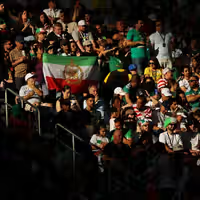
Protesters hold pre-1979 Iranian flags during a rally against Islamic Republic, in Munich, Germany on February 14, 2026.
Widespread rallies by Iranians abroad, held in response to a call by exiled Prince Reza Pahlavi, drew an outpouring of support from inside Iran, with many describing the gatherings as a renewed source of hope and unity.
German authorities said nearly 250,000 people attended the Munich rally, calling it the largest protest by Iranians in Europe to date. Organizers and local officials also reported large turnouts in Toronto and Los Angeles, each estimated at around 350,000, as well as 50,000 in London and 45,000 in Vancouver.
Speaking at the Munich event, Prince Reza Pahlavi addressed people inside Iran directly. “Know and see that you are not alone and that your voice has reached the world,” he said.
Messages sent to Iran International and widely shared on social media described what contributors called an unprecedented display of cohesion and discipline across continents.
Messages from inside Iran
One viewer wrote: “Salute to our honorable compatriots outside Iran. Seeing the beautiful images of unity, harmony, civility and order brought tears of joy to our eyes inside the country.”
Another message read: “We were tired and disappointed, but when we saw you in the gatherings abroad, we cried for all of us. Who can separate us from each other?”
A resident of Tehran wrote, “We bow our heads in respect to all our compatriots around the world. We saw your gatherings everywhere and wept.”
From Shiraz, a viewer addressed the authorities, writing: “Every bullet you fired at our young people united our hearts more. We are now united, aware and full of faith.”
Others described the rallies as a turning point after weeks of pressure at home. “Yesterday, after 37 days, for the first time we were not sad or hopeless. Everyone was talking about you, and there was excitement in their eyes,” one message said.
Several framed the demonstrations as evidence of a shared national purpose transcending borders. “It was proven that the power of love for Iran and Iranians does not fit within political and geographical boundaries,” one viewer wrote.
“With seeing you, every moment was tears and emotion. We hope to celebrate our freedom soon on our own soil,” another message said.
Support extended beyond messages sent directly to Iran International. Similar posts circulated widely across social media platforms, echoing themes of unity, perseverance and anticipation of political change.
The scale of the February 14 rallies prompted criticism from state media, officials and pro-government online activists, who questioned attendance figures and accused organizers of exaggeration.
Responses ranged from attempts to downplay the gatherings to verbal attacks on participants abroad. Supporters inside Iran, however, portrayed the demonstrations as a morale boost amid continuing domestic restrictions.
“Your presence is a bridge of hope and solidarity that lights many hearts inside the country,” another Tehran resident wrote.
Iran’s President Masoud Pezeshkian on Tuesday urged police to manage public unrest with the least possible cost, over a month after a sweeping crackdown on protests in which more than 36,500 people were killed.
Speaking at a graduation ceremony for police cadets, Pezeshkian said authorities must maintain order while minimizing harm to security forces and civilians, as Iran continues to grapple with the aftermath of nationwide unrest.
“We must be able, as far as possible, to manage the country and society with the least damage and establish peace and security within it,” Pezeshkian said.
The protests were suppressed in a crackdown that left 36,500 people dead over two days in January, one of the deadliest episodes of unrest in modern history.
Pezeshkian said preventing unrest from escalating into crisis should be a priority.
“If there is dissatisfaction or a problem in society, we must not allow it to turn into a crisis. It must be prevented and treated,” he said. “In the third step, when an incident occurs, it must be managed with the minimum cost to the parties involved.”
At the same time, he stressed that those deemed responsible for disturbances should be detained firmly.
“You must manage the scene in such a way that the person who has created disorder is arrested with strength, authority and safety and handed over to the judiciary to be dealt with according to the law,” he said.
The president called for equipping police and security forces with new technologies to manage incidents without injury to officers, adding that the government would support law enforcement.
“We must not allow the health of our police forces to be put at risk,” he said. “All our efforts must be that none of you, as far as possible, are harmed in any scene.”
Iranian authorities have described the unrest as part of foreign-backed efforts to destabilize the country, while protesters have demanded political change and economic relief.
Pezeshkian said public security was essential and credited law enforcement as “the creators of security in Iran.”
Iran’s Supreme Leader Ali Khamenei addresses a gathering of people from East Azarbaijan province in Tehran on February 17, 2026.
Iran’s Supreme Leader Ali Khamenei said the United States will never succeed in toppling the Islamic Republic and warned that even the world’s strongest military can suffer crippling blows.
“The US president said in one of his recent remarks that for 47 years America has been unable to eliminate the Islamic Republic; he complained about it to his own people. For 47 years, America has not been able to eliminate the Islamic Republic. That is a good admission,” Khamenei said at a meeting with people from East Azarbaijan province on Tuesday.
“I say: You, too, will not be able to do this.”
His comments come days after Trump said regime change “would be the best thing that could happen.”
Khamenei also addressed remarks by the US president that the American military is the strongest in the world.
“The strongest army in the world may at times receive such a slap that it cannot rise,” he said.
“They keep saying we have sent an aircraft carrier toward Iran. Very well, an aircraft carrier is a dangerous device, but more dangerous than the carrier is the weapon that can send it to the bottom of the sea.”
His statements come amid heightened rhetoric between Tehran and Washington over military deployments and regional security and at the time a new round of negotiations mediated by Oman is underway in Geneva.
Talks with US
US threats and demands, Khamenei added, reflected an attempt to dominate Iran. “These statements by the US president, sometimes threatening, sometimes saying this must be done or that must not be done, mean they seek domination over the Iranian nation,” he said.
“Iran will not pledge allegiance to corrupt leaders currently in power in the United States.”
“They say let us negotiate about your nuclear energy, and the result of the negotiation should be that you do not have this energy,” he continued. “If a negotiation is to take place, and there is no place for negotiation, determining its result in advance is wrong and foolish.”
Iran’s Supreme Leader Ali Khamenei meets with people from East Azarbaijan province in Tehran on February 17, 2026.
US presidents and some senators, he went on, were making an “absurd” demand by setting conditions before any dialogue.
January protest remarks
In the same speech, Khamenei said those killed during the January protests are mourned as martyrs.
“Blood was shed. We are grieving. I say we are in mourning for the blood that was shed,” he said, adding that not all of the dead fell into the same category.
Security forces responded to the latest nationwide protests with lethal force, mass arrests, and communication blackouts. At least 36,500people killed in the recent wave of unrest, while authorities acknowledge a far lower figure of about 3,117.
Security forces, according to the Amnesty International, moved quickly after the killings to impose sweeping controls aimed at silencing survivors, intimidating families of victims and preventing documentation of what it described as unlawful mass killings carried out to crush what it called a popular uprising.
The measures included arbitrary mass arrests, enforced disappearances, bans on gatherings, night-time curfews, and a near-total internet blackout, alongside the deployment of heavily armed patrols across cities and inter-city roads, Amnesty International said.
Khamenei argued some were “corrupt elements and instigators,” while others were not involved in organizing the protests. He divided the dead into three groups, beginning with what he described as "defenders of security" – police, Basij and Guards members and those alongside them – calling them “among the greatest martyrs.”
He described a second group as bystanders. When turmoil breaks out in a city, he said, “innocent people walking toward their workplace or their homes are also killed,” adding that they too should be considered martyrs because their deaths occurred within “the enemy’s sedition.”
A third group, he said, consisted of those who had been misled. “They were deceived, inexperienced… they are also ours; they are our children,” he said, adding that some later wrote to him expressing regret. Officials, he said, were right to count those killed from this group as martyrs.
“Therefore, the circle of our fallen whom we count as martyrs is a wide one,” he added, excluding only what he called “the ringleaders and those who took money and weapons from the enemy.”
Khamenei concluded by offering prayers for mercy and forgiveness for those he described as misled participants, framing the uprising as an enemy-driven plot rather than a domestic protest movement.