Iran deployed militarized crackdown to hide protest killings - Amnesty
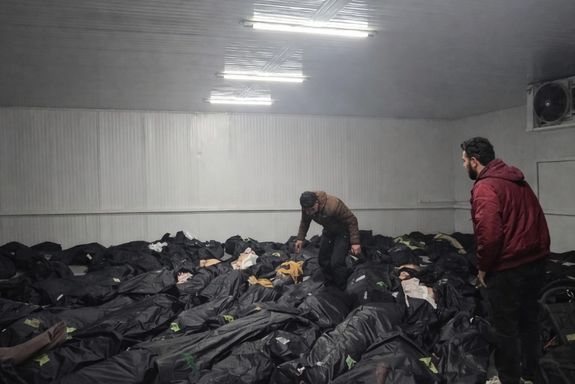
Men stand amid rows of corpses in a morgue in Tehran following mass killings of protestors by security forces in this undated image obtained by Iran International
Iran has deployed a nationwide militarized crackdown to scotch dissent and obscure the scale of its mass killings of protestors earlier this month, rights watchdog Amnesty International said in a report on Friday.
Security forces, Amnesty said, moved quickly after the killings to impose sweeping controls aimed at silencing survivors, intimidating families of victims and preventing documentation of what it described as unlawful mass killings carried out to crush what it called a popular uprising.
The measures included arbitrary mass arrests, enforced disappearances, bans on gatherings, night-time curfews, and a near-total internet blackout, alongside the deployment of heavily armed patrols across cities and inter-city roads, Amnesty International said.
“While people in Iran are still reeling from the grief and shock of the unprecedented massacres during protest dispersals, the Iranian authorities are waging a coordinated attack on the rights of people in Iran to life, dignity and fundamental freedoms in a criminal bid to terrorize the population into silence,” said Diana Eltahawy, Amnesty International’s deputy regional director for the Middle East and North Africa.
“Through the ongoing internet shutdown, the authorities are deliberately isolating over 90 million people from the rest of the world to conceal their crimes and evade accountability.”
“The international community must not allow another chapter of mass atrocities in Iran to be buried without consequence. Urgent international action, including steps towards accountability through independent international justice mechanisms, is long overdue to break the cycle of bloodshed and impunity.”
Conflicting death tolls
The clampdown followed the killings of protesters during demonstrations on January 8 and 9, which Amnesty described as unprecedented in scale.
On January 21, Iran’s Supreme National Security Council put the total number of people killed during the uprising at 3,117.
Days earlier, Mai Sato, the UN special rapporteur on human rights in Iran, said estimates suggested at least 5,000 civilians had been killed, adding that figures based on reports from doctors inside Iran could be significantly higher.
The information blackout since January 8, Amnesty said, has made independent verification difficult and led to the loss of crucial evidence after security forces confiscated mobile phones from those killed or detained.
Mass arrests and enforced disappearances
Tens of thousands of people, including children, have been arbitrarily detained, according to Amnesty. Arrests were reported during night-time home raids, at checkpoints, in workplaces, and in hospitals.
The organization said security forces removed wounded protesters from hospitals in several provinces and threatened medical staff with prosecution for treating injured demonstrators without notifying authorities.
Families and lawyers have frequently been denied information about detainees’ whereabouts, amounting to enforced disappearance under international law.
Amnesty documented cases of torture and ill-treatment, including beatings, sexual violence, threats of execution and denial of water, food and medical care.
Intimidation of families
Families of those killed have faced sustained pressure, Amnesty said, including being forced to bury victims by night, demands for money in exchange for bodies, and coercion to issue false statements blaming protesters or labeling victims as members of pro-government forces.
State media has broadcast forced “confessions” and statements from grieving relatives, a practice Amnesty said mirrors past efforts to justify repression and pave the way for harsh sentences, including executions.
Militarized control
Amnesty said security forces have established dense networks of checkpoints, enforced curfews, and warned residents through loudspeakers to remain indoors.
Videos reviewed by the group showed armored vehicles, heavy weapons and water-cannon trucks deployed in multiple cities.
The organization called on Iranian authorities to restore internet access, release arbitrarily detained individuals, disclose the fate of the disappeared, end harassment of victims’ families and allow independent investigations into the killings.
Bodies laid out at the Kahrizak morgue, south of Tehran, after a deadly crackdown.
Iran’s Supreme National Security Council instructed newspaper editors and online media managers to stop publishing independent reporting on protest deaths and to avoid interviewing bereaved families, according to information shared with Iran International.
The instruction, according to the information received by Iran International, was conveyed during a meeting with managers of domestic media outlets and explicitly required them to refer only to figures released by state bodies, while avoiding any independent accounting of deaths.
The same directive, the sources said, also prohibited interviews or conversations with families of those killed.
Sources described as familiar with the decision said the measure was aimed at preventing broader disclosure of the scale of the killings of protesters, which they said occurred under direct orders from Supreme Leader Ali Khamenei.
Media managers question the order
The directive was delivered, the report said, as some domestic media managers challenged the government’s line during the same session, pointing to internal information suggesting a death toll in the thousands and questioning instructions issued under President Masoud Pezeshkian and the Supreme National Security Council.
Those participants, according to the account, argued there is a wide gap between official numbers and information circulating inside the country.
Iran’s National Security Council, a body operating under the Interior Minister, on Wednesday published figures for the first time covering deaths on January 8 and 9.
The statement put the number of killed protesters at 690. It also listed a total death toll of 3,117 across the two days, but described 2,427 of those as “martyrs” drawn from “innocent people and guardians of order and security,” a designation in the Islamic Republic’s official language generally used for those aligned with state institutions.
The Islamic Republic’s Martyrs Foundation also announced on Wednesday that military and security forces had taken the lives of only 690 protesters, while another 2,427 people were said to have been killed by protesters. The institution had initially reported 3,317 deaths, but hours later revised the figure down to 3,117.
Iran International said the official numbers differ sharply from information it has received, eyewitness accounts, and reporting by international media.
The outlet’s editorial board has previously put the number of protesters killed by state forces at at least 12,000, according to its published statement.
The number of civilians killed in Iran’s crackdown on protests may be more than 20,000, the UN special rapporteur on human rights in Iran said, citing reports from doctors inside the country, Bloomberg reported.
Mai Sato said earlier this week that civilian deaths were estimated at 5,000 or more, adding that medical reports suggested the toll could be far higher, at about 20,000 or more.
Iran International’s statement described the killings on January 8 and 9 as unprecedented in modern Iranian history in geographic spread, intensity of violence, and number of deaths.
Venezuelan opposition leader Maria Corina Machado speaks with Iranian activist Masih Alinejad in Washington.
Venezuelan opposition leader Maria Corina Machado said democratic governments must raise the cost for Iran’s rulers to stay in power in an interview with Iranian activist Masih Alinejad.
Machado said Iran and Venezuela were bound by deep cooperation between their rulers, even as people in both countries rise up against repression.
“The Iranian people, the Venezuelan people, we are fighting the same struggle,” she said. “These regimes have been cooperating for many years, exchanging resources, information, technology, agents and weapons.”
She said authoritarian governments help each other bypass pressure and maintain control, while democracies often stop at statements.
“Dictators help each other, they exchange technology, resources, they help each other bypass sanctions and they support each other in international forums,” Machado said. “Democratic governments stay at statements and declarations that at the end do not serve the people.”
Machado said people in Iran had reached a breaking point and were calling on the world to respond.
“We reach a point where the people start asking the world to react and to support,” she said. “What we are asking for is to stop the killings and to save lives.”
She criticized what she described as double standards among democratic governments that condemn repression while maintaining economic ties.
“You sign declarations talking about freedom and equality and respect for human rights, then you do business with these regimes,” Machado said. “You buy oil from these regimes and you keep their assets and resources in your own financial systems.”
US President Trump meets with Venezuelan opposition leader Maria Corina Machado in the Oval Office, in Washington, DC, US, released January 15, 2026.
Praise for Trump action
Machado praised Donald Trump for taking decisive action against Venezuelan President Nicolas Maduro and said it showed what firm leadership could achieve.
“Finally in Venezuela we’re seeing President Trump making a tremendous important decision,” she said. “Bringing a criminal to justice is precisely what the world needs.”
She said the move sent a signal beyond Venezuela.
“It has brought a lot of hope,” Machado said. “This is a milestone.”
Machado said repression continues when dictators see little cost in using force.
“When you’re dealing with criminals, the only way they will leave is when the cost of staying in power is higher than the cost of leaving,” she said.
She said opposition movements cannot succeed alone without coordinated international pressure.
“We have done everything that any civic movement can do and they are killing us,” Machado said. “What we are asking for is applying law enforcement and cutting the resources they use to fund repression.”
Machado said the fall of Iran’s ruling system would have consequences far beyond the country.
“Imagine how the world will look once the Iranian criminal regime falls,” she said. “This is a unique moment in history.”
She said cooperation among opposition groups and diasporas was essential.
“These regimes help each other, and we the people need to connect and coordinate,” Machado said. “Regardless of how far away we are, we are united in this aspiration.”
Mark Levin, host of Life, Liberty and Levin on Fox News
US conservative commentator Mark Levin told Iran International on Thursday that Iran has effectively become a “concentration camp” amid a deadly crackdown on protests, urging the United States to act to help topple the Islamic Republic.
“I can only speak for myself. I don’t need any more reminding about how bad this regime is and that somebody better do something about it, because if it’s not us, nobody’s going to do anything about it,” Levin said.
Levin said recent reports of increased US military deployments to the region suggested Washington was keeping its options open, although he said he had no insight into whether military action was being considered.
“Most revolutions, including America’s own, needed outside help,” he said. “What is happening in Iran is a counter-revolution against a regime that rules by force and fear.”
Levin also criticized decades of US engagement with Tehran, arguing that successive administrations believed the Islamic Republic could be managed through negotiations.
“This is an ideological regime,” he said. “They talk, they negotiate, but they have no intention of abandoning their mission, and that is why they so brutally suppress their own people.”
Iran has faced widespread internet disruptions during renewed unrest, with only limited information reaching the outside world through satellite connections and virtual private networks.
“I can tell you that tens of millions of Americans stand with the people of Persia. There’s no question about it,” Levin said. “We know the regime there is Hitleresque, Nazi-like. The regime is slaughtering innocent people, especially young people, raping them, and pillaging towns. We know that regime is the enemy of the American people. They’ve made that abundantly clear.”
Iran International has reported that at least 12,000 people have been killed since the protests began, while CBS News has cited estimates placing the death toll as high as 20,000.
Sources told Iran International on Wednesday that hospitals and morgues are facing shortages of body bags, forcing authorities to store bodies in corridors and other areas.
“We know they still want to build nuclear weapons. They back terrorism in our country, throughout Europe, and across the Middle East, but the people they terrorize the most are the Persian people,” Levin said. “I feel horrible about what’s taking place, and all I can do is use my platforms to draw as much attention to this as I can.”
Levin said Iranians possess a long civilizational history distinct from other countries in the region and said those who emigrate to the United States often integrate successfully and contribute to American society.
“If the people of Iran were free, the contributions they could make to science, culture, and technology would be extraordinary,” he said. “Instead, they are focused on survival under repression.”
A grieving man embraces the body of a loved one shrouded in a body bag at the Kahrizak Forensic Center south of Tehran
A wounded Iranian protester played dead inside a plastic body bag for three days to hide from security forces and heard what he believed to be fellow protestors being summarily executed, a rights group reported on Thursday.
The IHRDC reported that the teenager, whose name it withheld for his safety, was held among bodies of slain protestors transferred to the Kahrizak Forensic Center south of Tehran where he stayed motionless until his family eventually found him alive.
It added it was not able to independently verify the account as a nationwide internet blackout persists in Iran.
The youth, who is under 18, was in critical condition after suffering gunshot wounds.
“During the three days he was held among the bodies transferred to Kahrizak, he heard the ringing of cell phones among the corpses and smelled the intense stench of decay,” the Iran Human Rights Documentation Center said, citing the teenager’s account.
The group said the young man described hearing gunfire after sounds from wounded detainees, suggesting they were summarily executed.
“The witness reported that whenever groans from the wounded were heard, they were shortly followed by the sound of gunfire and the cessation of the groaning, strongly indicating that security forces delivered fatal shots to wounded individuals who were still alive,” IHRDC said.
“These details raise serious concerns regarding the treatment of the wounded, violations of the right to life, and extrajudicial killings, including of minors, during the suppression of protests,” the rights group added.
An empty branch of Saedinia cafe in Tehran's affluent neighbourhood of Shahrak-e Gharb
Tehran has broadened its attack on dissent after the deadliest crackdown on protests in the Islamic Republic's history by seizing assets of those accused of supporting the unrest, in a tactic first deployed amid the state's chaotic birth.
Judicial authorities in Qom province last week announced the confiscation of all assets and bank accounts belonging to Mohammad Saeedinia, the founder of a popular cafe chain operating in several Iranian cities.
Saeedinia had been arrested a day earlier and officials linked the move to his alleged support for strikes and protests after he temporarily closed his cafés following calls for strikes and work stoppages.
State-affiliated Fars News reported that assets linked to Saeedinia—including cafe chains, a roadside complex and food-industry businesses—were valued at between 25 and 27 trillion rials ($17.5–19 million).
Prosecutors said similar cases had been opened against dozens of other cafes, as well as actors, athletes and signatories of protest statements, adding that some assets had already been seized to compensate for damage to public property.
No violent crime, financial fraud or national-security offense has been publicly substantiated in Saeedinia’s case. Instead, it illustrates how economic pressure has emerged as an element of state repression in a practice with a long pedigree.
The owner of the Saedinia café chain Mohammad Saeedinia attending a public event
Confiscation codified
From the earliest months after the 1979 revolution, confiscation was used not only to dismantle the ancien régime’s economic base, but to restructure ownership and concentrate power within institutions aligned with the new state.
In the chaotic post-revolutionary period, seizures were carried out in what amounted to a legal vacuum. Revolutionary courts and ad hoc committees confiscated property under broad ideological justifications, often before a coherent judicial framework existed.
Decrees issued by Ruhollah Khomeini concerning “ownerless” or “illegitimate” property created elastic categories through which private assets could be absorbed by revolutionary bodies.
Although framed as redistribution, these measures laid the economic foundations of new power centers.
Over time, confiscation was institutionalized through bodies such as the Foundation of the Oppressed and the Execution of Imam Khomeini’s Order, as well as through legal provisions including Article 49 of the constitution, which targets “illegitimate wealth” without defining the term.
Among the early and most consequential targets was Ahmad Khayami, a pioneer of Iran’s modern auto industry and co-founder of Iran National, later Iran Khodro. The seizure of his assets and removal of private control over the company marked a decisive break with Iran’s pre-revolutionary model of industrial entrepreneurship.
Another prominent case was Habib Sabet, an entrepreneur active in media, construction and commerce, and the founder of Iran’s first private television network. His assets were confiscated in the revolution’s aftermath, reflecting how independent capital—even without overt political involvement—was treated as incompatible with the new order.
Private sector hobbled
The execution of Habib Elghanian, a leading industrialist and head of Tehran’s Jewish community, sent a particularly chilling signal. After a summary revolutionary trial in 1979, his assets were seized and he was put to death, accelerating capital flight and underscoring the risks facing private enterprise in the new Islamic Republic.
The impact on Iran’s modern private sector was significant.
Entrepreneurs who had built manufacturing, retail and financial enterprises over decades were removed, their assets transferred to state or quasi-state structures. Many left the country.
Others were sidelined through prosecution or regulatory exclusion.
Habib Elghanian, a prominent leader of Iran's Jewish community, seen during his trial in Iran that led to his 1979 execution.
As revolutionary fervor faded, the practice evolved rather than disappeared. Highly publicized trials and executions gave way to asset freezes, license revocations and selective enforcement. Confiscation became less spectacular but more routine, embedded in administrative and judicial processes.
Recent protest cycles have again brought these mechanisms to the fore. Business closures, account seizures and professional bans have accompanied crackdowns, reinforcing the message that economic activity remains conditional on political compliance.
The seizure of Saeedinia’s assets fits squarely within this longer trajectory. It is not an isolated response to unrest, but part of a system in which control over property has, from the outset, served as a means of political management.