More evidence of mass killings surfaces despite Iran internet blackout
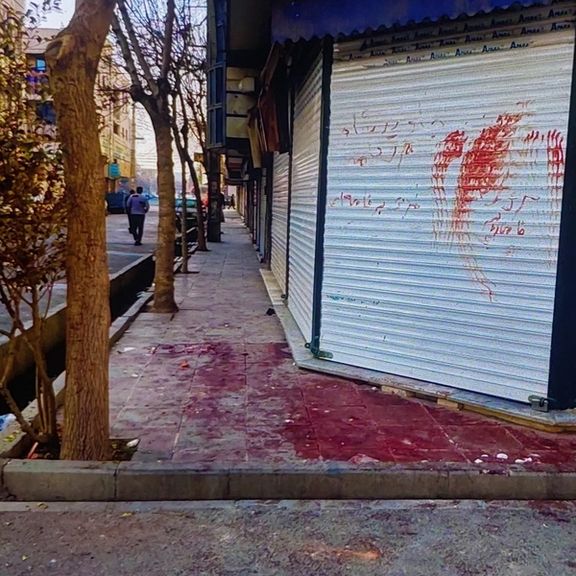
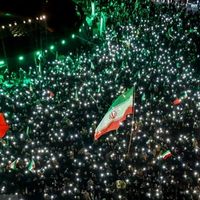
Scene from City of Golestan, Tehran Province – January 9, 2026
Fragments of what has unfolded in Iran over the past two weeks are beginning to emerge from beneath a near-total internet blackout, revealing killings that have largely remained hidden from public view.
Through sporadic messages, rare phone calls and accounts relayed to media outlets operating outside the country, details are surfacing of civilians shot during nationwide protests that erupted earlier this month and were met with what sources describe as one of the deadliest crackdowns in the Islamic Republic in decades.
Among the cases now coming to light is the killing of a shopkeeper in the southern city of Shiraz, according to people familiar with the incident who spoke to Iran International.
Local sources said the man had sheltered protesters inside his business during demonstrations on January 8.
The shop owner, identified as Gholamreza Zareh, ran the Linda flower shop on Qadamgah Street. Witnesses said that after protesters had fled, Zareh later opened his door to assess whether the security presence had subsided. Security forces then shot him in the neck, killing him instantly, according to the accounts.
The fate of the protesters who had sought refuge in the shop remains unclear.
In a separate incident in the southwestern city of Andimeshk, a 19-year-old protester, Shahab Fallahpour, was killed by security forces during demonstrations, people familiar with the case told Iran International.
Sources said Fallahpour, a wrestler from the Shohada neighborhood, was shot on January 9 by sniper fire from a rooftop on Parto Street, without warning. His body was buried three days later, before dawn on January 12, in the presence of his parents and under the supervision of government forces, according to the accounts.
No funeral ceremony was permitted, and the family has since been pressured not to speak publicly, the sources said.
Iran International has reported that at least 12,000 people have been killed since the protests began. CBS News has cited estimates placing the death toll as high as 20,000.
Sources told Iran International on Wednesday that hospitals and morgues are facing shortages of body bags, resulting in bodies being stored in corridors and other areas.
They described heavy security deployments at medical facilities, restrictions on families’ access, and limits on the registration of information related to the dead, which they said appeared aimed at preventing the true scale of the killings from becoming public.
With communications still largely severed, the full extent of what has occurred across Iran may not be known for weeks, if ever.
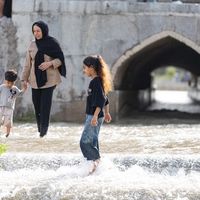
Pedestrians walk near Tehran's Grand Bazaar, January 2026
The protests that erupted across Iran in January 2026 may have appeared sudden to outside observers but inside the country, they were anything but.
For more than a year, Iranian political analysts, sociologists and even establishment insiders had warned that mounting economic pressure and social exhaustion were pushing the country toward a nationwide rupture.
The state, unable or unwilling to pursue reform, appeared to place its faith instead in a familiar instrument: brute force.
When unrest finally broke out, it was met with an exceptionally violent crackdown that claimed thousands of lives. The predictions came true in the worst possible way.
‘Boiling point’
In October 2025, former labor minister and government spokesman Ali Rabiei wrote in the reformist daily Sharq that Iranians were “fed up with the government’s promises.” Without meaningful economic relief, he warned, the country risked sliding into civil unrest.
A month later, sociologist Taghi Azad Armaki described the situation as “critical,” calling for national dialogue rather than denial. Accumulated social dissatisfaction, he told the moderate daily Etemad, had pushed society to its “boiling point.”
Moderate commentator Abbas Abdi went further weeks later, writing in Etemad that Iranian society had reached “the point of no return.”
State-affiliated news agencies — including Revolutionary Guards-linked Fars — did highlight economic grievances, but largely downplayed the likelihood of widespread protest, framing any potential unrest as the work of foreign actors.
A crisis mapped in advance
The clearest articulation of what lay ahead came in late December 2025, just as protests were beginning to spread and foreign-exchange and gold prices were surging.
Writing for the reformist website Rouydad24, analyst Amir Dabiri Mehr argued that Iran’s fate now hinged almost entirely on how the government chose to respond. He outlined four possible scenarios, ranging from de-escalation to catastrophe.
In the first two — economic reform or restraint by security forces — the government would seek to calm public anger without violence. Dabiri Mehr treated both as increasingly unlikely. Events soon confirmed that assessment.
The third scenario, a violent crackdown, did unfold. Security forces suppressed protests across cities including Tehran, Mashhad, Isfahan and Rasht, temporarily silencing dissent through force.
Ignoring it all
Dabiri Mehr’s fourth scenario envisioned escalation: a severe crackdown combined with the portrayal of protesters as “enemies” or “foreign agents,” pushing unrest toward militarization and raising the risk of foreign intervention or broader confrontation.
He cautioned that a social media blackout would not contain anger but displace it — forcing dissent from online spaces into the streets and transforming economic frustration into a wider social movement. Repression alone, he warned at the time, would not resolve the crisis.
The tragedy now unfolding was foreseen not only by contemporary analysts but, metaphorically, by Iran’s own literary tradition.
In Ferdowsi’s Shahnameh, written a millennium ago, a line captures the logic of the present moment: When a man’s fortune darkens, he does everything he should not do.
The warnings were clear. The alternatives were understood. What followed was not inevitability, but choice—and its consequences are now unfolding.
Pedestrians cross a street in Tehran with a large mural depicting clenched fists holding the Iranian flag looming in the background, January 19, 2026
The unprecedented brutal crackdown on recent protests in Iran suggests Tehran's rulers are no longer attempting to govern a discontented society but are in open conflict with it.
The large-scale killing of protesters may look like a panicked security response, but it is better understood as a calculated effort to destroy protest both on the streets and in people’s minds.
By deploying overwhelming force, the state is seeking to reframe protest as an act that guarantees death—so dangerous that it becomes irrational to attempt.
This logic has been reinforced by the nationwide internet shutdown. Cutting communication is not simply about hiding abuses from the outside world; it is about isolating protesters from one another, breaking networks of trust, and leaving individuals to face fear alone.
When information collapses, collective will fractures. The aim is to ensure that even before a demonstration forms, the decision to join it feels like a solitary, suicidal gamble.
The state has effectively pushed society into an impossible position, where enduring daily life is as unpleasant—and as unimaginable—as any attempt to change it. This paralysis is not accidental. It is Tehran’s endgame, and increasingly its only means of survival.
'Us against them'
The violence of January 9 and 10 served another purpose as well: consolidating power from within.
By tying the survival of the political system to the actions of those carrying out repression, the state has produced what might be called forced loyalty. Security forces and affiliated actors are drawn into violence so severe that there is no path back.
Once hands are stained with blood, survival becomes inseparable from the survival of the system itself. This creates a hardened core of enforcers whose only perceived option is to push forward, no matter the cost.
This dynamic encourages a “scorched earth” approach. The conflict is no longer managed or contained; it is framed as a total struggle between “us” and “them,” with protesters cast as enemies rather than citizens.
In such a framework, compromise is not weakness—it is betrayal. Mediation disappears. Violence becomes the only remaining language.
Murky repression
By ignoring collective demands and stripping the public of political relevance, the Islamic Republic has effectively dismantled politics itself. What remains is not governance, but a permanent security posture.
The use of plainclothes forces and paramilitary units fits squarely within this logic. By blurring the boundary between state and society, the authorities have sought to reframe repression as “people against people.”
Protesters are portrayed as violent elements within society, already dehumanized through labels such as “rioters” or “terrorists.” This allows the state to deflect responsibility while deepening social fragmentation.
Slain senior Revolutionary Guard commander Hossein Hamedani once boasted about mobilizing convicts and thugs to suppress protests. “They are not afraid of blood,” he said.
Their role is not only physical repression but also narrative production: muddying responsibility, normalizing brutality, and casting doubt on the moral legitimacy of protest itself. Their unofficial status also provides the state with plausible deniability.
Burned bridges
At the same time, the machinery of repression has become increasingly bureaucratic. Killings are absorbed into routine procedure; violence is carried out as a duty—lawful, necessary, even sacred.
Statements from military and security institutions during this period make clear that the deaths of protesters are not seen as a national loss, but as a means of preserving the political order.
This moment also exposes a deeper vulnerability. A system that securitizes everything produces nothing but control and coercion. Maintaining such a structure requires constant expenditure—of resources, manpower, and legitimacy—both at home and abroad.
A crisis in the domestic security sphere cannot remain contained indefinitely; it will eventually spill outward, generating external pressure and international consequences.
What is unfolding in Iran is therefore not a temporary crackdown. It is the outcome of a long shift from governing society to confronting it as an enemy.
It is almost impossible to predict where Iran is headed, but its rulers appear to have bet on the iron fist—suspending politics for a permanent emergency and burning all bridges back to mediation and consent.
A missile is test-fired from an unspecified location in Iran
Iran's foreign minister said the country was prepared to show no restraint in retaliating to any military attack and mocked Europe about its standoff with the United States over President Donald Trump's push to control Greenland.
Tensions between Tehran and Washington have flared in the wake of the deadliest crackdown on protests in the history of the Islamic Republic earlier this month.
Trump warned Iran not to kill protestors and vowed in a social media post the "help is on the way," in comments which heartened demonstrators and appeared to signal readiness for a military intervention which has yet to materialize.
"Unlike the restraint Iran showed in June 2025, our powerful armed forces have no qualms about firing back with everything we have if we come under renewed attack," Araghchi said in an editorial in the Wall Street Journal, referring to a 12-day war with Israel and the United States.
At least 12,000 protestors were killed by security forces, according to medics and government sources speaking to Iran International.
The veteran diplomat and strident defender of Tehran's crushing of the nationwide demonstrations had his invitation to the World Economic Forum in Davos, Switzerland revoked this week.
"An all-out confrontation will certainly be ferocious and drag on far, far longer than the fantasy timelines that Israel and its proxies are trying to peddle to the White House," he added. "It will certainly engulf the wider region and have an impact on ordinary people around the globe."
Trump is weighing "decisive" military options toward Iran in the wake of the mass killing of demonstrators, the same newspaper reported on Tuesday, as a US carrier strike group steams toward the region.
Meanwhile the United States has ramped up its bid to lay claim to Greenland, a part of Denmark, citing Arctic and world security in a diplomatic drama which is opposed by the European Union and is straining the nearly 80-year-old NATO alliance.
Araghchi cited what he called Europe's support for Trump's move to exit an international deal over Iran's disputed nuclear program in his first term, saying the United States was behaving in a unilateral way which challenged global order.
"Sadly for Europe, its current conundrum is the very definition of 'blowback'. The E3/EU faithfully obeyed and even abetted President Trump when he unilaterally abrogated the Iran Nuclear Deal," he wrote on X.
"Mr. Trump's threat to take over Greenland by any means—unlawful as it is under any conception of international law or even a 'rules-based order'—could not happen to a more deserving continent," he added.
Iranian Supreme Leader Ali Khamenei handles Islamic prayer beads in this file photo
The thank-you note from US President Donald Trump to Iran’s leadership for halting what he described as planned mass executions reveals much about his politics, but more about the rulers in Tehran who have canonised deception as a political instrument.
Trump said last week that he had it “on good authority” that Iran intended to execute 800 prisoners, a claim for which no corresponding evidence has appeared in Iranian official announcements or domestic reporting.
American media reports suggested Iran's foreign minister Abbas Araghchi had been communicating with Trump's Mideast envoy Steve Witkoff and his statements had influenced the president's thinking to relent on a mooted attack.
Trump’s apparent willingness to take the claim at face value may also reflect his own preference, at least momentarily, for de-escalation—or for deferring action he may have judged premature at that stage.
Whether the specific information circulated in this episode was exaggerated, fabricated, or misunderstood remains unclear. But if misleading claims were fed to American officials or intermediaries, such behavior would be entirely consistent with Tehran’s long-standing political logic.
Concealment as expediency
This logic does not arise from classical Islamic jurisprudence as such. In traditional Islamic legal thought, deception is generally condemned in ordinary political and social life and tightly constrained even in wartime.
The Islamic Republic, however, reconfigured this ethical boundary when its first supreme leader, Ruhollah Khomeini, argued that actions normally considered impermissible could be justified under the higher imperative of preserving Islam—and later, preserving the system itself.
Concepts such as maslahat (expediency) and political taqiyya (concealment) were thus transformed from narrowly defined exceptions into governing principles. Deception ceased to be situational and became structural.
This transformation was evident even before the Islamic Republic consolidated power. Khomeini publicly promised political pluralism, civil liberties, and limits on clerical authority. After 1979, these commitments were quietly discarded or retrospectively framed as tactical necessities of the revolutionary struggle.
What occurred was less a political reversal than the institutionalization of a widening gap between public narrative and actual intent. Decisions of lasting consequence were made offstage, while legality and transparency were preserved largely in appearance.
‘Managing’ foes
In later decades, deception became a stable feature of Iran’s foreign policy as well. Negotiations were often used not to resolve disputes but to reduce pressure, fragment opposition, and buy time.
Iran’s best-known diplomat, Mohammad Javad Zarif, boasted several years ago that his team had deliberately “managed” international perceptions. Misrepresentation was not incidental; it was strategic.
Within such a system, misleading a foreign government or manipulating a prominent political figure would be a default option, not merely a necessary evil.
Whether or not the recent execution claims were accurate, their circulation fits a familiar operational pattern: deflect scrutiny, reshape headlines, ease pressure, and gain time.
People march in support of nationwide protests in Iran, Los Angeles, California, January 18, 2026.
Iranians abroad staged at least 168 protests across 30 countries and 73 cities, turning the uprising inside Iran into a global wave of demonstrations that surged after internet shutdowns.
From Tokyo and Seoul in East Asia to Los Angeles and San Francisco on the US West Coast, and from Oslo, Stockholm, and Tampere in northern Europe to Melbourne and Adelaide in the Southern Hemisphere, Iranian communities took to the streets in what organizers described as coordinated expressions of solidarity with protesters inside Iran.
One of the largest gatherings took place in Toronto on January 16, where demonstrators marched despite blizzard conditions and subzero temperatures. Aerial images showed large crowds carrying Iranian national symbols and banners, making the event one of the most widely attended diaspora protests during this period.
Growth of diaspora mobilization
Large-scale mobilization among Iranians abroad is not unprecedented. Over the past 45 years, more than five million Iranians have fled the country as refugees, with an estimated additional two to four million emigrating for other reasons. By these estimates, roughly one in every 15 Iranians now lives outside the country.
The first demonstrations in this latest wave began on January 1, the fifth day of protests inside Iran. From that point through January 16, the number of gatherings increased steadily, with a marked acceleration following internet blackouts and a public call by exiled prince Reza Pahlavi for Iranians abroad to mobilize.
January 16, 10, and 9 saw the highest number of demonstrations worldwide, with 25, 24, and 23 events respectively.
Geographic distribution
More than half of all protests were held in Europe, with cities such as London, Hamburg, Frankfurt, and Stockholm among the most active.
North America accounted for roughly 25 percent of demonstrations, concentrated in cities including Toronto, Montreal, Los Angeles, New York, and Washington DC.
In Oceania, approximately 15 percent of protests took place, primarily in Sydney and Melbourne in Australia, and Auckland and Wellington in New Zealand.
Smaller demonstrations were also reported in cities such as Tbilisi, Yerevan, Tokyo, Seoul, New Delhi, and Istanbul. While Iranian populations in several Asian countries are sizable, organizers noted that legal and political restrictions made public demonstrations more difficult than in Western countries. In Turkey, some Iranian residents reported bans on holding protests.
Demonstrators hold a large "Lion and Sun" pre-Islamic Revolution national flag of Iran, during a gathering outside the Iranian embassy in support of nationwide protests in Iran, in London, Britain, January 18, 2026.
Organizers and symbols
With limited exceptions, most demonstrations were organized by nationalist and monarchist groups. Participants frequently carried pre-revolution Iranian flags featuring the lion-and-sun emblem, along with images of Reza Pahlavi and slogans echoing those used by protesters inside Iran.
A small number of rallies were organized by left-wing and feminist groups, including a modestly attended event in Toronto on January 4 and a Paris demonstration on January 16.
Clashes, attacks, and arrests
Several incidents of violence were reported during the demonstrations.
On January 10 in Los Angeles, a truck drove toward a gathering of protesters. Police intervention prevented serious injuries.
Six days later, on January 16, three individuals armed with knives attacked demonstrators at another Iranian rally, leaving two people seriously injured.
Clashes and arrests were also reported during protests in London, according to local media and eyewitness accounts.
Largest demonstrations
Official estimates of crowd sizes remain limited. In Toronto, organizers claimed attendance reached as high as 110,000 people, while official figures cited numbers exceeding 10,000.
Aerial footage showed dense crowds marching through snow-covered streets. Some Toronto residents described the event on social media as unprecedented, suggesting attendance exceeded official estimates.
In Cologne, Germany, participation was estimated at around 25,000 people. Large crowds were also reported in Hamburg.
Flag actions at diplomatic sites
Alongside street demonstrations, activists attempted to replace the Islamic Republic’s flag with the pre-1979 lion-and-sun flag at Iranian embassies and consulates worldwide.
On January 9, during a protest outside Iran’s embassy in London, a demonstrator climbed onto the embassy balcony, removed the official flag, and raised the lion-and-sun flag. The action drew strong condemnation from Iranian authorities.
On January 12 – exactly six years after a state television presenter told protesters to “pack up and leave Iran” if they rejected the government’s vision of society – Iranians demonstrated in cities including Sydney, Melbourne, Bern, Nicosia, Berlin, Genoa, The Hague, Toronto, Hamburg, London, Barcelona, Zurich, Yerevan, Lisbon, Tbilisi, and Athens.
Many demonstrators live in countries with high levels of political freedom and economic stability. Organizers said the protests were intended to signal that, despite living abroad, members of the Iranian diaspora continue to identify closely with events inside Iran.
From east to west, participants said, geography has not severed their ties to the country they left behind.