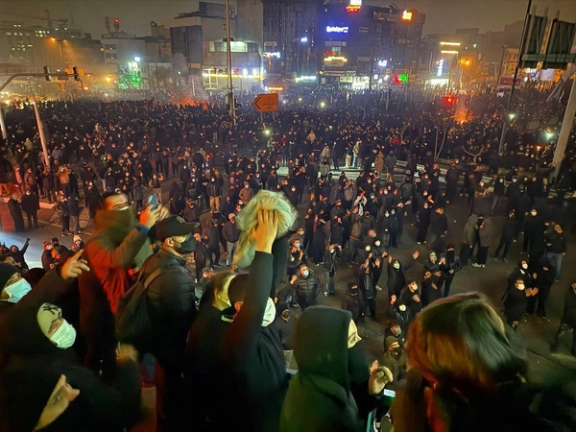
Iranian security forces deployed unknown chemical substances amid deadly crackdowns on protestors in several cities earlier this month, eyewitnesses told Iran International, causing severe breathing problems and burning pain.
They described symptoms that they said went beyond those caused by conventional tear gas, including severe breathing difficulties, sudden weakness and loss of movement.
“What was fired was not tear gas,” one protester said.
"People collapsed," another eyewitness said.
Iranian authorities crushed unrest earlier this month in the deadliest crackdown on protestors in the Islamic Republic's nearly 50-year history.
According to accounts, the gases caused intense burning of the eyes, skin and lungs, along with acute respiratory distress, repeated coughing, dizziness, loss of balance and, in some cases, vomiting or coughing up blood.
Witnesses said the severity and persistence of the symptoms differed from their past experiences with tear gas, although they said they could not identify the substances used.
Gas fired into crowds and escape routes
Witnesses said gas canisters were fired into crowds and along escape routes, including narrow streets and alleys.
According to the accounts, in some cases gunfire began at the same time, or immediately after, protesters lost the ability to walk or run and fell to the ground.
Several witnesses said that moments of immobilization became points at which shooting intensified, particularly when protesters collapsed in alleys or while trying to flee.
Reports came from multiple cities, including Tehran, Isfahan and Sabzevar.
Sabzevar footage
Videos received from Sabzevar, a city in Razavi Khorasan province in northeastern Iran, and reviewed by Iran International showed security personnel wearing special protective clothing and masks designed for hazardous chemical materials, positioned on military-style vehicles in city streets.
Warning symbols associated with hazardous substances were visible on vehicles in the footage. Sounds consistent with gunfire could be heard in separate videos.
Iranian forces are seen wearing chemical-hazard protective gear on military-style vehicles in the streets of Sabzevar, northeast Iran.
A yellow triangular hazardous-materials warning sign is visible in the footage, while gunfire can be heard in a separate video.
Isfahan accounts
In central province of Isfahan, witnesses said tear gas with chemical characteristics was fired directly into crowds of protesters, including teenagers, young people and older individuals.
They said attempts to reduce the effects of the gas using common methods such as wet cloths quickly proved ineffective.
Witnesses described scenes in which people fleeing into alleys developed severe breathing difficulties and collapsed after running short distances. They said shooting began while protesters were in that condition, with scenes they described as “like war movies.”
Other witnesses described the smell of the gases as a mixture of pepper, swimming-pool chlorine, bleach and vinegar, and said the sky filled with smoke in red, yellow and white colors.
Several women and a 17-year-old girl described seeing an unknown device that, they said, “without the sound of gunfire, fired something like flames in red and yellow.”
“Seconds later, the street was full of smoke and vapor,” they said, adding that the smell resembled ammonia, drain cleaner and, in some areas, mustard.
One woman said two plainclothes agents put on protective masks before throwing gas canisters toward nearby crowds. She said young people closest to the impact “quickly developed coughing, intense burning and inability to move” and shouted: “I’m burned.”
Tehran accounts
In Tehran, witnesses from several neighborhoods said gas was fired repeatedly, producing thick smoke and severe irritation.
Protesters said the gases caused intense burning of the eyes and lungs and numbness in the lips, with smoke described as green, yellow and black.
Witnesses said protesters who felt suffocation sought refuge inside nearby homes, but said security agents were positioned near some of those locations.
In addition to tear gas, witnesses spoke of “unknown gases with more severe effects,” saying those exposed experienced sudden weakness, inability to walk and loss of breath.
Fear of hospitals
In a number of accounts, witnesses said fear of the presence of security agents at hospitals and the risk of arrest led many wounded protesters to avoid medical centers.
They said some treatment was instead carried out at private homes with the help of volunteer doctors.
Some witnesses said people they knew continued to suffer severe coughing, nausea and skin blistering days after exposure.
Medical assessment
Alan Fotouhi, a physician and professor of clinical pharmacology based in Sweden, told Iran International that the symptoms described by witnesses did not match those typically associated with standard tear gas.
He said the pattern of symptoms, severity of harm and persistence of effects differed from what is normally observed with conventional tear gas exposure.
Fotouhi said the reported effects could result from a combination of high-dose tear gas and other highly irritating chemical substances, but said identifying the exact materials would require laboratory analysis.
Iranian authorities have not commented on the witness accounts.
Iran is a signatory to the Chemical Weapons Convention, which restricts the use of chemical agents against civilians.
Human rights groups have condemned the use of force against protesters in Iran, including the use of tear gas and live ammunition.
Men stand amid rows of corpses in a morgue in Tehran following mass killings of protestors by security forces in this undated image obtained by Iran International
Iran has deployed a nationwide militarized crackdown to scotch dissent and obscure the scale of its mass killings of protestors earlier this month, rights watchdog Amnesty International said in a report on Friday.
Security forces, Amnesty said, moved quickly after the killings to impose sweeping controls aimed at silencing survivors, intimidating families of victims and preventing documentation of what it described as unlawful mass killings carried out to crush what it called a popular uprising.
The measures included arbitrary mass arrests, enforced disappearances, bans on gatherings, night-time curfews, and a near-total internet blackout, alongside the deployment of heavily armed patrols across cities and inter-city roads, Amnesty International said.
“While people in Iran are still reeling from the grief and shock of the unprecedented massacres during protest dispersals, the Iranian authorities are waging a coordinated attack on the rights of people in Iran to life, dignity and fundamental freedoms in a criminal bid to terrorize the population into silence,” said Diana Eltahawy, Amnesty International’s deputy regional director for the Middle East and North Africa.
“Through the ongoing internet shutdown, the authorities are deliberately isolating over 90 million people from the rest of the world to conceal their crimes and evade accountability.”
“The international community must not allow another chapter of mass atrocities in Iran to be buried without consequence. Urgent international action, including steps towards accountability through independent international justice mechanisms, is long overdue to break the cycle of bloodshed and impunity.”
Conflicting death tolls
The clampdown followed the killings of protesters during demonstrations on January 8 and 9, which Amnesty described as unprecedented in scale.
On January 21, Iran’s Supreme National Security Council put the total number of people killed during the uprising at 3,117.
Days earlier, Mai Sato, the UN special rapporteur on human rights in Iran, said estimates suggested at least 5,000 civilians had been killed, adding that figures based on reports from doctors inside Iran could be significantly higher.
The information blackout since January 8, Amnesty said, has made independent verification difficult and led to the loss of crucial evidence after security forces confiscated mobile phones from those killed or detained.
Mass arrests and enforced disappearances
Tens of thousands of people, including children, have been arbitrarily detained, according to Amnesty. Arrests were reported during night-time home raids, at checkpoints, in workplaces, and in hospitals.
The organization said security forces removed wounded protesters from hospitals in several provinces and threatened medical staff with prosecution for treating injured demonstrators without notifying authorities.
Families and lawyers have frequently been denied information about detainees’ whereabouts, amounting to enforced disappearance under international law.
Amnesty documented cases of torture and ill-treatment, including beatings, sexual violence, threats of execution and denial of water, food and medical care.
Intimidation of families
Families of those killed have faced sustained pressure, Amnesty said, including being forced to bury victims by night, demands for money in exchange for bodies, and coercion to issue false statements blaming protesters or labeling victims as members of pro-government forces.
State media has broadcast forced “confessions” and statements from grieving relatives, a practice Amnesty said mirrors past efforts to justify repression and pave the way for harsh sentences, including executions.
Militarized control
Amnesty said security forces have established dense networks of checkpoints, enforced curfews, and warned residents through loudspeakers to remain indoors.
Videos reviewed by the group showed armored vehicles, heavy weapons and water-cannon trucks deployed in multiple cities.
The organization called on Iranian authorities to restore internet access, release arbitrarily detained individuals, disclose the fate of the disappeared, end harassment of victims’ families and allow independent investigations into the killings.
Iran has sharply reduced operations at its consulate in central London, Iran International reported, following protests that took place outside the building during the recent unrest in Iran.
According to information received by Iran International, the consulate’s first floor has been fully evacuated and locked, and staff numbers at the site have been significantly reduced. Consular services are now being provided at a much more limited level than before.
Images obtained by Iran International in recent days showed office equipment and administrative materials being removed from the building, with vehicles seen transferring staff and items to another location earlier this week.
The changes follow demonstrations held outside Iran’s embassy and consulate in London during the nationwide protests in Iran.
British police previously deployed metal barriers and vehicles to secure the area during the demonstrations.
Iran’s Supreme National Security Council instructed newspaper editors and online media managers to stop publishing independent reporting on protest deaths and to avoid interviewing bereaved families, according to information shared with Iran International.
The instruction, according to the information received by Iran International, was conveyed during a meeting with managers of domestic media outlets and explicitly required them to refer only to figures released by state bodies, while avoiding any independent accounting of deaths.
The same directive, the sources said, also prohibited interviews or conversations with families of those killed.
Bodies laid out at the Kahrizak morgue, south of Tehran, after a deadly crackdown.
Iran’s Supreme National Security Council instructed newspaper editors and online media managers to stop publishing independent reporting on protest deaths and to avoid interviewing bereaved families, according to information shared with Iran International.
The instruction, according to the information received by Iran International, was conveyed during a meeting with managers of domestic media outlets and explicitly required them to refer only to figures released by state bodies, while avoiding any independent accounting of deaths.
The same directive, the sources said, also prohibited interviews or conversations with families of those killed.
Sources described as familiar with the decision said the measure was aimed at preventing broader disclosure of the scale of the killings of protesters, which they said occurred under direct orders from Supreme Leader Ali Khamenei.
Media managers question the order
The directive was delivered, the report said, as some domestic media managers challenged the government’s line during the same session, pointing to internal information suggesting a death toll in the thousands and questioning instructions issued under President Masoud Pezeshkian and the Supreme National Security Council.
Those participants, according to the account, argued there is a wide gap between official numbers and information circulating inside the country.
Iran’s National Security Council, a body operating under the Interior Minister, on Wednesday published figures for the first time covering deaths on January 8 and 9.
The statement put the number of killed protesters at 690. It also listed a total death toll of 3,117 across the two days, but described 2,427 of those as “martyrs” drawn from “innocent people and guardians of order and security,” a designation in the Islamic Republic’s official language generally used for those aligned with state institutions.
The Islamic Republic’s Martyrs Foundation also announced on Wednesday that military and security forces had taken the lives of only 690 protesters, while another 2,427 people were said to have been killed by protesters. The institution had initially reported 3,317 deaths, but hours later revised the figure down to 3,117.
Iran International said the official numbers differ sharply from information it has received, eyewitness accounts, and reporting by international media.
The outlet’s editorial board has previously put the number of protesters killed by state forces at at least 12,000, according to its published statement.
The number of civilians killed in Iran’s crackdown on protests may be more than 20,000, the UN special rapporteur on human rights in Iran said, citing reports from doctors inside the country, Bloomberg reported.
Mai Sato said earlier this week that civilian deaths were estimated at 5,000 or more, adding that medical reports suggested the toll could be far higher, at about 20,000 or more.
Iran International’s statement described the killings on January 8 and 9 as unprecedented in modern Iranian history in geographic spread, intensity of violence, and number of deaths.
Venezuelan opposition leader Maria Corina Machado speaks with Iranian activist Masih Alinejad in Washington.
Venezuelan opposition leader Maria Corina Machado said democratic governments must raise the cost for Iran’s rulers to stay in power in an interview with Iranian activist Masih Alinejad.
Machado said Iran and Venezuela were bound by deep cooperation between their rulers, even as people in both countries rise up against repression.
“The Iranian people, the Venezuelan people, we are fighting the same struggle,” she said. “These regimes have been cooperating for many years, exchanging resources, information, technology, agents and weapons.”
She said authoritarian governments help each other bypass pressure and maintain control, while democracies often stop at statements.
“Dictators help each other, they exchange technology, resources, they help each other bypass sanctions and they support each other in international forums,” Machado said. “Democratic governments stay at statements and declarations that at the end do not serve the people.”
Machado said people in Iran had reached a breaking point and were calling on the world to respond.
“We reach a point where the people start asking the world to react and to support,” she said. “What we are asking for is to stop the killings and to save lives.”
She criticized what she described as double standards among democratic governments that condemn repression while maintaining economic ties.
“You sign declarations talking about freedom and equality and respect for human rights, then you do business with these regimes,” Machado said. “You buy oil from these regimes and you keep their assets and resources in your own financial systems.”
US President Trump meets with Venezuelan opposition leader Maria Corina Machado in the Oval Office, in Washington, DC, US, released January 15, 2026.
Praise for Trump action
Machado praised Donald Trump for taking decisive action against Venezuelan President Nicolas Maduro and said it showed what firm leadership could achieve.
“Finally in Venezuela we’re seeing President Trump making a tremendous important decision,” she said. “Bringing a criminal to justice is precisely what the world needs.”
She said the move sent a signal beyond Venezuela.
“It has brought a lot of hope,” Machado said. “This is a milestone.”
Machado said repression continues when dictators see little cost in using force.
“When you’re dealing with criminals, the only way they will leave is when the cost of staying in power is higher than the cost of leaving,” she said.
She said opposition movements cannot succeed alone without coordinated international pressure.
“We have done everything that any civic movement can do and they are killing us,” Machado said. “What we are asking for is applying law enforcement and cutting the resources they use to fund repression.”
Machado said the fall of Iran’s ruling system would have consequences far beyond the country.
“Imagine how the world will look once the Iranian criminal regime falls,” she said. “This is a unique moment in history.”
She said cooperation among opposition groups and diasporas was essential.
“These regimes help each other, and we the people need to connect and coordinate,” Machado said. “Regardless of how far away we are, we are united in this aspiration.”