Iran’s Supreme National Security Council instructed newspaper editors and online media managers to stop publishing independent reporting on protest deaths and to avoid interviewing bereaved families, according to information shared with Iran International.
The instruction, according to the information received by Iran International, was conveyed during a meeting with managers of domestic media outlets and explicitly required them to refer only to figures released by state bodies, while avoiding any independent accounting of deaths.
The same directive, the sources said, also prohibited interviews or conversations with families of those killed.

Iran’s Supreme National Security Council instructed newspaper editors and online media managers to stop publishing independent reporting on protest deaths and to avoid interviewing bereaved families, according to information shared with Iran International.
The instruction, according to the information received by Iran International, was conveyed during a meeting with managers of domestic media outlets and explicitly required them to refer only to figures released by state bodies, while avoiding any independent accounting of deaths.
The same directive, the sources said, also prohibited interviews or conversations with families of those killed.
Sources described as familiar with the decision said the measure was aimed at preventing broader disclosure of the scale of the killings of protesters, which they said occurred under direct orders from Supreme Leader Ali Khamenei.
Media managers question the order
The directive was delivered, the report said, as some domestic media managers challenged the government’s line during the same session, pointing to internal information suggesting a death toll in the thousands and questioning instructions issued under President Masoud Pezeshkian and the Supreme National Security Council.
Those participants, according to the account, argued there is a wide gap between official numbers and information circulating inside the country.
Iran’s National Security Council, a body operating under the Interior Minister, on Wednesday published figures for the first time covering deaths on January 8 and 9.
The statement put the number of killed protesters at 690. It also listed a total death toll of 3,117 across the two days, but described 2,427 of those as “martyrs” drawn from “innocent people and guardians of order and security,” a designation in the Islamic Republic’s official language generally used for those aligned with state institutions.
The Islamic Republic’s Martyrs Foundation also announced on Wednesday that military and security forces had taken the lives of only 690 protesters, while another 2,427 people were said to have been killed by protesters. The institution had initially reported 3,317 deaths, but hours later revised the figure down to 3,117.
Iran International said the official numbers differ sharply from information it has received, eyewitness accounts, and reporting by international media.
The outlet’s editorial board has previously put the number of protesters killed by state forces at at least 12,000, according to its published statement.
The number of civilians killed in Iran’s crackdown on protests may be more than 20,000, the UN special rapporteur on human rights in Iran said, citing reports from doctors inside the country, Bloomberg reported.
Mai Sato said earlier this week that civilian deaths were estimated at 5,000 or more, adding that medical reports suggested the toll could be far higher, at about 20,000 or more.
Iran International’s statement described the killings on January 8 and 9 as unprecedented in modern Iranian history in geographic spread, intensity of violence, and number of deaths.
A 37-year-old physiotherapist and clinic founder was shot dead during protests in Iran earlier this month, and his family was later forced to pay money to retrieve his body, a source familiar with the matter told Iran International.
The source identified him as Masoud Bolourchi, a Tehran-based physiotherapist and founder of Rush Physiotherapy Clinic, and said he was shot from behind on Jan. 8.
According to the source, his family later located his body in Kahrizak, south of Tehran, and were pressured by security officials into paying what was described as a “bullet fee” before it was released.
Bolourchi had studied in Budapest, Hungary, and had returned to Iran several years ago, the source said.

A serving official at Iran’s Interior Ministry has defected from his post and joined the protests, urging US President Donald Trump to intervene against the Islamic Republic, he said in a message to Iran International.
The official said in an audio message recorded on Sunday that he stayed away from work after a call by exiled Crown Prince Reza Pahlavi.
Iran International is withholding the official’s identity for security reasons.
The official said he took part in recent demonstrations and witnessed the Islamic Republic’s use of live fire against protesters.
He said protesters were facing armed forces with no means to defend themselves. “People have done everything they can and made their demands clear,” he said, adding that security forces were deliberately targeting demonstrators with live ammunition.
The official appealed directly to Trump to act, saying many Iranians were waiting for US intervention. “People are waiting for Trump, and if he does nothing, widespread hatred toward him will emerge among Iranians,” he said.
He accused security forces of using G3 rifles against civilians and warned that patience inside Iran was running out.
The official also described what he called de facto martial law in several provinces, with traffic tightly controlled, motorcycle units deployed, and armored vehicles patrolling streets to prevent gatherings.
According to the official, the scale of protests on January 8 and 9 was unprecedented in the history of the Islamic Republic, prompting authorities to restrict internet access and block the flow of images and videos.
“The Islamic Republic is ruthless and will do anything,” he said, adding that agents were operating openly with weapons in the streets.
The Interior Ministry official said he believed Trump would ultimately act but stressed that expectations among protesters were growing as violence continued.
Trump has previously warned Tehran that if Iranian authorities fired on protesters, the United States would respond in kind. Days later, he said he had been told executions in Iran were halted following his warning.
In his most recent comments to Politico, Trump spoke openly about the need for leadership change in Iran, calling Supreme Leader Ali Khamenei “a sick man.”
A serving official at Iran’s Interior Ministry has defected from his post and joined the protests, urging US President Donald Trump to intervene against the Islamic Republic, he said in a message to Iran International.
The official said in an audio message recorded on Sunday that he stayed away from work after a call by exiled Crown Prince Reza Pahlavi.
Iran International is withholding the official’s identity for security reasons.
The official said he took part in recent demonstrations and witnessed the Islamic Republic’s use of live fire against protesters.
The official appealed directly to Trump to act, saying many Iranians were waiting for US intervention. “People are waiting for Trump, and if he does nothing, widespread hatred toward him will emerge among Iranians,” he said.


After returning from Iran to Canada, Mona Bolouri said the unity and size of protests she witnessed firsthand convinced her that the Islamic Republic was doomed after she left the country a day before a deadly crackdown.
“I know it’s over,” Bolouri said, referring to the Islamic Republic. “I’m not afraid to say this openly, because I believe the regime will be a different regime.”
Bolouri, a 40-year-old Iranian Canadian, traveled to Iran in late December to visit family and was in Mashhad as protests erupted on January 8.
What she witnessed, she said, was unlike anything she had seen during earlier protest waves.
“It was the most magnificent thing I’ve ever seen,” Bolouri said. “The crowd was so huge that I couldn’t even get to the front line.”
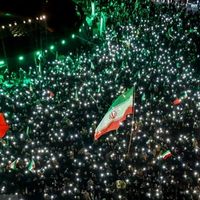
She described Vekilabad Boulevard, one of Mashhad’s largest and most prominent central avenues, filled shoulder to shoulder with demonstrators chanting slogans against Supreme Leader Ali Khamenei and calling for the return of Reza Pahlavi, the son of Iran’s deposed Shah.
The scale of the turnout initially made her feel safe, she said, despite the city’s reputation as a conservative stronghold and its symbolic closeness to Khamenei’s power base.
That sense of safety quickly evaporated as security forces moved in. Live gunfire and tear gas intensified as protesters pushed forward, with the gas becoming so thick it left people disoriented and unable to see.
She recalled being helped away by strangers after losing her vision and struggling to breathe amid the chaos.
What struck her most, she said, was the bravery of younger protesters who repeatedly surged toward security forces even as shots rang out.
“I am a brave person, but they are on a next-level brave,” she said. “Aren’t they afraid of their lives?”
As night fell, Iran’s internet was cut, severing communication and access to the outside world. Bolouri said she realized her messages were no longer sending and feared her parents would be unable to reach her.
“It’s a different city now,” she recalled telling her family once she was back home.
She described streets stripped of traffic signs and surveillance cameras, pulled down by protesters to block motorcycle units and avoid identification. Fires burned at sites linked to the security apparatus, including banks associated with the Islamic Revolutionary Guard Corps.
The damage, she said, was deliberate and defensive rather than random.
One moment, she said, stayed with her. An ambulance drove toward the crowd—the only vehicle moving against the flow. At first, she thought it was responding to a medical emergency.
“I was like, why is it coming this way?” Bolouri said. “Why wouldn’t it go around? The other streets were still open for cars.”
She soon realized that ambulances were being used to transport security forces. “That’s when it made sense,” she said.
Although she did not personally witness fatalities, Bolouri said she saw multiple injured protesters being carried away as gunfire flashed through clouds of tear gas.
She later learned from relatives that the violence intensified the following night.
Her uncle, who remained in Mashhad, told her that from early evening until nearly midnight, the sound of continuous gunfire echoed through residential neighborhoods.
“They were crying at home,” she said, describing how older family members panicked simply from the noise, aware that something terrible was unfolding outside.
Bolouri’s flight out of Iran was canceled, but she managed to leave via a domestic route to Istanbul. Her family believed she might not survive if she stayed another night.
Now back in Canada, she says the experience has left her unexpectedly hopeful. Comparing the protests she witnessed in Iran with rallies abroad, Bolouri said what stood out inside the country was unity and certainty.
“In Iran, there was no hesitation,” she said. “Everybody was on the same page.”
Despite the violence and mass killings, she believes the uprising marked a turning point.
The scale of participation, the open calls for regime change, and the willingness of protesters to face live fire convinced her that this movement had gone beyond anything she had previously witnessed.
Bolouri said she would normally avoid speaking publicly about her experience, out of concern for being able to return to Iran, but decided to speak out because she firmly believes the Islamic Republic is finished.