“I know it’s over,” Bolouri said, referring to the Islamic Republic. “I’m not afraid to say this openly, because I believe the regime will be a different regime.”
Bolouri, a 40-year-old Iranian Canadian, traveled to Iran in late December to visit family and was in Mashhad as protests erupted on January 8.
What she witnessed, she said, was unlike anything she had seen during earlier protest waves.
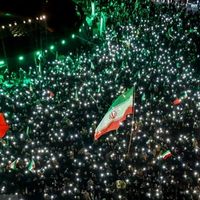
“It was the most magnificent thing I’ve ever seen,” Bolouri said. “The crowd was so huge that I couldn’t even get to the front line.”
She described Vekilabad Boulevard, one of Mashhad’s largest and most prominent central avenues, filled shoulder to shoulder with demonstrators chanting slogans against Supreme Leader Ali Khamenei and calling for the return of Reza Pahlavi, the son of Iran’s deposed Shah.
The scale of the turnout initially made her feel safe, she said, despite the city’s reputation as a conservative stronghold and its symbolic closeness to Khamenei’s power base.
That sense of safety quickly evaporated as security forces moved in. Live gunfire and tear gas intensified as protesters pushed forward, with the gas becoming so thick it left people disoriented and unable to see.
She recalled being helped away by strangers after losing her vision and struggling to breathe amid the chaos.
What struck her most, she said, was the bravery of younger protesters who repeatedly surged toward security forces even as shots rang out.
“I am a brave person, but they are on a next-level brave,” she said. “Aren’t they afraid of their lives?”
As night fell, Iran’s internet was cut, severing communication and access to the outside world. Bolouri said she realized her messages were no longer sending and feared her parents would be unable to reach her.
“It’s a different city now,” she recalled telling her family once she was back home.
She described streets stripped of traffic signs and surveillance cameras, pulled down by protesters to block motorcycle units and avoid identification. Fires burned at sites linked to the security apparatus, including banks associated with the Islamic Revolutionary Guard Corps.
The damage, she said, was deliberate and defensive rather than random.
One moment, she said, stayed with her. An ambulance drove toward the crowd—the only vehicle moving against the flow. At first, she thought it was responding to a medical emergency.
“I was like, why is it coming this way?” Bolouri said. “Why wouldn’t it go around? The other streets were still open for cars.”
She soon realized that ambulances were being used to transport security forces. “That’s when it made sense,” she said.
Although she did not personally witness fatalities, Bolouri said she saw multiple injured protesters being carried away as gunfire flashed through clouds of tear gas.
She later learned from relatives that the violence intensified the following night.
Her uncle, who remained in Mashhad, told her that from early evening until nearly midnight, the sound of continuous gunfire echoed through residential neighborhoods.
“They were crying at home,” she said, describing how older family members panicked simply from the noise, aware that something terrible was unfolding outside.
Bolouri’s flight out of Iran was canceled, but she managed to leave via a domestic route to Istanbul. Her family believed she might not survive if she stayed another night.
Now back in Canada, she says the experience has left her unexpectedly hopeful. Comparing the protests she witnessed in Iran with rallies abroad, Bolouri said what stood out inside the country was unity and certainty.
“In Iran, there was no hesitation,” she said. “Everybody was on the same page.”
Despite the violence and mass killings, she believes the uprising marked a turning point.
The scale of participation, the open calls for regime change, and the willingness of protesters to face live fire convinced her that this movement had gone beyond anything she had previously witnessed.
Bolouri said she would normally avoid speaking publicly about her experience, out of concern for being able to return to Iran, but decided to speak out because she firmly believes the Islamic Republic is finished.