Killed, blinded, stranded: dispatches from Iran's bloody crackdown
Vignettes of horror on Iran's streets were trickling past a state-imposed internet blackout, as eyewitnesses described to Iran International the widespread killing and blinding of protestors with live fire and the denial of medical care to survivors.
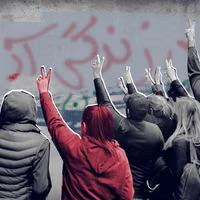
Street protests which burst forth on Dec. 28 citing economic grievances quickly morphed into calls for the downfall of the nearly 50-year-old theocracy.
Authorities deployed deadly force to largely quell the unrest in the bloodiest crackdown on demonstrations since the 1979 Islamic Revolution.
Accounts of the violence which unfolded on Iran's streets at its height on Jan. 8-10 were related to Iran International on Monday and shed light on killing which authorities have acknowledged claimed the lives of thousands but according to medics and government officials total at least 12,000, according to Iran International.
Karaj: wounded protestors shot in Taleghani Square
In Karaj, west of Tehran in north-central Iran, an eyewitness said security forces fired directly at protesters during demonstrations on Jan. 9 in Taleghani Square, killing and wounding a number of people.
The witness said forces deliberately shot dead some wounded protesters and blocked others from reaching hospitals.
Gorgan and Shahin Shahr: snipers on rooftops
In Gorgan, in northeastern Iran, an eyewitness said security forces fired at protesters from the rooftop of Panj Azar Hospital on Jan. 9, adding that a 15-year-old girl was directly targeted and killed.
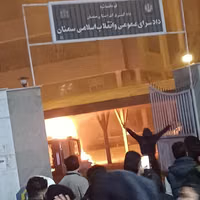
Separate eyewitness accounts from Shahin Shahr, in Isfahan province in central Iran, said armed forces fired at protesters from the rooftops of public buildings, including a haberdashery bazaar, the education department building, the municipality and the Negarestan building on the nights of Jan. 8 and Jan. 9.
Qazvin: hospitals filled with bodies and wounded
In Qazvin, in northwest Iran, an eyewitness said more than 1,000 people were killed in the city over three nights of protests from Jan. 8 to Jan. 10.
The witness said hospitals were filled with bodies and wounded people within two hours of direct gunfire by security forces on the evening of Jan. 8, adding that the blood on the floors of some medical centers lapped up to exit doors.
Behbahan: eye injuries, machine gun deployment
At least 40 people, and possibly up to 50, suffered eye injuries, a medical worker in Behbahan, in Khuzestan province in southwest Iran, told Iran Iran International. Use of buckshot which has blinded protestors has been reported in previous waves of deadly violence.
The source said vehicles equipped with machine guns were stationed in the city and fired at people on Jan. 8 and Jan. 9.
Hashtgerd: young child shot on sight
In Hashtgerd, west of Tehran in Alborz province, police fired on a family accompanied by a young child on Friday, Jan. 9, a local source told Iran International.
According to the source, a six- or seven-year-old child was seriously injured and suffered heavy bleeding after being hit in the leg by pellets.
The child’s mother said the family was not chanting slogans while leaving their home, but police opened fire as soon as they saw them, according to the source.
Shahroud: protestor shot through the heart
A 31-year-old protester identified as Matin Montazerzohur was killed after being shot by security forces on the evening of Jan. 8 during protests in the city of Shahroud, in northeastern Iran, local sources told Iran International.
Eyewitnesses said he had travelled from Gorgan to Shahroud with friends to take part in the protests and remained in contact with his family until around 8 p.m.
Hours later, his friends informed his family that he had been shot.
The source said the bullet struck him in the chest and ripped through his heart.
His body was returned to his family after four days, on Jan. 12, and transferred to Gorgan. He was buried the following day without a ceremony. Sources said he was self-employed, worked in bodybuilding and had planned to migrate to Turkey.
Isfahan: summonses and pressure on striking shopkeepers
In Isfahan, in central Iran, local sources told Iran International said the Revolutionary Guards intelligence unit summoned shopkeepers who joined strikes and blocked the bank accounts of some of them.
As Iran endures a nationwide internet shutdown in the wake of the deadliest crackdown on protestors in decades, families abroad are using satellite television to try to reach loved ones cut off from the outside world.
A Telegram-based chatbot run by Iran International allows users to submit short messages that may be aired on television, defying the blackout.
The chatbot was launched in late December, shortly before protests spread across Iranian cities and was meant to collect photos, videos and testimonials from people inside Iran. Now the information is flowing in the other direction.
Before the shutdown, the network said it was receiving more than 10 messages a minute from users inside Iran, many of them sending videos and first-hand accounts of protests and arrests.
The tool was a key means of relaying events inside Iran to the outside world, as foreign media continue to face tight restrictions on reporting from the country and the internet shutdown which began on January 8 largely cut off that flow of information.
A tool repurposed
With most global websites blocked, social media unavailable and SMS messaging down, many people inside Iran have little or no access to the internet. Some can still make international phone calls, but the connections are unstable and expensive.
People outside Iran are mostly unable to call into the country at all.
As a result, families abroad have begun using the chatbot to send short personal messages, hoping their relatives inside the country will see them on the satellite broadcasts which are one of the few means of getting information from outside.
The network displays a QR code during live programs. Viewers outside Iran can scan it or use the Telegram handle @intlmedia_bot to submit messages, some of which are then shown on air.
Since the shutdown began, the chatbot has received more than 60,000 messages, according to the broadcaster.
How the system works
The network said it has long relied on staff to review and verify user-submitted material, but introduced automated tools to help manage the growing volume of messages.
Mahdi Tajik, an editorial lead at Iran International, said the system does not store personal data, an issue that many users worry about during periods of unrest.
Tajik said the idea of using the chatbot to relay family messages emerged after the internet shutdown cut off millions of Iranians abroad from their relatives.
“Within a day, more than 60,000 messages came in,” he said. “Many people were worried about their families. Many spoke about hope and about freedom being near.”
Some users inside Iran who managed to briefly connect to the internet told the network that seeing the messages had given them comfort, he added.
'My dear husband ...'
Many of the notes are addressed clearly to specific people, often including names, cities and family details.
“My dear husband, Shabnam and I are fine. I hope you are well in Behbahan,” one message read.
Another said: “Marjan from New Zealand ... I hope you are okay. I found no way to reach you. I hope you see this message.”
A third listed several names: “Hello to Parvin, Giti, Fereshteh, Farzaneh, Houshang, Mohsen, Alireza. I am worried about you all. I hope for our beloved Iran and to see you again. Mohammad, Canada.”
Another woman wrote: “Sister Leila, my beautiful Helia and Helna. I love you so much. I am very worried about you and miss you. Take care of yourselves and our whole family. Parinaz from San Diego.”
Editors say many of the notes come from people whose spouses, parents or children are inside Iran with no way to communicate.
The messages often focus on reassuring loved ones rather than grim news events.
Pressure on access
Satellite television remains one of the few ways information can still enter Iran. Authorities, however, have sought to limit access in some areas, including by seizing satellite dishes, according to people familiar with the situation.
At the same time, Iranians abroad have taken to the streets in cities across Europe, North America and Australia to show support for protesters at home, holding rallies and vigils and calling for international pressure on Tehran.
The messages sent through the chatbot do not allow two-way communication, and there is no guarantee they will be seen by their intended recipients.
Still, for families separated by borders and the internet shutdown, they offer one of the few remaining ways to penetrate the current digital iron curtain.
Comments by British musician Roger Waters saying Iranians do not seek regime change triggered a wave of criticism from Iranian social media users, with some circulating edited images portraying him as a cleric.
Waters, a co-founder of Pink Floyd, made the remarks on Piers Morgan Uncensored on Friday when asked about nationwide protests in Iran.
He said calls for political change were not representative of the public and portrayed the demonstrations as driven by economic pressures such as inflation and currency depreciation.
“The Iranians do not want regime change,” Waters said, adding that protesters were focused on economic pressures rather than political transformation.
Waters also dismissed support for a return to monarchy or any political role for the former shah’s son, Reza Pahlavi, whose name has been chanted by protesters in the streets.
The comments drew swift pushback from Iranian users online, many of whom said Waters misrepresented the scale and slogans of the protests. Critics accused him of echoing official narratives and downplaying the extent of violence against demonstrators.
In response, activists launched an online petition titled “Show Roger Waters the True Desires of Iranians.” Arash F., the organizer, said Iran was at a critical moment and that Waters’ remarks prompted the campaign to convey what the petition describes as the demands of most Iranians at home and abroad.
“The people of Iran want regime change. The people of Iran are tired of Islam being imposed on them. The people of Iran at this point welcome any means that helps to rid us from these tyrants and thieves that operate our country,” the petition text said.
It urges Waters not to speak on behalf of Iranians and invites him to witness conditions firsthand if he wishes to comment.
Iranian rapper Shahin Najafi also weighed in on X, delivering one of the sharpest rebukes of Waters’ comments.
Najafi wrote that a figure he described as a public defender of Hamas had no legitimacy to comment on what he called the Iranian people’s revolution or their demands, arguing that such remarks amounted to aligning with “terrorist regime” and the Iranian authorities.
“More than twelve thousand Iranians have been killed by the regime’s forces. By justifying this violence, you stand complicit with the Islamic Republic. After Iran is freed from this child-killing terrorist regime, you will owe the Iranian people a clear and public apology,” he wrote.
Iranian musician and television host Arash Sobhani also criticized Waters in a post on X, saying the interview was a reminder that when an artist “replaces truth with ideology,” they stop being an artist and become a propagandist.
Sobhani added that similar images and narratives would likely be used to fire up audiences at Waters’ upcoming concerts, ending his post with a pointed reference to Pink Floyd’s Another Brick in the Wall.
Claims about protest violence
In another part of the interview, Waters attributed the killing of protesters not to state forces but to “organized armed thugs,” which he suggested could be linked to foreign intelligence services including MI6 and the CIA.
“The government sent the police out to protect those grocers, those business owners, those ordinary working people in Iran. They were attacked by gangs of armed thugs who murdered… Armed thugs probably organized by MI6 and the CIA,” said Waters.
The allegation, made without evidence, was widely criticized online as repeating official talking points and minimizing responsibility for the crackdown.
Iran International has previously reported that at least 12,000 people were killed in the largest mass killing in Iran’s modern history, during protests on January 8 and 9 that were carried out largely by the Islamic Revolutionary Guard Corps and the Basij on the orders of Supreme Leader Ali Khamenei.
User reactions remained sharp. One X user wrote that they had once admired Waters but now saw his comments as either naive or financially motivated. Another accused him of “washing away the blood of Iranians” by distorting reality.
Others shared altered images of Waters wearing a clerical turban, depicting him as sympathetic to authoritarian governments and armed groups in the region – posts that quickly spread as a symbol of anger over his remarks.
Iran’s second-largest mobile phone operator removed its chief executive amid a dispute over enforcement of the government’s internet blackout during widespread protests.
MTN Irancell failed to promptly enforce authorities’ shutdown orders as demonstrations spread, Iranian media reported.
Alireza Rafiei was dismissed after about a year in the job because he “disobeyed orders from security bodies and violated issued regulations under crisis conditions” to restrict internet access during the uprising, IRGC-linked Fars news agency said.
The move could signal “defections at the most senior levels” of the government, Mehdi Saremifar, a science and technology journalist, told Iran International.
The dismissal followed remarks by MP Hamid Rasaei, who criticized what he described as a delay in shutting down the internet during a parliament session on Monday.
Iran cut off communications nationwide on January 8 without warning as calls intensified for anti-government protests across the country.
“While it was clear that riots were about to start and despite a request by the supreme national security council, why was the Internet shut down with delay and at 10:00 pm?” Rasaei said. “If some people had not refused, the losses and casualties would not have reached this level.”
Iran’s authorities have faced sustained criticism from activists, rights groups and some foreign governments for cutting or throttling internet access during protests, a tactic critics say hampers organizing, documentation of abuses and communication with the outside world.
Officials have framed restrictions as necessary for security and public order, while critics say shutdowns isolate communities and heighten risks for protesters during periods of violence and mass arrests.
On Monday, internet monitor NetBlocks said Iran’s nationwide blackout has entered its twelfth day, with national connectivity still at minimal levels.
“In recent days, the filternet has occasionally allowed messages through, suggesting that the regime is testing a more heavily filtered intranet,” NetBlocks added.
More than 20 days into protests across Iran which have been largely quelled in the deadliest violence in decades, accounts from inside the country sent to Iran International describe a widening crackdown.
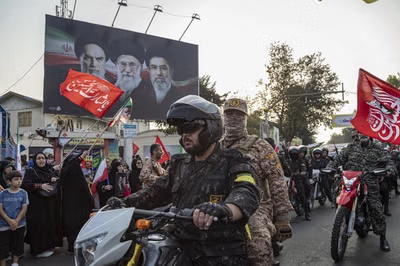
The internet remains largely cut, de facto curfews persist in several cities, authorities continue to pressure families of slain protestors while security deployments deepen in hospitals and morgues.
The protests began on December 28 and have continued despite sweeping security measures, according to witnesses and reports gathered from multiple cities across the country.
NetBlocks, an internet monitoring group, said on Monday that Iran’s nationwide internet blackout had entered its 12th day, with international connectivity still minimal. Authorities appear to be testing a heavily filtered domestic intranet that intermittently allows limited messaging, NetBlocks said.
Iranian authorities have not publicly detailed the scope or duration of the restrictions, which activists say have severely limited communication, emergency services and independent verification of events.
A small aircraft flies over the city while carrying a banner reading "Free Iran," as part of demonstrations supporting nationwide protests in Iran, in Los Angeles, California, January 18, 2026.
Judiciary warns of swift punishment
On Monday, judiciary chief Gholamhossein Mohseni Ejei described protesters as “rioters and troublemakers” and said cases linked to unrest would be handled rapidly.
“Swift and timely implementation of punishment, without delay, is one of the elements of deterrence,” Ejei said, according to state media, adding that no delay would be tolerated in pursuing protest-related cases.
Under Iranian law, some charges related to unrest – such as moharebeh (enmity against God) can carry severe penalties, including the death sentence.
Accounts received by Iran International suggest the crackdown has extended beyond the streets into hospitals, emergency care and the handling of bodies.
Witnesses in several cities said security forces entered hospitals, removed injured protesters and restricted treatment. One doctor in the northern city of Rasht told Iran International that security forces took wounded protesters from a hospital and transferred blood supplies to a military facility.
Similar reports from other cities described morgues filling rapidly and security forces maintaining a visible presence around medical centers.
Families of those killed said they faced pressure when seeking information about bodies or burial arrangements, including financial demands and restrictions on funerals.
Several accounts said ambulances failed to reach areas where shootings occurred, with some witnesses saying phone networks were down and emergency calls could not be placed.
Others said wounded protesters bled to death after taking shelter in nearby buildings because hospitals refused to admit them or because transport was unavailable.
Witnesses described widespread use of live ammunition and pellet guns in cities including Karaj, Rasht, Shiraz and parts of Tehran province.
In Karaj, residents said security forces used tactical withdrawals to funnel large crowds into enclosed areas before opening fire. In Rasht, witnesses said protesters were trapped amid smoke and flames before being shot. No specific dates were mentioned in these accounts.
Reports from multiple cities indicated that informal curfews were in effect on Sunday, with armed patrols, checkpoints, phone searches and restrictions on nighttime movement. Residents said leaving homes after certain hours could lead to threats or detention.
Detentions and holding sites
Witnesses also reported large numbers of arrests, with some detainees held in non-prison facilities such as government buildings, camps or utility compounds.
In the northern city of Gorgan, one resident said dozens of bodies were temporarily held at a camp, while detainees were taken to a nearby prison quarantine area. Similar accounts from Qom and Isfahan described protesters being held in improvised locations.
Tight controls on burials
Accounts described families being warned to accept official narratives about the deaths of relatives or face delays in retrieving bodies. Some said burials were conducted at night with limits on attendance, while others described threats of unmarked or collective burials.
Witnesses also reported verbal abuse by security personnel at burial sites and forensic facilities.
International reaction
The protests have prompted demonstrations by Iranian communities abroad, including in Europe, Asia and Oceania with massive rallies held in the US, UK and Canada.
Several European countries have summoned Iranian ambassadors in recent weeks, while senior officials in Germany and other states have made unusually blunt statements criticizing Tehran’s handling of the unrest.
Iranian officials have repeatedly blamed foreign powers, including the United States and Israel, for the protests, accusations denied by Western governments.
With internet access still largely cut and independent journalists unable to operate freely, the full scale of the violence remains unclear.
Iran International continues to receive a high volume of consistent eyewitness accounts from across the country, but verification remains difficult due to the communications blackout and security restrictions.
For many Iranians, witnesses said, the combination of street violence, disrupted medical care and pressure on families has turned daily life into what they described as an atmosphere of fear and uncertainty more than three weeks after the protests began.
At least 16,500 protesters have been killed and about 330,000 injured during Iran’s unrest, according to a report compiled by doctors inside the country and cited by The Sunday Times, as a near-total internet blackout has made independent verification increasingly difficult.
The report, based on information from a network of medical professionals across Iran, said the injuries included widespread gunshot wounds and severe eye trauma, with hundreds to thousands suffering permanent blindness.
Iran’s Supreme Leader Ali Khamenei acknowledged for the first time on Saturday that “several thousands” had been killed since protests began three weeks ago, blaming the violence on protesters and foreign enemies.
The doctors’ report said most deaths occurred over two days during what it described as the most violent phase of the crackdown in the Islamic Republic’s 47-year history, with most victims believed to be under 30.
Professor Amir Parasta, an Iranian-German eye surgeon and medical director of Munich MED, told The Sunday Times the data was gathered through doctors communicating via smuggled Starlink satellite terminals after internet access was cut on January 8.
“This time they are using military-grade weapons,” Parasta was quoted as saying, adding that doctors were seeing gunshot and shrapnel wounds to the head, neck and chest. He said at least 700 to 1,000 people had lost an eye.
Figures compiled from eight major eye hospitals and 16 emergency departments cited in the report put the number of injured between 330,000 and 360,000. One Tehran eye hospital, Noor Clinic, documented around 7,000 eye injuries alone, according to the report.
An ophthalmologist quoted by The Sunday Times said the volume of pellet-related eye injuries had overwhelmed hospitals. Another witness cited said more than 800 eye removals were performed in a single night in Tehran.
Medical sources said some patients died due to blood shortages, with one surgeon quoted as saying security forces had at times prevented blood transfusions.
Witnesses who spoke to The Sunday Times described security forces firing live ammunition at protesters, including shots aimed at heads, and deploying snipers on rooftops. Accounts also described the use of Kalashnikov rifles and machineguns mounted on vehicles.
The report said many wounded protesters avoided hospitals out of fear of arrest, while some injured patients were allegedly taken from operating theatres by security forces.
Several witnesses said bodies were removed from streets by security forces and transferred to other cities, while families were pressured to pay large sums to retrieve remains.
Iranian authorities have repeatedly blamed the unrest on foreign powers, including the United States and Israel. In his address, Khamenei described protesters as “foot-soldiers of the United States” and claimed they were armed with weapons imported from abroad.
The protests began in late December over economic grievances and rapidly spread nationwide, intensifying after January 8 following a call to demonstrate by Reza Pahlavi, son of Iran’s late shah.
Despite the scale of reported casualties, the full extent of the violence remains unclear due to the ongoing communications blackout, now in its tenth day, and restrictions on independent reporting.
Human rights activists and medical professionals cited in the report warned that the true toll could be higher, saying many deaths and injuries have gone unrecorded amid fear, secrecy and the continued presence of security forces across Iranian cities.