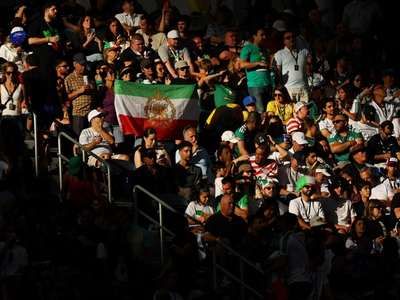
Iranians at home applaud overseas rallies as source of ‘hope and unity’
Protesters hold pre-1979 Iranian flags during a rally against Islamic Republic, in Munich, Germany on February 14, 2026.
Widespread rallies by Iranians abroad, held in response to a call by exiled Prince Reza Pahlavi, drew an outpouring of support from inside Iran, with many describing the gatherings as a renewed source of hope and unity.
German authorities said nearly 250,000 people attended the Munich rally, calling it the largest protest by Iranians in Europe to date. Organizers and local officials also reported large turnouts in Toronto and Los Angeles, each estimated at around 350,000, as well as 50,000 in London and 45,000 in Vancouver.
Speaking at the Munich event, Prince Reza Pahlavi addressed people inside Iran directly. “Know and see that you are not alone and that your voice has reached the world,” he said.
Messages sent to Iran International and widely shared on social media described what contributors called an unprecedented display of cohesion and discipline across continents.
Messages from inside Iran
One viewer wrote: “Salute to our honorable compatriots outside Iran. Seeing the beautiful images of unity, harmony, civility and order brought tears of joy to our eyes inside the country.”
Another message read: “We were tired and disappointed, but when we saw you in the gatherings abroad, we cried for all of us. Who can separate us from each other?”
A resident of Tehran wrote, “We bow our heads in respect to all our compatriots around the world. We saw your gatherings everywhere and wept.”
From Shiraz, a viewer addressed the authorities, writing: “Every bullet you fired at our young people united our hearts more. We are now united, aware and full of faith.”
Others described the rallies as a turning point after weeks of pressure at home. “Yesterday, after 37 days, for the first time we were not sad or hopeless. Everyone was talking about you, and there was excitement in their eyes,” one message said.
Several framed the demonstrations as evidence of a shared national purpose transcending borders. “It was proven that the power of love for Iran and Iranians does not fit within political and geographical boundaries,” one viewer wrote.
“With seeing you, every moment was tears and emotion. We hope to celebrate our freedom soon on our own soil,” another message said.
Support extended beyond messages sent directly to Iran International. Similar posts circulated widely across social media platforms, echoing themes of unity, perseverance and anticipation of political change.
The scale of the February 14 rallies prompted criticism from state media, officials and pro-government online activists, who questioned attendance figures and accused organizers of exaggeration.
Responses ranged from attempts to downplay the gatherings to verbal attacks on participants abroad. Supporters inside Iran, however, portrayed the demonstrations as a morale boost amid continuing domestic restrictions.
“Your presence is a bridge of hope and solidarity that lights many hearts inside the country,” another Tehran resident wrote.
Iran’s President Masoud Pezeshkian on Tuesday urged police to manage public unrest with the least possible cost, over a month after a sweeping crackdown on protests in which more than 36,500 people were killed.
Speaking at a graduation ceremony for police cadets, Pezeshkian said authorities must maintain order while minimizing harm to security forces and civilians, as Iran continues to grapple with the aftermath of nationwide unrest.
“We must be able, as far as possible, to manage the country and society with the least damage and establish peace and security within it,” Pezeshkian said.
The protests were suppressed in a crackdown that left 36,500 people dead over two days in January, one of the deadliest episodes of unrest in modern history.
Pezeshkian said preventing unrest from escalating into crisis should be a priority.
“If there is dissatisfaction or a problem in society, we must not allow it to turn into a crisis. It must be prevented and treated,” he said. “In the third step, when an incident occurs, it must be managed with the minimum cost to the parties involved.”
At the same time, he stressed that those deemed responsible for disturbances should be detained firmly.
“You must manage the scene in such a way that the person who has created disorder is arrested with strength, authority and safety and handed over to the judiciary to be dealt with according to the law,” he said.
The president called for equipping police and security forces with new technologies to manage incidents without injury to officers, adding that the government would support law enforcement.
“We must not allow the health of our police forces to be put at risk,” he said. “All our efforts must be that none of you, as far as possible, are harmed in any scene.”
Iranian authorities have described the unrest as part of foreign-backed efforts to destabilize the country, while protesters have demanded political change and economic relief.
Pezeshkian said public security was essential and credited law enforcement as “the creators of security in Iran.”
Iran’s Supreme Leader Ali Khamenei addresses a gathering of people from East Azarbaijan province in Tehran on February 17, 2026.
Iran’s Supreme Leader Ali Khamenei said the United States will never succeed in toppling the Islamic Republic and warned that even the world’s strongest military can suffer crippling blows.
“The US president said in one of his recent remarks that for 47 years America has been unable to eliminate the Islamic Republic; he complained about it to his own people. For 47 years, America has not been able to eliminate the Islamic Republic. That is a good admission,” Khamenei said at a meeting with people from East Azarbaijan province on Tuesday.
“I say: You, too, will not be able to do this.”
His comments come days after Trump said regime change “would be the best thing that could happen.”
Khamenei also addressed remarks by the US president that the American military is the strongest in the world.
“The strongest army in the world may at times receive such a slap that it cannot rise,” he said.
“They keep saying we have sent an aircraft carrier toward Iran. Very well, an aircraft carrier is a dangerous device, but more dangerous than the carrier is the weapon that can send it to the bottom of the sea.”
His statements come amid heightened rhetoric between Tehran and Washington over military deployments and regional security and at the time a new round of negotiations mediated by Oman is underway in Geneva.
Talks with US
US threats and demands, Khamenei added, reflected an attempt to dominate Iran. “These statements by the US president, sometimes threatening, sometimes saying this must be done or that must not be done, mean they seek domination over the Iranian nation,” he said.
“Iran will not pledge allegiance to corrupt leaders currently in power in the United States.”
“They say let us negotiate about your nuclear energy, and the result of the negotiation should be that you do not have this energy,” he continued. “If a negotiation is to take place, and there is no place for negotiation, determining its result in advance is wrong and foolish.”
Iran’s Supreme Leader Ali Khamenei meets with people from East Azarbaijan province in Tehran on February 17, 2026.
US presidents and some senators, he went on, were making an “absurd” demand by setting conditions before any dialogue.
January protest remarks
In the same speech, Khamenei said those killed during the January protests are mourned as martyrs.
“Blood was shed. We are grieving. I say we are in mourning for the blood that was shed,” he said, adding that not all of the dead fell into the same category.
Security forces responded to the latest nationwide protests with lethal force, mass arrests, and communication blackouts. At least 36,500people killed in the recent wave of unrest, while authorities acknowledge a far lower figure of about 3,117.
Security forces, according to the Amnesty International, moved quickly after the killings to impose sweeping controls aimed at silencing survivors, intimidating families of victims and preventing documentation of what it described as unlawful mass killings carried out to crush what it called a popular uprising.
The measures included arbitrary mass arrests, enforced disappearances, bans on gatherings, night-time curfews, and a near-total internet blackout, alongside the deployment of heavily armed patrols across cities and inter-city roads, Amnesty International said.
Khamenei argued some were “corrupt elements and instigators,” while others were not involved in organizing the protests. He divided the dead into three groups, beginning with what he described as "defenders of security" – police, Basij and Guards members and those alongside them – calling them “among the greatest martyrs.”
He described a second group as bystanders. When turmoil breaks out in a city, he said, “innocent people walking toward their workplace or their homes are also killed,” adding that they too should be considered martyrs because their deaths occurred within “the enemy’s sedition.”
A third group, he said, consisted of those who had been misled. “They were deceived, inexperienced… they are also ours; they are our children,” he said, adding that some later wrote to him expressing regret. Officials, he said, were right to count those killed from this group as martyrs.
“Therefore, the circle of our fallen whom we count as martyrs is a wide one,” he added, excluding only what he called “the ringleaders and those who took money and weapons from the enemy.”
Khamenei concluded by offering prayers for mercy and forgiveness for those he described as misled participants, framing the uprising as an enemy-driven plot rather than a domestic protest movement.
About a quarter of cafés in parts of Iran have shut down in the past three months, according to a senior industry official who says protests, legal pressure and economic strain have severely affected the sector.
Ali Za’fari, deputy head of the coffee shop owners’ union, said cafés have faced waves of closures, legal cases and official sealing orders since protests began earlier this year.
“From the beginning of the protests, there were lots of reports about cafés – from sealing to judicial cases and the closure of many of them,” he was cited as saying by the website Kafenevesht.
He said business activity has not recovered despite some customers returning. “Customers more or less came back to cafés, but the situation is not like before,” Za’fari said, adding that many venues are still closing in silence or operating only partially.
“In the past three months, 25 percent of cafés have shut down,” he said. Za’fari added that conditions worsened during the protests and that the union’s efforts to defend café owners “barely” produce results.
The difficulties facing cafés reflect broader challenges for small businesses, particularly those dependent on daily customer traffic.
The crackdown on protests and the prolonged internet blackout have aggravated an already strained economy, leaving businesses facing uncertainty as Iran remains in a prolonged economic and political limbo.
The disruption has coincided with continued tensions and diplomatic talks unfolding under the shadow of potential military escalation, further complicating the outlook for investment and employment.
Job marker on ‘red alert’
Separate data based on figures from the online recruitment platform IranTalent indicate that hiring demand across the economy has also fallen sharply since internet restrictions were imposed last month.
According to the analysis, overall hiring demand has dropped by 57 percent since nationwide internet disruptions began. The decline has been especially severe among small and medium-sized companies.
In the first three weeks of the international internet blackout, demand for new hires at these firms fell by 74 percent compared with the period before the restrictions, according to the same data.
IranTalent’s chief executive, Asiyeh Hatami, described the job market as being in a “red alert” state and warned of a wave of employment contracts that may not be renewed at the end of the year.
The figures indicate a broad slowdown in hiring activity, particularly among smaller employers.
Za’fari said the pressure on cafés has continued even after the most visible enforcement actions subsided, with many businesses shutting down without public announcements.
While some cafés remain open, he said, the sector continues to face legal, economic and operational challenges following the unrest and related restrictions.
Exiled Prince Reza Pahlavi during solidarity march in Munich, February 14, 2026
As President Trump weighs options against Iran, he faces a legacy‑defining choice that could reshape the century, with the Islamic Republic at its most precarious moment since 1979 after years of US pressure and a determined popular uprising.
The emergence of Iran’s exiled Crown Prince Reza Pahlavi as the clear leader of the democratic opposition, should offer reassurance to President Trump, who is weary of protracted military entanglements. During the January uprising in Iran, Pahlavi’s name was the only one consistently chanted on Iran’s streets, even as the regime’s brutal crackdown claimed over 30,000 lives.
The Prince’s domestic support is matched by the massive backing of the Iranian diaspora, demonstrated last weekend in the “Global Day of Action,” with over a million people rallying in Munich, Toronto, Los Angeles, and other cities worldwide. That grassroots support is now translating into international recognition, underscored by Pahlavi’s momentous weekend in Munich.
This year’s Munich Security Conference (MSC) reflected a meaningful shift. In a departure from past gatherings, officials from the Islamic Republic—including Foreign Minister Abbas Araghchi—were disinvited. Instead, organizers invited Pahlavi, signaling that the international debate on Iran is shifting from regime normalization toward recognition of the Prince as a viable alternative.
At a press conference in Munich, the Crown Prince outlined a roadmap to democracy: drafting a new constitution, ratifying it via national referendum, and holding free elections under international oversight. On this global stage, he emerged as the architect of a credible, orderly transition—one the Trump administration and other governments could confidently support. Asked about his political ambitions, he called himself a bridge to free elections, not the final destination.
Pahlavi’s vision rests on four core pillars for a post-clerical Iran: the country’s territorial integrity; individual liberties and equality for all citizens; the separation of religion and state; and the Iranian people’s right to choose their version of a democratic form of government—whether a republic or a constitutional monarchy, like in the UK, Spain, or Sweden. These principles form the political foundation of his broader approach to national renewal.
That strategy also includes a detailed economic plan called the Iran Prosperity Project (IPP), which outlines the first 100 days following the regime’s collapse and the longer-term reconstruction of a free Iran. As Washington Post’s David Ignatius observed, IPP is a “superb transition blueprint” that is “smarter than anything the U.S. government or Iraqi exiles produced before the 2003 invasion.”
The plan is deliberate in its scope: “agency by agency, it details how to rebuild a cohesive Iran. It lists 34 military, intelligence and police organizations and describes the approach that should be taken to each—dissolving a few, retaining and vetting the others.”
IPP is supported by prominent business leaders. At the initiative’s rollout event, Uber’s Iranian-American CEO, Dara Khosrowshahi, indicated that Uber—and other major companies—would “invest aggressively” in Iran within the first 100 days, adding, “The sky is the limit.”
Economic vision aside, Pahlavi has also proposed six ways the international community can help Iranians to liberate themselves: degrade regime repressive capacity by targeting IRGC leadership; deliver maximum economic pressure by blocking assets and dismantling ghost tankers; break information blockades with Starlink; hold the regime accountable by expelling Iranian diplomats and pursuing legal action; demand immediate release of political prisoners; and prepare for democratic transition by recognizing a legitimate transitional government.
That recognition of the inevitable regime change in Iran has gained momentum over the last month and was unmistakable in Munich. German Chancellor Friedrich Merz declared, “A regime that can only hold onto power through sheer violence and terror: its days are numbered.” European Parliament President Roberta Metsola said, “The world is witnessing a wave of change in Iran. Now is the time to double down on support for liberty.” Canadian Foreign Minister Anita Anand was unequivocal: “We will not open diplomatic relationships with Iran unless there is regime change. Period.” U.S. Senator Lindsey Graham, waving the Lion and Sun flag at a Munich rally, proclaimed, “Liberation is at hand.”
International acknowledgement of Pahlavi’s leadership was further underscored by his meeting with Ukraine’s President Volodymyr Zelenskyy in a setting typically reserved for heads of state. Zelenskyy, whose country has been terrorized by Iranian Shahed drones, warned bluntly: “Regimes like the one in Iran must not be given time. When they have time, they only kill more.” Weeks earlier in Davos, he cautioned that rewarding brutality with survival sends a dangerous message: “Kill enough people and you stay in power.”
For his part, President Trump has said just days ago that regime change in Iran “would be the best thing that could happen.” During the height of what has become known as the Lion and Sun Revolution, he pledged support for protesters, posting that “help is on its way.” As his armada heads toward Iran, a rare moment in history is taking shape when a resolute leader of the free world can save lives, protect America from a regime that has sought “Death to America,” and cement his legacy as one of history’s greatest peacemakers.
At this Munich moment, all eyes are once again on Donald J. Trump. His decision, undoubtedly, hinges on the answer to “what happens next?” Reza Pahlavi’s emergence as a credible leader could tilt the scales toward regime change. History—and the Iranian people—await the President’s call.
Sam Afshari, 17, was wounded during nationwide protests in Iran and taken away alive by security forces before later being shot and killed, according to human rights investigators.
A 17-year-old protester wounded during Iran’s January protests was later killed after being taken into custody by security forces, according to testimony and forensic analysis gathered by the Iran Human Rights Documentation Center (IHRDC).
Human rights investigators say evidence indicates Sam Afshari was alive when security forces detained him in the city of Karaj, but was later killed by a gunshot wound to the head consistent with an execution carried out after his arrest.
“The bullet entered through the back of his head and exited through his face," Shahin Milani, IHRDC Executive Director told Iran International.
"The injury he sustained during the protests was not the shot that killed him,” Milani said.
Before leaving to join the protests, Sam sent a final message to his father on Jan 7.
“Dad, don’t tell mom anything. I’m going to fight for my rights. Iran is in danger. Please don’t tell my mother.”
His father, Parviz Afshari, who lives in Germany, would spend days searching for answers after his son disappeared.
According to Milani, testimony gathered from the family indicates that Sam’s initial injury during the protests was not fatal.
Residents living nearby Taleghani Square in Karaj saw that Sam had been wounded and attempted to bring him inside to help. Before they could do so, security forces arrived and dragged him away while he was still alive, according to his father’s account.
"The inhuman repressive forces dragged my son," Parviz told IRHDC in a video recording.
After that, he vanished.
“When his family eventually recovered his body, it was clear he had been shot again,” Milani said.
Where the fatal shooting occurred remains unclear. Sam’s father received conflicting accounts — one suggesting it may have happened at a medical facility and another claiming detainees were shot while being transported. Investigators say those details cannot yet be independently confirmed, but the available evidence indicates he was killed after arrest.
Sam's father described him as an exceptionally talented teenager — a computer science prodigy, a competitive swimming champion and fluent in multiple languages.
Milani said interviewing the father was deeply personal, underscoring how the profile of victims in Iran has changed over time.
“The father is nearly my age,” Milani said. “It forces you to realize that the young people being killed today are children who could have been our own.”
Sam Afshari’s case is part of a broader pattern emerging from Iran’s January crackdown, during which students and minors were among those killed. An Iranian teachers’ union has published the names of roughly 200 students killed during the protests, describing the list as both a record of loss and a demand for accountability.
At least 24 children, including a three-year-old, were killed by direct fire from security forces during Iran’s nationwide protests, according to the HANA Human Rights Organization. The group said it confirmed the identities of the children through on-the-ground research and cross-checking multiple sources.
HANA said the shooting of children was not an isolated incident but part of a systematic pattern, with gunfire in many documented cases directed at vital parts of the body.
For Sam's father - the loss is already painfully clear — a teenager who left home believing he was fighting for his future and never returned.
Sam had been preparing to join him in Germany later this year — a plan that ended before it could begin.