Republican Senator Tommy Tuberville speaks with Iran International's Marzia Hussaini in the US Capitol
Gaza ceasefire talks advanced largely because Tehran was excluded, Republican Senator Tommy Tuberville told Iran International, urging the Trump administration to focus on reviving Israel normalization deals instead of engaging in negotiations with Iran.
During Donald Trump’s presidency, Tuberville argued, Iran had little sway over events in Gaza, and that US diplomacy was more effective because the White House avoided direct engagement with Tehran on the issue.
“Iran is non-relevant right now,” he said. “As President Trump said – they weren’t. There was no negotiation.”
Speaking on Capitol Hill, the Republican senator praised Qatar and Turkey for their roles in clinching the Gaza peace agreement but said efforts to end the Israel-Palestine conflict should not rely on temporary truces.
“In the Middle East, between Hamas and Israel -- obviously we’ve fought for 2,000 years,” Tuberville said. “We’re not going to solve it in a week with just one ceasefire and a peace deal.”
Under a US-brokered truce, Hamas was required to release the final 20 living Israeli hostages within 72 hours of Israel’s withdrawal on October 10, a condition it met, and to provide the remains or details of all those killed within the same timeframe.
Hamas failed to meet that latter condition, later handing over 15 of 28 deceased hostages. Israel has accused the group of deliberately withholding the remains of others believed to be in its custody.
Iran has long supported Hamas with funding, weapons, and training, positioning the group as part of what Tehran calls its “axis of resistance” against Israel and Western influence.
Tuberville said restoring the Abraham Accords - Trump-brokered normalization deals between Israel and Arab countries - should be a key regional priority.
“Maybe we can get the Abraham Accords back intact,” he said. “I think that’s going to be a big deal — but it’s a mess.”
Last month, Trump expressed hope that even Iran would join the Abraham Accords.
"Who knows maybe even Iran can get in there, we expect, we hope we are going to be able to get along with Iran. I think they're going to be open to it, I really believe that" Trump told reporters in late September.
"I long ago said at one point Iran would be a member of the accords. And little did I realize it was going to take this turn. It was some turn we did with the B-2s."
"I think they might very well be there, it would be a great thing for them economically."
Land subsidence driven by decades of groundwater over-extraction is emerging as a direct threat to some of Iran’s most treasured heritage sites, including Persepolis, Naqsh-e Jahan Square and the Tomb of Cyrus, Iranian scientists and officials say.
Geologists cited by Tasnim news agency said subsidence has accelerated across provinces such as Isfahan, Fars and Tehran, with field observations of cracks, surface fissures and foundation instability near historic structures.
“Nearly half of Iran’s valuable historic fabric lies in subsidence-prone zones,” geologist Ali Shahbaz was quoted as saying, adding that “63 nationally registered monuments and 27 world-class sites” are in affected areas.
In Isfahan, the long-dry Zayandehrud river has been linked to ground settlement of roughly 16-25 cm a year in the city’s north, raising stability concerns for Naqsh-e Jahan Square, the Shah and Sheikh Lotfollah mosques, and the Safavid-era Si-o-se-Pol and Khajou bridges, Tasnim reported.
In Fars province, subsidence in the Marvdasht plain -- estimated around 14 cm a year -- has prompted warnings about drainage systems and stone platforms at Persepolis and potential long-term risks to the Tomb of Cyrus at Pasargadae and the rock-cut tombs of Naqsh-e Rostam.
The concerns come amid broader alarms over nationwide land-subsidence.
Tasnim, citing official tallies, said 380 cities and about 9,000 villages have reported some level of subsidence, with roughly 42 million people living on sinking ground.
Iran’s Geological Survey says two decades of drought and sustained over-pumping, compounded by fragmented water governance, have pushed 106 plains into non-recoverable subsidence.
Cultural-heritage specialists stress there is no immediate risk of collapse at marquee sites, but warn that cumulative deformation, coupled with drying soils and sporadic heavy rains, could inflict irreversible damage over years to decades.
“No site is on the brink today,” Shahbaz said. “But without curbing withdrawals and restoring groundwater, we are setting the stage for losses that cannot be repaired.”
Mossad logo and Israel flag are seen in this illustration taken May 6, 2025.
Israel’s Mossad identified a senior Islamic Revolutionary Guards Corps (IRGC) commander it says directed a series of thwarted attacks on Israeli and Jewish targets across multiple countries, exposing what it called a years-long Iranian campaign of global terrorism.
The Mossad named Sardar Ammar, a senior Quds Force officer operating under commander Esmail Ghaani, as the leader of a network responsible for planned operations in Australia, Greece, and Germany during 2024-2025, a statement released via the prime minister’s office on behalf of the Mossad said on Sunday.
The Mossad described the network’s methods as “terror without Iranian fingerprints,” using foreign recruits, criminal intermediaries, and covert communications to conceal Tehran’s role.
“Thanks to intensive activity with partners in Israel and abroad, dozens of attack tracks were thwarted, saving many lives,” the statement said.
Commander Ammar (upper left), and other prominent commanders from the IRGC’s Quds Force in a diagram published by Mossad
In August, Australia expelled Iranian Ambassador Ahmad Sadeghi and announced plans to designate the IRGC as a terrorist organization, after intelligence linked Tehran to antisemitic arson attacks in Melbourne and Sydney. Sadeghi denied the allegations upon his departure.
In Germany, authorities summoned Iran’s ambassador, Majid Nili Ahmadabadi, in July after the arrest of a Danish suspect accused of spying on Jewish and Israeli-linked sites in Berlin for Iranian intelligence. German officials said the surveillance could have been preparatory to terrorist attacks.
Iran’s covert campaign and regional reach
The Mossad accused Iran of pursuing a long-term strategy “to harm innocents around the globe while maintaining deniability,” but said the recent revelations “strip Iran of its space for denial and impose heavy diplomatic costs.”
The statement cited earlier cases in Greece as part of the same pattern. In 2024, Greek police arrested suspects, including Iranian and Afghan nationals, over arson attacks on an Israeli-owned hotel and a synagogue in Athens.
A year earlier, two Pakistani men were charged with plotting attacks on Israeli and Jewish sites in the city under Iranian direction.
The dismantling of Ammar’s network and the resulting diplomatic pressure, the Mossad said, marked a significant blow to Iran’s covert operations abroad, demonstrating what it called the Islamic Republic’s “repeated operational failures and growing international isolation.”
File photo of arms shipment intercepted at the Jordanian border
Three Turkish nationals have been charged in Israel with attempting to smuggle firearms into the country from Iran through Jordan, in what prosecutors describe as part of a wider Iranian effort to arm militants inside Israel.
The State Attorney’s Office filed the indictment on Sunday at the Nazareth District Court against Rahman Gokayer, Younes Ozel, and Oktay Asci, accusing them of illegal entry, weapons trafficking, and ties to foreign arms dealers. Asci also faces a charge of aiding terrorist activities.
Gokayer and Asci traveled from Turkey to Saudi Arabia and then to Jordan in September 2025, where they agreed to infiltrate Israel and smuggle three handguns supplied by Iranian intermediaries, according to the indictment.
The plan was later abandoned after internal disagreements, but the two crossed illegally near Kibbutz Shaar HaGolan.
Asci had previously lived in Israel without a permit for more than two years before being deported in July 2025. During that period, prosecutors say, he obtained a firearm in Bat Yam, buried it near his apartment, and later handed it to an unidentified individual.
After his deportation, Asci maintained contact with Gokayer and Iranian brokers through Turkish intermediaries, planning to route guns from Iran to Jordan and into Israel via Palestinian laborers. Gokayer’s role was to collect the weapons, transfer them to others, and manage the proceeds, for a promised payment of one million dollars.
“The plan was to transport the guns to Jordan and smuggle them into Israel using workers crossing the border. Gokair was supposed to receive the guns and transfer them to other parties and collect the money from the transactions. For his role in the smuggling network, Gokair was promised a payment of $1 million,” reads the indictment.
Ozel, already in Israel, was told to complete a weapons deal in Tel Aviv but twice left empty-handed. Prosecutors say he kept 5,000 shekels from the funds meant for the transaction. All three men remain in custody.
Iranian smuggling networks foiled
Earlier this month, Israel’s Shin Bet security agency said it had thwarted a major Iranian attempt to move a cache of advanced weapons into the West Bank for planned attacks. The haul included explosive devices, drones, anti-tank weapons, grenades, rifles, and ammunition.
An image of Iranian weapons seized in the West Bank, released by Shin Bet on October 8, 2025.
Shin Bet traced the operation to Iran’s Islamic Revolutionary Guard Corps, involving Unit 400 under Javad Ghafari and Unit 18840 in Syria, which reports to Asghar Bakri, head of the covert Unit 840. Two IRGC operatives killed in Israeli strikes in Lebanon in July -- Salah al-Husseini and Muhammad Shuayb -- were also involved.
Iran is pursuing a broader strategy to arm groups in the West Bank to attack Israeli civilians and forces, the agency said.
In March 2024, Shin Bet and the Israel Defense Forces intercepted another Iranian arms shipment that included grenade launchers, explosives, mines, and assault rifles.
A nine-year-old student died suddenly during a school break in the western Iranian city of Ilam on Saturday, local media reported, amid a spate of student deaths and allegations of mistreatment in schools across the country.
The student, identified as Parnia Rezaei, collapsed during recess at Naderi Elementary School, according to the news outlet Didban Iran. The cause of death has not yet been determined.
Abbas Omidi, the head of Ilam’s education department, said the death occurred suddenly and that school staff immediately called emergency services.
“The student was transferred to hospital for urgent medical care, but resuscitation efforts were unsuccessful,” Omidi told reporters.
Authorities in Ilam said an investigation into Rezaei’s death is underway.
Rezaei’s death follows several recent incidents involving students’ deaths and alleged abuse in schools since the start of the new academic year in late September.
Earlier in October, 12-year-old Sam Zarei in Shiraz took his own life after psychological pressure from school officials, according to reports on Iranian media.
Also in October, Zahra Golmakani, a 10-year-old student in Mashhad, died of what authorities described as cardiac arrest during class.
Similar reports have emerged from the provinces of Mazandaran, Qazvin, and Zanjan, where students have died or been injured following disciplinary actions.
Despite an education ministry directive explicitly banning corporal punishment and verbal abuse, rights advocates and teachers’ unions say such incidents remain frequent, reflecting systemic failures in oversight and student protection.
Iran’s top social affairs official on Sunday warned of a rise in suicide among children under 12, calling it a troubling shift that was once “very rare.”
Mohammad Bathaei, head of the National Organization for Social Affairs, told ILNA that schools and universities lack effective curricula to build resilience and coping skills, saying “education systems have not started preventive work in a meaningful way.”
Bathaei said emergency responses also remain inadequate despite efforts by the Social Emergency network and Health Ministry.
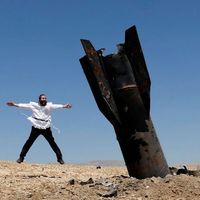
Iranian missile Sayyad-2 on display in an exhibition in Iran
Tehran has never relied on Russia for its military power, a former chief-commander of Iran's Revolutionary Guards said, adding that Moscow now depends on Iranian missiles and drones, not the other way around.
“Iran received assistance from Libya and North Korea in the field of missile technology, but not from the Russians,” Mohammad-Ali Jafari said in an online interview posted on YouTube on Saturday.
During the early post-revolutionary years, he added, Iran was permitted to reverse-engineer certain systems and exchange limited technical information with Tripoli and Pyongyang.
“The Russians offered no real help,” he said. “On the contrary, they are now the ones who need our missiles and drones.”
Iranian-designed drones have been key to Russia's war effort against Ukraine, even though Tehran denies providing Moscow with such weapons.
However, Moscow provided little, if any, support during Iran's brief summer war with Israel.
The two countries have signed a long-term security framework, but Russia’s restraint underscores the limits of its backing.
Earlier this month, Russian Foreign Minister Sergey Lavrov said his country was "engaged in supplying the equipment that the Islamic Republic of Iran needs" even after UN sanctions were reimposed last month.
‘Russia now seeking Iranian technology’
Iran has "never relied on Russia for our [military] capabilities, they are the ones who need our missiles and drones," Jafari said in his online interview, adding that Moscow’s reliance on Iranian systems underscores how the balance of capability has shifted.
Jafari dismissed the notion that Moscow’s technology exceeds Tehran’s, arguing that Iran’s advancements in precision and guidance systems outpace those of Russia.
“It’s unlikely that the Russians possess the pinpoint accuracy our missiles have. In terms of precision and technology, we are different from them,” he said.
Iran’s strength lies in domestically developed systems, the former IRGC chief said, describing the country’s missile and drone capabilities as products of “decades of indigenous effort.”
“Foreign input had been useful in the early stages but our engineers quickly surpassed the models we studied.”
Iran, Jafari said, had been preparing for potential conflict with Israel since the 1990s, which guided the decision to focus on missile and drone forces over fighter jets.
“At that time, it was decided that the army’s air force would concentrate on aircraft and defense, while the IRGC would handle the aerospace, missile, and drone sectors.”
Earlier this month, leaked Russian defense documents indicated Iran had signed a €6 billion deal to buy 48 Su-35 fighter jets from Moscow, with deliveries expected between 2026 and 2028.
Last month, an Iranian lawmaker said Russian MiG-29 fighter jets had arrived in Iran as part of a short-term plan to bolster its air force, with more advanced Sukhoi Su-35 aircraft to follow gradually.
Iran has long sought to modernize its aging air force, which relies heavily on US-made jets purchased before the 1979 revolution and a small number of Russian and locally upgraded aircraft.
Western analysts say Iran’s request for 50 aircraft remains only partly fulfilled, with deliveries slowed by Russia’s own needs in Ukraine.
Tehran also faces vulnerability in air defenses after Israeli strikes earlier this year destroyed its last Russian-provided S-300 systems. Iran had acquired the four S-300 battalions from Russia in 2016.