Food prices surged and basic goods slipped out of reach across Iran, citizens told Iran International in recent days, describing shortages and daily price jumps following a ceasefire that has coincided with worsening economic conditions.
“Prices here have increased tenfold and rice and cooking oil are hard to find,” one resident wrote from Zahedan in southeastern Iran, pointing to worsening access to staple goods.
Other citizens described the rapid erosion of purchasing power. “We go to sleep and wake up to everything being twice as expensive,” one message said, reflecting widespread concern over accelerating inflation.
Food costs climb, access narrows
Messages from multiple cities highlighted steep increases in the cost of everyday items. Citizens said even the most basic foods were becoming unaffordable, with eggs, rice and cooking oil among the hardest hit.
“Eggs have become so expensive they are being removed from our tables,” one citizen wrote, describing the shrinking range of affordable protein options.
Shoppers queue at a butcher’s counter in Iran as food costs continue to climb.
Restaurant prices were also cited as an indicator of inflation. Citizens said a single serving of kebab now costs between 5,000,000 and 6,000,000 rials (about $3.10 to $3.75), while a plate of chicken with rice ranges from 3,000,000 to 4,000,000 rials (about $1.90 to $2.50). Soft drinks were reported to exceed 1,000,000 rials (about $0.60).
Based on an exchange rate of around 1,600,000 rials per dollar, the new minimum monthly wage of 162,550,000 rials is equivalent to roughly $104. This comes as annual inflation had already exceeded 70 percent before the start war on February 28, reaching its highest level since World War II.
man sells fruit at the Grand Bazaar, amid the US-Israeli conflict with Iran, in Tehran, Iran, March 18, 2026.
As of late 2025/early 2026, average Iranian incomes have contracted to roughly $200 per month.
Shortages compounded the problem. Messages described difficulty finding chicken in distribution centers and limits on purchasing cooking oil in shops. Others pointed to disruptions in supply chains linked to industrial slowdowns and rising production costs.
Economic journalist Arash Azarmi said the surge in food prices was hitting lower-income households hardest. “Eggs priced at 200,000 rials ($0.12) each are shocking. This is a basic food item, especially for lower-income households, and it is effectively being pushed out of their consumption basket,” Azarmi said.
Official data, he added, already showed food inflation exceeding 112 percent, with some categories such as cooking oil rising by more than 200 percent.
Iran’s monthly minimum wage for workers is set at one of the lowest levels compared to many countries in the region. Among Oman, Saudi Arabia, Turkey, Iraq, Qatar, Pakistan and Lebanon, the lowest minimum wage belongs to Pakistan, where workers earn at least the equivalent of $133. This figure is about $201 in Lebanon, around $275 in Qatar, about $345 in Iraq, and $625 and $585 in Turkey and Oman, respectively.
A woman shops for groceries in a store in Iran as prices continue to rise.
Pressure spreads beyond food
Beyond rising prices, citizens said financial obligations continued to tighten during and after the conflict period, adding to the strain on households and businesses.
A billboard about the Strait of Hormuz on a building in Tehran, April 22, 2026.
“During the war there was no tax relief, insurance was taken in full from the private sector, and all loans faced late penalties despite earlier promises,” one message said, describing continued pressure on businesses.
Another citizen pointed to mounting banking enforcement and legal follow-up tied to unpaid debts. “All checks were bounced, accounts were closed and legal action started. Loan installments were either collected with interest or deducted from guarantors,” the message read.
Business owners described a cycle of rising costs and falling demand. A clothing seller said prices for goods were increasing by around 35 percent each week, while customers’ ability to pay continued to decline.
A shopkeeper stands in his clothing store at the Grand Bazaar, amid the US-Israeli conflict with Iran, in Tehran, Iran, March 18, 2026.
Jobs scarce, costs rising
Citizens also pointed to a lack of job opportunities and growing difficulty in covering basic living expenses, including rent and utilities.
“There is no work and our savings are gone,” one citizen said, describing limited options for supplementing income.
Others reported rising bills even as businesses slowed or shut down. “We cannot pay rent, we cannot work,” another citizen wrote, pointing to disruptions affecting daily commerce.
Small business owners said they were increasingly operating at a loss. One restaurant operator said higher meat prices and reduced customer demand were pushing the business toward closure. “If this continues, we will shut down and pay rent from our own pockets,” the message read.
Experts warn of accelerating inflation
Economist Mohammad Machinechian said the pace of price increases had reached a point where monthly inflation was more relevant than annual figures.
“I’m no longer talking about annual inflation, but monthly inflation, and that is the reality we’re dealing with,” Machinechian said. “Even in the best-case scenario, inflation could average at least 5 percent a month, meaning prices rise around 80 percent over a year.”
Machinechian added that in a prolonged stalemate scenario, prices could triple over the year, while renewed conflict could push monthly inflation above 20 percent, leading to annual increases approaching 500 percent.
File photo of people shopping for eggs and bread at a street market in Iran amid rising food prices.
Azarmi described the situation as a “modern famine,” where goods remain available but are increasingly unaffordable for many households.
The accounts from citizens across the country depict an economy where rapid price increases, supply constraints and falling incomes are converging, leaving many struggling to secure even the most basic necessities.
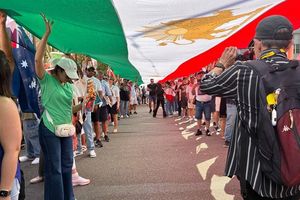
Demonstrators march toward the Iranian embassy in London during a rally supporting nationwide protests in Iran, Jan, 2026.
The Islamic Republic is escalating its campaign against the diaspora, moving beyond domestic seizures to explore the confiscation of assets held by Iranians in foreign countries and possible revocation of their citizenship.
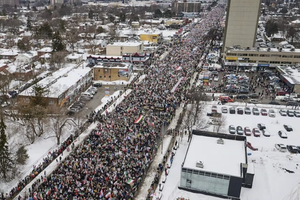
The move follows a period of intense pressure on the establishment. Hundreds of thousands of Iranians took to the streets globally to protest the government following a mass killing of protesters in January.
Tehran, currently facing a severe economic crisis and the rising costs of war, appears to be targeting the financial and legal identities of those it labels as "enemy collaborators."
Pursuing assets across borders
In a significant escalation of rhetoric, the Chief Justice of Ilam Province told the judiciary-linked Mizan news agency on Thursday that officials are examining the legal dimensions of "confiscating the property" of Iranians abroad within their countries of residence.
While the state has already begun identifying and freezing assets within Iran, this official called for international judicial mechanisms to target property held in the West. "Generally, the legal possibility for these actions exists," he said, adding that success would depend on "legal coordination with the country where the assets are located."
This follows a directive from Gholam-Hossein Mohseni-Ejei, the head of the Judiciary, to accelerate the seizure of property belonging to those linked to "overseas services and subversive networks."
By framing political dissent as "material support for hostility," a cash-strapped Tehran is attempting to create a legal pretext to pursue the private wealth of its citizens globally.
Citizenship as a political tool
In addition to financial threats, some officials are calling for the removal of the most basic legal tie between the state and the diaspora: Iranian citizenship.
Hassanali Akhlaghi Amiri, a member of parliament from Mashhad, said earlier this month that cooperation with "hostile countries" should lead to the revocation of a person's national identity.
"The punishment for cooperating with hostile countries against national security and interests begins with the confiscation of property and may even include the revocation of citizenship," Akhlaghi Amiri said.
The suggestion has sparked a heated debate within Iran. The moderate outlet Rouydad24 argued that the constitution treats citizenship as an absolute right that cannot be taken away.
The outlet warned that treating a national identity as a "revocable privilege" to be traded for political loyalty is a dangerous shift that makes the law a matter of "personal taste."
'Stray' citizens: Deprivation of consular services
While the legal debate over formal revocation continues, many Iranians abroad are already experiencing a de facto loss of citizenship through the denial of consular services.
Maryam Ebrahimvand, an independent filmmaker and activist also known as Maryam Taher, recently said that the Iranian consulate in Paris has repeatedly informed her that her "citizenship has issues." Ebrahimvand said that her identity documents were previously seized and have not been returned.
"For the third time, they verbally told me my citizenship is problematic," Ebrahimvand said in a video message. "When they say my citizenship has a problem, it means I have been stripped of it... I have no passport from any country. I am in a state of statelessness."
A globalized crackdown
The escalation comes as the government faces unprecedented opposition from the diaspora. Since the January massacre, massive rallies in cities across Europe and North America have drawn millions of people, marking the largest Iranian opposition movement in decades.
Authorities in Tehran have also alluded to the stance some members of the diaspora have taken regarding the recent military conflict with the US and Israel.
While the topic is delicate, officials have increasingly used "wartime protocols" to justify harsher punishments for those they accuse of siding with foreign adversaries during a time of crisis.
By threatening to seize assets, withholding consular services, and discussing the formal cancellation of passports, the government is attempting to create a climate of fear for protesters who previously felt safe beyond Iran’s borders.
These measures signal a government that no longer sees its people as citizens with rights, but as assets to be seized or enemies to be erased.
Iran’s Prince Reza Pahlavi gestures as he speaks during a press conference at the House of the Bundespressekonferenz in Berlin, Germany, on April 23, 2026.
The Islamic Republic’s negotiators in talks with the US are “different faces of the same machine,” that suppresses the Iranian people, exiled Prince Reza Pahlavi said at a press conference in Berlin on Thursday.
“They are not pragmatists; they are not reformers,” he said, referring to lead negotiator Mohammad Bagher Ghalibaf and Foreign Minister Abbas Araghchi during his speech at the Haus der Bundespressekonferenz. “Neither are the IRGC killers behind the curtains.”
Pahlavi was in Berlin for meetings with German lawmakers and members of the press as part of a European trip focused on Iran’s political future.
The Iranian prince warned that continued rule by the Islamic Republic would lead to further conflict in the region as the authorities will continue to pose threats to the people, the region, and beyond as long as they remain in power.
“For 47 years, the world has known Iran through the actions of a regime that took a great nation hostage,” Pahlavi said. “No deal will solve this. No negotiations will solve this. It is in their DNA.”
‘Choosing free Iran over a dying regime’
Pahlavi further addressed Europe, saying it faces a choice between the current Iranian system and a free Iran that could become a partner for stability.
“The choice before Europe is not between war and peace. It is between a dying regime that endangers us all and a free Iran that can become a partner for stability,” he said.
The Iranian prince urged European authorities to seek “a new course” in dealing with Tehran, or keep facing “constant blackmail” from the Islamic Republic.
“European governments must stop appeasing this regime. Expel regime ambassadors, refuse to legitimize any arrangements that preserve the IRGC-centered power structure and prepare to recognize the transitional government when it is announced,” he said, addressing European powers.
‘Iranians don’t want to see regime legitimized’
Pahlavi referred to nationwide protests in Iran, saying the Iranian people demand world countries refrain from strengthening or legitimizing a government that terrorizes the nation.
“The Iranian people are not asking us to fight their revolution. They are already doing that, and with a courage that should humble all of us,” he said. “They are asking something far more modest: do not legitimize those who oppress them. Do not strengthen those who terrorize them.”
He said it was time for the world to “catch up with their courage,” noting that the international community’s contribution to their struggle could help bring about an end to the government's violence.
“If you stand with us, if you act in honor of those 40,000 innocent protesters, you will save lives, you will stop the flow of blood,” he said.
Pahlavi also touched upon the Iran war, saying the destruction of governmental infrastructure employed in suppressing dissent, could potentially facilitate protests aimed at subverting the government.
“The air cover campaign that included hitting the regime infrastructure and apparatus of repression was a necessary step to equalize the playing field for the Iranians who were getting massacred on the streets defenseless, by a regime that used military weapons to hit them on the streets,” Pahlavi said.
He argued that a democratic transition in Iran could reduce regional tensions and open the way for broader economic cooperation.
“A free Iran would be a stabilizing anchor for the entire Middle East, ending the proxy wars that have ravaged Lebanon, Yemen, Iraq, and Syria, and becoming a partner for regional economic integration,” Pahlavi said.
A Tehran loyalist wraps herself in Iran's flag, at a state-sponsored rally, April 2026
Iran’s state broadcaster has sparked ridicule after claiming that 87% of Iranians support continuing the war with the United States, in a curious turn from early in the conflict where pro-war sentiments of an alienated populace was branded treachery.
The controversy began following a Monday broadcast on the state television, where hardline commentator Mostafa Khoshcheshm asserted that the Iranian people overwhelmingly favor military confrontation over diplomatic efforts to end the war.
“According to polls conducted by academic centers regarding the war, 87% of the people said that once and for all, this decayed tooth should be pulled out,” he said, arguing that reopening the Strait of Hormuz could leave Iran unable to close it again if needed.
No details about such a survey—its methodology, sample size or sponsoring institution—have been published, making the claim impossible to independently verify.
Yet the figure is notable less for its credibility than for what it reveals about a shifting narrative inside Iran.
Early in the conflict, some hardline factions and state-aligned voices attacked members of the Iranian diaspora and others who openly welcomed military pressure on the Islamic Republic or argued that war might weaken the system.
At some rallies and in media commentary, those seen as supporting foreign intervention were portrayed as traitors or collaborators.
Now, some of those same domestic factions are the ones most vehemently opposing negotiations with the United States and calling for the continuation of the war.
The contradiction reflects a more complicated reality.
Many Iranians may initially have supported military escalation—not out of loyalty to the Islamic Republic, but in the belief that war could weaken or even topple the regime.
That is not the kind of support state television appears to be claiming.
Instead, hardliners and state media have pointed to crowds at nightly rallies as evidence of a “majority” favoring war, though critics argue these gatherings represent a narrow and possibly organized segment of society.
At some of these rallies, participants have described the conflict with the United States as “existential” and argued it must continue until the “victory of good over evil.”
Online, many reacted with ridicule.
“When was the last time the opinion of the people of Iran—not the presenters of IRIB—was important and influential in the country’s major decisions?” one reader wrote on the Khabar Online website.
Another user sarcastically noted: “I don't know, maybe your ‘people’ are different from our ‘people.’ Who are these 87%? 87% of government supporters? … Do you even count us as part of the statistics?”
Public skepticism has been further fueled by allegations of digital manipulation by organized “commenting forces,” often referred to as the “Cyber Army.”
Readers have pointed out that while pro-negotiation comments often initially receive the vast majority of “likes,” those numbers are sometimes reversed within hours.
One user wrote: “Unfortunately, within a few hours, the ‘Zombies’ of the cyber army change the scores.”
Whether or not 87% of Iranians support continuing the war, the backlash to the claim suggests the battle over public opinion—and over who gets to define patriotism—may be intensifying alongside the conflict itself.
People walk through Tehran’s Grand Bazaar beneath a banner of Iran’s slain supreme leader Ali Khamenei, April 20, 2026
As uncertainty clouds the next round of Iran-US talks, the economic pain of the war is mounting inside Iran and beyond, increasing pressure on both sides to find a way out.
On Wednesday, US President Donald Trump suggested renewed talks with Tehran could take place as soon as Friday, though Iranian officials and state media quickly pushed back, saying no official position had yet been announced.
For ordinary Iranians, the diplomatic uncertainty comes atop an economy already battered before the March war.
Domestic news agencies, including the Labor News Agency ILNA, report that more than one million jobs have been lost since the start of the war, while the government is reportedly struggling to meet pension obligations.
ILNA said in recent weeks between three and four million workers, including insured employees as well as informal and uninsured laborers, may have lost their jobs. That would leave 12 to 15 million people with no source of income.
ILNA said the government’s only support for many of those affected by wartime job losses has been a monthly cash subsidy and a food voucher that “barely covers the cost of a single 10-kilogram bag of rice.”
The agency’s Wednesday front page painted a bleak picture: widespread business closures, workers protesting inadequate wages, thousands displaced by US-Israeli strikes still living in hotels, and even a 40% increase in funeral costs.
For many Iranians, economic hardship now feels more immediate than diplomacy.
On Tuesday, Trump claimed on Truth Social that Iran was “collapsing financially” and losing $500 million a day because of the closure of the Strait of Hormuz.
US Treasury Secretary Scott Bessent said this month Washington would not renew temporary sanctions waivers that had allowed some Iranian and Russian oil already at sea to reach global markets, tightening pressure on energy supplies.
Oil prices rose on Wednesday despite Trump’s ceasefire extension, reflecting market doubts over whether the truce would hold and whether shipping through the Strait would fully resume.
Iranian politicians and media outlets have increasingly highlighted the global economic repercussions of the conflict, a narrative some analysts see as an attempt to increase pressure on Washington.
The reform-leaning Asr Iran wrote this week that although the second round of negotiations remains uncertain, “geopolitical necessities and crushing economic pressures may push both sides toward accepting an emergency agreement.”
On Tuesday night, after Trump announced a continued ceasefire without a formal deal, many Iranians on social media and in messages to Persian-language outlets abroad accused him of abandoning them to hardline commanders in Tehran.
Others argued that economic strain and internal political divisions may ultimately force Iran’s leadership back to the table.
What remains unclear is whether Tehran’s leaders know what they want from the talks—or whether some are still prepared to risk a prolonged war of attrition.
For ordinary Iranians, any notion of “victory” may increasingly depend less on geopolitics than on whether they can endure the economic collapse unfolding around them.
Young Iranians appreciate a Picasso in Tehran's Museum of Contemporary Arts, March 22, 2025
Iran’s new “Internet Pro” rollout may tighten state control in the short term, but experts who spoke to Iran International question whether the Islamic Republic can sustain a class-based internet in one of the Middle East’s most connected societies.
Tens of millions of Iranians have been cut off from the rest of the globe since US-Israeli strikes began on Feb. 28. It has been described as the world’s longest state-imposed internet blackout to date.
Under the new plan, approved by Iran’s Supreme National Security Council, selected businesses and institutions would regain global internet access while much of the public remains restricted.
The rollout would begin with commercial card holders and later expand to sectors tied to production, industry and trade, according to officials, who present the measure as economic management.
Critics see something larger: the formalization of a two-tier digital system. Those fears have intensified after leaked material circulated in recent days suggested authorities were considering more permanent restrictions.
Iran International has not independently verified the documents.
‘War as excuse’
Neda Bolourchi, executive director of the Public Affairs Alliance of Iranian Americans, said the announcement appears less like an emergency wartime measure than the rollout of a long-prepared policy.
“What we can understand is that this has been a multi-year project,” she told Iran International. “That the war has given it the excuse to roll it out.”
She added that she does not expect a quick return even to the limited internet environment that existed before the latest shutdowns.
But Amin Sabeti, the London-based founder of CERTFA, a cybersecurity lab focused on cyberattacks linked to Iran, questioned whether Tehran could maintain such a model for long.
“They are trying to implement it, but the big question mark for me is how long they can carry on,” he told Iran International. “I don’t think they can continue the next six months as it is.”
Sabeti argued that wartime conditions may allow governments to impose extraordinary restrictions, but Iran is not North Korea and cannot easily be transformed into one.”
‘The Gen Z problem’
The economic consequences are already mounting.
For millions of Iranians, Instagram, Telegram and WhatsApp are not luxuries. They are storefronts, classrooms, advertising platforms and lifelines to clients abroad.
Bolourchi warned that while the model may be sustainable for the state, it could be punishing for ordinary households, many of whom make their living online.
Sabeti noted that this would carry political risks for the ruling elite.
“If you offer it to the Iranian people—internet, Instagram, XYZ—and suddenly you want to take it away, that’s the level of the anger. We will see huge protests,” Sabeti said.
Holly Dagres, a senior fellow at The Washington Institute who focuses on Iranian society, Gen Z and social media, said the blackout cannot be separated from the Islamic Republic’s broader information war.
“The reason they are basically not allowing Iranians access to the outside world is because the internet and social media is the only way for their voices to be heard,” Dagres said.
She also stressed that the economic damage has been particularly severe for entrepreneurs, women-led businesses and rural sellers who depend on social media income streams.
Tightening control
The system may also deepen surveillance.
Even if Iran does not become a replica of North Korea, a permission-based internet would still mean more monitoring and greater pressure on citizens to censor themselves.
Dagres argued that the government may be trying to normalize the blackout through small concessions while preserving overall control.
Direct-to-cell technology, which could one day allow ordinary smartphones to connect directly to satellites without dishes or ground terminals, is still not meaningfully available in Iran and remains more promise than practical solution.
For Tehran, “Internet Pro” may solve one immediate problem: how to keep strategic sectors online while limiting the wider public. In doing so, it may create another.
Iran is a country where tens of millions have built livelihoods, relationships and daily routines online. Restricting that access while rewarding approved groups may tighten control today, but deepen resentment tomorrow.