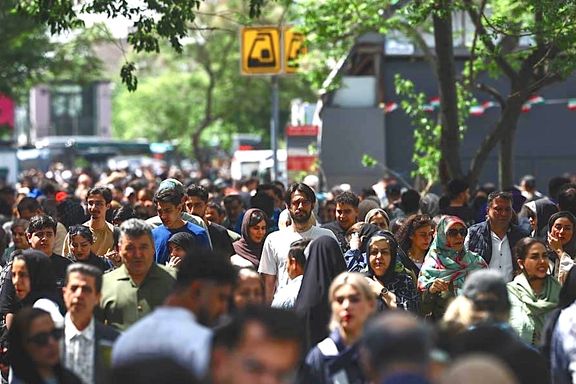
People walk near Tehran's Grand Bazaar, April 21, 2026
I am online again after 51 days. It is difficult to describe what things feel like here in Tehran. Bad is not quite the word. Weird, perhaps. Unreal.
The question on most minds is this: how did we get here? And where are we going?
In about ten months we have lived through a huge protest, a deadly crackdown and two wars. Both, from where most of us stand, utterly futile.
Leaders in Washington and Tel Aviv may declare victory. The rulers in Tehran—whoever truly holds power right now—will say they have been vindicated. Exiled opposition figures urge people inside Iran to fight again.
But people here are exhausted. Completely spent, at least for now.
The economic shock is already visible. Layoffs are spreading and prices keep rising. Inflation has reached the point where people joke that of course the shops are full of basic goods because no one can afford to buy them.
It is still unclear how badly steel plants and petrochemical facilities have been damaged in US-Israeli strikes. But these so-called “mother industries” sit at the heart of Iran’s economy. If they falter, the disruption will soon ripple everywhere.
Meanwhile diplomats and besuited Revolutionary Guards commanders haggle over uranium enrichment and the fate of the Strait of Hormuz, supposedly on our behalf, but without ever asking whether we are willing to pay the price for these grand strategies.
Even the language we once used to describe life here has begun to feel worn out. Talking about the “struggle for subsistence” sounds almost hackneyed now.
Last year I wrote that when people in Iran speak about the future they usually mean tomorrow, or perhaps next week at best. Now even that horizon has shrunk.
The future, psychologically, has been shut down as a coping mechanism. People do not want to imagine more bombs. And they want even less to imagine the Islamic Republic surviving all this—perhaps harsher and more unified after two rounds of war.
President Trump says Iran’s capabilities have been “obliterated.” From where we stand, the only thing truly obliterated is morale. He says “regime change” is complete. Here, we have not even seen it begin.
The authorities and their supporters appear firmly in control of the streets. Night after night they stage loud displays of celebration—part rally, part carnival—proclaiming victory and, implicitly, daring anyone who disagrees to come outside.
Even if a grand bargain emerges somewhere between capitals and diplomats, ordinary people here are not on anyone’s agenda.
I have no figures, but I suspect fewer than one in a thousand people currently has any meaningful internet access. And even that connection is so slow that voice messages barely work.
Almost no one outside seems to notice how isolated we have become. Soon, they say, even text messages will be capped. The country is being sealed off, one piece of red tape at a time.
And still life goes on. People go to work—the lucky ones. People eat, drive, hang out. But when you look into their eyes, there is often very little soul behind them.
That does not mean things will never improve. They might. But we have stopped hoping.
File photo of a baker arranging Barbari flatbread at a traditional bakery in Iran.
Bread shortages and steep price hikes are undermining access to a key staple for many in Iran, with citizen accounts received by Iran International describing long lines, flour shortages and prices far exceeding official rates.
“Many bakeries are facing flour shortages and cannot keep up with long lines of customers,” a resident from Malard west of Tehran said.
Another account said: “Right after the war, bread prices doubled. Barbari (a type of Iranian bread) is now 250,000 rials and Sangak is 350,000. Subsidized flour has been removed.”
The reported prices are far above official rates, with the latest approved price for Sangak at about 76,000 rials and Barbari around 55,000.
April 20 marks National Wheat and Bread Day in Iran, meant to highlight the central role of wheat in daily life, but accounts point to worsening conditions for a basic staple.
Conflicting claims on wheat supply
Wheat self-sufficiency has long been a goal promoted by many officials of the Islamic Republic. The first celebration of wheat self-sufficiency was held on November 16, 2004, during the presidency of Mohammad Khatami.
However, this self-sufficiency did not continue in subsequent years for various reasons, including water shortages, and Iran remained reliant on wheat imports. Still, the aspiration for self-sufficiency has continued to be repeated in officials’ statements.
Now, 22 years after the first “self-sufficiency celebration,” as buying bread is becoming an economic challenge for citizens, Ataollah Hashemi, head of the National Wheat Farmers Foundation, has once again reiterated the goal. Speaking on Saturday, April 18, he said: “The country will not need to import wheat this year.”
Yet official customs data shows Iran imported about 2.75 million tons of wheat worth nearly $1 billion in the 10 months to February 2026. The imports were sourced largely from Russia, as well as through intermediaries such as the United Arab Emirates and Turkey.
The reliance on intermediaries, which are not major wheat exporters themselves, points to complications tied to banking restrictions and payment channels, increasing costs through additional transport and fees.
The gap between official statements and import figures raises questions about the sustainability of domestic production and the credibility of self-sufficiency statements.
File photo of a baker handing stacks of Sangak flatbread to customers at a neighborhood bakery.
Rising costs and policy pressures
Bread prices have increased across provinces in the current Iranian year that began on March 21, following subsidy cuts and the move toward a single flour pricing system. Prices now vary depending on flour type and region, with some bakeries selling above official rates.
Despite parliament approving a budget that allocates more than 5,000 trillion rials (over $3 billion) for bread subsidies, no new national price list has been issued for the current year. As a result, last year’s rates remain in effect, while enforcement appears inconsistent.
Inflation and shortages
Before the latest conflict and US-Israeli strikes, annual inflation had already exceeded 70 percent, with food inflation reaching triple digits. Official data shows bread and cereals recorded year-on-year inflation of about 140 percent.
The removal or reduction of subsidized flour in parts of the market has added to the pressure, with more bakeries operating under higher-cost “free flour” systems.
Citizen reports suggest the combined impact of shortages and rising prices is becoming more visible. Long queues at bakeries and inconsistent supply have emerged alongside sharp increases in retail prices.
For many households, bread remains a primary food source, making these changes particularly significant.
The accounts from Tehran and other areas point to a broader strain across the country, where access to basic goods is increasingly shaped by rising costs, uneven supply, and policy shifts that have yet to stabilize the market.
A painting remains unscathed in a residential building hit by US-Israeli strikes, in Karaj, Iran, April 3, 2026
The Iranian government has stepped back from earlier promises to compensate homeowners whose properties were destroyed in US-Israeli strikes, triggering anger among residents who expected the state to take responsibility for rebuilding.
Reports from Tehran suggest the government’s new reconstruction plan has created a deep sense of abandonment among citizens who assumed war-related destruction caused by a national conflict would be covered by the state.
On Thursday, the Iranian Labor News Agency (ILNA) quoted Tehran Province official Mohammad Sadeq Motamedian as saying that “nearly 40,000 residential units across Tehran Province have been damaged.”
Earlier, Donya-ye Eghtesad reported that the Ministry of Roads and Urban Development estimated roughly 45,000 residential and non-residential units were damaged during the March war but did not require demolition, while nearly 1,000 units needed full reconstruction.
Motamedian’s assessment has intensified debate over the true scale of destruction and the government’s approach to rebuilding.
In Tehran, Mayor Alireza Zakani had previously promised full reconstruction of ruined homes and restoration of damaged buildings, but there has been little clarity on how much progress has been made.
The government’s reconstruction strategy became more controversial after spokesperson Fatemeh Mohajerani said on April 15 that the administration would not provide direct financial assistance to rebuild destroyed homes.
Instead, she said the government would offer what officials call “floating density,” a system of additional building permits intended to encourage private developers to help reconstruct damaged housing.
Under the plan, builders could reconstruct damaged or destroyed homes in exchange for permission to add one or two additional floors to new buildings, which they would then be allowed to sell for profit.
Critics say the proposal is unrealistic. Density bonuses cannot compensate families who have lost their homes, especially at a time when construction costs are soaring.
For many displaced households, the absence of direct financial support raises serious questions about how reconstruction could realistically proceed.
Government bodies have also released widely differing figures about the scale of damage. Some officials have suggested only a few thousand homes were affected, while others have put the number in the tens of thousands.
Donya-ye Eghtesad noted that estimates range from about 1,000 homes requiring full reconstruction to tens of thousands with varying levels of damage, leaving residents uncertain about the true scale of destruction and the level of support they can expect.
The discrepancies have fueled speculation that the government may be downplaying the extent of war damage in order to limit financial obligations, reinforcing broader criticism of opaque communication during and after the conflict.
A woman uses her laptop at home as Iran’s internet shutdown persists, leaving millions offline.
Freelancers and small business owners say their incomes have collapsed and daily operations have halted during Iran’s prolonged internet shutdown, which NetBlocks said has caused $1.8 billion in losses over 48 days.
“I work as a freelance web developer and my income has dropped to zero because of the internet outage. I am selling my belongings to cover debts,” a citizen wrote in a message to Iran International.
Another said: “As a student and computer technician, I am stuck in uncertainty. Online classes are heavily disrupted, and I cannot even access the internet to complete projects. My workplace has no customers.”
NetBlocks said on Thursday the disruption had lasted 1,128 hours, describing the shutdown as unprecedented in scale for a country with deep reliance on global connectivity. The group added that its estimate, based on its COST methodology, also reflects wider social and human rights impacts.
Digital economy grinds to a halt
The outage has hit Iran’s digital sector, which had absorbed part of the country’s unemployment pressure over the past decade. Online businesses have lost access to customers, payment systems, and essential tools tied to the global internet.
The Rokna news website said on Wednesday the disruption amounted to a shutdown of the digital economy, noting that the cut to international internet access dealt a direct blow to online businesses.
A couple walk in a park overlooking Tehran, with the iconic Milad Tower seen in the background, April 1, 2026.
Hundreds of small digital enterprises have been unable to maintain sales, customer communication, or after-sales services. Layoffs have spread across technology firms and media organizations, affecting employees whose work depends on stable connectivity, the outlet added.
Journalists and media workers have also faced income losses and job cuts as communication channels narrowed and publishing operations slowed, according to the report.
Workers face mounting financial strain
“I managed to connect briefly using expensive VPNs, but I have lost my job due to the internet disruption. I have loans to repay and rent to cover, and many others are in the same situation,” another citizen told Iran International.
Accounts from across the country point to a broader slowdown. “Prices have increased several times over. Many people have lost their jobs. At least 50 percent of shops are closed,” one resident said, adding that only essential services such as repair shops and small markets remain partially active.
Delays in salary payments have become more common in some businesses, increasing pressure on workers already affected by rising prices. Inflation has further reduced real wages, leaving even those still employed struggling to cover basic living costs.
File photo of a young Iranian man who checks his phone outside a store
Professional networks also reflect the downturn. Users on LinkedIn have publicly said they are seeking new job opportunities, indicating a rise in job seekers among skilled and experienced workers.
Experts warn of lasting damage
Economic journalist Arezoo Karimi said the losses extend beyond immediate income declines, warning of wider consequences for employment and growth.
“This means zero income for businesses that depend on international connectivity. It leads to layoffs and rising unemployment,” Karimi said, adding that daily losses run into tens of millions of dollars.
Karimi said the broader economic impact could reach several times the direct losses, pointing to reduced production and slower economic growth. Inflation, already elevated, is likely to worsen if disruptions continue.
“Businesses are not only losing income, they are losing their position in international markets and online visibility. These are damages that cannot easily be reversed,” Karimi added.
With limited access to global markets and tools, many digital workers now face a choice between prolonged uncertainty and leaving the country.
The outage has exposed the dependence of Iran’s digital economy on stable international connectivity, with weeks of disruption enough to dismantle businesses built over years.
Two young women stroll in a Tehran park a day after the ceasefire between Iran and the United States
Messages from Iran International viewers inside the country reveal a society grappling with a mix of hope, anger and deep uncertainty as a fragile ceasefire with the United States persists.
Officials in Washington and Tehran are now considering extending the truce, raising new questions about whether the pause could evolve into a broader settlement or simply delay further confrontation.
The roughly 3,500 messages received and reviewed since April 8 show a wide array of emotions, with no single voice or issue dominating.
More than a quarter of the messages expressed hope about what might come next, often framing the ceasefire as a temporary pause rather than a turning point.
Some said they believed the truce was merely a tactical step that would ultimately weaken the Islamic Republic.
“Don’t lose hope. This ceasefire means another surprise is coming. Be patient,” one viewer from Rasht wrote.
Others expressed confidence that outside pressure on the government would continue.
“Trump knows what he’s doing. Don’t worry—there’s a plan behind this ceasefire,” a viewer from Tabriz wrote.
Many messages referred to Prince Reza Pahlavi as a potential focal point for opposition hopes, with some writers saying they were waiting for a “final call” to action.
About 18 percent of the messages focused less on politics and more on daily hardship.
Writers described worsening economic conditions, rising prices for food and medicine, job losses and the effects of the country’s internet shutdown.
A viewer from Karaj said he had paid the equivalent of nearly $20 for a single gigabyte of internet access through unofficial services.
“My business is destroyed,” he wrote.
Another viewer from Mashhad said cancer medicines had become scarce and far more expensive. “People are not well,” the message read.
Nearly 17 percent of the messages expressed deep despair, describing the ceasefire as the collapse of hopes that the conflict might bring fundamental political change.
“The world collapsed on my head,” one message from Tehran read. “We didn’t endure all this hardship just for a ceasefire.”
Others expressed anger at foreign leaders, accusing them of abandoning the Iranian people after raising expectations during the conflict.
Some messages directly criticized President Donald Trump and Israeli Prime Minister Benjamin Netanyahu, using words such as “betrayal” and “deception.”
“Mr. Trump, a ceasefire means betrayal of the blood of thousands of fallen heroes,” one viewer wrote.
Another message addressed the United States more broadly: “We asked you to help free Iran. Instead you left us with a worse situation.”
The messages, sent mainly from cities including Tehran, Mashhad, Karaj, Shiraz, Rasht, Isfahan, Tabriz, Ahvaz, Bandar Abbas and Kermanshah, offer a rare glimpse of public sentiment inside Iran at a time of near-total internet blackout.
Most messages were sent by users who managed to reach the global internet through workarounds. Some may have come from individuals with access to government-authorized “white SIM cards,” which allow limited connectivity.
Taken together, the messages portray a society that is exhausted yet resilient.
Many said they opposed any agreement that would leave the Islamic Republic in place. Some said they were prepared to endure further hardship rather than see what they called the “blood of the fallen” go unavenged.
The strongest refrain running through the messages echoed a familiar Persian expression: “Light will prevail over darkness.”
A woman walks across the street, with a banner of all three leaders of Iran, late Ruhollah Khomeini, late Ayatollah Ali Khamenei, and Mojtaba Khamenei in the background, amid the US-Israeli conflict with Iran, in Tehran, Iran, March 15, 2026.
War damage to Iran’s economy has reached $270 billion in 40 days, equivalent to roughly $3,000 per person, according to official figures, with losses expected to grow as trade disruptions deepen under a US blockade of Iranian ports.
Fatemeh Mohajerani, the spokesperson for the Iranian government, said on Tuesday losses from the US-Israeli military campaign are estimated at around $270 billion.
The New York Times, citing three Iranian officials and two economists, reported that early estimates broadly align with that figure, placing the damage at roughly $300 billion or higher.
Preliminary estimates by the US-based think tank Foundation for Defense of Democracies also suggest Iran absorbed roughly $150–$300 billion in economic damage.
Using a population of about 92 million, the lower estimate of $150 billion translates to roughly $1,600 per person, rising to nearly $3,250 per person under the higher estimate.
These figures reflect national wealth lost through destruction, halted production and disrupted trade.
Iran’s central bank has warned President Masoud Pezeshkian that rebuilding the country’s war-damaged economy could take more than a decade, sources familiar with internal deliberations told Iran International.
In a stark assessment delivered to the president in recent days, senior economic officials said the damage inflicted during the 40-day war with the United States and Israel—combined with Iran’s already fragile economic situation—could take up to 12 years to repair.
Industrial sectors bear largest losses
Petrochemicals account for the largest share of damage. Iran’s petrochemical sector, with annual sales of $29.1 billion, has seen about 85% of export capacity disrupted following strikes on major hubs including Mahshahr and South Pars. Estimated losses range from $30 billion to $50 billion.
Energy infrastructure has also been heavily affected. Refineries, storage depots and gas facilities have been struck, weakening a sector that generated about $78 billion in exports in 2024. Losses are estimated at $15 billion to $25 billion.
Explosion at Iran's Mahshahr petrochemical complex during US-Israeli strikes
Steel production, which underpins both industrial output and reconstruction, has been severely reduced, with about 70% of capacity disrupted. Losses are estimated at $5 billion to $10 billion.
Beyond physical losses, the war has triggered a sharp contraction in output.
Experts estimated a decline of more than 10% in GDP, equivalent to $34 billion to $44 billion in lost economic activity, affecting an economy that was already under strain before the conflict.
Beyond physical damage, policy-driven disruptions have compounded the losses.
Internet shutdown
A nationwide internet blackout beginning Feb. 28 has imposed additional costs.
Direct losses are estimated at $37 million to $42 million per day, totaling $1.5 billion to $2.5 billion over more than five weeks.
Afshin Kolahi, a member of Iran’s Chamber of Commerce, said Monday indirect losses could raise the daily figure to $70 million to $80 million due to disruption to online businesses.
Online sales fell by about 80% during the shutdown, while the Tehran Stock Exchange lost 450,000 points within four days.
The shutdown is affecting multiple layers of the economy simultaneously, according to economic analyst Masoumeh Taherkhani.
“The Iranian economy is damaged at three levels by internet disruption, starting with the digital core, which employs between four and five million people,” Taherkhani told Iran International. “Then the platform layer collapses, and finally the broader economy is affected in a way that spreads across production and services.”
Taherkhani said the combined effect leads to widespread job losses. “When the economy is fully stagnant, the outcome is unemployment for workers, and that is not something that can easily be reversed,” she said.
Trade disruption and self-inflicted losses
Disruptions linked to the Strait of Hormuz have added further pressure, with estimated losses of $5 billion to $15 billion.
The restrictions have affected imports of essential goods and weakened non-oil exports, contributing to supply chain disruptions across the economy.
A US naval blockade targeting Iran’s maritime trade routes is expected to deepen losses.
Sanctions strategist and former US Treasury official Miad Maleki estimated that cutting off seaborne trade could eliminate about $435 million in daily economic activity, equivalent to roughly $13 billion per month.
Iran relies on the Persian Gulf for more than 90% of its trade, leaving it highly exposed to sustained disruption.
Oil exports of about 1.5 million barrels per day – generating roughly $139 million daily – could be halted almost entirely, removing the country’s main source of foreign currency.
What the losses could have funded
The scale of damage corresponds to investment levels that could have reshaped core sectors of the economy.
A large combined-cycle power plant with capacity of around 1,000 to 1,500 megawatts typically costs between $600 million and $1 billion to build, depending on technology and fuel infrastructure.
At the lower estimate of $150 billion in losses, Iran could have financed roughly 150 to 250 such plants. At the upper estimate of $300 billion, that rises to between 300 and 500 plants, enough to eliminate electricity shortages and significantly expand export capacity.
In housing, average construction costs for a modest apartment unit range between $30,000 and $50,000. With $150 billion, between 3 million and 5 million housing units could have been built. At $300 billion, that increases to roughly 6 million to 10 million units, enough to address shortages across major urban areas.
High-speed rail construction typically costs between $20 million and $40 million per kilometer. The lower estimate of losses could have funded approximately 3,750 to 7,500 kilometers of rail, while the higher estimate could support up to 15,000 kilometers, connecting major cities nationwide.
A modern hospital costs between $200 million and $500 million to construct and equip. The lower-end losses could have built 300 to 750 hospitals, while the higher estimate could fund up to 1,500 facilities, expanding healthcare access across the country.
What it means for individual Iranians
The per capita loss of up to $3,250 represents a substantial share of annual income for many households.
With average monthly earnings between $150 and $200, an individual earns roughly $1,800 to $2,400 per year, meaning a $3,250 equivalent exceeds a full year of income for many citizens.
If such an amount were available, it could cover between 12 and 20 months of living expenses for an average worker. Families could use it toward housing costs, including down payments or completing home purchases in smaller cities.
Small businesses could be launched with startup capital of $2,000 to $5,000, enabling self-employment in sectors such as retail, services or online commerce. Households could also afford private healthcare, education or relocation costs that are otherwise beyond reach.
Even the lower estimate per person represents several months of income, providing a buffer against inflation, job loss or unexpected expenses.
The overall range reflects damage already incurred, with additional losses building as trade, production and financial flows remain disrupted.
At up to $3,250 per person and rising, the economic toll underscores the scale of damage to Iran’s productive capacity, with long-term implications for recovery and growth.