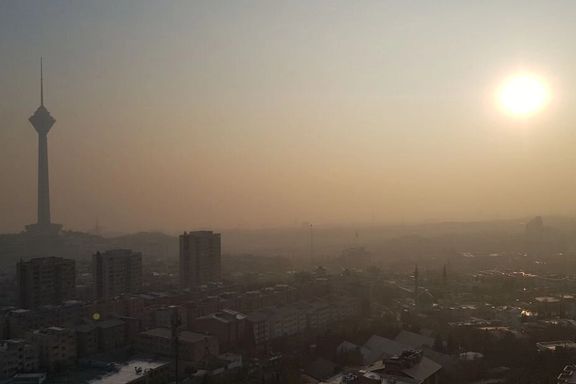
Tehran's iconic Milad tower in a typically polluted day
Tehran and Washington are set to resume talks this weekend, but growing calls to condition any agreement on the dismantling of Iran’s nuclear infrastructure are casting a shadow over early optimism.
The hard line on full dismantlement is the newly stiffened public stance of the White House and US envoy Steve Witkoff and has also been pushed by Israel's prime minister, Benjamin Netanyahu, who asserted on Monday that nothing less would be acceptable to his government.
His intervention did not sit well with Tehran.
“Israel’s fantasy that it can dictate what Iran may or may not do is so detached from reality that it hardly merits a response,” Iranian Foreign Minister Abbas Araghchi posted on X, calling Netanyahu "brazen" for telling a US president what to do.
Somewhat surprisingly, he went on to criticize the Democratic administration of Joe Biden in what appeared to be an attempt to court Donald Trump.
“Netanyahu’s allies in the failed Biden team—who failed to reach a deal with Iran—are FALSELY casting our indirect negotiations with the Trump administration as another JCPOA,” Araghchi wrote.
The significance of this public gesture from an Iranian official—at the expense of the man accused of appeasing Tehran almost every week of his term—cannot be overstated.
This shift in tone may be partly driven by the economic fallout from the port fire in Bandar Abbas, which observers believe has deepened Tehran’s financial strain.
The Islamic Republic, and its chief negotiator Araghchi, have every reason to be apprehensive about a breakdown in talks, given the "very bad" alternative mooted by Trump.
The desire to project cautious optimism was also evident in an editorial on Iran Diplomacy, a website closely aligned with the foreign ministry.
The article outlined two scenarios: the U.S. targeting Iran's nuclear sites, or accepting a “new regional order” in which Tehran becomes a key energy supplier to the West. The latter, it said, is the more likely outcome.
In this scenario, according to Iran Diplomacy, Iran-allied armed groups in the region would be redefined and gradually integrated into formal military structures.
Curiously, the piece framed all this as proof of Tehran's deterrent power and Washington's surrender to Iran’s demands, while cautioning against overconfidence when dealing with a president who has a “bad record of undermining commitments.”
Two reformist publications, Sharq and Etemaad, published similar stories on the same day.
Sharq said there was room for cautious optimism while talks continue, noting that major issues remain unresolved.
Etemaad reported that a recent poll showed 8 in 10 respondents support the talks and a potential agreement, provided it protects Iran’s interests and preserves advances in nuclear science and missile technology.
The pro-government publication pointed out that in a similar poll conducted just before the 2015 nuclear deal, fewer people - 7 in 10 - said they favored a deal.
A currency dealer poses for a photo with a U.S one dollar bill and Iranian rials in an exchange shop in Tehran, Iran December 25, 2022.
Foreign exchange rates, which have a critical impact on economic life, fluctuate frequently depending on where they are traded, adding to the anxiety of businesses and ordinary Iranians enduring inflation and sanctions.
The Iranian rial hit an all-time low in March, trading at one million per US dollar in March as tensions with the United States flared.
Now ahead of a third round of Iran-US nuclear talks in Oman on Saturday, the open market rate for the dollar was around 810,000 rials, while two government-controlled rates, the EST and the official rate for importing basic goods stood at 692,000 and 280,000 respectively.
Ordinary people, who often convert their savings into hard currency or gold during periods of political and international uncertainty, generally only have access to the open market.
Many businesses — and even some semi-official entities — also turn to the open market when they cannot access foreign currency through official channels or when they require immediate liquidity.
In recent years, successive governments have attempted to reform Iran’s tangled foreign exchange system to curb corruption fueled by cronyism, where favored individuals, groups and state entities secure access to cheaper rates to import goods that are later sold at much higher open market prices.
The reforms have mostly failed because entrenched political networks benefiting from the system oppose them.
The open market
Iran’s open or free foreign exchange market operates largely outside government control. It consists of authorized currency exchange shops or sarrafi as well as informal street-level transactions.
The open market -- where currencies like the US dollar, Euro, and UAE dirham are the most actively traded -- reflects real-time supply and demand. Prices in the open market are heavily influenced by inflation expectations, political risks, sanctions developments and broader economic conditions.
Open market rates typically run significantly higher than the officially controlled rates, particularly during times of instability and often provide the clearest snapshot of Iran’s underlying economic and political realities.
They serve as a crucial, unofficial benchmark that influences pricing, import costs, and inflation across the country.
The government occasionally intervenes, injecting foreign currency through selected sarrafi or cracking down on street traders they deem illegal when volatility escalates amid ramped up political tension or rapid devaluation.
Official rates for staples, medical goods
This rate, currently 285,000 rials to the dollar, is provided through designated banks to importers of basic goods such as wheat, rice, and animal feed as well as medicine and medical supplies.
The decision on allocation of this type of currency lies with related ministries and the Central Bank of Iran (CBI).
An earlier preferential rate for these imports fixed at 48,000 rials has now been almost completely scraped.
Electronic Trading System (ETS) rates
The ETS rate, closer to the free-market rate, is set by supply and demand within the Electronic Trading System (ETS) of the Iran Center for Currency and Gold Exchange.
Established in late February 2022, the center was intended to provide a formal platform for cash currency exchanges to undercut the open market.
While exchange rates on ETS are determined by market forces, the CBI actively supervises the platform, intervening by injecting or limiting foreign currency supplies to influence rates.
This managed market — accessible to licensed banks and exchange offices — handles both cash transactions and informal transfers called hawala. Transactions that previously took place through a system dubbed NIMA are now also routed through ETS.
The defunct NIMA system
The NIMA system, an acronym for integrated system of foreign exchange, was created to regulate foreign currency earned through exports and allocate it for imports of non-essential goods and services. It was officially scrapped in January.
Within NIMA, transactions occurred between exporters and importers under CBI supervision, with the central bank setting a floor and ceiling for permissible exchange rates.
For years, NIMA served as the government’s primary tool for managing the trade balance and controlling the flow of foreign currency.
Its elimination marked a significant shift toward market-based pricing mechanisms — albeit still heavily managed — through the ETS platform.
Corruption amid multiple rates
Several major corruption scandals have rocked Iran in recent years, many of which stem from its multi-tiered exchange rate system.
The Debsh Tea Company scandal is one of the most recent and possibly largest embezzlement cases in the history of the Islamic Republic.
High-ranking officials from various ministries, the Customs Administration and the Central Bank were implicated in the scandal that first came to public attention in 2023.
The family-owned company received $3.37 billion in subsidized foreign currency (at the NIMA rate) to import tea and machinery but sold $1.4 billion of the currency it had received in the open market at higher rates, did not import the promised equipment and allegedly imported low-quality tea it labelled as premium-grade.
US Senator Joni Ernst (R-IA) speaking to reporters, Washington D.C., March 2024
Iran must agree to cease uranium enrichment in any nuclear deal and the US congress could move to enshrine such an agreement in a treaty should US President Trump wish, Republican senators told Iran International.
Whether Iran will be allowed to maintain its domestic uranium enrichment capacity has emerged as a key potential stumbling block in ongoing talks between Washington and Tehran.
The White House and US envoy Steve Witkoff appeared to stiffen their public stance on the issue this month, ruling out enrichment in any deal a day after Witkoff gave a media interview in which he suggested a cap on enrichment would be permissible.
Iran, which maintains that its nuclear program is peaceful, has repeatedly said it will not end enrichment.
"I am grateful that they want to achieve a settlement with Iran, but it needs to be much stiffer. There could be no nuclear enrichment," Senator Joni Ernst of Iowa said.
"We do hope for a very good deal. We want to avoid war, if at all possible. But no nuclear enrichment."
Iran's foreign minister Abbas Araghchi this month proposed a deal to the US delegation envisioning a cap on their uranium enrichment in exchange for the lifting of US sanctions, three diplomatic sources in Tehran told Iran International.
In Tehran's framework, the US congress would approve a final agreement, potentially sparing it the fate of a 2015 deal which was axed by President Trump in his first term.
"I think that President Trump is holding Iran accountable, that he's going to tell him exactly the way the hog eats the cabbage. They can't have nuclear weapons," Senator Roger Marshall told Iran International.
A treaty would be more difficult but not impossible, with Trump's backing, the Kansas Republican said.
"I think it'll be very complicated to accomplish that. The amount of senators to agree to that will be a tough, uphill battle, but if that's what President Trump wants to do, then I guess it's feasible."
Outspoken Iran hawk Senator John Kennedy of Louisiana blessed Trump's approach, in which the president has vowed to attack if Iran doesn't agree to a new deal, and said Tehran's foreswearing of enrichment could aid the chances of a treaty.
"It's totally dependent on Iran," Kennedy said. "We can do it the easy way or the harder way.
"I think Congress will consider (a treaty) if Iran is willing to give up all of its nuclear capabilities, civil and military, but other than that, I can't see it."
Talks with Tehran aim to deprive Washington's Middle East nemesis of a nuclear weapon, but time will tell whether US President Donald Trump will carry through on his threat to bomb the country.
After a stunning political comeback landed Trump back in the White House for a second term, the outcome of a typically Trumpian, bumpy dash for a deal is not yet known after 100 days.
Trump’s new term began with a reinstatement of his so-called “maximum pressure” campaign, this time aggressively targeting Iran’s energy and oil sectors, including Chinese importers and independent refineries processing Iranian crude.
Since Trump took office, the Iranian currency initially plummeted by 80,000 rials to the dollar. However, it has recently clawed back some value due to growing optimism around nuclear negotiations between Washington and Tehran.
This diplomatic track is being pursued alongside potential military contingency plans, with Trump repeatedly warning that if a deal is not reached, "there will be bombing."
"It will be bombing the likes of which they have never seen before," the president said during an NBC news interview in March.
Signs of military posturing are evident: strategic bombers positioned near Iran in Diego Garcia, a surge of US aircraft in Doha, and intensified strikes against the Iran-backed Houthis in Yemen—all serving as a backdrop to the ongoing negotiations.
'Rushed, inconsistent'
Trump’s Iran policy so far appears muscular but inconsistent, said retired Major General Andrew Fox in an interview with Iran International.
“Trump is showing military flex but he’s not using all the leverage America has,” Fox argued. “In terms of timing, the Iranian economy was already struggling. That could have been leveraged further. We saw the rial jump 20% as soon as the talks were announced—so potentially a negotiating lever was given away too easily."
Fox described Trump's approach so far as "mixed, rushed, and inconsistent."
“We know Trump values a deal above all else. He’s super anti-war. He doesn't like using the military lever of governance,” said Fox, now a research fellow at the Henry Jackson Society.
One reason for the haste may be Trump’s self-imposed 60-day deadline for reaching a nuclear agreement with Iran's Supreme Leader Ayatollah Khamenei. Trump issued this timeline in a letter delivered shortly after taking office, news outlet Axios reported.
Speed versus Substance
Holly Dagres, creator of the newsletter The Iranist and a senior fellow at The Washington Institute, warned that Trump's fast-track approach risks overlooking critical issues like human rights.
“This hurry might meet the 60-day deadline Trump wants,” Dagres said. “But it risks rushing past key issues that deserve deeper negotiation.”
Dagres suggested human rights benchmarks could be tied to sanctions relief—crediting Nobel laureate Narges Mohammadi and other activists inside Iran for pushing to include human rights in the nuclear discussions.
Mixed Messaging from Trump's Team
Adding to the confusion, US Special Envoy to the Middle East Steve Witkoff recently issued conflicting public statements on the goal of the negotiations.
On April 14, Witkoff told Fox News the US might accept Iran maintaining uranium enrichment at those permitted by a 2015 nuclear deal (3.67%) under stringent verification.
Yet a day later he insisted on social media that a "Trump deal" must require Iran to "stop and eliminate" its enrichment program entirely.
The apparent contradiction could be strategic, according to Behnam Ben Taleblu, senior fellow at the Foundation for Defense of Democracies (FDD).
“The president actually likes to cultivate uncertainty,” Taleblu said, arguing it is too early to fully grade Trump’s Iran policy—or even predict where it is headed.
Ironically, Taleblu added, Trump’s biggest success so far has gone largely unrecognized.
“The most successful element of the Iran policy has not been celebrated even by die-hard politicos who believe in the president, and that is getting the Islamic Republic of Iran under Ali Khamenei to engage, be it directly or indirectly, with the Trump administration."
Early Days, Uncertain Outcomes
For Iranian-American policy director Cameron Khansarinia of the National Union for Democracy in Iran (NUFDI), it’s simply too soon to judge.
Trump’s unpredictable style, Khansarinia said, makes it difficult to forecast his next move. But he praised Trump’s first-term Iran policy as the most effective against Iran's theocratic rulers —and sees similar themes emerging now.
“I think he does have a strategy. It just hasn't had time yet to bear fruit," Khansarinia said. "For a successful Iran strategy, all he has to do is go back to his first term and implement those policies.”
President Trump’s unpredictable style arguably may have forced Tehran into negotiations—an achievement or a mishap depending on where one sits on the political spectrum.
His current Iran policy reflects a strategic shift from his first term, combining diplomatic overtures with overt threats of attack, the wisdom of which remains unclear.
A member of Iran's parliament (Majles) scratching his head in an open session, Tehran, Iran, April 22, 2025
Iran hopes to resolve its biggest foreign affairs challenge through talks with the United States at the same time it grapples with some of the toughest domestic problems in the Islamic Republic's nearly 50-year history.
Some commentators and former officials say the government of Masoud Pezeshkian is unable to resolve even the simplest domestic political issues that could improve the lives of ordinary Iranians.
One example, noted by centrist politician and former presidential candidate Mostafa Hashemi-Taba, is the failure to adopt daylight saving time to help with Iran's energy crisis.
Iran's parliament recently discussed the importance of the measure, but lawmakers refused to prioritize the bill, with Speaker Mohammad Bagher Ghalibaf joking that the matter would be taken up at a later date.
In an interview with the news website Rouydad24, Hashemi-Taba attributed such failures to a "lack of rationality" in governance.
"The government has no principles when it comes to addressing problems," he said, accusing officials of resorting to empty slogans instead of practical solutions, and engaging in futile debates until a new crisis diverts attention from unresolved issues.
"There is no public participation in Iran. Only a select group of people make decisions," Hashemi-Taba said.
Another stalled initiative is changing the weekend from Thursday–Friday to Saturday–Sunday to facilitate international commerce.
Despite months of debate in parliament and other government offices, the measure—deemed necessary by some economists—has been dismissed by some lawmakers with bizarre arguments.
Any weekend change, some critics have asserted, could hinder population growth, since Iranians traditionally conceive children on Thursday nights, and a Saturday–Sunday weekend would disrupt this pattern, as people would have to work on Fridays.
Meanwhile, more pressing issues, such as water and energy shortages, remain unresolved.
Tehran's freshwater resources stand at just 14% of their usual levels, according to official statistics, prompting the capital's governor to declare a water shortage emergency last week.
The government has not managed to find a solution, instead proposing to divert water from other regions—an approach that could cause shortages elsewhere.
Civil unrest erupted in the historic city of Isfahan last week, as residents took matters into their own hands by blocking the flow of water from the Zayandeh Rood River to neighboring Yazd Province.
Electricity is in short supply too, causing regular power cuts in the capital and other regions. Officials have released a blackout schedule, but people say it lacks clarity, leaving them to discover outages only when they are plunged into darkness.
"Fake experts make all the wrong decisions and prevent a minority of true experts from solving problems," prominent sociologist Taqi Azad Armaki told the news website Fararu.
The problem, Armaki argued, is that the government cannot compile or prioritize the crises it faces, as those making crucial decisions lack expertise and are disconnected from what the people want.
"The majority of our society desires peace, jobs and engagement with the world, free from constant worry," Armaki said. "This group constitutes approximately 90 percent of the population. But there is a 5-percent minority that opposes such a lifestyle.
"Those elected to parliament with the support of this minority are louder and disproportionately influential," he added. "The country's resources have been distributed unfairly and unevenly between these two groups."
Iran is stepping up diplomatic outreach to the E3 group of countries—France, Britain and Germany—in an effort to delay or prevent their activation of the so-called snapback mechanism built into a 2015 deal if nuclear talks with the United States fail.
The so-called snapback of UN sanctions on Iran can technically be restored automatically if any party to the Joint Comprehensive Plan of Action (JCPOA) deems Iran to be non-compliant.
But after US President Donald Trump pulled the United States out of the deal in 2018, Washington cannot itself trigger the snapback but those European countries can, giving them key leverage as the high-stakes diplomacy rumbles on.
Appearing to recognize their clout, Tehran has proposed a meeting with the E3 in either Rome or in Tehran on the Friday before the US talks are due to enter their fourth round, Reuters reported citing diplomatic sources.
An Iranian official cited by the news agency said the E3 had yet to respond.
The initiative follows Iranian Foreign Minister Abbas Araghchi’s public offer last week to travel to Britain, France, and Germany for nuclear discussions with his counterparts. None have formally responded to his proposal yet.
French Foreign Minister Jean-Noel Barrot on Monday warned that the E3 would not hesitate to trigger the snapback clause if Iran’s nuclear escalation was deemed a threat to European security.
“Iran is on the verge of acquiring nuclear weapons,” Barrot told reporters. “There is no military solution to the Iranian nuclear problem. There is a diplomatic path to achieve it, but it is a narrow road.”
Barrot added that the E3 remains in close contact with US Secretary of State Marco Rubio on the issue, who said before the US-Iran talks began this year that Trump sought the snapback of sanctions.
Tehran faces tight deadline before JCPOA sunset
The three powers are currently negotiating with Iran about future steps to salvage the agreement, and they last met in January in Geneva.
In March, the E3 issued a joint statement expressing concerns over Iran's nuclear activities, including unprecedented enrichment levels, advanced centrifuge deployment, lack of transparency and threats to non-proliferation.
With UN Security Council Resolution 2231—which enshrined the JCPOA—set to expire in October 2025, Iran has a narrow window to persuade the countries not to trigger the sanctions.
Tehran has warned that it may withdraw from the Nuclear Non-Proliferation Treaty (NPT) in retaliation if the sanctions are triggered.
As with North Korea in 2003, leaving the NPT would lift Iran’s legal obligation to remain a non-nuclear weapons state and allow it to end IAEA inspections and monitoring entirely.
Such a move would escalate tensions dramatically, raising the risk of preemptive military action by Israel or the United States and potentially sparking a regional arms race if countries like Saudi Arabia seek to develop their own nuclear programs.
How the snapback mechanism works
Under UN Security Council Resolution 2231, any JCPOA participant—the E3, Russia, China or the United States —could file a non-compliance complaint with the UN Security Council.
The other participants in the JCPOA have argued that the United States can no longer enforce the snapback mechanism because it withdrew from it in 2018.
If no resolution is adopted to continue sanctions relief within 30 days, all previous UN sanctions are automatically reimposed, including cargo inspections on Iranian shipments, Reinstated arms embargoes and restrictions on missile-related technologies.
This automatic snapback process cannot be vetoed—even by permanent members like Russia or China, which have boosted ties with Iran in recent years and whose relationship with the West is increasingly adversarial.
Although both countries may oppose the move politically, they lack the power to stop it once initiated.
To avert snapback, the Council must pass a resolution during the 30-day review period to continue sanctions relief. But any permanent member can veto it—meaning if the US or E3 object, the resolution will fail, and sanctions will snap back by default.