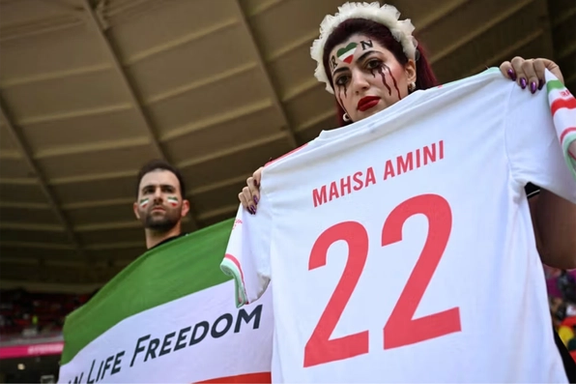
Two Iranian fans holding a jersey in memory of Mahsa Amini at 2022 Qatar World Cup
The absence of the usual jubilation after Iran secured a spot in the 2026 FIFA World Cup earlier this week reflects deep societal and political divisions that extend far beyond the football pitch.
Iran's national football (soccer) team, Team Melli, secured a World Cup spot with a draw against Uzbekistan on Tuesday. In the past, such a victory would have brought millions to the streets in celebration, but this time, the public response was largely indifferent.
Media outlets in Tehran, such as Rouydad24, and numerous social media users noted this apathy. "The national football team qualified for the World Cup, but there was no enthusiasm in the public sphere or on social media. The event seemed so insignificant that people behaved as if they had no connection to the team," journalist Mohammad Parsi wrote on X.
In stark contrast, when Iran qualified for the 1998 World Cup by defeating Australia, millions celebrated in the streets nationwide. The euphoria of that moment, when people danced in public without fear of morality police intervention, remains a historic memory.
Football has long been Iran's most popular sport, but many Iranians say they no longer take pride in their national team. This shift is largely political, rooted in the 2022-2023 "Woman, Life, Freedom" protests, sparked by the death of 22-year-old Mahsa Amini in September 2022 while in morality police custody for allegedly violating hijab laws.
During the nationwide protests, Team Melli initially showed solidarity with the demonstrators. Some players, including forward Sardar Azmoun, openly condemned the brutal crackdown. Many others wore black armbands and refused to sing Islamic Republic's anthem before their World Cup match against England in November 2022, as a gesture of support.
However, under apparent pressure from security forces, the team’s public support for the protesters waned. This led to widespread disillusionment among fans, who began referring to the squad as the government’s or "mullahs' team."
The team's meeting with then-president Ebrahim Raisi before leaving for Qatar angered many supporters who did not expect the players to ignore the continued crackdown on protesters. Legendary striker Ali Daei and outspoken star Ali Karimi, charged in absentia for supporting the protests, said they rejected FIFA and Qatar’s invitation to watch the matches in Doha. The unpopularity of Team Melli reached a peak in February 2024 when thousands celebrated its defeat to Qatar in the Asian Cup tournament.
Inter Milan striker Mehdi Taremi, who scored both goals in Tuesday’s match, has also faced backlash. Taremi, known for his pro-government stance, was criticized for distancing himself from political issues and denying allegations that the team had been coerced into singing the national anthem.
The declining support has also been evident in dwindling stadium attendance—despite the match attended by President Masoud Pezeshkian falling during the New Year holidays, only one-third of Azadi Stadium’s 100,000 seats were occupied.
Ordinary Iranians are bearing unprecedented economic pain as their Islamic government's row with its hated enemies Israel and the United States ramps up and Tehran prioritizes military spending to shore up defense and its regional clout.
“It is a real tragedy,” said Mohamad Machine Chian, a senior researcher at the Center of Governance and Markets at Pittsburgh University on the Eye for Iran podcast. “Their quality of life has been steadily dropping for the past couple of years. But especially the past year, it has been a disaster.”
Chian told Eye for Iran that the Iranian government has continued to prioritize funding the Islamic Revolutionary Guard Corps (IRGC) and military ventures over investing in the wellbeing of its citizens.
Since President Masoud Pezeshkian took office, the Iranian currency has halved in value.
With unemployment surging above 70 percent, millions are struggling to afford basic necessities as crippling inflation and poverty grip the nation.
The sharp depreciation has driven inflation above 40 percent, with food prices soaring by as much as 100 percent in some cases. As the crisis deepens, the economic strain on ordinary Iranians is only expected to worsen in the coming months.
Machine Chian said President Pezeshkian missed numerous opportunities to address the deepening crisis and has failed to include a welfare plan in the budget to alleviate citizens' suffering.
“One such opportunity was that President Pezeshkian could have put together next year's budget in a way that convinced the Islamic Republic’s powers to at least, for a year, halt increases in military spending. That could have deescalated the situation,” said Machine Chian.
"This is during a crisis. He (Pezeshkian) should have prioritized the budget for basic necessities. But he prioritized the IRGC," said Machine Chian.
Iran implemented a 200 percent increase in military spending for the Persian year beginning this month and will aim to boost revenue through higher taxes despite a big deficit and a moribund currency besetting the economy.
It's bad...but just how bad?
The economic crisis is the worst Iran has experienced since the inception of the Islamic Republic, according to Mahdi Ghodsi, an economist at the Vienna Institute for International Economic Studies. Remarkably, Ghodsi says that the economy was better even during the eight-year war between Iran and Iraq.
“It's the worst situation, it's the worst condition, the direst condition that Iran has ever experienced,” said Ghodsi.
Ghodsi added that the reasons for this collapse are multifaceted, including Iran's militant stance in the region as a means of preserving the ruling system.
“It’s a dark comedy,” Ghodsi told Eye for Iran. “Leaders of Iran are mingling in a situation of lack of policy because their only objective is to survive. And to survive, they feel the need to initiate wars and increase tensions with other countries.”
Oil revenue: how much does it matter?
The looming uncertainty over a potential war with the United States or a new nuclear deal is also deepening the economic crisis.
Since President Trump took office, the rial has plummeted by 80,000. The administration has imposed new sanctions targeting Iran’s oil industry, including Chinese “teapot refineries” processing Iranian crude.
The Iranian state relies heavily on oil exports. However, at the current rate of oil exports, the revenue generated is insufficient to cover even basic pension funds, according to Machine Chian.
Iran's oil exports totaled $54 billion in 2024, up slightly from $53 billion in 2023, with volumes averaging 1.5 million barrels per day, according to the US Energy Information Administration.
However, President Trump signed an executive order vowing to reduce Iran’s oil exports to zero. Both Ghodsi and Machine Chian say that while the world markets can endure such a move, the impact on Iran’s economy would be crushing.
Iran currently attempts to stabilize the prices of basic goods and services by injecting US dollars into the economy. But if oil exports fall to zero, the state will lack sufficient foreign currency reserves, leading to further spikes in inflation and continued depreciation of the rial.
This also means Iran would no longer be able to subsidize the price of gasoline.
If the government can't subsidize gasoline prices, then there will likely be an increase in prices this summer, both economists warn.
Ghodsi and Machine Chian said that could lead to nationwide protests similar to the November 2019 protests, which erupted after a sudden increase in fuel prices and quickly spread as a broader expression to fight the establishment. Hundreds were killed and more than 7,000 were arrested.
But according to both economists, any meaningful change in Iran’s leadership through maximum pressure cannot happen without maximum support for the Iranian people.
With the shadow of war looming or a potential nuclear deal, the rial may continue to spiral. Rising inflation and economic hardship will likely fuel further public discontent, while tensions keep diplomatic and military risks high.
Persian poet and scholar Omar Khayyam's mausoleum in Neyshabur, Iran
A hardline cleric’s call to demolish the monument of Persian poet and scientist Omar Khayyam sparked widespread backlash this week, with many seeing it as an assault on Iran’s national identity by religious hardliners.
The controversy erupted after a preacher, identified only by his last name, Robati, claimed in a sermon that Khayyam’s monument was deliberately built to overshadow an adjacent Shia shrine where he was speaking. His comments came just a day after large crowds gathered at the mausoleum in Neyshabur on March 21 to celebrate Nowruz, the Persian New Year. Some in the crowd also chanted anti-government and pro-monarchy slogans in favor of the last ruling dynasty, including “Reza Shah, bless your soul.”
The cleric was initially mistaken for the Friday prayer leader of Neyshabur, but later reports clarified that he was a local preacher speaking at the shrine of 9th-century Shia saint Muhammad ibn-e Husayn, known as Emamzadeh Mahruq.
The remarks sparked swift condemnations, with critics accusing hardliners of attempting to erase Iran’s historical and cultural heritage. “Destroying historical memory by demolishing national symbols is one of the most dangerous and costly acts of ignorance that threaten a country’s national security,” wrote academic and political analyst Mehdi Motaharnia on X.
Shrine of Imamzadeh Mahruq, Neyshabur, Iran
Amid the growing backlash, several government officials, including the Minister of Culture and Islamic Guidance Abbas Salehi, the President’s Executive Deputy Jafar Ghaempanah, and prominent reformist politician Azar Mansoori, criticized the attack on national symbols and warned about its consequences.
“Juxtaposing religious symbols with Iran’s national and historical heritage, whoever it benefits, is a massive mistake,” Mansoori posted on X.
Khayyam is celebrated not only for his philosophical quatrains (rubaʿiyat), remarkably secular for their time, but also for his contributions to mathematics, astronomy, and the development of the Jalali calendar, which remains Iran’s official calendar. His poetry, popularized in the West through Edward FitzGerald’s 19th-century translations, has earned him global recognition, while his scientific achievements have left a lasting impact. In Iran, his legacy is deeply ingrained in the culture, with many knowing at least a few of his verses by heart.
Thousands of Iranians flocked to the monuments of Iran's national poets Omar Khayyam in Neyshabur, Ferdowsi in Mashhad, and Hafiz in Shiraz, as well as historical sites such as Persepolis, on March 21 to celebrate the Persian New Year with music and dancing. At some gatherings, people also chanted anti-government slogans.
In the wake of the Nowruz celebrations, authorities in Khorasan-e Razavi Province shut down the mausoleums of both Khayyam and Ferdowsi, Iran’s other literary giant, citing the coincidence with Shia mourning days.
There was a dispute over the boundaries of Khayyam’s mausoleum and the adjacent shrine between the Religious Endowments Organization and the Cultural Heritage Organization for several decades.
The current monument, designed by renowned architect Hooshang Seyhoun, was inaugurated in the 1960s under the Shah. Khayyam was originally buried in a small structure beside the shrine in 1131, his bones were exhumed and reburied in the new monument built at a distance from the shrine.
The Shia shrine is several centuries old. An older shrine on the site is believed to have been destroyed during the Mogul invasion of Iran in the 13th century. The current building is believed to be from the 16th century. Many additions, including the tile work, date from later periods.
People walking in Iran's historic Naqsh-e Jahan square, Isfahan, Iran, March 25, 2025
A senior adviser to Iran’s Supreme Leader urges the government to cede more economic control to the people, arguing that this is necessary to address sanctions, soaring inflation, and a rapidly depreciating currency.
By some estimates, 80% of Iran’s economy is controlled directly and indirectly by the state or affiliated religious foundations operating under Ali Khamenei’s orders.
Ali Larijani, a senior adviser to Khamenei, told the Eco Iran website that “what Iran’s economy needs is security, and that does not mean control by security institutions,” a clear jab at the influence of the IRGC and other forces.
Criticizing the involvement of security organizations in the economy, Larijani, a former parliamentary speaker, said Iran’s economy should be controlled by the people rather than the government. He also called for administrative reforms, global engagement, and resolving Iran’s nuclear issue through dialogue.
Larijani emphasized that "the government controls some 85 percent of Iran's industries and mines," but argued that it lacks the efficiency to manage these sectors effectively.
He also stressed the need for the government to ensure security for the private sector by passing relevant laws and persuading the Supreme Leader to support the move.
Speaking on Iran's foreign policy and negotiations with the United States, Larijani stated, "If the Americans had acted wisely, they could have changed the course of Washington's relationship with Tehran." He argued that US sanctions have hindered Iran’s economic development, emphasizing that economic prosperity is unattainable under such restrictions.
Washington imposed oil export and international banking sanctions on Iran after President Donald Trump withdrew from the JCPOA nuclear deal in 2018. Iran’s already struggling economy, burdened by inefficiencies, immediately sank into a prolonged recession, while its currency depreciated 25-fold.
Regarding the future of nuclear negotiations, Larijani stated, "Everything depends on US behavior. There is a gap between what the United States declares and what it actually does." He also emphasized that Iran should pursue its national interests in both the East and the West.
Meanwhile, in an interview with a Tehran-based website, Iranian economist Ali Ghanbari, addressing the current financial crisis, noted that some Iranian politicians appear to overlook the fundamental principle that every country must prioritize its own national interests.
Ghanbari stated, "Realistically speaking, it is unlikely that the country's economic situation—regarding inflation, poverty, and unemployment—will improve significantly compared to last year, as Iran's economy remains constrained by structural issues in foreign policy that are beyond the government's control."
The economist added, "We cannot expect any improvement in the country's economic situation as long as sanctions pressure continues." He noted that this is in addition to the broader issue of insufficient domestic and foreign investment in Iran.
Ghanbari stressed that the defining characteristic of Iran's economic policy is "confusion," a problem that has become even more evident following the impeachment and dismissal of the former Minister of Economy.
As a way forward, Ghanbari suggested that Iran should abandon the idea of indirect talks and engage in direct negotiations with the United States, arguing that intermediaries only complicate the process.
He also urged the government to prioritize its employees to safeguard its social capital. At the same time, he emphasized that if Iran is serious about easing tensions and sanctions in the coming year, it must carefully select its strategic partners, a veiled reference to Tehran’s preference for close ties with China and Russia.
While both Larijani and Ghanbari emphasized the need to address foreign policy challenges to resolve Iran’s economic woes, analyst Hamid Aboutalebi suggested that a new path for dialogue with the United States may have emerged. Writing on the conservative Nameh News website in Tehran, he pointed to recent conciliatory remarks by Trump’s Middle East adviser, Steve Witkoff, as a potential opening.
Aboutalebi further argued that the Iranian government should move away from propaganda campaigns against Washington and pursue direct negotiations to de-escalate tensions.
Iran's armed forces' ceremony at Jamkaran Mosque in September 2023
Reverence for the Shi'ite messiah, or Mahdi, has played a central yet contested role in Iran’s Islamic theocracy—bolstering the legitimacy of its two leaders while also fueling subtle power plays by hardline zealots.
Iran’s system of clerical rule broadly considers the Supreme Leader to be the representative of the Mahdi, the twelfth Imam in Shi'ite Islam, who is destined to return and rule over a period of divinely-inspired justice just ahead of the end times.
The Islamic governance theory developed and institutionalized by the founder of the Islamic Revolution, Ayatollah Ruhollah Khomeini, is based on the belief that a paramount Islamic scholar (Vali-ye Faqih) should lead the country with ultimate authority over state and religious affairs.
A major early critic of this view was the Hojjatiyeh Society, originally a Mahdist faction animated by contempt for the Baha'i religious minority in the run-up to the 1979 Revolution.
Khomeini later banned the group for opposing political involvement and theocratic rule. Although officially dissolved in 1983, its influence persists within certain conservative religious circles, where some followers argue that only the Mahdi himself can usher in true Islamic rule and a period of chaos will precede his return.
What is Mahdism and who is Mahdi?
Mahdism is the belief in the second coming of Imam Mahdi, a messianic figure in Islamic eschatology, especially in Twelver Shi'ite Islam.
Born in 868 CE, Mahdi is believed to have gone into occultation at the age of six after his father, the Eleventh Imam, was allegedly poisoned on the orders of the Sunni Abbasid ruler.
According to Twelver Shi'ite doctrine that is Iran's official religion, he communicated with his followers through four deputies until 941 CE, after which no direct contact has occurred. He is expected to reappear at the end of times to establish justice, defeat tyranny, and bring global peace under Islamic rule.
In contrast, most Sunni sects believe the Mahdi is a righteous leader from the Prophet Muhammad’s family who will appear before the Day of Judgment to restore justice and uphold Islam. Unlike Shi'ite beliefs, Sunnis do not consider him infallible or divinely appointed.
The Politicization of Mahdism
While various factions within the Islamic Republic acknowledge Mahdism, some have politicized and institutionalized it, elevating it to a cult-like ideology.
The now ostracized ‘Ahmadinejad Circle’, ultra-hardline Paydari (Steadfastness) Party, and its ally, Jebhe-ye Sobh-e Iran (MASAF), are the most influential among the political groups that promote Mahdism as a political ideology.
Former Tehran mayor and perhaps Iran's most strident critic of the West as president, Mahmoud Ahmadinejad made frequent references to the Mahdi while in office. Out of favor with Khamenei, he now never appears alongside him.
These factions wield significant influence within the Revolutionary Guards and its Basij militia, state-funded Shi'ite seminaries, and numerous governmental institutions.
The groups emerged from the circle of the followers of the late Ayatollah Mohammad-Taqi Mesbah-Yazdi, a radical cleric who strongly emphasized Mahdism and theocratic rule.
Mesbah-Yazdi initially supported Ahmadinejad but later withdrew his backing due to conflicts with Supreme Leader Khamenei. This led to a split, with Ahmadinejad’s supporters forming their distinct brand of Mahdism.
Many consider ultra-hardliner Ayatollah Mohammad-Mehdi Mirbagheri, who endorsed ultra-hardliner Saeed Jalili in last year’s snap elections, as Mesbah-Yazdi’s successor. Mirbagheri teaches that fighting and overcoming infidels is a prerequisite for the return of the hidden Imam.
Ahmadinejad’s Mahdist agenda
During his 2005–2013 presidency, Ahmadinejad and his allies strongly promoted Mahdism, often hinting at having a direct connection with the Mahdi.
His administration allocated substantial funds for Mahdist propaganda and policies aimed at hastening Mahdi’s return.
Ahmadinejad’s government also significantly expanded the Jamkaran Mosque, a small historical site near Qom associated with Mahdist traditions.
Since the late 1990s, Jamkaran has evolved into a grand complex and a major pilgrimage destination, symbolizing the Islamic Republic’s ideological commitment to Mahdism.
Some religious scholars have debated the historical legitimacy of Jamkaran's connection to Mahdi, but Supreme Leader Ali Khamenei has visited Jamkaran Mosque multiple times, effectively giving it his official blessing.
Hardline-dominated clerical institutions and the Revolutionary Guards (IRGC) actively encourage visits to Jamkaran.
In September 2024, Iran’s armed forces held a joint ceremonial morning assembly at the mosque to renew their allegiance to Mahdi on the anniversary of his assumed leadership as the Twelfth Imam. The IRGC Commander-in-Chief, Hossein Salami, addressed the ceremony.
Mahdism and modern geopolitical conflicts
Political hardliners and the Ahmadinejad Circle often view modern geopolitical conflicts in the Middle East region through an eschatological lens.
In Shi'ite beliefs on the end times, certain events and conflicts in Syria and Yemen are believed to be signs preceding the emergence of Imam Mahdi from occultation.
These prophecies are derived from hadiths or sayings attributed to the Prophet Muhammad and the Imams, including the prophesies of the rise of a tyrannical and brutal leader in Damascus (Sufyani) and his invasion of Iraq and a righteous leader (Yamani) who emerges in Yemen and supports Mahdi.
Iran's Supreme Leader Ali Khamenei casting his vote in an election (March 2024)
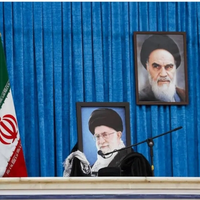
A prominent political commentator in Tehran has suggested that the best way for Supreme Leader Ali Khamenei to break the current deadlock is to hold a national referendum on the question of war or peace with the United States.
In two speeches delivered in the opening days of Nowruz, Supreme Leader Ali Khamenei appeared to indirectly respond to US President Donald Trump's letter proposing a new deal.
In his first address, a pre-recorded message aired on state television, Khamenei blamed the United States for instability in the region. In the second, delivered live, he denied commanding Iran’s regional proxy forces but warned Washington of a strong response to its military actions in the region.
Tehran has yet to issue an official response to Trump’s letter, as few details of its contents have been made public. In a New Year’s Eve interview with state TV, Foreign Minister Abbas Araghchi said the letter included “many threats and a few opportunities.” He added that Tehran is still evaluating the message. Meanwhile, US media reported that Trump gave the ayatollah two months to consider before replying.
Perhaps in an attempt to ease the pressure on Khamenei, Reformist commentator Ahmad Zeidabadi suggested in a tweet that the Islamic Republic should hold a referendum to determine the will of the people.
Given the widespread concerns expressed on social media and in call-ins to Persian-language TV channels based in Europe and the United States, it's clear that the economy—and its impact on daily life—is the top priority for most Iranians. It would not be difficult to predict the likely outcome of such a referendum.
Iranian political commentator, Ahmad Zeidabadi
In a post on X, Ahmad Zeidabadi wrote that Iran has two months to choose between war and an agreement with the United States. “Tehran must make a decision while its officials are unprepared for either option,” he said, adding, “They believe an agreement would bring humiliation, while a war could be devastating. Hence, the indecision.”
Zeidabadi warned that some are exploring a so-called third path—one that could ultimately lead to both humiliation and destruction. He noted that the current situation was foreseeable and, in fact, some politicians had predicted it, but their warnings went unheeded.
He also pointed out that while referenda are mentioned in Article 59 of Iran’s Constitution as tools to resolve difficult political, economic, social, and cultural issues, they have never been clearly defined or seriously pursued within the Islamic Republic’s framework.
Khamenei, however, has consistently rejected the idea of holding a referendum on any issue, dismissing proposals even from well-wishers like former presidents Hassan Rouhani and Mohammad Khatami on multiple occasions.
Yet, a referendum could offer him a way to resolve the current impasse—allowing him to shift the burden of any potential compromise with the United States onto the people. Still, many who commented on Zeidabadi’s post on X argued that no meaningful referendum is possible under current conditions. They noted that without a free press, functioning political parties, and open public debate, a genuine vote would be impossible. They also called for an end to the imprisonment of political activists, the unblocking of social media platforms, and guarantees for freedom of expression and assembly as prerequisites for any credible referendum.
Some analysts believe the mix of threats and defiance in Khamenei’s recent speeches suggests he is thinking aloud, searching for a way out of the current impasse. As he acknowledged in his first address, Iran’s main challenge is its struggling economy, severely weakened by US sanctions. While he is unwilling to appear submissive to his archenemy, America, the only viable path to economic relief may lie in accepting Trump’s conditions—an option that would be especially difficult for a leader known for his uncompromising stance.
Others pointed out that the government has consistently ignored public opinion in the past and holding a referendum now would be shifting responsibility onto the people for any potential compromise. Some expressed skepticism that even after a referendum, the Iranian government would truly respect the people’s will.
One commenter remarked that, as usual, Iranians would be left choosing between “bad and worse.” Still, some speculated that Zeidabadi may be hoping a referendum would give like-minded reformists an opportunity to participate more freely in the political process.