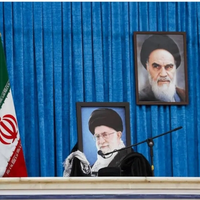
Iran's armed forces' ceremony at Jamkaran Mosque in September 2023
Reverence for the Shi'ite messiah, or Mahdi, has played a central yet contested role in Iran’s Islamic theocracy—bolstering the legitimacy of its two leaders while also fueling subtle power plays by hardline zealots.
Iran’s system of clerical rule broadly considers the Supreme Leader to be the representative of the Mahdi, the twelfth Imam in Shi'ite Islam, who is destined to return and rule over a period of divinely-inspired justice just ahead of the end times.
The Islamic governance theory developed and institutionalized by the founder of the Islamic Revolution, Ayatollah Ruhollah Khomeini, is based on the belief that a paramount Islamic scholar (Vali-ye Faqih) should lead the country with ultimate authority over state and religious affairs.
A major early critic of this view was the Hojjatiyeh Society, originally a Mahdist faction animated by contempt for the Baha'i religious minority in the run-up to the 1979 Revolution.
Khomeini later banned the group for opposing political involvement and theocratic rule. Although officially dissolved in 1983, its influence persists within certain conservative religious circles, where some followers argue that only the Mahdi himself can usher in true Islamic rule and a period of chaos will precede his return.
What is Mahdism and who is Mahdi?
Mahdism is the belief in the second coming of Imam Mahdi, a messianic figure in Islamic eschatology, especially in Twelver Shi'ite Islam.
Born in 868 CE, Mahdi is believed to have gone into occultation at the age of six after his father, the Eleventh Imam, was allegedly poisoned on the orders of the Sunni Abbasid ruler.
According to Twelver Shi'ite doctrine that is Iran's official religion, he communicated with his followers through four deputies until 941 CE, after which no direct contact has occurred. He is expected to reappear at the end of times to establish justice, defeat tyranny, and bring global peace under Islamic rule.
In contrast, most Sunni sects believe the Mahdi is a righteous leader from the Prophet Muhammad’s family who will appear before the Day of Judgment to restore justice and uphold Islam. Unlike Shi'ite beliefs, Sunnis do not consider him infallible or divinely appointed.
The Politicization of Mahdism
While various factions within the Islamic Republic acknowledge Mahdism, some have politicized and institutionalized it, elevating it to a cult-like ideology.
The now ostracized ‘Ahmadinejad Circle’, ultra-hardline Paydari (Steadfastness) Party, and its ally, Jebhe-ye Sobh-e Iran (MASAF), are the most influential among the political groups that promote Mahdism as a political ideology.
Former Tehran mayor and perhaps Iran's most strident critic of the West as president, Mahmoud Ahmadinejad made frequent references to the Mahdi while in office. Out of favor with Khamenei, he now never appears alongside him.
These factions wield significant influence within the Revolutionary Guards and its Basij militia, state-funded Shi'ite seminaries, and numerous governmental institutions.
The groups emerged from the circle of the followers of the late Ayatollah Mohammad-Taqi Mesbah-Yazdi, a radical cleric who strongly emphasized Mahdism and theocratic rule.
Mesbah-Yazdi initially supported Ahmadinejad but later withdrew his backing due to conflicts with Supreme Leader Khamenei. This led to a split, with Ahmadinejad’s supporters forming their distinct brand of Mahdism.
Many consider ultra-hardliner Ayatollah Mohammad-Mehdi Mirbagheri, who endorsed ultra-hardliner Saeed Jalili in last year’s snap elections, as Mesbah-Yazdi’s successor. Mirbagheri teaches that fighting and overcoming infidels is a prerequisite for the return of the hidden Imam.
Ahmadinejad’s Mahdist agenda
During his 2005–2013 presidency, Ahmadinejad and his allies strongly promoted Mahdism, often hinting at having a direct connection with the Mahdi.
His administration allocated substantial funds for Mahdist propaganda and policies aimed at hastening Mahdi’s return.
Ahmadinejad’s government also significantly expanded the Jamkaran Mosque, a small historical site near Qom associated with Mahdist traditions.
Since the late 1990s, Jamkaran has evolved into a grand complex and a major pilgrimage destination, symbolizing the Islamic Republic’s ideological commitment to Mahdism.
Some religious scholars have debated the historical legitimacy of Jamkaran's connection to Mahdi, but Supreme Leader Ali Khamenei has visited Jamkaran Mosque multiple times, effectively giving it his official blessing.
Hardline-dominated clerical institutions and the Revolutionary Guards (IRGC) actively encourage visits to Jamkaran.
In September 2024, Iran’s armed forces held a joint ceremonial morning assembly at the mosque to renew their allegiance to Mahdi on the anniversary of his assumed leadership as the Twelfth Imam. The IRGC Commander-in-Chief, Hossein Salami, addressed the ceremony.
Mahdism and modern geopolitical conflicts
Political hardliners and the Ahmadinejad Circle often view modern geopolitical conflicts in the Middle East region through an eschatological lens.
In Shi'ite beliefs on the end times, certain events and conflicts in Syria and Yemen are believed to be signs preceding the emergence of Imam Mahdi from occultation.
These prophecies are derived from hadiths or sayings attributed to the Prophet Muhammad and the Imams, including the prophesies of the rise of a tyrannical and brutal leader in Damascus (Sufyani) and his invasion of Iraq and a righteous leader (Yamani) who emerges in Yemen and supports Mahdi.
Iran's Supreme Leader Ali Khamenei casting his vote in an election (March 2024)
A prominent political commentator in Tehran has suggested that the best way for Supreme Leader Ali Khamenei to break the current deadlock is to hold a national referendum on the question of war or peace with the United States.
In two speeches delivered in the opening days of Nowruz, Supreme Leader Ali Khamenei appeared to indirectly respond to US President Donald Trump's letter proposing a new deal.
In his first address, a pre-recorded message aired on state television, Khamenei blamed the United States for instability in the region. In the second, delivered live, he denied commanding Iran’s regional proxy forces but warned Washington of a strong response to its military actions in the region.
Tehran has yet to issue an official response to Trump’s letter, as few details of its contents have been made public. In a New Year’s Eve interview with state TV, Foreign Minister Abbas Araghchi said the letter included “many threats and a few opportunities.” He added that Tehran is still evaluating the message. Meanwhile, US media reported that Trump gave the ayatollah two months to consider before replying.
Perhaps in an attempt to ease the pressure on Khamenei, Reformist commentator Ahmad Zeidabadi suggested in a tweet that the Islamic Republic should hold a referendum to determine the will of the people.
Given the widespread concerns expressed on social media and in call-ins to Persian-language TV channels based in Europe and the United States, it's clear that the economy—and its impact on daily life—is the top priority for most Iranians. It would not be difficult to predict the likely outcome of such a referendum.
Iranian political commentator, Ahmad Zeidabadi
In a post on X, Ahmad Zeidabadi wrote that Iran has two months to choose between war and an agreement with the United States. “Tehran must make a decision while its officials are unprepared for either option,” he said, adding, “They believe an agreement would bring humiliation, while a war could be devastating. Hence, the indecision.”
Zeidabadi warned that some are exploring a so-called third path—one that could ultimately lead to both humiliation and destruction. He noted that the current situation was foreseeable and, in fact, some politicians had predicted it, but their warnings went unheeded.
He also pointed out that while referenda are mentioned in Article 59 of Iran’s Constitution as tools to resolve difficult political, economic, social, and cultural issues, they have never been clearly defined or seriously pursued within the Islamic Republic’s framework.
Khamenei, however, has consistently rejected the idea of holding a referendum on any issue, dismissing proposals even from well-wishers like former presidents Hassan Rouhani and Mohammad Khatami on multiple occasions.
Yet, a referendum could offer him a way to resolve the current impasse—allowing him to shift the burden of any potential compromise with the United States onto the people. Still, many who commented on Zeidabadi’s post on X argued that no meaningful referendum is possible under current conditions. They noted that without a free press, functioning political parties, and open public debate, a genuine vote would be impossible. They also called for an end to the imprisonment of political activists, the unblocking of social media platforms, and guarantees for freedom of expression and assembly as prerequisites for any credible referendum.
Some analysts believe the mix of threats and defiance in Khamenei’s recent speeches suggests he is thinking aloud, searching for a way out of the current impasse. As he acknowledged in his first address, Iran’s main challenge is its struggling economy, severely weakened by US sanctions. While he is unwilling to appear submissive to his archenemy, America, the only viable path to economic relief may lie in accepting Trump’s conditions—an option that would be especially difficult for a leader known for his uncompromising stance.
Others pointed out that the government has consistently ignored public opinion in the past and holding a referendum now would be shifting responsibility onto the people for any potential compromise. Some expressed skepticism that even after a referendum, the Iranian government would truly respect the people’s will.
One commenter remarked that, as usual, Iranians would be left choosing between “bad and worse.” Still, some speculated that Zeidabadi may be hoping a referendum would give like-minded reformists an opportunity to participate more freely in the political process.
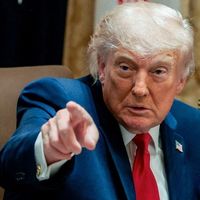
US Special Envoy to the Middle East, Steven Witkoff, with President Donald Trump
Steve Witkoff’s suggestion that he or another member of President Donald Trump’s team could potentially visit Iran for talks has received widespread coverage in Iranian online media.
At the end of an interview with Tucker Carlson on Friday, President Trump’s special envoy to the Middle East expressed hope that he or someone else from the administration might visit Tehran, as Carlson had suggested. Witkoff acknowledged the complexity of the Iran issue due to its nuclear dimension and the need for technical expertise. “I’m going to welcome that opportunity if I’m involved,” he stated.
So far, there has been no official Iranian reaction to Witkoff’s remarks. However, Nour News, a media outlet close to Iran's Supreme National Security Council, said in a tweet in English on Sunday that Witkoff’s tone “won’t clear up misunderstandings as no behavioral changes have occurred,” referring to US policies toward the Islamic Republic. Nour News added that the US is still pursuing talks while exerting pressure on Tehran. “If Washington wants a new nuclear verification process, it must first present real evidence of Iran's intent to obtain nukes!”
The lack of more commentary in online publications may be due to limited resources during the Nowruz holidays. Some public figures, however, have also commented on the interview via social media, where high engagement suggests significant public interest.
Throughout the lengthy interview, Witkoff reiterated that President Trump was open to negotiating a resolution with Iran, allowing the country to reintegrate into the global economy without the burden of sanctions. He emphasized Trump’s preference for diplomacy over military action and suggested that a verification program could be established to ensure Iran’s nuclear program remains peaceful.
Speaking on Fox News on Sunday, Witkoff reinforced the administration’s message to Iran, urging diplomatic engagement to resolve ongoing tensions. “And if we can't, the alternative is not a great alternative,” he warned, stressing that the U.S. would not allow Iran to develop nuclear weapons.
Diverging perspectives within the Trump administration
Witkoff’s remarks—particularly his focus on controlling Iran’s nuclear program through verification—contrast with statements from President Trump and other senior officials, who have called for the complete dismantling of Tehran’s nuclear program. White House National Security Advisor Michael Waltz reiterated on Sunday that the Trump administration seeks the full dismantlement of Iran’s nuclear program in a transparent manner that satisfies the international community.
Reactions from Iranian figures
“Dear friends in the Foreign Ministry, Witkoff has expressed interest in visiting Iran!” wrote Nosratolah Tajik, a relatively moderate politician and former diplomat, in a brief post on X on Saturday. He suggested that Tehran should invite Witkoff before formally responding to President Trump’s letter to Supreme Leader Ali Khamenei—both as a gesture of diplomatic goodwill and a display of political savvy, while also helping to deflect public criticism.
“It’s not just me saying this—former senior diplomats from the Foreign Ministry also advise against rejecting Witkoff’s expression of interest in visiting Iran,” wrote senior reformist journalist Mohammad Sahafi, referencing Tajik’s post.
An expatriate dissident, Akbar Ganji, echoed this sentiment, advocating for direct talks between Iran and the US, starting with a meeting between Iranian officials and Witkoff and eventually progressing to a summit between the Iranian and US presidents to finalize an agreement.
Former Reformist diplomat and political editor Abdolreza Raisi also backed the idea of hosting Witkoff in Iran. “How can we refuse to host him now that he’s expressed interest in visiting, especially to verify such claims and put the ball in their court?” he wrote in a post on X.
Skepticism from US analysts
Jason Brodsky, Policy Director at United Against Nuclear Iran (UANI), suggested in a post on X that certain Iranian officials and regime sympathizers may be attempting to exploit perceived divisions within the Trump administration. According to Brodsky, these figures are bypassing Secretary of State Marco Rubio and National Security Advisor Mike Waltz while engaging with officials they believe are more receptive to negotiations.
In his Nowruz speech, Supreme Leader Ali Khamenei denied involvement in economic decision-making, claiming it falls under the responsibility of the president. In reality, however, his influence over the economy is both profound and far-reaching.
Khamenei’s formal role in economic planning
While Khamenei does not directly manage economic ministries or oversee the national budget—duties formally assigned to the presidential administration and parliament—he exerts control through other channels. This influence, rooted in both constitutional authority and informal networks, is complex and multifaceted.
According to Article 110 of Iran’s Constitution, Khamenei has the authority to determine the general policies of the Islamic Republic. In collaboration with the Expediency Council, whose members he appoints, Khamenei issues "General Policies of the System," which shape the country’s economic direction.
The Planning and Budget Organization, an administrative body, must ensure that Iran’s development plans—such as macro policies in the oil sector—align with the overarching guidelines drawn in the General Policies of the System documents.
Political
He also holds sway over the expenditure of oil revenues. Any withdrawal from the National Development Fund of Iran (NDFI) requires his approval, for instance. At least 20 percent of all oil revenues are allocated to the NDFI, and successive administrations, including Masoud Pezeshkian’s, have sought his permission to borrow billions of dollars from the fund over the years to cover budget deficits.
Directing the economy through political engineering
Khamenei appoints the head of the judiciary and the members of the constitutional Guardian Council, which has the power to veto legislation, including economic policies and budget plans if they conflict with his prescribed policies. As Iran's election watchdog, the Council also engineers all elections and ensures that candidates whose platforms are not aligned with Khamenei’s political and economic vision are not elected as president or make it to the parliament.
Economic entities under Khamenei’s direct control
Khamenei wields significant economic power through a network of quasi-charitable foundations, known as bonyads, and religious endowments.
Among the largest bonyads are:
Mostazafan Foundation
Execution of Imam Khomeini's Order Headquarters
Martyrs Foundation
Originally established to redistribute wealth and support social welfare following the 1979 Islamic Revolution, these institutions have evolved into major economic conglomerates operating in diverse sectors, including agriculture, construction, mining, energy, manufacturing, telecommunications, financial services, and real estate.
Their financial activities remain opaque, despite assets worth hundreds of billions of dollars.
These entities function as strategic instruments for maintaining Khamenei’s political and economic dominance. By appointing their leadership, he ensures loyalty and strengthens his control. They also help finance Iran’s regional allies and domestic political factions aligned with him through a complex system of privilege distribution—commonly referred to as rent in Iranian economic and political jargon.
The IRGC’s economic influence
The Revolutionary Guards (IRGC), which operate directly under Khamenei’s authority as commander-in-chief, also control vast segments of Iran’s economy. They are allocated a portion of the country’s oil exports, which they reportedly sell through front companies and intermediaries to evade US sanctions—generating funds for their military operations and regional activities.
The IRGC dominates industries such as construction, energy, and telecommunications. Additionally, it is granted a direct share of Iran’s oil revenues, allegedly selling oil through front companies and third-party intermediaries to bypass US sanctions and finance military and regional operations.
The extent of Khamenei’s economic control
Quantifying the economic footprint of bonyads, religious endowments, and the IRGC is difficult due to their opaque financial practices. Nonetheless, estimates suggest these entities collectively control at least half of Iran’s GDP.
Though they are technically subject to taxation and audits, they use complex methods to conceal financial data, making meaningful oversight nearly impossible.
Khamenei’s firm grip over these institutions reinforces his dominance over the Iranian economy, limiting transparency and blocking major reforms. This control expanded significantly after a 2005 privatization initiative that channeled state assets not to a genuine private sector, but to IRGC-linked entities, bonyads, and companies benefiting from monopolistic privileges.
Donald Trump’s Middle East envoy, Steve Witkoff, said Iran used indirect channels to respond after the US president sent a letter to Supreme Leader Ali Khamenei earlier this month.
“I’m not at liberty to talk about the specifics,” Witkoff said in an interview released Friday on The Tucker Carlson Show. “But clearly through a, you know, back channels, through multiple countries and multiple conduits, they've reached back out.”
According to Axios, Trump’s letter to Ali Khamenei, delivered via a senior Emirati diplomat, included a two-month deadline for reaching a new nuclear agreement and warned of consequences if Iran expanded its nuclear program. The letter was described by sources as “tough” in tone.
However, Witkoff presented the message differently during his interview. “It roughly said, I'm a president of peace. That's what I want. There's no reason for us to do this militarily,” he said. “We should talk. We should clear up the misconceptions. We should create a verification program so that nobody worries about weaponization of your nuclear material.”
He also said Trump believes the issue “has a real possibility of being solved diplomatically” and “acknowledged that he's open to an opportunity to clean it all up with Iran.”
Iranian Foreign Minister Abbas Araghchi recently affirmed that indirect talks through countries like Oman are “not a strange method,” and on Friday he held a phone call with his Emirati counterpart. No details were released about the conversation.
Witkoff added that Trump wants to build trust with Iran and would prefer to avoid war. “He’s a president who doesn’t want to go to war,” he said. “He’ll use military action to stop a war.”
Carlson, a longtime ally of Trump, warned earlier in the week that a military strike on Iran “would certainly result” in a broader conflict and “thousands of American deaths.” Iranian media highlighted both his remarks and Witkoff’s interview, portraying them as possible signs of a shifting tone in Washington.
Still, Iran’s official stance remains defiant. Khamenei has rejected direct talks under pressure and, in a speech on Friday, focused instead on deterrence. “Anyone who commits villainy against the Iranian people will be struck with a harsh slap,” he said.
At the US State Department, spokesperson Tammy Bruce said Friday that Washington remains committed to preventing Iran from acquiring nuclear weapons and continues to rely on pressure. “Iran’s behavior, as we know, across the globe threatens US national interests,” she said, adding that the administration’s campaign of sanctions and diplomatic isolation has been very effective.
Israeli Prime Minister Benjamin Netanyahu wished the Iranian people a happy Nowruz in a video message on Thursday, calling for freedom from what he described as the oppression of the Islamic Republic.
"I would like to wish the Iranian people, and Persians everywhere, a happy Nowruz...I wish you freedom," Netanyahu said.
"Real freedom. Freedom from oppression..." he added.
Netanyahu said he wished for a year in which "the people of Iran can finally enjoy Iran's rich natural resources, those resources that have been so long denied to you by an oppressive regime."
He also called for "security" in spiritual, economic, and physical terms, as well as "friendship" with those who "have your best interests at heart, and that includes my country, Israel."
Netanyahu has frequently addressed the Iranian people in video messages, positioning himself as a supporter of Iranian opposition to the country’s leadership.
His message comes amid rising tensions between Iran and Israel, as Israeli officials continue to push for stronger action against Iran's nuclear program.
Earlier this month, Israel's new military chief, Eyal Zamir, warned that 2025 would be focused on war with Iran and its allied groups across the region, underscoring the risk of escalation.