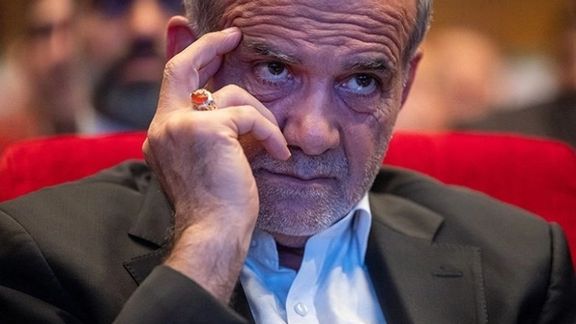
Iranian pundits and media say recent rumors allegedly started by ultra-hardliners on social media about President Masoud Pezeshkian’s resignation are part of a psychological operation to weaken his government.
A government official’s refutation of the rumors, which started on Friday, confirmed the seriousness of the allegations and quickly made headlines on news websites Saturday.
In an X post, Ali Ahmadnia, head of the government's information and media council, accused what he called "a certain group" of taking advantage of the Pezeshkian administration’s deliberate reticence, presumably over the host of crises originating in his predecessor’s mismanagement of the economy, to attack him.
"The government does not pay attention to outrageous lies, such as the president’s resignation rumors aimed at gaining followers, and it will not get distracted by such peripheral issues," Ahmadnia wrote.
Social media users, particularly those posting on domestically developed platforms such as Eitaa, a platform very popular with ultra-hardliners, alleged in the past two days that Pezeshkian has submitted his resignation to Supreme Leader Ali Khamenei.
In a campaign video in July, Pezeshkian promised to quit if he could not fulfill his promises to the people. Some reformist politicians and activists have urged Pezeshkian in the past few weeks to resign if, despite his strong objection, the new controversial hijab law that ultra-hardliners insist on implementing comes into effect and internet filtering is not lifted.
Some ultra-hardliner social media users have also declared that the head of the so-called “shadow government”, the former nuclear negotiator Saeed Jalili, would succeed Pezeshkian if his resignation was accepted.
The reformist Ensaf News attributed ultra-hardliners’ role in creating and spreading the rumors to the fear of “radicals in the so-called revolutionary current” of being eliminated from the country’s political scene “in the near future”.
“I think designing and implementing such projects or spreading such rumors is primarily to present an unstable image of the government to the society … They are trying to present Pezeshkian’s government as a fleeting one that will not last,” prominent sociologist and social media researcher Mohammad Rahbari told the Reformist Ham-Mihan newspaper.
In the past few weeks, ultra-hardliners of the Paydari (Steadfastness) Party and their allies in the parliament, notably the Jebhe-ye Sobh-e Iran (MASAF), and their supporters on social media have intensified their attacks on Pezeshkian, demanding his resignation or impeachment for refusing to sack his Strategic Affairs Deputy, Mohammad-Javad Zarif, refusing to promulgate the new hijab law and his insistence on negotiations with the West to resolve the economic crises resulting from sanctions.
“The continuation of Pezeshkian’s presidency is more dangerous for the country than an atom bomb,” ultra-hardliner cleric Mohammad-Ali Jaberi tweeted Thursday urging the parliament to impeach the President.
They accuse Pezeshkian of being responsible for the lack of a military response to Israel’s recent strikes on Iran in October, delaying what they refer to as the “True Promise 3” retaliation. They also blame him and his government for a host of crises including the depreciation of the national currency and rolling power outages that his government claims resulted from the previous administration’s failure to store enough fuel to run power plants in fall and winter.
Iran's Supreme Leader Ali Khamenei in a meeting with religious eulogizers on December 22, 2024.
Supreme Leader Ali Khamenei denied that Iran uses proxy forces in the region, asserting that groups like Hezbollah, Hamas, and the Houthis act independently out of their own faith and beliefs, not as agents of the Islamic Republic.
In a meeting with religious eulogizers on Sunday, Khamenei addressed what he described as "absurd statements from Western and Israeli officials," dismissing the notion that Iran’s regional influence is based on the use of proxy forces.
"They constantly say that the Islamic Republic has lost its proxy forces in the region! This is another mistake! The Islamic Republic does not have proxy forces. Yemen fights because of its faith; Hezbollah fights because its faith gives it strength to fight; Hamas and Jihad fight because their beliefs compel them to do so," Khamenei said.
"They do not act as our proxies. If one day we want to take action, we will not need any proxy forces."
Khamenei's comments come amid ongoing tensions surrounding Iran’s involvement in regional conflicts, particularly in Syria, where Tehran used militias for many years to further its geopolitical interests but to no avail.
Iran has labeled the Lebanese Hezbollah, Yemen's Houthis, the Assad government and a hodgepodge of paramilitary groups in Iraq as the "Resistance Front," and began to speak more directly of a united front since the Hamas attack on Israel in 2023. In September, Iran's Foreign Minister Abbas Araghchi said, “The government’s policy is to provide unlimited support to the resistance. We will support the resistance front, which has established itself as a reality in the region. The regime [Israel] has so far failed to achieve its main goal of destroying Hamas.”
The commander of the Revolutionary Guard’s Quds Force, Esmail Qaani, said in May, that Iran has humiliated Israel by organizing the 'Islamic resistance.' “At this point, Israel has reached a level of humiliation that it has surrounded itself with barbed wire and radars to prevent infiltration,” Qaani told a gathering of young clerics.
Iran’s involvement in Syria has been one of its most significant and costly regional ventures. The Islamic Republic invested between $30 and $50 billion in financial and military support to sustain the government of Bashar al-Assad who was overthrown by the armed groups and fled to Russia this month.
Iran's aid included sending elite military units, weapons, and advisers to help counter rebel factions. This support was not only about military might but also tied to Tehran's strategic interests, particularly maintaining influence in the Levant and ensuring the continuity of the Axis of Resistance — a network of allies in Syria, Lebanon, Iraq, and Yemen.
Khamenei also warned that those within Iran who align themselves with foreign powers, particularly the United States, would face severe consequences.
"The fools smell the scent of kebab," Khamenei quipped, using a metaphor to describe what he sees as misguided ambitions from those in Iran seeking to overthrow the Islamic Republic. "Anyone inside the country who chooses to serve the Americans, the Iranian people will trample them underfoot."
Syria’s future: Khamenei’s optimism amid setbacks
Turning to Syria, Khamenei expressed confidence in the resilience of the Syrian people, despite the fall of his long-time ally Bashar al-Assad. He predicted that a group would rise to lead Syria out of its instability.
"The young Syrian has nothing to lose. His university is unsafe, his school is unsafe, his home is unsafe, his street is unsafe, his life is unsafe. What should he do? He must stand strong and determined against those who designed this insecurity and those who implemented it, and God willing, he will triumph over them," Khamenei said.
Despite the dire picture painted by Khamenei, there have been no reports of major incidents in Syria since the current leadership took control in Damascus, except tensions between Turkish-back forces and Kurds in the north.
Iran has faced significant setbacks in recent years, not only in Syria but also through its proxy networks. Groups like Hamas and Hezbollah have faced challenges, and the broader Middle East continues to see shifting alliances and power dynamics.
Despite these challenges, Khamenei expressed optimism for the future of Syria and the region, saying, "The future of the region will be better than today, by the grace of God."
Khamenei's remarks come at a pivotal moment for Iran, as the country faces mounting pressure from both regional and global powers, particularly the United States and Israel. His speech reflects Tehran's continued defiance of foreign influence, especially in Syria.
Ultra-hardliner politicians Sadegh Koushki, Foad Izadi, and Mehdi Ghazanfari
A newspaper linked with Iran’s Parliament Speaker has slammed what it called “super-revolutionaries" or ultra-hardliners for publicly opposing “official and revolutionary institutions.”
“The recent statements of [Sadegh] Koushki, [Mehdi] Ghazanfari, and [Foad] Izadi can be seen as the emergence and expression of a tendency in the right-wing that poses a radical reading of revolutionism against revolutionary rationality and official and revolutionary institutions,” Sobh-e No (New Dawn), a daily linked to Parliament Speaker Mohammad-Bagher Ghalibaf wrote Monday.
The statements referred to by Sobh-e No were mainly focused on foreign policy including Israel’s attacks on Iran's allies in the region, ultra-hardliners’ demand to sack Mohammad-Javad Zarif, the vice-president for strategic affairs, and the implementation of a new hijab law that President Masoud Pezeshkian's administration insists cannot be implemented amid nationwide and global backlash.
The newspaper dedicated a large part of its front page to a photo montage of the three ultra-hardliners’ images with the headline “Super Revolutionism’s Leap to Deviate Revolutionism”.
“The statements Kuskhi, Izadi, and Ghazanfari have made in recent days can be taken as the manifesto of super revolutionism,” Sobh-e No wrote.
On social media on December 10, Koushki alleged that Pezeshkian’s government is bending to foreign demands.
“Next, with completion of negotiations with the US and Europeans, the [government] will surrender [the Islamic Republic’s] missile capabilities and the rest of the Resistance Axis to the enemy, [this is the] like entering Damascus and the finalization of their mission,” he wrote.
The so-called “super revolutionaries” that Sobh-e No has referred to in its editorial have strong links to the Paydari (Steadfastness) Party and Jebhe-ye Sobh-e Iran (MASAF), which was established less than a year ago. They often refer to themselves as 'arzeshi' or guardians of the Islamic Republic's values.
Both groups have very close ties to the ultra-hardliner former nuclear negotiator Saeed Jalili who lost the recent presidential elections, and cleric Ayatollah Mohammad-Mehdi Mirbagheri who is known for having a radical interpretation of Sharia law, with pro-Russia, pro-China political tendencies.
Members of the Paydari Party and MASAF and their supporters are not only intensely critical of President Masoud Pezeshkian and his government but also often attack Ghalibaf and his supporters, too.
Arzeshi groups have been campaigning on social media for “True Promise 3”, a retaliation for Israel’s 26 October attack on multiple locations in Iran, and accusing authorities of negligence of their promise not to leave it unanswered.
Around 50 vigilantes linked with these groups staged a protest in Tehran Sunday demanding that authorities take military action against Israel. “We order the authorities to raze Tel Aviv and Haifa to the ground. If you don’t attack, we, the people who voted for you, will get rid of you,” the speaker of the rally declared.
Marandi is a frequent voice in international media defending Tehran’s policies as well as in the state-run television currently controlled by ultra-hardliners.
He wrote: "Slight problem. The US Al Udeid air base in is tiny Qatar. In case of aggression, the natural gas facilities and infrastructure in Qatar will be totally destroyed. Hence, there will be no natural gas from Doha. Hence, there will be no Qatar. Things won’t end there either…”
Illegal crypto-mining equipment seized by Iranian Police in Sanandaj, March 2023
Rolling power outages that have brought the country to a standstill in many areas has once again sparked controversies over the role of ‘illegal’ Bitcoin mining in overburdening the electricity grid.
While underscoring that illegal bitcoin mining was not the sole reason for the current energy crisis, Iran's minister of energy, Abbas Aliabadi, told reporters after a cabinet meeting Wednesday that citizens who provide the government with information on unauthorized mining activities would receive a cash prize.
“I will not disclose the amount of the bounty but it will be considerable,” Aliabadi said.
When reporters asked if certain economic enterprises or individuals organized illegal crypto-mining activities, Aliabadi responded that authorities had discovered both large-scale organized and domestic activities. “I don’t have a figure to announce now but there has been a considerable number of them,” he said.
Mostafa Rajabi, the CEO of Iran's government-owned energy company, TAVANIR, in a meeting with judiciary officials on December 2 urged the Judiciary to take appropriate action against cryptocurrency miners using highly subsidized electricity for personal gain. Currently, there is no dedicated legislation against cryptocurrency mining with subsidized energy.
Iran recognized cryptocurrency mining as a legal industry in 2018. In June 2019, however, authorities blamed illegal cryptocurrency mining for an unusual seven percent spike in electricity usage.
Bitcoin mining, which has a high carbon footprint, is usually carried out in high-tech data centers making huge demands on the electricity grid due to the many computers required to process and verify transactions before they are recorded on the cryptocurrency ‘blockchain.’
Consequently, the use of subsidized industrial electricity for mining was banned and authorities said they had seized around 1,000 mining machines from two mining farms at two derelict factories in Yazd Province.
The media also reported crypto-mining at some state-sponsored establishments such as mosques that pay highly reduced rates for energy.
In January 2021, some energy industry officials again blamed illegal crypto-mining for power outages in the capital Tehran, and elsewhere.
Some political activists and journalists alleged that “a military entity”, presumably the Revolutionary Guards, had established a joint 175-megawatt bitcoin mine in collaboration with Chinese investors at Rafsanjan Special Economic Zone (RSEZ) in Kerman Province, which benefitted from cheap electricity tariffs offered to those mining cryptocurrencies.
But experts say the power supply crisis has much deeper roots than cryptomining including the dilapidation of power plants and failure to store enough fuel for running them in winter.
“The Blockchain network is so transparent that it shows every country’s mining share. Iran's share of the whole Bitcoin network (both authorized and illegal) has dropped to under 0.1 percent,” an Iranian cryptocurrency expert behind Coinicap Telegram channel said in a tweet on December 16.
Some figures offered about the number of Bitcoins mined legally and illegally in Iran by Omid Ghaibaf, the spokesman of the ministry of industries in September 2022 suggested that Iran had a share of around eight percent in the global Bitcoin mining.
Iran's power outages got much worse in August during the country’s most sever heatwaves in fifty years and have developed into an energy crisis that has forced the government to fully or partially shut down schools, universities, government offices in most areas of the country in the past few days. Only four provinces out of the 31 have remained unaffected by the closures so far.
The outages are also seriously affecting large and small industries, including the steel industry. According to Iranian media daytime supply to many industrial compounds was cut off to decrease the demand on the national grid.
“The damages resulting from power outages in the country amount to over $25b a year,” Bargh News, a news website dedicated to the electricity industry, wrote last week, calling the current situation a “super-crisis”.
Police posted on Storgatan Street where gunfire was heard during the night to Friday in Stockholm Sweden, May 17, 2024.
Attacks targeting Jewish and Israeli institutions in Europe this year reveal a growing trend of Iran-affiliated groups recruiting local criminals, including minors, Bloomberg reported Saturday.
"The incidents show how the war between Israel and Iran’s proxies across the Middle East is also driving Tehran to escalate its covert operations in Europe — and that is rattling governments already concerned that the conflict is stirring tension between communities divided over immigration," the report said.
Incidents include a 15-year-old in Stockholm taking a taxi with a loaded gun heading toward the Israeli embassy and a 13-year-old in Gothenburg shooting at the offices of the Israeli defense firm Elbit Systems.
This fall, Swedish and Norwegian security agencies warned of Iranian-backed operations. In response, Norway temporarily raised its terror alert to high in October, armed its police, and introduced border controls with Sweden.
In early October, Iran International exclusively reported that Tehran enlisted criminals to carry out armed attacks on Israeli embassies in Stockholm and Copenhagen, coinciding with its extensive missile barrage against Israel, according to a Swedish police source and another informed source.
Shots were fired at the Israeli embassy in Stockholm that same week, followed by two explosions near Israel’s embassy in central Copenhagen in the early hours of Wednesday. No injuries were reported.
Two Swedish teenagers, aged 16 and 19, were later arrested in connection with the incidents. Authorities did not immediately release details about their identities. A Swedish police source told Iran International that evidence found during the preliminary investigation pointed to the Islamic Republic’s involvement.
Earlier, in May, Swedish authorities arrested two teenage boys, aged 14 and 15, after a shooting near the Israeli embassy. At the time, Sweden’s intelligence agency accused Tehran of recruiting gang members to attack Israeli interests in the country.
A Swedish insider speaking to Iran International stated that investigations revealed the group behind the May attack was also “directed by agents linked to the Islamic Republic.”
According to separate statements last year by Säpo (Sweden’s intelligence agency) and Mossad, the Swedish criminal group Foxtrot was among those recruited by Tehran. The group, led by Rawa Majid, a Swedish citizen of Kurdish origin allegedly detained in Iran, is conducting sabotage operations on behalf of Tehran.
The Islamic Republic has never acknowledged recruiting criminals for operations outside its borders, yet its leaders have repeatedly expressed support for attacks on Israeli interests globally.
The spokesperson for Iran's Foreign Ministry said Saturday that a local employee of Iran's embassy in Damascus was killed last week after being shot in his vehicle in the city.
Esmaeil Baghaei said that Davood Bitaraf was killed by "terrorists" and added that the Syrian transitional government is responsible for "identifying, prosecuting, and punishing the perpetrators of this crime."
"The Ministry of Foreign Affairs is seriously pursuing the matter through appropriate channels and various diplomatic and international avenues," Baghaei added.
In an interview published Friday, Syria's de facto new leader, Ahmed al-Sharaa, said Iran’s influence in the region has been significantly diminished following the fall of its ally, President Bashar al-Assad. The interview with Asharq Al-Awsat comes after Sharaa's radical Sunni Islamist group, Hayat al-Tahrir Sham (HTS), swiftly defeated Assad's forces this month.
Sharaa said that Syria's opposition had “set the Iranian project in the region back by 40 years,” signaling a major shift in Syria’s stance toward Iran.
“By removing Iranian militias and closing Syria to Iranian influence, we’ve served the region’s interests—achieving what diplomacy and external pressure could not, with minimal losses,” he said.
Iran's Islamic government has been shaken by recent developments in Syria, where it had supported Assad's regime since anti-government protests began in 2011. Its withdrawal from Syria follows setbacks faced by its other ally, Hezbollah, in Lebanon.