In an interview with state television Saturday, Rezaei said diplomatic exchanges had been underway for more than a month and Washington had made three proposals, with Tehran now waiting for a US response to its latest position.
“We are now waiting for the Americans' response,” Rezaei said, adding that the Strait of Hormuz “cannot reopen unless Iran's seven conditions are met.”
The comments came as Iranian negotiators met Qatari mediators in Doha after more than 12 hours of talks between Iranian and Qatari officials in Tehran the previous day. The Qatari team has maintained regular contact with Washington during the discussions, Reuters reported, citing an official briefed on the negotiations.
US Secretary of State Marco Rubio said Saturday that President Donald Trump had not decided whether to resume military action and that Washington remained open to a diplomatic solution.
Foreign Minister Abbas Araghchi said there were no plans for direct talks with US officials and that consultations over Iran's conditions were continuing through mediators.
US and Iran remain divided over terms
Rezaei said Washington's first response was insufficient and its second proposal was more favorable, but said the United States intended to negotiate and then attack Iran again. A third proposal still contains ambiguities and remains under discussion, he said.
Washington wants Iran to make nuclear concessions as part of restarting talks, while Tehran is seeking measures including the lifting of the US naval blockade, the release of frozen Iranian funds and permission to sell oil before negotiations resume, Axios reported.
Reuters reported that Qatar had proposed a seven-day confidence-building plan that Iran considered inadequate. Iran's own proposal includes lifting the blockade, unfreezing assets and approving an Iranian-backed shipping route through the Strait of Hormuz.
Araghchi similarly tied progress toward negotiations to the Strait of Hormuz, saying Saturday that reopening it on Iran's terms could pave the way for talks with Washington.
Rezaei said Iran's seven conditions were intended to address ambiguities in an earlier Islamabad understanding, including the management of the Strait of Hormuz and the collection of fees.
Vance letter signals new US approach, Rezaei says
Washington's direct outreach to Rezaei has emerged as another channel in the effort to restart negotiations. US Vice President JD Vance sent him a letter at Trump's direction, the Wall Street Journal reported this week, citing US officials and people familiar with the matter.
Vance also offered to meet Rezaei personally to discuss a negotiated settlement, the Washington Post reported Thursday, citing a US official familiar with the negotiations. Istanbul or Doha would be the most likely venues if a meeting takes place, according to the report.
The Post reported that Vance's letter described Washington's central interest as ensuring Iran does not obtain a nuclear weapon and called for Tehran to provide representatives empowered to discuss nuclear issues.
The Trump administration views Rezaei, a former commander of the Revolutionary Guards, as the key point of contact in Tehran and as someone capable of building consensus behind an agreement to halt Iran's nuclear program, the Post reported.
Rezaei said Saturday that he had read the letter but had not responded, though he described its tone as markedly different from an earlier letter from Trump.
“The tone of the letter has completely changed,” he said.
Trump later said the outreach concerned efforts to help Iran obtain medical supplies.
Nuclear issue remains central to diplomacy
With Iran's nuclear program central to any potential negotiations, Rezaei said Tehran had made no decision to change its nuclear doctrine despite public calls for a shift following attacks on the country's nuclear facilities.
“There has been no new decision regarding a change in the nuclear doctrine,” he said.
Rezaei said Iran was a member of the Nuclear Non-Proliferation Treaty and would insist on what he described as its rights under the treaty in any future nuclear talks.
“If there are to be nuclear negotiations, we will demand our rights,” he said.
Rezaei also attacked International Atomic Energy Agency Director General Rafael Grossi, calling him a “mercenary and servant of the Zionist regime.”
He said Iran's nuclear facilities had undergone extensive inspections and asserted that there had been no diversion in its nuclear program.
He also warned of a severe Iranian response to renewed US military action.
Iran pushes regional security role
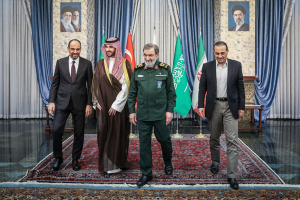
Beyond the negotiations with Washington, Rezaei portrayed Iran as seeking a broader role in shaping regional security, pointing to recent four-way talks in Tehran with senior Saudi, Turkish and Pakistani officials.
Rezaei said the visiting officials voiced strong concerns about Israel, including a warning from Saudi Defense Minister Khalid bin Salman that Israel could eventually target Saudi Arabia.
“Prince Khalid said that after you, Israel will go after Turkey, and then it will come after us, Saudi Arabia,” Rezaei said.
Rezaei said the three countries had requested the visit and that all four sides agreed to continue the meetings. “They spoke so firmly against Israel,” he said.
He said Turkish intelligence chief Ibrahim Kalin also raised concerns about Israel, while the Pakistani representative expressed concern about what Rezaei described as growing ties between Hindus and Jews directed against Muslims and Pakistan.
Rezaei said the talks covered the Mecca pact, Yemen and Syria, as well as Israel's presence in southern Lebanon and southern Syria and the situations in Gaza and the West Bank.
“We believe that foreign powers should leave the region and the countries of the region themselves should maintain their security,” Rezaei said.