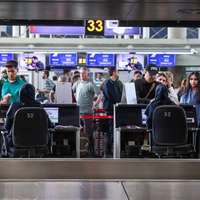
File photo: Passengers check in for flights at Tehran’s Imam Khomeini International Airport
Expanding US pressure on Iran's aviation sector is bringing a class dimension to the debate over the costs of the country's growing isolation, with some Iranians welcoming restrictions they say are finally reaching the better-off.
Washington has threatened sanctions against airports and companies that provide services to Iranian carriers as international travel options are already narrowing.
Mahan Air has suspended flights to Turkey and Oman, while Georgia has announced a halt to flights by all Iranian airlines.
Iran International asked its Instagram audience what they thought about the growing restrictions. Responses ranged from support for measures seen as increasing pressure on the state to concern about their consequences for medicine, essential goods and family travel.
“At last, the water has reached the upper decks,” one respondent wrote.
The phrase captured a recurring argument among those who welcomed the restrictions: hardships that have long affected ordinary Iranians may now be reaching wealthier or better-connected sections of society.
Others argued that air travel had already become unaffordable for much of the population and said they were prepared to tolerate further restrictions if they increased the economic and political cost for the authorities or made it more difficult for officials and those close to them to travel abroad.
The responses do not constitute a representative survey of Iranian public opinion, but they point to a revealing tension over who bears the cost of external pressure.
‘The issue isn't just travel’
US Treasury Secretary Scott Bessent said Iranian airlines would effectively be shut out of international operations from September 23, warning that airports and companies providing them with services could themselves face US sanctions.
The restrictions do not amount to the closure of Iranian airspace or automatically prohibit foreign airlines from flying to Iran. But the threat of sanctions could make it increasingly difficult for Iranian carriers to operate abroad.
For some respondents, that raised concerns extending well beyond passenger travel to medicine, raw materials, spare parts and other goods entering Iran by air.
“Everyone is thinking about passenger flights, but the real problem that will emerge is cargo flights,” one wrote.
“The issue isn't just travel,” another respondent wrote. “A lot of goods reached Iran by air, such as medicine … what is supposed to happen to patients now?”
Others pointed to higher ticket prices, longer journeys involving indirect routes and increasing difficulties visiting relatives abroad. Some feared higher import costs would feed into inflation, further squeezing household finances.
“In the war and confrontation between the government and America, it is the people who are being crushed,” one respondent wrote.
Some also pointed to congestion at land crossings such as Bazargan and Razi, fearing that further disruption to air travel would push more passengers onto already strained overland routes.
Where does tolerance for pressure end?
The responses also revealed differing interpretations of what Washington is trying to achieve.
Some saw the aviation restrictions as another sign of escalating confrontation, while others interpreted them as an attempt to increase pressure on Tehran to reach an agreement.
Several said years of sanctions and economic crisis had left society increasingly accustomed, or even numb, to new restrictions.
Measures perceived as restricting officials, state institutions or wealthier Iranians attracted support from many of those who responded to Iran International.
But that support became less straightforward when people contemplated medicine and essential goods becoming harder to obtain, more expensive travel, separation from relatives or further increases in household costs.
The responses suggest tolerance for outside pressure can be easier to sustain when its costs appear concentrated on the state. Once those costs become tangible in everyday life, the calculation becomes more complicated—even among Iranians who want greater pressure on Tehran.
File photo: A Mahan Air Airbus a300 series at Tehran's Mehrabad airport
Iran has canceled flights from Tehran to Baghdad and Muscat from midnight Wednesday as regional airports begin restricting Iranian carriers under mounting US pressure aimed at cutting the country’s airlines off from international operations.
Iran’s Civil Aviation Organization said flights to the Iraqi and Omani capitals would be canceled from 12 a.m. local time on September 23, the semi-official Tasnim news agency reported Tuesday. Iranian authorities are working to divert Baghdad-bound flights to Najaf, it added.
The remaining international flights, including services to Istanbul, will operate according to schedule, Tasnim said.
Two sources at Iraq’s Civil Aviation Authority separately told Reuters that the Iraqi government had ordered authorities to suspend Iranian flights to Baghdad beginning at midnight Wednesday.
Two other sources familiar with the matter said Baghdad was discussing whether flights operated by Iranian airlines could instead be diverted to Najaf.
Majid Akhavan, spokesperson for Iran’s Civil Aviation Organization, also said Muscat airport would no longer accept Iranian passengers and that Tehran was holding talks with Omani authorities over the restrictions.
The cancellations are among the first visible consequences of Washington’s intensified campaign against Iran’s aviation sector.
US Treasury Secretary Scott Bessent said Monday that Iranian airlines would effectively be shut out of international operations from September 23, warning airports, fuel suppliers, ground-handling firms and other companies that providing services to sanctioned Iranian carriers could expose them to US penalties.
Iraq is particularly important for Iranian travelers because millions visit the country’s Shiite holy sites, especially Najaf and Karbala. Travel between the two countries increases sharply around religious occasions including the annual Arbaeen pilgrimage.
Iran’s international travel options were already narrowing before the latest restrictions.
Turkish Airlines, long one of the most widely used foreign carriers for Iranians traveling for tourism, business or onward connections, told Iran International on Monday that it had suspended all of its flights to Iran until at least March 2027, with no guarantee that services would resume then.
Tasnim’s statement that Istanbul flights remain scheduled refers to flights operated from Iran and does not mean Turkish Airlines has resumed its own Iran routes.
The US push threatens to further isolate Iranian aviation by targeting not only the airlines themselves but the foreign airports and companies needed to keep their international routes running.
Iranian applicants are turning to costly overseas trips and alternative exams after access to international tests narrowed, compounding difficulties caused by internet disruption, payment restrictions and the falling value of the rial.
Students and language teachers described cancelled exams, disrupted preparation and growing reliance on overseas testing in interviews with Iranian newspaper Etemad.
TOEFL and GRE testing inside Iran stopped after the US Treasury Department suspended an authorization covering certain educational services involving Iran on August 24. Applicants have also faced restrictions affecting PTE and Duolingo, although the rules differ between providers.
“The morning she arrived at the center, they told her the test would not be held because of sanctions,” Homa, a language teacher identified only by her first name, said of a student who travelled from Gilan province in northern Iran. “That Saturday, all I could hear was students crying, some of whom had only a few weeks until their test date.”
Some candidates had already paid for transportation and accommodation before learning their exams would not take place. Others were approaching university deadlines with little time to find alternatives.
Exam trips become a new expense
Applicants are increasingly looking to Armenia, Turkey and other nearby countries, feeding an informal business offering what Homa described as “exam tours.”
Intermediaries arrange appointments, foreign-currency payments, transportation and accommodation, sometimes allowing applicants to leave Iran, sit an exam and return within 24 or 48 hours.
Applicants travelling overland and sharing accommodation can spend around 300 million rials, about $130 at an open-market rate of roughly 2.3 million rials to the dollar. More expensive trips can reach 1 billion to 1.5 billion rials, or about $435 to $650, Homa estimated.
Those sums compare with a government-set minimum base wage of about 166 million rials, or $72, a month. With standard allowances, the minimum monthly package for a single worker is around 218 million rials, or $95.
Telegram groups have become information hubs for testing centers, accommodation and foreign payments. Homa said some operators also offer to manipulate internet or computer settings to make applicants inside Iran appear to be abroad, potentially exposing them to cancelled scores or blocked accounts.
Few alternatives without travel
Switching exams can mean losing months of specialized preparation and does not necessarily eliminate the need to travel.
IELTS is in a different position because it is jointly owned by the British Council, Australia's IDP and Cambridge University Press & Assessment rather than a US testing organization. The suspension of General License G therefore does not directly apply to it.
IELTS testing inside Iran, however, had already ended on January 31, 2026, after IDP cited separate “financial and regulatory factors” outside its control. Iranian applicants seeking the test must therefore also travel abroad.
Tabassom, identified only by her first name, had spent nine months preparing for PTE as part of plans to obtain an Australian work visa. She now expects to switch to IELTS.
Students take an exam at a testing center in Iran.
“I spent an average of 150 million rials ($65) a month on language training,” Tabassom said. “Over nine months, I spent nearly one billion rials ($435) just on classes and training. I had reached the point where I was going to take the exam in another month and a half, but now I have to switch to IELTS and start preparing again.”
Domestic problems compound the disruption
The testing restrictions have landed on applicants already dealing with economic and infrastructure problems inside Iran.
Tabassom said internet outages had already disrupted contact with her immigration lawyer before the problems surrounding PTE forced her to change plans.
Applicants with sufficient resources can respond by travelling abroad or paying for additional preparation. Others may have to borrow money or delay their plans. Homa said some students had sold gold or household belongings or taken loans to continue pursuing testing and migration.
For Iranians seeking to study or work abroad, the challenge is no longer only achieving the required score, but finding an affordable way to reach the examination room.
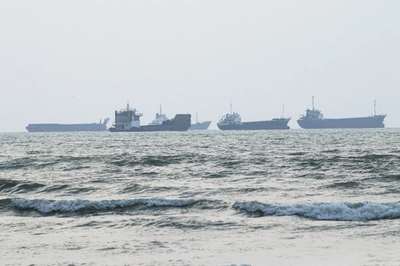
Vessels in the Strait of Hormuz, as seen from Musandam, Oman, August 3, 2026.
Iranian investigative journalist Yashar Soltani says the middlemen who move Iran's sanctioned oil revenues had a financial motive to wreck the June deal with Washington, and that the tanker attacks weeks later served it. Hardline outlets have answered with accusations of treason.
Speaking on an online program last week, Soltani said networks built to evade oil sanctions stood to lose from the June memorandum between Tehran and Washington, because implementing it would have cut their role in oil sales.
Three Saudi and Qatari tankers were attacked in the Strait of Hormuz less than three weeks after the memorandum was signed. Soltani said the attacks served to derail the agreement and prevent sanctions on Iranian oil from being lifted for good, keeping the networks in business.
The people he described as trustees are not the traders who sell the oil, he said, but the intermediaries who move the money. He named Ruhollah Razavi, son-in-law of Majid Motaghifar, spokesman for the hardline Paydari Party, as one of four who control much of the trade.
The margins are the point. Moving the proceeds of a single tanker carrying about $90 million of oil costs roughly $4 million through these intermediaries, Soltani said. Through SWIFT, the international banking system Iran is cut off from, it would cost about $500.
He also said the four had run monthly debts to the government in the hundreds of millions of dollars while using the money for other business, putting the monthly average attributed to Hossein Shamkhani, son of the late security chief Ali Shamkhani, at about $800 million.
Iranian outlets have recently named Razavi, Shamkhani and two others as the network's main trustees, and asked how they were chosen and how the system works.
The backlash
Fars News Agency, affiliated with the Revolutionary Guards, said Washington had violated the memorandum, particularly its provision on the Strait of Hormuz, and rejected any suggestion that Iran bore responsibility for its collapse.
"Recent reports, including material published by Yashar Soltani and affiliated media, seek to switch the roles of victim and culprit and portray Iran as responsible for the failure of the memorandum," Fars wrote. "The narrative that vigilantes broke the agreement is simple and attractive, but when placed alongside the successive violations by the United States, it falls apart."
Tasnim, also linked to the Guards, called it performative justice-seeking. "If a nation is told that the war with the United States and Israel is not the product of the wickedness and crimes of these two regimes, but rather the result of the mischief of some people inside the country seeking to continue benefiting economically, what incentive will remain there for unity?" it asked.
The state broadcaster's political program Be Vaght-e Iran argued on social media that no commercial network could have carried out the attacks whatever its motive.
"Trustees have neither a military structure, nor anti-ship cruise missiles, nor links to the command levels of the IRGC and army," the post said. "This type of narrative is not only unprofessional, but also a dangerous and disturbing game aimed at discrediting the defenders of the country's security who have stood by this land for years."
A military analyst in an accompanying video said that while the United States had violated the memorandum, only Iran's wartime command, the Khatam al-Anbiya Central Headquarters, could have ordered missile strikes.
The accusations
Hardline users have accused Soltani of serving those who want to pressure Iran's armed forces.
Ehsan Hosseini, who edits the hardline publication Khat-e Energy, said Soltani was trying to swap one set of trustees for another: "The project Yashar Soltani has launched is not against the trustees; it seeks to oust some and replace them with other trustees, those who failed to return $13 billion in oil revenues and caused the January protests."
Majid Shakeri, an adviser to parliament speaker Mohammad-Bagher Ghalibaf, called the revelations a propaganda campaign by one group of trustees against another. Both groups, he said, had contributed to two wars and to last year's protests, and anyone attributing Iran's response to the American violation to this rivalry deserved a "field trial for wartime treason."
Journalist Davoud Modarresian put the blame on the government, which he said had neither the nerve to leave the dollar-based financial order nor the ability to control the trustees.
"By implementing currency shocks and releasing the dollar exchange rate in December, they pushed the economy to the brink of collapse and created the conditions for the enemy's military greed," he wrote.
Not all of it was hostile. "If oil is sold without obstruction or sanctions by the ministry under the memorandum, and its money returns through transparent channels, the profits of the trustees and the IRGC will be cut," one user wrote, arguing that this pointed to collusion between the two.
File photo shows a flight board displaying flight information after flights resumed at Imam Khomeini International Airport, amid a ceasefire between U.S. and Iran, in Tehran, Iran, April 25, 2026.
Travel to and from Iran is becoming harder as major foreign airlines, including the flag carrier of Turkey, a key affordable hub for Iranians, suspend services and new US sanctions threaten remaining international routes operated by Iranian carriers.
For Iranians visiting relatives abroad, returning home has become increasingly uncertain. For those living outside the country, reaching parents, children and other loved ones in Iran is becoming just as difficult.
The disruption has left travelers trying to determine which flights are still operating, whether future bookings can be relied upon and what alternatives remain if they cannot fly.
US Treasury Secretary Scott Bessent said Monday that US sanctions would effectively shut Iranian airlines out of international operations from September 23, warning foreign companies against providing them with fuel, ground services or ticket sales.
“All the Iranian airlines will be shut down around the world,” Bessent told CNBC. “If they land, you cannot provide them with fuel, you cannot provide them with landing services, you cannot sell them tickets, or you will be knocked out of the dollar system.”
The warning does not itself close foreign airspace to Iranian aircraft, but raises the risk of US penalties for companies and financial institutions that continue doing business with sanctioned carriers. The practical impact will depend on how governments, airports and service providers respond.
Iran International contacted multiple international airlines and four travel agencies specializing in travel to Iran to establish what options remain for passengers.
Which flights are still available?
Options are increasingly limited and can change at short notice.
Turkish Airlines has suspended all flights to Iran until at least March 2027, a company representative told Iran International by phone, adding that no services are currently scheduled before then and there is no guarantee they will resume in March.
Emirates said it is no longer operating flights to Tehran, while Lufthansa and Austrian Airlines confirmed that flights to and from Iran are suspended until at least October 24, 2026.
Both Lufthansa and Austrian Airlines said they were monitoring the situation and could not guarantee that flights would resume after that date.
Qatar Airways told Iran International that its flights to Iran are currently suspended because of airspace restrictions. Services are tentatively scheduled to resume on November 29, but the airline said that date could change depending on conditions.
Four travel agencies specializing in Iran travel said they were also unable to book operating services on airlines from Russia, China and Oman, as well as Turkey’s Pegasus Airlines and carriers serving routes from Armenia, at the time they spoke to Iran International.
One agency said it had seen Pegasus continue to accept some bookings for Iran routes that were later cancelled at short notice, forcing passengers to change their travel plans.
Iran International found some Pegasus itineraries between Turkey and Iran displayed on booking platforms from November 29, but the listings do not guarantee that the flights will operate.
Iran also did not appear as a destination option in searches on Flydubai’s or Expedia’s booking systems. Other routes checked by Iran International produced no available itineraries before March 2027.
Those searches provide only a snapshot of what booking platforms were displaying at the time and do not establish when international services will resume or whether other routes may remain available.
How are people getting to and from Iran?
The travel agencies, which requested anonymity, said their businesses had been severely affected as passengers looked for alternatives to flying directly into Iran.
They said some travelers arriving from Western countries were flying to Turkey and then taking a roughly 17-hour bus journey to Van, near the Iranian border.
From there, travelers could cross into Iran and continue by road. The agencies estimated that reaching Tehran from Van could take another 16 to 17 hours by bus or car.
That can mean more than 30 hours on the road alone, excluding the initial flight, border crossings and waiting times.
The agencies said Mahan Air had already stopped operating from Turkish airports after losing access to ground-handling services.
The disruption followed the US Treasury’s September 8 sanctions package, which designated all Iranian airlines and also targeted three Turkey-based companies accused of providing services to Mahan Air. Treasury described the 27 sanctioned carriers as Iran’s remaining airlines not already covered by US sanctions.
Other Iranian carriers were still operating through Turkish airports as of September 21, the agencies said, but they expected those services to come under increasing pressure after September 23 as companies assessed the risk of continuing to service sanctioned aircraft.
What changes on September 23?
The US Treasury sanctioned 36 targets connected to Iran’s aviation sector on September 8, including 27 Iranian airlines. Treasury accused the aviation sector of being used to transport weapons, military personnel and illicit cargo.
Bessent said on September 21 that the restrictions would effectively shut Iranian airlines out of international operations from September 23 by targeting the foreign services they rely on.
The sanctions do not automatically prohibit Iranian aircraft from entering every country or close foreign airspace to them. But airlines need access to airports, fuel, ground handling, ticketing, banking and other services to operate internationally, giving Washington significant leverage over their ability to continue flying abroad.
Some countries have already moved to restrict Iranian carriers.
Flights by US-sanctioned Iranian airlines to Georgia stopped from September 21 after the affected carriers operated their final services the previous day, according to Georgian media. Georgia’s Civil Aviation Agency had earlier said it takes US and European sanctions mechanisms into account when granting foreign airlines access to its aviation market.
Iraq is moving even earlier than Bessent’s September 23 deadline. Two Iraqi government sources told AFP that Baghdad would suspend flights operated by Iranian airlines from dawn on Tuesday, September 22.
One official said Iraq would implement the restriction in accordance with the US Treasury decision and warned that countries failing to comply risked sanctions. A second source confirmed the decision.
The suspension could particularly affect Shiite pilgrims travelling from Iran to the Iraqi holy cities of Najaf and Karbala, as well as families and other passengers who rely on flights between the two countries.
For travelers, the central problem is that schedules displayed today may offer little certainty about what will actually operate in the coming weeks. With foreign airlines withdrawing and Iranian carriers facing new barriers abroad, travelling both into and out of Iran is increasingly dependent on a shrinking number of routes — or long overland journeys through neighboring countries.
An illustrative image of a fetus in an amniotic sac.
An informal market for frozen embryos appears to be emerging on Iranian social media and online marketplaces, where sellers are advertising them for cash outside the country’s donation system, local media reported on Monday.
One advertisement offered eight frozen embryos for one billion rials (about $4400), although it was unclear whether the price applied to each embryo or the entire group, Jahan-e Sanat newspaper reported on Monday.
Another seller advertised 18 frozen embryos and asked prospective buyers to suggest a price. Similar advertisements for embryos, eggs, sperm and surrogacy services have appeared on Instagram and Telegram.
The advertisements directed prospective buyers away from the original platform to continue discussions elsewhere, with little information about the people offering the embryos or how any transfer would take place.
Iranian law provides for donation, not direct sales
Iranian legislation passed in 2003 permits embryo donation to infertile married couples under specified conditions, with implementing regulations adopted the following year also covering frozen embryos.
Under those regulations, embryo donation is defined as the voluntary and free transfer of one or more embryos to authorized infertility treatment centers. Written consent from the couple providing the embryo is required, and transfers must take place through authorized specialist centers.
A newborn baby rests in a hospital neonatal care unit in Iran.
Prospective recipients must apply jointly as a married couple to a court and meet requirements covering infertility, legal capacity, health, drug use and Iranian citizenship.
The regulations therefore provide a formal route for donating frozen embryos but do not define them as commodities that can be sold directly between individuals.
Sociologist points to poverty and intermediaries
The online advertisements could reflect a combination of financial hardship among potential sellers and the desperation of couples struggling with infertility, sociologist Alireza Sharifi-Yazdi told Jahan-e Sanat.
“Behind this are a number of digital intermediaries who operate on Instagram, Telegram, and similar platforms and exploit the poverty and financial vulnerability of families, particularly women, as well as the desperation and confusion of infertile couples,” Sharifi-Yazdi said.
He distinguished regulated infertility treatment from an informal market in which intermediaries seek to profit from reproductive services.
Some infertile couples may turn to such channels after unsuccessful treatments including intrauterine insemination, or IUI, and in vitro fertilization, or IVF, he said.
Lengthy adoption procedures and the cost and waiting times associated with infertility treatment can also make unofficial alternatives appear easier, Sharifi-Yazdi added.
The financial circumstances of people offering embryos, he said, are another part of the picture, with worsening poverty potentially making them more susceptible to intermediaries seeking to profit from their situation.
Questions over oversight and identity
Sharifi-Yazdi also raised concerns about the possible consequences for children born following informal embryo transactions, including questions about their genetic parentage and legal status.
Modern DNA testing could allow children conceived through such arrangements to discover that the people raising them are not their genetic parents, potentially creating psychological and legal complications later in life, he argued.
Iran also lacks a transparent centralized national system through which people seeking to donate embryos without payment can readily register and navigate the legal process.