Iran threatens wider war as tanker attacks test mediation efforts
File photo shows a group of Iranian Shia clerics wearing Revolutionary Guard uniforms.
Iran’s Revolutionary Guards warned they would widen the battlefield and use new weapons if US attacks resume, as two tankers were hit in the Strait of Hormuz and Qatar said it seeks a short-term deal aimed at reviving talks between Tehran and Washington.
The warnings came as President Masoud Pezeshkian prepared to travel to New York for the UN General Assembly and regional mediators stepped up contacts with both sides.
Iran would change the “geography of the war” if it came under renewed attack, Revolutionary Guards spokesperson Hossein Mohebbi said Monday, warning that Tehran would also use weapons it has not yet deployed and strike new targets.
“If a new aggression occurs, we will certainly change the weaponry and the geography of the war,” Mohebbi said.
“We will introduce new weapons with new capabilities into the battlefield, and the world will be astonished,” he added.
Mohebbi said Iran was prepared for a prolonged conflict and that its targets in another round would not necessarily be the same as before.
Iran’s armed forces also pledged in a joint statement to make the United States, Israel and their allies “taste the bitterness of further defeats,” while Army Commander Amir Hatami said the military remained on full alert.
New ship attacks in Hormuz
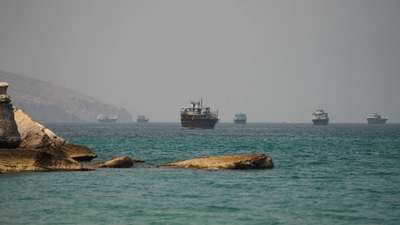
The threat came with tensions still high around the Strait of Hormuz, where two tankers were hit in separate incidents within hours on Monday.
An inbound tanker was struck by an unknown projectile, leaving two crew members with minor injuries, according to the United Kingdom Maritime Trade Operations. The vessel remained under its own power and continued toward its next port.
UKMTO later reported that an LPG tanker leaving the strait had been hit by debris from unknown projectiles. Its crew was safe and no environmental damage was reported. Authorities were investigating both incidents.
Shipping through Hormuz remains far below pre-war levels. Seventeen commodity vessels crossed the waterway over the weekend, down from 37 a week earlier, according to shipping data cited by Reuters. Before the war, about 125 large commercial vessels typically transited the strait each day.
Qatar seeks short-term deal to revive talks
Qatar, meanwhile, said mediators were exchanging proposals between Iran and the United States in an effort to secure a short-term agreement that could reopen negotiations.
Foreign Ministry spokesperson Majed Al-Ansari said Qatari mediators had been discussing proposals for nearly two weeks and traveling between capitals in search of a formula acceptable to both sides. Doha had also received assurances from US officials that Washington wanted an agreement, he said.
Pakistan has also remained involved in efforts to reduce tensions. Interior Minister Mohsin Naqvi met his Iranian counterpart Eskandar Momeni in Tehran on Monday, weeks after Naqvi and Pakistan’s army chief Asim Munir visited Iran as part of Islamabad’s mediation efforts.
Iranian media said the latest visit was focused on bilateral relations and that Naqvi was not carrying a US message. Iran’s Foreign Ministry had earlier said it was unaware of any specific proposal being brought by the Pakistani minister.
Pezeshkian is due to leave for New York on Tuesday for the UN General Assembly, where the Iran-US conflict is expected to feature prominently in diplomatic contacts.
Washington tightens pressure
Washington showed no sign Monday of easing economic pressure while those contacts continued.
Treasury Secretary Scott Bessent said Iranian airlines would effectively be shut out of international operations from September 23 by threatening sanctions against airports and companies that provide them with fuel, landing services or ticket sales.
“If they land, you cannot provide them with fuel, you cannot provide them with landing services, you cannot sell them tickets, or you will be knocked out of the dollar system,” Bessent told CNBC.
The effects were already spreading. Turkish Airlines told Iran International it had suspended all flights to Iran until at least March 2027, while Iraqi government sources said Baghdad would stop Iranian airlines from operating in the country in line with the US measures.
Pezeshkian’s arrival in New York on Tuesday will give mediators another opportunity to test whether the proposals being exchanged can produce a path back to negotiations. The US airline measures are due to take effect the following day.
An illustrative image of a fetus in an amniotic sac.
An informal market for frozen embryos appears to be emerging on Iranian social media and online marketplaces, where sellers are advertising them for cash outside the country’s donation system, local media reported on Monday.
One advertisement offered eight frozen embryos for one billion rials (about $4400), although it was unclear whether the price applied to each embryo or the entire group, Jahan-e Sanat newspaper reported on Monday.
Another seller advertised 18 frozen embryos and asked prospective buyers to suggest a price. Similar advertisements for embryos, eggs, sperm and surrogacy services have appeared on Instagram and Telegram.
The advertisements directed prospective buyers away from the original platform to continue discussions elsewhere, with little information about the people offering the embryos or how any transfer would take place.
Iranian law provides for donation, not direct sales
Iranian legislation passed in 2003 permits embryo donation to infertile married couples under specified conditions, with implementing regulations adopted the following year also covering frozen embryos.
Under those regulations, embryo donation is defined as the voluntary and free transfer of one or more embryos to authorized infertility treatment centers. Written consent from the couple providing the embryo is required, and transfers must take place through authorized specialist centers.
A newborn baby rests in a hospital neonatal care unit in Iran.
Prospective recipients must apply jointly as a married couple to a court and meet requirements covering infertility, legal capacity, health, drug use and Iranian citizenship.
The regulations therefore provide a formal route for donating frozen embryos but do not define them as commodities that can be sold directly between individuals.
Sociologist points to poverty and intermediaries
The online advertisements could reflect a combination of financial hardship among potential sellers and the desperation of couples struggling with infertility, sociologist Alireza Sharifi-Yazdi told Jahan-e Sanat.
“Behind this are a number of digital intermediaries who operate on Instagram, Telegram, and similar platforms and exploit the poverty and financial vulnerability of families, particularly women, as well as the desperation and confusion of infertile couples,” Sharifi-Yazdi said.
He distinguished regulated infertility treatment from an informal market in which intermediaries seek to profit from reproductive services.
Some infertile couples may turn to such channels after unsuccessful treatments including intrauterine insemination, or IUI, and in vitro fertilization, or IVF, he said.
Lengthy adoption procedures and the cost and waiting times associated with infertility treatment can also make unofficial alternatives appear easier, Sharifi-Yazdi added.
The financial circumstances of people offering embryos, he said, are another part of the picture, with worsening poverty potentially making them more susceptible to intermediaries seeking to profit from their situation.
Questions over oversight and identity
Sharifi-Yazdi also raised concerns about the possible consequences for children born following informal embryo transactions, including questions about their genetic parentage and legal status.
Modern DNA testing could allow children conceived through such arrangements to discover that the people raising them are not their genetic parents, potentially creating psychological and legal complications later in life, he argued.
Iran also lacks a transparent centralized national system through which people seeking to donate embryos without payment can readily register and navigate the legal process.
US President Donald Trump weighed military action, economic pressure and a possible deal with Iran, while Iranian leaders paired diplomatic overtures with warnings over the Strait of Hormuz on Sunday.
Trump told Fox News he was in a “deciding mode” over Iran and expected “very big things” soon. The network described the options under consideration as military action, allowing economic pressure to continue or reaching an agreement.
“My question is, if and when, do I blow the entire nation up? They better behave,” Trump told Fox News.
Trump also said he would probably be open to meeting Iranian President Masoud Pezeshkian during the UN General Assembly, leaving diplomacy on the table despite his warnings.
Hormuz remains central
Iranian officials continued to present the Strait of Hormuz as a source of leverage. Parliament Speaker Mohammad Bagher Ghalibaf responded to a September 17 JPMorgan oil-market report that said the bank no longer had a baseline view for how the conflict would end.
“This endgame cannot be modeled. It will be opened, and Iran's hand is already on the lever,” Ghalibaf wrote on X.
JPMorgan said assumptions underlying its earlier outlook had been overtaken by events and that it could no longer confidently model an endgame.
“For the first time since the start of the Iran conflict, we don't have a baseline view. We simply don't know how to model the endgame,” the report said.
Pressure around the waterway was also visible in maritime traffic. US Central Command said its forces had redirected 109 commercial vessels to ensure compliance by September 20.
A separate maritime security update from the UKMTO-linked Joint Maritime Information Center recorded four tankers involved in attacks or suspicious activity near the Strait over the past week. Two cases were recorded on September 17 and another two on September 18.
The economic consequences remain significant for Persian Gulf producers. QatarEnergy chief executive Saad al-Kaabi said normal gas operations could resume within weeks of the Strait reopening, but warned that disruption to shipments of critical equipment could delay the country’s expansion plans.
Iran keeps diplomatic channel open
Iranian officials also emphasized their willingness to negotiate. President Masoud Pezeshkian said Iran did not want war and considered conflict harmful to both the country and the wider world, but would not yield to force or intimidation.
“We do not want war and conflict and consider them harmful not only to the people of our country but to the world. At the same time, we will in no way yield to force and bullying,” Pezeshkian said.
Meanwhile, Foreign Minister Abbas Araghchi left for New York with a diplomatic delegation to attend the UN General Assembly, state media reported. Araghchi made a brief stop in Qatar before continuing to New York.
People walk past a mural featuring the Islamic Republic flag in Tehran, Iran, May 5, 2026.
Iran’s military threatened sustained attacks on US bases and interests across the Middle East on Sunday, while parliament speaker Mohammad-Bagher Ghalibaf argued that Tehran must both fight and negotiate.
Some lawmakers, meanwhile, raised the prospect of withdrawing from the Nuclear Non-Proliferation Treaty and changing the country’s nuclear-weapons policy.
The developments highlighted the competing signals coming from Tehran as President Donald Trump’s administration weighed its next move in the nearly seven-month war. Trump returned to the White House from Camp David on Saturday evening, a day earlier than scheduled, without an official explanation.
Iran’s Khatam al-Anbiya joint military command said it had received information that Washington, with approval from some regional countries, was preparing at a meeting in Europe to resume action against Iran.
“Every US base and interest in the region, without restriction or consideration, will be targeted by sustained, effective and painful attacks,” the command said.
It also warned that regional states supporting an American attack would be treated as participants and “could no longer expect restraint or leniency from Iran’s powerful armed forces.”
US diplomatic missions in nine Middle Eastern countries have meanwhile urged Americans to exercise heightened vigilance, warning of possible rapid escalation, flight cancellations and airspace closures. The alerts said Iran and Tehran-aligned groups could target US interests or locations associated with Americans.
The US military has also said it is strengthening regional air defenses, forming a coalition attack-drone unit and working with partners to keep the Strait of Hormuz and surrounding waters open.
Iranian officials responded with renewed assertions of control over the strategic waterway. IRGC deputy commander Mostafa Izadi said the strait remained under the control of Iran’s armed forces, while lawmaker Mohsen Zanganeh said restrictions there could impose significant economic pressure on the United States and other countries.
“The Strait of Hormuz is in Iran’s hands,” Zanganeh said, arguing that disruption would raise energy and production costs in East Asia and affect US technology companies with manufacturing operations there.
Against the military threats, Ghalibaf rejected the idea that Iran must choose between war and diplomacy.
“We must fight rationally and forcefully, and negotiate at the appropriate time with authority and reason,” he told a virtual session of parliament on Sunday.
Ghalibaf criticized two positions within Iran’s political establishment. He said one advocated war without presenting a credible path toward ending it and rejected diplomacy at the risk of drawing Iran into an open-ended conflict. The other, he said, underestimated the country’s capabilities and promoted accepting the adversary’s unilateral demands.
The first approach would keep Iran in a state of permanent crisis, while the second would sacrifice national resources and dignity, Ghalibaf said.
His remarks followed comments by Supreme National Security Council Secretary Mohsen Rezaei, who said Tehran had sent Washington seven conditions for renewed negotiations. Rezaei told Al Jazeera that Iran was seeking an end to the war on all fronts, the release of frozen Iranian assets and an end to the US naval blockade.
Rezaei said Qatar had conveyed Iran’s terms and Tehran was awaiting Trump’s response. Turkish Foreign Minister Hakan Fidan also said Turkey and other countries had presented new proposals to Washington and Tehran.
The diplomatic signals were accompanied by increasingly explicit statements by lawmakers about Iran’s nuclear policy.
Ebrahim Azizi, chairman of parliament’s national security committee, said renewed negotiations with the United States would be meaningless and warned that Iran could reconsider its NPT membership if remaining in the treaty no longer served its national interests.
Azizi also threatened the International Atomic Energy Agency with “serious and regrettable responses” if it continued what he described as one-sided conduct.
Another lawmaker, Hosseinali Hajideligani, said remaining in the NPT brought Iran nothing but harm and urged parliament’s leadership to consider an urgent motion submitted by a group of lawmakers seeking withdrawal from the treaty.
“It is in our interest to withdraw from the NPT,” he said.
Tehran representative Kamran Ghazanfari went further, raising the possibility of a change in the country’s position on nuclear weapons if the survival of the Islamic Republic came under serious threat.
“If conditions change in such a way that we feel the existence of the Islamic Republic is seriously threatened, the leadership could take a position on nuclear weapons,” Ghazanfari said.
The comments stopped short of announcing a policy change. Rezaei said Saturday that Tehran remained committed to slain Supreme Leader Ali Khamenei’s fatwa prohibiting nuclear weapons and had not altered its doctrine, while adding: “We do not know what will happen in the future.”
The growing debate nevertheless marked a sharper public challenge to Iran’s longstanding declared nuclear position at a moment when military threats, maritime pressure and mediated diplomatic efforts were unfolding simultaneously.
File photo: Mohsen Rezaei attends a farewell ceremony for Iran's late Supreme Leader Ayatollah Ali Khamenei, who was killed on February 28 during Israeli and U.S. airstrikes on Iran, for international delegates at the Imam Khomeini Grand Mosalla in Tehran, Iran, July 3, 2026.
Iran has conveyed seven conditions to Washington for the start of any negotiations, Supreme National Security Council Secretary Mohsen Rezaei said Saturday, as President Donald Trump weighs whether to resume major attacks on Iran.
“The United States, if it wants to extricate itself from the predicament it has created, must accept Iran’s rights and conditions,” Rezaei wrote on X, saying the seven demands had been communicated to Washington.
He did not spell out all seven in the post. Earlier Saturday, however, Rezaei told Al Jazeera that Tehran was demanding an end to the war “on all fronts,” the release of frozen Iranian assets and an end to the US naval blockade as conditions for a settlement.
He said a Qatari mediator had conveyed Iran’s terms to Washington and that Tehran was awaiting Trump’s response.
Iran and the United States have remained engaged in indirect diplomacy throughout months of fighting and since the collapse of the Islamabad memorandum of understanding.
The memorandum, signed in June after Pakistan-hosted talks, was intended to halt the fighting and pave the way for a broader agreement. Both sides later accused the other of violations, and it expired in August without producing a lasting settlement.
Trump told Axios on Thursday that he had a “big decision” coming over whether to resume large-scale attacks on Iran, while saying Tehran remained in direct contact with Washington and wanted a deal. He is due to discuss the war with leaders of six Persian Gulf states in New York next week.
Pakistan, another key intermediary, is sending Interior Minister Mohsin Naqvi to Tehran on Sunday. Iranian Foreign Ministry spokesperson Esmaeil Baghaei said the visit was focused on bilateral ties and previous agreements between the two countries and that he was not aware of any specific US message or proposal due to be conveyed.
Baghaei acknowledged Pakistan’s continuing mediation role, saying it was natural for Islamabad to pursue diplomatic efforts, but said he had no information about any particular initiative attached to the visit.
Rezaei meanwhile struck a harder military tone, saying Iran had changed its strategy toward Washington after the United States withdrew from the memorandum. He said Tehran had recently tested an anti-ship missile near a US aircraft carrier and claimed Iran was better prepared to confront American air attacks after identifying weaknesses in the US military.
Nuclear pressure
On nuclear policy, Rezaei said Tehran remained committed to the late supreme leader’s fatwa against nuclear weapons and had not changed its nuclear doctrine, though he added that “we do not know what will happen in the future.”
He said Israeli and US actions already provided grounds for Iran to withdraw from the Nuclear Non-Proliferation Treaty (NPT), but Tehran had not made such a decision and any move would depend on Washington’s conduct.
Rezaei told the state TV Washington had demonstrated that adherence to the global nuclear non-proliferation system offered countries little protection from military attack.
Saudi-Yemen escalation
In his Saturday interview, Rezaei also said Iran wanted the fighting between Saudi Arabia and Yemen to end and believed the Yemeni side also sought an agreement with Riyadh.
Hours earlier, an air attack struck a jet-fuel storage facility at Riyadh’s King Khalid International Airport, marking the first direct assault on the Saudi capital in months, The Wall Street Journal reported.
The Houthis later claimed two operations using missiles and drones, saying they struck “sensitive and important” targets in Riyadh and Saudi Aramco facilities in Yanbu. Military spokesman Yahya Saree did not explicitly identify the airport as a target.
Iran has executed a man it accused of passing information about missile sites in Isfahan to Israel's Mossad, the judiciary said on Saturday, the latest in a series of espionage executions that rights groups say rest on confessions extracted in detention.
The judiciary's news agency, Mizan, identified him as Hossein Pedaran and said he had been convicted of espionage and intelligence cooperation with Israel and sentenced to death, with the sentence upheld by the Supreme Court. He had been arrested in Isfahan on charges related to the war.
Mizan published a long account of what it described as Pedaran's confessions. According to that account, he first messaged the CIA offering to cooperate and received no reply, then contacted Mossad and was answered days later by an officer who introduced himself as "Ben" using a Dutch WhatsApp number.
The agency said he sent encrypted reports on military facilities and on staff who worked at them, including personal details and their spouses' phone numbers, used numerous SIM cards registered to others, and was given a remote-control device capable of taking hidden photographs.
It said he was paid in euros collected from a magnetic box behind a guardrail near a Tehran bridge and, on another occasion, from a coffee shop bathroom, and that a notebook on missile subjects marked "highly confidential" was found at his home.
Mizan said Pedaran had cut contact before the war and tried to reach Mossad again by Telegram once it began, and was arrested. It said he had a lawyer, that a forensic examination found no impairment of his judgment, and that the court held his information had contributed to strikes in which personnel were killed or wounded.
None of these claims can be independently verified, and Mizan did not provide any evidence for the allegations.
Iran's espionage cases are heard by Revolutionary Courts, which operate without public scrutiny of the evidence, and the state routinely broadcasts and publishes confessions that defendants and their families have later said were obtained through torture, prolonged solitary confinement and threats against relatives.
Rights organizations have documented the pattern for years, and have recorded cases in which people detained during protests were subsequently charged with working for Israel.
Iran has executed at least a dozen people on espionage or Mossad-collaboration charges since the June 2025 war with Israel, according to human rights groups, and the pace has increased since the recent war began in February.
Those executed this year include Ali Ardestani in January, Mehdi Farid, a former employee of the atomic energy organization, in April, and Omid Behzad and Pouria Safvat in August. Iran Human Rights recorded at least 1,639 executions in the country in 2025, the highest annual total since 1989.