• العربية
  • فارسی
Brand
  • Iran Insight
  • Politics
  • Economy
  • Analysis
  • Special Report
  • Opinion
  • Podcast
  • Live TV
  • Iran Insight
  • Politics
  • Economy
  • Analysis
  • Special Report
  • Opinion
  • Podcast
  • Live TV
  • Theme
  • Language
    • العربية
    • فارسی
  • Iran Insight
  • Politics
  • Economy
  • Analysis
  • Special Report
  • Opinion
  • Podcast
  • Live TV
All rights reserved for Volant Media UK Limited
volant media logo

Tehran ‘ashamed’ as Iranians struggle to make ends meet

Behrouz Turani
Behrouz Turani

Iran International

Sep 18, 2026, 17:07 GMT+1
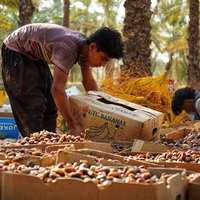
Workers sort freshly harvested dates in a palm grove in Bushehr province, southern Iran, September 15, 2026

Iran’s economic hardship has grown so acute that senior government officials are increasingly acknowledging in public the scale of the pressure on ordinary households.

“We are ashamed that the public’s income does not cover their expenses, especially for wage earners,” First Vice President Mohammad Reza Aref said Thursday. “You cannot increase salaries by 20% when inflation is running above 60–70%.”

Government spokeswoman Fatemeh Mohajerani has disclosed a roughly 310-trillion-toman shortfall in expected tax revenues during the first half of the current year, while the head of the Food and Drug Administration says medicine prices have risen roughly 103% this year.

President Masoud Pezeshkian has offered an equally stark assessment of the public mood, invoking the 2019 fuel-price protests as a warning against imposing further economic pressure.

“People are now on the edge; if I impose another pressure, they may fall off,” he said.

The warning has not prevented the government from doubling the gasoline price for high-volume consumers, highlighting the difficult choices facing Tehran as it tries to contain household pressure while confronting the economic costs of war.

The household squeeze

The free-market dollar has traded at around 2.30–2.33 million rials this week, with the Iranian currency losing roughly 44% of its value against the dollar over the past six months.

Food and beverage inflation has officially exceeded 127% year on year, contributing to a sharp contraction in consumption of protein, dairy products and legumes among urban working-class households.

State-run ILNA has published unusually blunt reports on the cost of living, including unofficial bread-price increases in Tehran, families cutting meat from their diets and rents doubling.

The financial daily Donya-ye Eghtesad has warned of signs of a “new inflationary regime” in which persistent price rises are shaping contracts, expectations and everyday economic decisions, making confidence in the rial increasingly difficult to restore.

The approaching academic year provides another measure of the squeeze.

According to Donya-ye Eghtesad, equipping a single primary or secondary-school student with basic uniforms, a schoolbag, shoes and stationery now costs between 150 million and 200 million rials.

A basic pack of notebooks that cost around 3.5 million rials last year now costs approximately 15 million, forcing some lower-income families to reuse old school supplies.

War adds to the strain

Iranian oil exports have reportedly fallen from around 2 million barrels per day before the war to approximately 220,000–255,000 barrels per day in August, sharply reducing one of Tehran’s principal sources of foreign currency.

The Economy Ministry has established an “Economic War Headquarters” as officials increasingly frame the economic crisis as part of the broader confrontation with Washington. But falling oil revenues leave the government with fewer resources to cushion households against rising prices and a weakening currency.

Oil-industry workers have staged weekly Monday protests over pay and taxes at offshore platforms and in Assaluyeh, while nurses demonstrated in Kermanshah on September 8 over unpaid wages.

Accounts in Iranian media offer a more immediate picture of the pressure behind such discontent: street vendors struggling with higher rents, households going months without eating meat and parents weighing school expenses against basic food costs.

The combination of high inflation, declining purchasing power and sharply reduced oil revenues leaves Tehran with increasingly limited room to ask households to absorb further economic costs from the war.

Banner

Most Viewed

Video of Iran's police sexually abusing teenager draws fury
1

Video of Iran's police sexually abusing teenager draws fury

2

US House passes Iran sanctions as Trump signals war may be nearing end

3

Iran rapidly rebuilding site tied to past nuclear weapons research - report

4

Trump weighs major Iran escalation as China steps up diplomatic push

5

Calls to quit NPT grow in Iran as critics warn of strategic trap

Banner
Banner

Spotlight

  • Tehran ‘ashamed’ as Iranians struggle to make ends meet

    Tehran ‘ashamed’ as Iranians struggle to make ends meet

  • Iran faces postwar winter with a third of gas capacity lost
    ANALYSIS

    Iran faces postwar winter with a third of gas capacity lost

  • Iran’s nightly pro-state rallies become factional battleground
    INSIGHT

    Iran’s nightly pro-state rallies become factional battleground

  • Woman, Life, Freedom and the Iran that cannot go back
    OPINION

    Woman, Life, Freedom and the Iran that cannot go back

  • From Halkbank to Golden Global: Turkey’s Iran banking ties under US scrutiny

    From Halkbank to Golden Global: Turkey’s Iran banking ties under US scrutiny

Banner
•
•
•

More Stories

Iran's Guards stage show of force two days after protest anniversary

Sep 18, 2026, 12:57 GMT+1
100%
Women sit beside mock-ups of Iranian missiles during the state-organized Janfadayan-e Iran parade in Tehran on September 18, 2026.

Iran's Revolutionary Guards paraded uniformed volunteers, Basij paramilitaries and children through Tehran on Friday in a state-organized show of force, two days after the anniversary of the 2022 protests.

The event, named Janfadayan-e Iran, roughly "those ready to give their lives for Iran," began in the morning on the order of Hassan Hassanzadeh, commander of the Guards' Tehran corps, with the password "Labbaik ya Khamenei," at your service, Khamenei.

State media put the number on the streets at more than 300,000 and said 600,000 had registered for military training. None of the figures could be independently verified. State television had spent several days urging Iranians to sign up.

The organizers billed it as a 313,000-strong parade, a number with religious rather than statistical meaning. Shiite tradition holds that 313 companions will rise alongside the Hidden Imam, the twelfth imam of Shiite Islam, who is believed to have vanished in the ninth century and to be destined to return.

100%
Women carry models of Iranian missiles during the state-organized Janfadayan-e Iran parade in Tehran on September 18, 2026.

Hassanzadeh said the purpose of the exercise was to counter "the propaganda and media operations of the enemies of the Islamic Republic."

Hossein Taeb, the former Revolutionary Guards intelligence chief who now heads the Basij, described the marchers as "resistance battalions" ready for "full-fledged defense" and called the campaign "the biggest popular movement in the history of the world's wars."

Similar parades would follow in every province, he said, and the United States would soon be defeated and leave the region.

President Masoud Pezeshkian attended and described the display as "a magnificent manifestation of solidarity, cohesion and national loyalty."

Footage from the event showed, alongside Basij units and supporters organized by the Guards, children and teenagers marshalled by the Basij, and members of Iran-backed groups from the region, including Houthis.

100%
Children hold rifles during the state-organized Janfadayan-e Iran parade in Tehran on September 18, 2026.

Women from the Guards carried rifles beneath a banner showing Donald Trump in crosshairs above the words "We will kill." Participants trampled US and Israeli flags. Anti-aircraft batteries, truck-mounted machine guns and the drones used against shipping in the Strait of Hormuz were put on display.

The parade closed a week in which the rial fell past 2.3 million to the dollar under a US naval blockade and new sanctions, and came two days after the fourth anniversary of the death of Mahsa Amini in morality police custody, which set off the 2022 protests.

Police and the Guards had increased patrols in Tehran and Isfahan ahead of the date.

Iran faces postwar winter with a third of gas capacity lost

Sep 18, 2026, 11:49 GMT+1
•
Umud Shokri
100%
A worker during maintenance operations at facilities in Iran's northeastern Khangiran gas field, September 13, 2026

Iran is racing to restore gas infrastructure before winter after losing about a third of its pre-war production capacity, a reconstruction challenge that could force Tehran into difficult choices between keeping homes warm, power plants running and industry supplied.

Iranian officials say attacks have knocked out about 230 million cubic metres a day of gas-production capacity, compared with pre-war output of roughly 650 million cubic metres a day. That is just over a third of pre-war production.

Tehran has begun trying to claw some of that capacity back. Officials have said roughly 100 million cubic metres a day could be restored in the coming months, still less than half the capacity reported lost.

But restoring production is only part of the problem. Rystad Energy estimated in April that repairing damage to Iran’s energy infrastructure could cost as much as $19 billion, affecting gas processing, refining and export facilities.

That figure covers physical repairs rather than the wider economic consequences of lost production, disrupted exports and industrial shutdowns. Rystad has also identified shortages of critical equipment and workers as major obstacles to recovery.

Winter could provide the first major test of whether Iran can repair enough of its energy system quickly enough to prevent wartime damage from developing into a broader economic crisis.

A system already under pressure

Iran entered the war with an energy system already struggling to match supply with demand.

The US Energy Information Administration has said sanctions slowed development of the country’s natural-gas infrastructure and that limited storage capacity left Iran poorly equipped to manage seasonal swings in consumption.

In 2022, residential and commercial consumers accounted for 33% of Iran’s gas consumption, industry including petrochemicals for 27%, and electricity generation for another 28%, according to the EIA.

Household and commercial gas consumption rises during winter, while demand from the electricity sector is highest during summer.

The loss of production capacity therefore leaves Tehran having to allocate a reduced supply among households, power stations, petrochemical plants and other industrial users.

The problem is not simply how much gas Iran has underground. Gas reserves alone do not guarantee reliable supply: the country also needs functioning processing plants, pipelines and storage facilities, as well as electricity, maintenance, equipment and skilled workers to keep the system operating.

Damage beyond gas

Reduced gas supplies to power plants could constrain electricity generation, while restrictions on industrial users could hit petrochemicals and energy-intensive sectors such as steel, aluminium and cement.

That means the eventual cost of the damage cannot be measured solely by the reconstruction bill. Lower production can also translate into weaker industrial output and exports at a time when Tehran needs resources to finance repairs.

Iran's broader energy sector is already under severe financial pressure. The war and US naval blockade have sharply curtailed Iranian oil exports, leaving tens of millions of barrels stranded in storage and depriving Tehran of crude export revenue.

The combination creates the risk of a cycle in which energy shortages constrain economic activity while reduced revenues make restoring the energy system more difficult.

A longer-term problem

The war has also magnified structural weaknesses that predate the conflict.

South Pars, which Iran shares with Qatar, is the country's largest non-associated natural-gas field and the centre of its gas industry. But the EIA had already warned before the war that without additional investment Iran could struggle to satisfy domestic demand while meeting its export commitments.

Sanctions have restricted access to foreign investment, technology and specialised equipment, leaving Tehran with an existing infrastructure challenge before US and Israeli attacks added an urgent reconstruction burden.

Rystad said delays in procuring critical equipment were likely to determine how quickly damaged energy infrastructure could be restored, while shortages of workers were another major obstacle.

The winter test

For Tehran, the immediate question is how much of the reported 230 million cubic metres a day of lost gas capacity can be restored before colder weather drives household demand higher. How severe the remaining deficit becomes will depend on demand, further repairs and whether additional infrastructure is damaged.

Tehran may have to balance household heating against industrial production and electricity generation while trying to rebuild infrastructure under sanctions.

Rystad's $19 billion estimate gives a sense of the potential physical repair bill. The larger test is whether Iran can restore enough of the system to prevent damaged gas infrastructure from feeding through into electricity shortages, industrial disruption and further economic pressure.

The coming winter should provide the clearest indication yet.

Trump weighs major Iran escalation as China steps up diplomatic push

Sep 18, 2026, 01:03 GMT+1
100%
US Marines train on the flight deck of the USS Portland in the Arabian Sea. (CENTCOM/X)

President Donald Trump said Thursday he was weighing renewed large-scale strikes on Iran as China intensified diplomatic contacts with Washington and Tehran amid mounting pressure to contain the regional conflict.

Trump told Axios he was approaching a major decision on whether to resume broad attacks on Iran, after saying a day earlier that he hoped the war was nearing its end.

“I have a big decision coming up. Do I want to go in and annihilate them [the Iranian regime] or do I not? It's a big decision. Anything could happen with me,” Trump said in an interview published Thursday.

He is expected to meet leaders from Saudi Arabia, the United Arab Emirates, Qatar, Bahrain, Kuwait and Oman on the sidelines of the UN General Assembly next week before deciding on the next phase of the war. Axios reported that Trump wants to hear from regional allies before making his decision.

The consultations come as Washington’s partners and rivals push in different directions over whether the war should be contained or intensified.

China intensifies diplomatic push

China expanded its diplomatic engagement over the conflict Thursday, when Foreign Minister Wang Yi spoke with US Secretary of State Marco Rubio, one day after holding talks with Iranian Foreign Minister Abbas Araghchi in Beijing.

China’s Foreign Ministry said Wang and Rubio discussed preparations for the next stage of high-level exchanges between the two countries and exchanged views on the Middle East.

During Wednesday’s talks with Araghchi, Wang urged Iran and the United States to exercise restraint and resume substantive consultations, while also calling for the Strait of Hormuz to reopen.

Beijing’s diplomacy comes as the conflict threatens shipping routes at both ends of the Arabian Peninsula, increasing the risk of wider disruption to regional energy flows.

China has also privately asked Iran to use its influence to rein in Yemen’s Houthis after Saudi Arabia appealed to China for help, Reuters reported Thursday, citing three Iranian sources familiar with the matter.

The sources said Saudi Arabia sought Beijing’s intervention as Houthi advances around Bab el-Mandeb increased risks to oil exports and commercial shipping. China asked Tehran to help prevent the fighting from spreading further across energy routes important to Beijing.

The intensified diplomacy has not narrowed broader differences between Beijing and Washington over Iran.

Russia and China on Thursday vetoed a US-drafted Security Council resolution extending the mandate of the UN panel monitoring sanctions on Tehran, underscoring the continuing divide over the international sanctions framework.

Israel signals campaign is not over

While China pressed for restraint, Israel signaled that it was not ready for the military campaign to end.

Prime Minister Benjamin Netanyahu said Israel still had work to complete against Iran and its regional allies and said Israel intended to bring down Iran’s regime.

“We have done most of the work, but there is still work to complete, and we will complete it,” Netanyahu said in remarks published Thursday by his official account.

Defense Minister Israel Katz separately said Israel still had “important goals” to achieve against Iran and in other arenas, adding that the broader military campaign was not over.

“We will act with military force and political wisdom to achieve them,” Katz said.

Shipping pressure persists from Hormuz to Aden

The stakes surrounding Trump’s decision were also visible at sea, where commercial traffic remained severely depressed and new security incidents were reported along key regional shipping routes.

Only three commodity vessels transited the Strait of Hormuz Wednesday, down from 12 a day earlier and well below the 10-day average of about 17, Reuters reported Thursday, citing preliminary ship-tracking data.

The figures exclude vessels that may have crossed with their Automatic Identification System transponders switched off.

Fresh maritime security reports added to concerns over the region’s main shipping routes.

UK Maritime Trade Operations said it received a report of a security event in the Strait of Hormuz about 16 nautical miles northeast of Khasab, Oman. The crew was reported safe and no environmental impact had been confirmed while authorities investigated.

Farther west, a westbound tanker in the Gulf of Aden reported being pursued by a skiff that attempted to intercept it about 75 nautical miles east of Aden, according to UKMTO.

Trump has not said when he will decide whether to resume large-scale strikes. His meeting with six Persian Gulf leaders next Tuesday will bring him face to face with governments exposed to the economic and security costs of a wider conflict, as Washington weighs whether to intensify the campaign or pursue another diplomatic opening.

US House passes Iran sanctions as Trump signals war may be nearing end

Sep 17, 2026, 13:11 GMT+1
100%
Ukraine's President Volodymyr Zelenskiy welcomes US Senator Lindsey Graham (R-SC) before their meeting in Kyiv on July 10, 2026.

The US House of Representatives passed the Lindsey O. Graham Sanctioning Russia and Iran Act of 2026, clearing the sweeping measure for President Donald Trump’s signature as Washington also signaled that the Iran war could be approaching a diplomatic turning point.

The House approved the sweeping sanctions legislation by a vote of 262-159 on Wednesday, after the Senate passed it 86-11 last month. Fifty-eight Democrats supported the bill, while seven Republicans opposed it.

The legislation would authorize the president to impose tariffs of up to 100% on the largest purchasers of Russian oil and natural gas and sanction senior Russian officials, oligarchs, banks and financial institutions. At Trump’s request, lawmakers also expanded the measure to include sanctions targeting Iran’s energy and weapons sectors.

Republican Representative Joe Wilson welcomed its passage and said lawmakers were looking forward to Trump signing it into law.

The measure could affect major importers of Iranian and Russian energy. India said Thursday that it had noted the bill’s passage while emphasizing that it remained committed to securing energy supplies through diversified sourcing and in response to changing market conditions.

The sanctions push came alongside indications that Washington and Tehran may be exploring a path toward ending the war. Trump said on Wednesday after arriving in North Carolina that he hoped the conflict was nearing its conclusion, adding that Iran was seeking an agreement.

“Well, hopefully we’re toward the end of the war,” Trump told reporters. “Iran is very much wanting to make a deal. We’ll see how that works out.”

Trump is also expected to meet leaders or foreign ministers from the six Persian Gulf states on the sidelines of the UN General Assembly in New York next Tuesday, Axios reported. The meeting is expected to address the next phase of the war and US proposals for a postwar strategy.

Iranian Foreign Minister Abbas Araghchi, meanwhile, said consultations during his visit to China had been successful and endorsed Chinese President Xi Jinping’s proposals for ending the conflict.

China’s Foreign Ministry said Araghchi told Foreign Minister Wang Yi that Iran did not want the hostilities to continue and hoped to return to diplomacy. Wang urged Iran and the United States to revive the negotiating framework established under the Islamabad memorandum, called for the reopening of the Strait of Hormuz and backed dialogue between Iran and Persian Gulf states.

Araghchi also held separate telephone calls from Beijing with Turkish Foreign Minister Hakan Fidan and Pakistan’s army chief, Field Marshal Asim Munir, to discuss regional developments.

A parallel diplomatic channel emerged in Oman, where US officials met senior representatives of Yemen’s Iran-backed Houthis over the weekend, Reuters reported. The Houthis said they had no intention of attacking American vessels and remained committed to their 2025 ceasefire with Washington, according to the report.

Two sources told Reuters that the group promised not to target US ships. A Yemeni source said the Houthis also pledged not to attack Israeli or other commercial vessels, with the exception of Saudi ships.

The discussions took place against a backdrop of continued fighting between the Houthis and Saudi Arabia. Riyadh said it intercepted a Houthi drone near Mecca this week, an allegation the group denied. Saudi Arabia has also sought air-defense assistance from France, Britain, Pakistan and Egypt as its interceptor stocks decline, the Associated Press reported.

Houthi-run media said Saudi strikes in Yemen on Thursday hit telecommunications towers in Taiz and killed one person in Abs. The Houthis also released footage they said showed the downing of a Saudi F-15, a claim that Saudi Arabia had not confirmed.

Maritime traffic through the Strait of Hormuz remained severely constrained despite the diplomatic activity. Only three commodity vessels transited the waterway on Wednesday, down from 12 a day earlier and far below the 10-day average of about 17, Reuters reported, citing preliminary ship-tracking data.

US Central Command maintained that commercial traffic was still moving and that Iran did not control the strait. Its spokesperson said US forces had helped vessels carrying more than 900 million barrels of crude pass through the waterway since early May and had cleared mines from internationally recognized shipping lanes.

The sanctions bill, diplomatic contacts and continuing disruptions at Hormuz and in Yemen left Washington applying further economic pressure while testing whether negotiations could reduce the regional fighting.

Iran cancer patients sell household goods to pay for treatment

Sep 17, 2026, 11:27 GMT+1
100%
A cancer patient receives treatment at a hospital in Iran.

Some cancer patients in Iran are selling essential household goods or abandoning medication as soaring drug prices and gaps in insurance coverage put treatment beyond the reach of low-income families, a charity director said on Thursday.

Families have sold refrigerators and televisions to buy cancer drugs, while some patients have stopped taking medication because they can no longer afford it, Hossein Zehtaban, the head of a cancer support charity in the western province of Kermanshah, told Iran's ILNA news agency.

“We are facing patients who explicitly say they cannot afford their medication, that they are no longer taking it and are waiting to see what happens,” he said.

The warning comes during a sharp rise in pharmaceutical costs across Iran. Producer inflation in the pharmaceutical, chemical and herbal products sector reached 114% year-on-year, according to Iranian economic outlet Zooman.

A recently published price list from Iranian pharmaceutical manufacturer Loghman showed increases of more than 500% for some medicines. Donepezil, used to treat symptoms of Alzheimer's disease, rose 543% for a 10-milligram dose, while the price of clarithromycin increased 308%.

Workers struggle with treatment bills

Zehtaban cited one family with three cancer patients whose main breadwinner is a worker. Medication for each patient can cost 400 million to 500 million rials ($174-$217 at an exchange rate of 2.3 million rials to the dollar) a month, he said.

100%
A healthcare worker tends to a patient in an intensive care unit at a hospital in Iran.

Iran’s minimum base wage for workers is about 166 million rials a month, meaning the medication for just one of the three patients could cost roughly two-and-a-half to three times a minimum-wage worker’s monthly pay.

The charity has about 1,700 cancer patients registered for support, though the charity director said the figure does not represent the total number of cancer patients in Kermanshah province because other organizations also provide assistance.

Insurance problems are adding to the financial pressure, he said. Pharmacies facing unpaid insurance reimbursements have reduced provision of some medicines, forcing cancer patients to search multiple pharmacies for prescribed drugs, he added.

Drug prices surge

The financial strain described by Zehtaban extends beyond cancer treatment.

Loghman's published price changes show increases across dozens of medicines, with 23 products rising by at least 100%. Donepezil rose by 427% for the five-milligram dose and 543% for the 10-milligram dose, while Tadalafil, which is used to treat erectile dysfunction, enlarged prostates and pulmonary arterial hypertension, had the largest increase at about 706%, according to reports citing the company's regulatory disclosure.

100%

Rising medicine costs have combined with food and other household expenses to make supporting cancer patients increasingly difficult, Zehtaban said. Vitamins and nutritional supplements recommended during treatment are also often excluded from insurance coverage.

The charity provides financial assistance as well as weekly psychological and physical rehabilitation sessions, but he said its resources cannot cover the mounting treatment costs.