• العربية
  • فارسی
Brand
  • Iran Insight
  • Politics
  • Economy
  • Analysis
  • Special Report
  • Opinion
  • Podcast
  • Iran Insight
  • Politics
  • Economy
  • Analysis
  • Special Report
  • Opinion
  • Podcast
  • Theme
  • Language
    • العربية
    • فارسی
  • Iran Insight
  • Politics
  • Economy
  • Analysis
  • Special Report
  • Opinion
  • Podcast
All rights reserved for Volant Media UK Limited
volant media logo
ANALYSIS

Far-right overreach against Pezeshkian exposes cracks in the hardline camp

Jun 1, 2026, 23:19 GMT+1

Iran’s conservative establishment appears to be pushing back against its own ultra-radical fringe after a hardline lawmaker accused President Masoud Pezeshkian of bypassing the Supreme Leader over the April ceasefire with the United States.

Some Iranian hardliners now appear to be distancing themselves from the “extremist” ultraconservatives who have spent recent weeks attacking the president and the nuclear negotiating team.

Two prominent conservative figures with longstanding ties to Iran’s security establishment have publicly condemned hardline MP Kamran Ghazanfari after he accused Pezeshkian of undermining the authority of Supreme Leader Mojtaba Khamenei.

The fallout from these interventions, and from the incident itself, points to a visible fracture inside Iran’s right wing. It highlights the growing fragmentation of the hardline camp and the marginalization of its far-right fringe, a dynamic that may inadvertently provide the embattled president with some political breathing room.

Read the full article here.

Most Viewed

Iran’s president offers resignation, citing total takeover by IRGC commanders
1
EXCLUSIVE

Iran’s president offers resignation, citing total takeover by IRGC commanders

2

Tehran cafe sealed over gig deemed ‘satanic activity’

3
INSIGHT

No breakthrough yet, but Iranians are betting on one

4
EXCLUSIVE

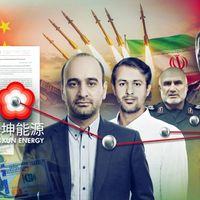
Leaked documents link Chinese firms to IRGC missile fuel network

Banner
Banner
•
•
•

Spotlight

  • Lebanon becomes a test of Trump's Iran diplomacy
    ANALYSIS

    Lebanon becomes a test of Trump's Iran diplomacy

  • Lebanon becomes a test of Trump's Iran diplomacy
    ANALYSIS

    Lebanon becomes a test of Trump's Iran diplomacy

  • Far-right overreach against Pezeshkian exposes cracks in the hardline camp
    ANALYSIS

    Far-right overreach against Pezeshkian exposes cracks in the hardline camp

  • Leaked documents link Chinese firms to IRGC missile fuel network
    EXCLUSIVE

    Leaked documents link Chinese firms to IRGC missile fuel network

  • Hardline MP draws backlash over post seen as swipe at Mojtaba Khamenei

    Hardline MP draws backlash over post seen as swipe at Mojtaba Khamenei

More Stories

Far-right overreach against Pezeshkian exposes cracks in the hardline camp

Jun 1, 2026, 20:40 GMT+1
•
Behrouz Turani
Far-right overreach against Pezeshkian exposes cracks in the hardline camp
100%
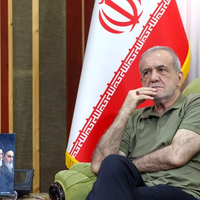
Iranian President Masoud Pezeshkian removed his jacket and appeared in a T-shirt during a water crisis management meeting on May 30, 2026, in a move aimed at encouraging energy conservation.

Iran’s conservative establishment appears to be pushing back against its own ultra-radical fringe after a hardline lawmaker accused President Masoud Pezeshkian of bypassing the Supreme Leader over the April ceasefire with the United States.

Some Iranian hardliners now appear to be distancing themselves from the “extremist” ultraconservatives who have spent recent weeks attacking the president and the nuclear negotiating team.

Two prominent conservative figures with longstanding ties to Iran’s security establishment have publicly condemned hardline MP Kamran Ghazanfari after he accused Pezeshkian of undermining the authority of Supreme Leader Mojtaba Khamenei.

The fallout from these interventions, and from the incident itself, points to a visible fracture inside Iran’s right wing. It highlights the growing fragmentation of the hardline camp and the marginalization of its far-right fringe, a dynamic that may inadvertently provide the embattled president with some political breathing room.

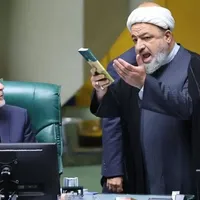
In a video clip that went viral last week, Ghazanfari accused the president of bypassing the Supreme Leader, demanding: “Why did you accept the ceasefire without Khamenei’s permission?”

He claimed that the Leader’s silence in public messages signaled disapproval and alleged that Pezeshkian had similarly accepted an unauthorized ceasefire during a previous 12-day conflict.

Ghazanfari argued that by halting military operations, Pezeshkian had effectively “saved America and Israel from the crushing blows of Iran’s missiles and drones” just as they were facing destruction.

Ghazanfari's remarks were criticized by hardline commentator Abbas Salimi Namin in an interview with the pro-reform Rouydad 24 website, and by Abdollah Ganji in an editorial in the IRGC-linked Javan newspaper.

The reactions represented unusually sharp internal pushback from within the broader conservative, or principlist, spectrum.

Their target is the extreme and destabilizing fringe of their own camp.

Salimi Namin warned that “extremism damages the system from within.” He argued that the presence of ultra-radicals like Ghazanfari in the parliament is a disaster that alienates the public and degrades political discourse. He also accused radical hardliners of weakening the Supreme Leader’s authority rather than defending it.

“The presence of people like Ghazanfari in the Majles is a disaster,” Salimi Namin said, adding that such statements, “before being an accusation against Pezeshkian, are an insult to the leadership and the armed forces.”

Ganji, who previously served as managing editor of Javan before moving to Hamshahri, made a similar argument in an editorial titled “The Reckless Ghazanfar(s).” The headline used “Ghazanfar,” a colloquial Persian term for a clumsy teammate who scores an own goal, as a pointed play on the MP’s name.

Ganji reminded the “rogue” ultraconservative lawmaker that under Article 110 of the Constitution, decisions on war, peace and major strategic shifts rest with the Supreme Leader and the Supreme National Security Council, not the president.

He described Ghazanfari’s outbursts as “a psychological pathology rather than legitimate political criticism.” He also accused him of exploiting parliamentary questioning as a legal loophole to smear opponents with labels such as “spy,” “Bahai” or “secular.”

Ganji urged “revolutionary youth and elites” to break their silence and “push back against these reckless figures who drive people away from the revolution.”

He characterized Ghazanfari’s accusations as “so disgusting, illogical, insulting, and slanderous… that at first, I thought it was generated by artificial intelligence.”

Both articles unequivocally condemned Ghazanfari’s conspiratorial attacks on Pezeshkian. They argued that although Ghazanfari claims to defend the Revolution and the Leader, his logic ultimately insults the Leader by implying that a president could easily bypass his authority on matters such as striking Israel or agreeing to a ceasefire.

Both warned against mistaking such toxic behavior for revolutionary zeal.

Together, these interventions expose a major structural tension in Iranian politics: how the system manages a reformist or moderate president operating within a conservative-dominated state.

Pezeshkian entered office on a platform of consensus-building, direct engagement with the West to ease sanctions, and domestic de-escalation. The recent criticism of Ghazanfari suggests that mainstream institutional conservatives recognize that, for the system to function, the president must retain at least a basic level of legitimacy.

By attacking the president over core security decisions, the ultra-radicals disrupt the carefully calibrated systemic harmony engineered by the leadership.

The fact that high-profile conservatives are publicly rebuking an ultra-hardline MP indicates that, at this moment, the establishment is prioritizing state stability over factional purity.

Millions face poverty as Iran’s economy reels from war and sanctions

May 30, 2026, 16:00 GMT+1
•
Maryam Sinaiee
Millions face poverty as Iran’s economy reels from war and sanctions
100%

As US economic pressure, staggering inflation and negative growth converge, economists warn that Iran faces an increasingly bleak outlook that could push millions more people below the poverty line.

Hojattollah Mirzaei, an economics professor at Allameh Tabataba'i University and former head of the country’s retirement funds, shed light on the compounding crisis at a panel hosted by Donya-e-Eqtesad newspaper.

He said rising exchange rates, import restrictions, higher transportation costs, intensifying inflationary expectations, internet shutdowns and government financial deficits are driving up unemployment and eroding household purchasing power.

According to Mirzaei, an additional 3.5 million to 4.5 million people are expected to fall into poverty this year alone due to the economic fallout from the March war.

The cost-of-living crisis and the inflationary spiral

The macroeconomic pressure is being felt most sharply in household expenses.

The Central Bank of Iran reported an annual inflation rate of more than 50.6% in April. According to the same report, monthly inflation spiked to 67%.

Prices of some goods and services rose by up to 100% during the same period, vastly outpacing stagnant wage growth.

Prominent economist Masoud Nili warned that even if military tensions ease, economic conditions will not easily return to normal.

“The greatest current danger to Iran’s economy is being caught in an escalating inflationary spiral,” Nili said, calling it “a path that becomes increasingly difficult to control the further it goes.”

Market paralysis and the rise of the working poor

The inflationary pressure is coinciding with severe economic contraction.

Mirzaei projected that Iran’s economy will shrink by 8.8% to 10% in the current Iranian year, adding that even the 10% forecast may be optimistic.

The downturn has also frozen the labor market.

Hossein Rajabpour, head of the Saba Research Institute, said job creation has sharply declined, with the industrial sector suffering the heaviest losses following the recent conflict.

The crisis has also changed the profile of poverty in Iran. Social policy researcher Kowsar Yousefi said a significant share of those who are employed still live below the poverty line.

Frozen assets and the limits of a short-term fix

To ease the acute economic pressure, Iran is pushing for the release of roughly $24 billion in assets frozen in foreign banks.

Tehran hopes access to those funds could help stabilize the currency market, lower inflationary expectations and reduce the cost of importing basic goods and raw materials. Iranian officials have said “meaningful negotiations will not begin without the release of these assets.”

But economists warn that such cash injections would offer only temporary relief.

While access to foreign exchange reserves could help exchange rates, inflation and short-term growth, deeper structural problems would remain.

Iran is also hoping that a deal with Washington will end the blockade that has severely restricted its access to oil revenues in recent months, leaving 60 million barrels worth $6 billion stranded on tankers, according to TankerTrackers.

Even if a deal resolves those issues and sanctions are lifted, chronic weakness in domestic and foreign investment would continue to weigh heavily on the economy.

That vulnerability is reflected in global resilience data. According to a business environment resilience index compiled by Factory Mutual Insurance Company, which evaluates how effectively 130 countries withstand and recover from economic shocks, Iran ranks near the bottom at 125th.

The ranking stands in sharp contrast to regional peers such as Qatar and Saudi Arabia, both of which are among the world’s top 50 most resilient economies.

Oil pressure and economic strain drive Iran-US talks

May 26, 2026, 04:12 GMT+1

More than six weeks after Iran disrupted shipping through the Strait of Hormuz and the United States moved to enforce a naval blockade, the confrontation increasingly appears to be entering a new phase: negotiations driven by exhaustion.

What began as a military and geopolitical standoff has evolved into a contest over economic endurance, one that neither Iran nor the global economy appears capable of sustaining indefinitely.

After weeks of escalation, diplomacy has regained momentum. Talks involving Tehran, Washington and regional mediators have intensified, while US President Donald Trump has repeatedly suggested a deal may be close.

At the center of the latest negotiations lies the issue of frozen Iranian assets.

Read the full article here.

Could Iran be building a Chinese-style internet system?

May 26, 2026, 04:04 GMT+1
•
Negar Mojtahedi
Could Iran be building a Chinese-style internet system?
100%
Children look at a mobile device among spring tulips in a flower garden in Tabriz, northwestern Iran, May 24, 2026

Iran may be moving beyond temporary internet blackouts toward something more durable: a Chinese-style system of digital control.

Concerns intensified after a former head of Iran’s state broadcaster said Tehran had imported Chinese equipment for a “permanent internet shutdown,” while millions of Iranians endure what monitoring group NetBlocks says is now the world’s longest ongoing nationwide blackout.

Experts warn the Islamic Republic may not be trying to shut the internet off forever but instead attempting to build a controlled and heavily surveilled online ecosystem designed to filter information, monitor communications and isolate Iranians from the outside world while still keeping parts of the economy online.

Mohammad Sarafraz, the former head of Islamic Republic of Iran Broadcasting and a current member of the Supreme Council of Cyberspace, said in an interview with the online newspaper Faraz that factions in Tehran are seeking to restrict global internet access for the general public while preserving it for a limited and controlled group.

He said the Islamic Republic had imported Chinese equipment for “permanently cutting off the internet.”

Spectre of digital control

Laura Edelson, assistant professor of computer science at Northeastern University, said the closest comparison may be China’s internet crackdown in Xinjiang after unrest there in 2009, when authorities isolated the Uyghur-majority region from the outside internet for 10 months.

“Functionally, for the vast majority of the population, they were effectively cut off entirely from the outside world,” Edelson said.

She said China’s model is far more sophisticated than simply blocking websites, relying on centralized state control to filter content, surveil users and selectively determine what information people can access.

“This centralized model is one that a lot of other countries, including and almost especially Iran, has been moving toward,” she told Iran International.

She added that turning off the internet forever “is not useful,” meaning authoritarian governments increasingly favor adaptable systems that can tighten restrictions during politically sensitive moments and loosen them when economic activity is needed.

“Iran’s government doesn’t trust its own people,” Edelson said. “The vast majority of people don't support the government.”

“If you can have an internet that you can adaptively not just turn on and off, but control what people can reach and what they can’t reach — that’s a set of internet censorship and surveillance systems that I would be more afraid of personally,” she said.

Can Tehran pull it off?

Max Meizlish, Senior Research Analyst at the Foundation for Defense of Democracies and a former US Treasury official focused on sanctions enforcement, said China has long exported censorship technologies and surveillance capabilities to authoritarian partners.

“We know that China has been a significant partner to several malign actors, including Iran, but also Russia and North Korea, with respect to cyber technology censorship capabilities,” Meizlish told Iran International.

He said China’s own internet system gives Tehran both a blueprint and a commercial partner.

According to Meizlish, Iran’s centralized control over internet infrastructure already gives authorities the ability to regulate what information enters or leaves the country.

“What we could actually see is Iran building out its own internet,” he said, “so that the people of Iran are only able to view what the government wants them to view.”

He said technology transfers between Beijing and Tehran should increasingly be viewed through the lens of human rights abuses and digital repression.

“There’s an argument to be made that this form of censorship constitutes a wide-scale human rights abuse,” Meizlish said.

But Amin Sabeti, founder of cybersecurity research group CERTFA, cautioned that Iran still lacks many of the domestic technological capabilities that made China’s censorship system possible.

“The Iranian regime imports the technology; it doesn't own the technology,” Sabeti said.

Unlike China, he said, Iran lacks strong domestic alternatives to many global services and remains heavily dependent on foreign infrastructure and technology.

“In China, there isn't a need for Gmail because they have good services in terms of email,” Sabeti said. “In Iran, there isn't any proper email service.”

Sabeti said Iran has repeatedly shown it can temporarily shut down the internet during protests and unrest, but questioned whether the regime could sustain a truly permanent nationwide blackout over the long term.

“I don't think it will happen,” he said.

Iran’s rulers may not want to permanently disconnect Iranians from the global internet, but they appear to be moving toward a more sustainable architecture of digital control that allows the state to keep commerce functioning while isolating citizens from independent information, encrypted communications and even family members abroad.

For many Iranians, the question is no longer whether the internet will fully return, but what kind of internet the state intends to allow back.


Oil pressure and economic strain drive Iran-US talks

May 26, 2026, 01:02 GMT+1
•
Dalga Khatinoglu
Oil pressure and economic strain drive Iran-US talks
100%
The Galaxy Globe bulk carrier and the Luojiashan tanker sit anchored as Iran vows to close the Strait of Hormuz, amid the US-Israeli conflict with Iran, in Muscat, Oman, March 9, 2026

More than six weeks after Iran disrupted shipping through the Strait of Hormuz and the United States moved to enforce a naval blockade, the confrontation increasingly appears to be entering a new phase: negotiations driven by exhaustion.

What began as a military and geopolitical standoff has evolved into a contest over economic endurance, one that neither Iran nor the global economy appears capable of sustaining indefinitely.

After weeks of escalation, diplomacy has regained momentum. Talks involving Tehran, Washington and regional mediators have intensified, while US President Donald Trump has repeatedly suggested a deal may be close.

At the center of the latest negotiations lies the issue of frozen Iranian assets.

Iranian officials are demanding guaranteed access to billions of dollars held abroad before accepting any preliminary understanding, while reports from Tehran suggest Qatar may be exploring financial mechanisms that would allow limited transfers without direct US payments to Iran.

The diplomacy reflects mounting pressure on both sides.

The head of the International Energy Agency warned in May that unless progress is made toward ending the crisis with Iran, the global oil market could enter a “red zone” by summer.

Beginning in mid-March — roughly two weeks after Iran moved to disrupt shipping through the Strait of Hormuz — IEA member states began gradually releasing strategic petroleum reserves to offset sharp declines in Gulf energy exports.

Hundreds of millions of barrels have already been released from emergency stockpiles, according to market estimates, as governments attempt to stabilize prices and prevent a broader supply shock.

But strategic reserves are not unlimited.

Even when commercial inventories are included, only part of global oil storage can realistically be released to the market. Much of the world’s inventories are tied to operational infrastructure, while many governments face legal and political constraints on how deeply emergency reserves can be depleted outside wartime conditions.

The strain is increasingly visible across the global economy.

High energy prices have weakened demand growth and raised recession fears in major economies, while shipping disruptions in the Persian Gulf continue to inject volatility into global markets.

Iran, meanwhile, faces mounting economic pressure of its own.

Exports of crude oil and petroleum products, which account for a large share of the country’s export revenues, have sharply declined under blockade conditions. Iranian steel and petrochemical facilities have also faced repeated disruptions and attacks during the conflict.

According to estimates by Kpler, Iran’s floating oil storage near East Asian waters has fallen sharply in recent weeks as Tehran struggles to maintain exports to China despite mounting logistical constraints.

The United States and its allies retain significant escalation options economically and militarily, while Iran’s ability to sustain prolonged confrontation increasingly appears tied to its capacity to continue threatening shipping routes and regional stability.

But Washington also faces limits. A prolonged energy crisis, rising oil prices and fears of a wider regional war are creating growing pressure on the United States and Gulf allies to secure at least a temporary understanding with Tehran.

That pressure helps explain the renewed urgency surrounding the Doha talks.

What now seems increasingly clear is that neither Iran’s economy nor the global economy can sustain the current trajectory for much longer.

The question is no longer whether economic pressure is being felt. It is whether the pressure forces compromise before miscalculation produces another round of escalation.