IRGC-linked propaganda posts targeted across platforms, Europol says
Europol said on Monday that 14,200 posts and links tied to Iran’s Islamic Revolutionary Guards (IRGC) had been targeted in a coordinated operation against online terrorist material.
The operation, led by Europol’s EU Internet Referral Unit, involved 19 countries and focused on content used to spread propaganda, recruit supporters and raise funds.
The material, Europol said, appeared across social media, streaming services, blogs and websites in several languages, including Persian, English, Arabic, French and Spanish.
The content, it said, included AI-generated videos glorifying the IRGC, political messaging, calls for revenge over Iran's Supreme Leader Ali Khamenei and material linked to allied groups including Hezbollah, Houthis, Hamas and Palestinian Islamic Jihad.
Europol said the IRGC’s main X account, which had more than 150,000 followers, was withheld in the EU, while thousands of other links had been removed or were under review.
Investigators also identified cryptocurrency transactions used to support online operations, Europol said.
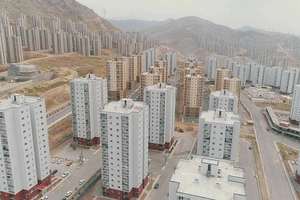
Two men overlook Tehran in this undated file photo illustrating Iran’s housing and rent crisis.
Pressure on Iran’s housing market is pushing a rise in shared living arrangements in small urban apartments, with landlords and tenants increasingly dividing limited space to cope with rising rents and mortgage costs, according to local media.
A report by Peyam-e Ma documents a growing trend in which 40–60 square meter apartments are being split between unrelated occupants as rent levels outpace incomes and turn standard tenancy into negotiated cohabitation.
Conditions reshape tenancy norms
In one case cited by the report, a landlord in a central district of Tehran asked for a deposit of 1,000,000,000 rials (about $550) and monthly rent of 50,000,000 rials ($28) for a shared arrangement, alongside strict conditions including limited visitors, full-time employment, and no pets.
The minimum wage in Iran is currently around $90 per month.
Another listing involved a 50-square-meter apartment where the owner offered reduced rent in exchange for domestic work. The monthly payment was set at 70,000,000 rials ($39), down from 120,000,000 rials ($67) if cooking duties were included.
A separate case involved a duplex property being partially rented out for a deposit of 3,000,000,000 rials ($1,667) and monthly rent of 150,000,000 rials ($83), with cohabitation offered to another couple.
From coping mechanism to structural pressure
A deputy head of Iran’s real estate brokers’ association told Peyam-e Ma that shared housing can be understood as a lifestyle choice seen in other countries, noting its historical presence in Iran as well.
But the report highlights a widening gap between that framing and current conditions, with landlords increasingly using cohabitation models to cover mortgage payments and living costs, while tenants accept reduced privacy in exchange for affordability.
File photo of Tehran amid rising housing and property prices in Iran.
Exit from Tehran’s rental market
Brokers interviewed for the report say some tenants are leaving the capital altogether or returning to smaller cities as rents rise beyond sustainable thresholds. Others, particularly single occupants, are moving back into parental homes.
One housing expert quoted in the report warns that continued displacement from urban centres could accelerate informal settlement growth around major cities, describing it as an emerging phase of housing exclusion rather than a temporary adjustment.
Another analyst argues that prolonged multigenerational living has masked underlying demand for independent housing, particularly among younger Iranians delaying marriage or household formation due to cost barriers.
This suppressed demand, he said, is becoming more visible as household structures shift and single-person living increases, exposing shortages in affordable rental stock.
Rising pressure on tenants
Data referenced in the report from Iran’s statistics authority indicates that roughly 51 percent of Tehran residents are renters, underscoring the city’s dependence on the private rental sector.
With average monthly rents for standard apartments ranging between 180,000,000 and 270,000,000 rials ($100–$150), costs now far exceed minimum wages reported at around 166,000,000 rials ($92).
Inflation in rent prices is recorded at 31.1 percent year-on-year, but market participants in the report say this figure reflects affordability limits rather than easing pressure, as tenants are unable to absorb further increases.
Poverty exposure among renters
Refering to a parliamentary research, the report says that around 27 percent of renting households fall below the poverty line under conventional measures, rising to roughly 40 percent when housing costs are included.
It also adds that the majority of low-income renters are concentrated in the bottom income deciles, with Tehran accounting for the largest share.
The spread of shared housing is therefore presented not as an isolated social shift, but as part of a broader tightening of access to independent accommodation in Iran’s largest urban centre.
File photo of drug addicts detained during a police crackdown in Iran.
Severe shortages of opium syrup are disrupting addiction treatment across Iran, Shargh daily reported on Sunday, raising fears that thousands of recovering drug users could return to narcotics use as clinics struggle to secure supplies of a key maintenance medication.
The shortages follow repeated disruptions in the production and distribution chain of opium syrup, a drug widely used in Iran’s maintenance treatment programs for patients who cannot easily switch to alternatives such as methadone because of physical dependence or medical complications.
Experts and addiction treatment activists warned the shortages are no longer only a clinical problem but a broader social crisis with potential consequences for public health, crime and family stability.
“These medications are essential for patients and stopping access does not mean they stop using drugs,” addiction expert Habib Bahrami told Shargh. “In many cases they return directly to narcotics use, bringing social, economic and family consequences.”
Some clinics, according to the report, have seen supplies fall so sharply that only one out of every 100 eligible patients can obtain opium syrup.
Patients pushed back toward illicit drugs
Bahrami said shortages had already emerged before the recent regional conflicts and economic pressures intensified.
“Before the war we were already seeing reduced supplies,” he said. “In some medical universities, opium syrup distribution was nearly halted before the Persian New Year (late March) without explanation.”
Patients unable to obtain the medication, he said, often return to street narcotics markets to avoid severe withdrawal symptoms, undermining years of treatment and increasing pressure on healthcare.
Methadone syrup continues to be distributed more consistently, Bahrami said, but many patients cannot easily transition to substitute medications.
Supply chain problems deepen shortages
Activists and treatment providers offered differing explanations for the shortages, with some blaming administrative restrictions and others pointing to shortages of raw materials used in production.
File photo of patients at an addiction treatment center in Iran.
Abbas Deilamizadeh, head of the addiction recovery NGO Tavallod-e Dobareh (Rebirth Society), said insufficient access to raw opium materials has sharply reduced production and fueled the emergence of a black market.
“The shortage of raw materials has caused shortages in the market and created serious problems for patients,” Deilamizadeh told Shargh.
He argued that tighter state oversight of legal cultivation could provide a long-term solution.
“The only solution, in my view, is government-supervised poppy cultivation to supply the raw materials needed for this treatment method,” he said.
Addiction centers face mounting pressure
Treatment providers also warned that financial pressures and recent regional conflict have weakened addiction recovery services more broadly.
Deilamizadeh said many residential treatment centers are struggling with unrealistic state tariffs that fail to cover operational costs amid high inflation.
“For a 30-day stay, less than 100 million rials ($55) is allocated per patient,” he said. “That amount does not realistically cover accommodation, utilities, staff and treatment standards.”
He also said voluntary admissions to treatment centers have dropped sharply in recent months because of insecurity and public anxiety linked to regional military escalation.
“Based on our experience, voluntary admissions have fallen by around 40 percent,” he said.
Bahrami said some centers discharged patients during periods of heightened military tension and avoided taking new admissions because of security concerns.
“When society is overwhelmed by war-related fears, vulnerable groups are pushed further to the margins,” he said.
A trial date has been set for three defendants charged over an alleged arson incident near Iran International’s studios in northwest London, with the case scheduled to begin on January 25, 2027, at the Central Criminal Court.
At a preliminary hearing on Friday that lasted about 30 minutes, Oisin McGuinness, 21, and Nathan Dunn, 19, appeared by video link before Mrs. Justice Cheema-Grubb at the Central Criminal Court.
A third defendant, who is under 16 and cannot be named for legal reasons, is also charged in the case.
No pleas were entered at Friday’s hearing. A Plea and Trial Preparation Hearing has been set for August 28, 2026, when pleas are expected to be heard. The trial is listed for three weeks.
McGuinness, Dunn and the third defendant are charged with arson with intent to endanger life, contrary to the Criminal Damage Act 1977.
The charges relate to an alleged incident on April 15, 2026, when an ignited container was thrown into a car park near the network’s studios in northwest London.
There were no reports of injuries or damage following the attempted attack. Officers pursued a black SUV which later crashed on Ballards Lane in Finchley.
McGuinness also faces a charge of dangerous driving, contrary to the Road Traffic Act 1988, in relation to alleged driving on Ballards Lane and Woodberry Way.
McGuinness and Dunn were remanded in custody. The third defendant is on remand under local authority supervision.
All charges are alleged and have not been proven.
In a statement, Iran International said the attack highlights increasing pressure on its journalists and their families, particularly following the recent war involving Iran.
The broadcaster said its staff and their relatives have faced threats and harassment, describing the situation as an effort to silence independent reporting.
Fuel shortages and tighter rationing are pushing drivers across Iran into a growing gasoline black market, with citizens describing long lines at gas stations and sharply inflated prices in messages sent to Iran International.
The accounts describe growing frustration over restricted access to subsidized gasoline and arbitrary limits imposed by operators, leaving many motorists dependent on costly unofficial sales.
“One day there’s quota left on your card, the next day it says your quota is finished,” one citizen said. “They even steal the few drops of gasoline they give people.”
Iran uses a subsidized fuel quota system controlled through electronic fuel cards. Every private vehicle receives a monthly gasoline allocation at discounted prices, while extra consumption is charged at higher rates.
Under Iran’s latest pricing system introduced in late 2025, the first 60 liters of gasoline each month cost 15,000 rials per liter (about $0.008), the next 100 liters cost 30,000 rials ($0.017), and any amount above 160 liters costs 50,000 rials ($0.028).
Despite heavy fuel subsidies, Iran’s minimum monthly wage is now worth less than $90 because of inflation and the sharp decline of the rial.
Another driver said he could not use his personal fuel card on Wednesday because his monthly allocation had already run out. The station operator, he said, agreed to provide a fuel card only if payment was handed directly to him, and even then limited sales to 15 liters at 70,000 rials ($0.038) per liter.
President Masoud Pezeshkian said in late April that the country faced “some shortages” in sectors including energy and fuel.
On May 9, Esmail Saghab Esfahani, vice president and head of Iran’s Strategic Energy Policy and Management Organization, said damage during the war had affected parts of the country’s gas and fuel infrastructure and disrupted some gasoline production capacity.
He said Iran had “no choice but to conserve” fuel consumption for at least the next 18 to 24 months.
But Oil Minister Mohsen Paknejad said on April 29 there were no concerns over fuel supply or distribution.
File Photo: A worker adjusts fuel pumps at a gas station in Iran
Black market prices rise
A resident of Bandar Abbas in southern Iran said drivers often wait more than an hour at gas stations, even with personal fuel cards, while gasoline is “widely available” on the black market at 150,000 rials, about $0.08, per liter.
In Zahedan, in southeastern Iran, one resident said gasoline shortages and tighter controls had accelerated illegal fuel sales.
“Everything has been left without oversight,” the resident said. “Sometimes 20 liters of gasoline is sold on the street for 10 million rials ($5.5).”
One driver from Isfahan said operators demanded between 1 million rials ($0.55) and 4 million rials ($2.22) to provide access to only 15 liters.
Citizens also described growing congestion at gas stations nationwide, with drivers saying some stations on major routes had limited purchases to 15 liters.
A resident of Sistan and Baluchestan said 70 liters of gasoline now costs around 50 million rials, about $28, while many villagers must drive hundreds of kilometers to reach hospitals or provincial centers.
For many Iranians, the shortages have become less a matter of conservation than another daily pressure in an increasingly strained economy.
File photo of a father and child overlooking apartment blocks in Tehran amid soaring rents and deepening economic pressure on Iranian households.
More Iranians are moving back in with family or taking on roommates after losing jobs and struggling to keep up with rising rents in major cities, according to messages sent to Iran International.
“I worked at a petrochemical company and got fired. Since we can no longer afford rent, my wife, two children and I have moved back into my parents’ house,” one citizen told Iran International.
Another, a woman supporting her household alone, said she was forced to share her home after losing her job at a restaurant.
“I am the head of my household and after losing my job at a restaurant, I had no choice but to get a roommate to reduce rent and living costs while raising my teenage child,” she told Iran International.
Shargh newspaper reported on Thursday that more tenants in Tehran and other large cities are turning to shared housing, returning to parents’ homes or leaving the capital altogether as rent and living costs climb.
The newspaper cited residents who said they were searching for roommates for the first time after years of living independently, while others described plans to move back with family members or relocate to smaller cities after losing income.
A 45-year-old woman who had lived alone in central Tehran for two decades told Shargh she was considering taking in roommates because she could no longer afford rent on her own.
“More than two decades passed living alone and now I have to change my standards,” she told the newspaper. “Paying 400 million rials ($220) in rent in Tehran’s Bahar neighborhood is impossible for me.”
Another resident said he and his brother were looking for a third housemate after his workplace suspended operations and stopped paying salaries.
File photo: Iranians move household belongings as soaring rents and economic pressure force many families to move back in with parents or relatives.
Reverse migration from Tehran
Shargh said some residents were preparing to leave Tehran entirely after years in the capital, describing what it called a wave of reverse migration driven by economic hardship and shrinking work opportunities.
One editor told the newspaper she was returning to her hometown Kashan in her mid-40s after more than two decades in Tehran because rising costs and declining work in publishing left her unable to continue living independently.
“I thought I would return to Kashan after retirement, not in middle age because I can no longer survive economically in Tehran,” she told Shargh.
The report also pointed to signs of tighter housing supply, citing online property listings and real estate agents who said available rental units had declined while demand increased, particularly after displacement linked to the conflict with Israel.
Erosion of independence
Sociologist Abdolvahab Shahlibar told Shargh that shared housing in Iran is increasingly a financial necessity rather than a lifestyle choice.
“Efforts to improve quality of life have in many cases been replaced by efforts to preserve basic survival,” Shahlibar told the newspaper, warning that being forced to return to parents’ homes or abandon independent living could reshape social relationships and personal identity.