Women protesters held in basement ward at northeastern Iran prison
Iran's Mashhad prison
At least 30 women detained during recent protests and a security crackdown linked to Iran’s conflict with the US and Israel are being held in overcrowded, unsanitary conditions at Vakilabad prison in northeast Mashhad, the rights group HRANA reported.
The detainees include women swept up during the nationwide uprising and others arrested following the military conflict involving Iran, the US, and Israel that began in February.
According to the HRANA report, 23 women are being held in the Aramesh ward, described as a basement-like structure with low ceilings and minimal ventilation.
Former detainees told the group the cramped conditions, which one compared to an ant nest, frequently trigger breathing problems and panic attacks.
Seven other women are currently being held in a quarantine unit characterized by poor sanitation and sewage odors. HRANA said that prisoners face a shortage of beds, limited medical treatment, and are often denied phone calls and family visits during their interrogation.
Serious charges and legal limbo
The reports of poor conditions coincide with concerns over the legal status of those currently held in the facility. Iran International reported earlier that three female political prisoners – Mahboubeh Shabani, theatre actress Sima Anbaei Farimani, and Azar Yahou – remain in legal limbo at the prison.
These women face severe charges including enmity against God, conspiracy against national security, and alleged links to Israel. Despite weeks in detention, they have been denied access to lawyers and have not been informed of the status of their cases.
Mahboubeh Shabani, Sima Anbaei Farimani, and Azar Yahu
Escalation of executions
The crackdown in the northeast reflects a wider national trend of severe punishment for security-related detainees. Center for Human Rights in Iran reported that at least 28 prisoners accused in political and security cases have been executed across Iran in the past 50 days.
Of those executed, 13 were individuals detained during the recent winter protests.
A Shahed drone on display during the 47th anniversary of the Islamic Revolution in Tehran, Iran February 11, 2026.
Chinese companies continue to ship drone-related parts and other dual-use goods to Iran and Russia despite US sanctions, the Wall Street Journal reported on Tuesday, citing customs data, former US officials and weapons analysts.
The report said small Chinese firms were openly marketing items including engines, batteries, fiber-optic cables and computer chips that can be used in military drones.
The newspaper highlighted Xiamen Victory Technology, a Chinese company that offered to sell German-designed Limbach L550 engines, which the US has barred from export to Iran and Russia. The engines have been linked to Iran’s Shahed-136 attack drones, which Russia has used in Ukraine, the report said.
The Shahed-136, Iran’s main attack drone, has a range of about 1,000 miles and costs an estimated $20,000 to $50,000 to produce, making it a cheaper alternative to cruise missiles.
According to the Journal, the company sent the marketing email in March during the Iran-Israel war that began in February and has since moved into a ceasefire.
“We are deeply shocked and outraged by the aggression against Iran, and our hearts are with you,” the email said, while promoting the sale of the engines.
China’s Foreign Ministry told the Journal that Beijing enforces controls on dual-use exports in line with its laws and international obligations.
The report said US officials are increasingly concerned because many drone parts are now made in China by smaller firms that have limited exposure to the US financial system and are less vulnerable to sanctions.
The Journal also said Chinese exports of lithium-ion batteries and fiber-optic cables to Russia and Iran rose sharply as both countries expanded drone production and use.
US officials told the newspaper they are also trying to curb Iran’s oil revenue to limit funding for drone and missile programs.
The Wall Street Journal reported that some Chinese firms previously hid shipments through mislabeled cargo or Hong Kong shell companies, but analysts and former officials said some exporters are now acting more openly.
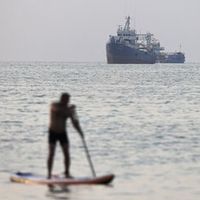
US War Secretary Pete Hegseth said the United States is not seeking conflict with Iran as it launches a temporary operation to protect shipping in the Persian Gulf.
“We’re not looking for a fight,” Hegseth said, describing the effort as defensive and limited in scope.
He said the operation, known as Project Freedom, aims to restore the flow of commerce through the Strait of Hormuz and protect commercial vessels from Iranian aggression.
“Project Freedom is defensive in nature, focused in scope and temporary in duration, with one mission, protecting innocent commercial shipping from Iranian aggression,” he said.
Hegseth said US forces would not need to enter Iranian waters or airspace, adding the mission is designed to secure global energy routes and support international trade.
He warned Iran against interfering with shipping. “If you attack American troops or innocent commercial shipping, you will face overwhelming and devastating American firepower,” he said.
Hegseth added the operation would eventually be handed over to international partners, saying the waterway is more critical to the global economy than to the United States.
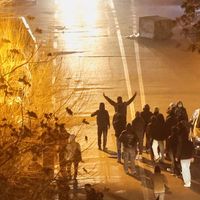
Protesters gather around burning barricades during anti-government demonstrations in Iran in January 2026.
Iranians need access to weapons to challenge their rulers, President Donald Trump said on Monday, arguing that protesters would fight effectively if armed but are currently outmatched by government forces.
“They have to have guns. And I think they’re getting some guns. As soon as they have guns, they’ll fight like, as good as anybody there is,” Trump said in an interview with The Hugh Hewitt Show.
Trump also suggested that US military pressure had already significantly weakened Iran and that further action could be completed within a short timeframe.
“We’ve taken out much of what we’d have to do, probably another two weeks, two weeks, maybe three weeks,” he said.
Trump said large numbers of Iranians would struggle to confront armed forces without access to weapons.
“You can’t have an unarmed population against people with AK-47s,” he said, adding that even hundreds of thousands of protesters would struggle against a smaller armed force.
He said previous protests had been met with heavy force, citing the deaths of tens of thousands of demonstrators, and suggested this had made him cautious about encouraging renewed unrest.
“I’m very torn on it, because they lost 42,000 people in the first two weeks. I don’t really want to see that,” Trump said.
Past weapons transfers
Trump said during a phone interview with Fox Sunday in early April that his administration had previously attempted to send firearms to Iranian protesters but that the effort did not reach its intended recipients.
“We sent guns to the protesters, a lot of them. We sent them through the Kurds. And I think the Kurds took the guns,” he said.
He repeated similar complaints, saying he was “very upset with a certain group of people” and warning they would “pay a big price.”
Several Kurdish groups have denied receiving such shipments.
Republican Senator Lindsey Graham has also urged the administration to pursue a policy of directly arming Iranian civilians.
“If I were President Trump and I were Israel, I would load the Iranian people up with weapons so they can go to the streets armed and turn the tide of battle inside Iran,” Graham said in an interview with Fox News on Monday.
“We don’t need American boots on the ground. We’ve got millions of boots on the ground in Iran. They just don’t have any weapons,” he added.
Graham described the idea as “a Second Amendment solution,” suggesting that arming civilians could help bring down the government without direct foreign military involvement.
He also called for alternative channels to deliver weapons, urging the administration not to rely on Kurdish intermediaries.
Military pressure and internal divisions
Trump framed his comments within a broader assessment that Iran’s military and economic capacity had been significantly weakened.
“They have no navy. They have no air force. They have no anti-aircraft,” he told The Hugh Hewitt Show.
Trump added that financial pressure may have affected the government’s ability to pay its forces.
“We don’t think they’re paying their soldiers and their Guard anymore,” he said.
He also suggested divisions within Iran’s security structure, drawing a distinction between the regular army and other forces.
“We purposefully have not gone after them too much, because we think that they’re much more moderate,” Trump said.
At the same time, he said the United States was not seeking to dismantle the country’s military institutions entirely.
“We’re not looking to decimate the army,” he said, referring to past regional experiences.
“You know, when they did Iraq... and the worst thing was they got rid of the all the leaders, so nobody knew who the leader was. And then all of a sudden, you had ISIS. We don’t want to do that.”
Nuclear focus remains central
Despite discussing internal unrest, Trump said that preventing Iran from acquiring nuclear weapons remains the central objective of US policy.
“The one thing I will say is they will never have a nuclear weapon,” he said.
Trump said any potential agreement would require the return of highly enriched uranium and limits on missile development, though he stressed that nuclear restrictions remain the priority.
People walk past a banner depicting the late leader of the Islamic Revolution Ayatollah Ruhollah Khomeini, late Supreme Leader of Iran Ayatollah Ali Khamenei and Iran's new Supreme Leader Mojtaba Khamenei, in Tajrish Square in Tehran, Iran, May 4, 2026.
Iran’s labor-focused news agency ILNA has pushed back against government efforts to downplay the economic impact of the recent conflict, citing experts who warn that actual unemployment figures far exceed official estimates.
The dispute highlights a growing rift between state reporting and the reality described by workers following the conflict that began on February 28.
While some officials have attempted to minimize the scale of the crisis, labor advocates and citizens report a significant downturn across key industrial sectors.
Dueling unemployment estimates
The scale of the crisis remains a point of intense domestic debate. Last month, Gholamhossein Mohammadi, Deputy Minister of Cooperatives, Labor, and Social Welfare, admitted the war had directly destroyed over 1 million jobs and that an additional 2 million people had lost work through indirect effects.
However, some lawmakers have moved to discredit these higher figures. Lawmaker Meysam Zohourian said people should be aware that it is falsely claimed 2 million have become unemployed due to the war.
He added that social security data suggests only about 100,000 unemployment insurance cases may be added. Labor Minister Ahmad Meydari offered a different figure, stating that 150,000 people had registered for unemployment benefits in recent weeks.
Industrial fallout and uncounted layoffs
ILNA and labor activists argue that official data is misleadingly narrow. Alireza Mahjoub, a prominent labor representative, has reported hundreds of thousands of job losses that remain uncounted in state insurance tallies.
The steel and petrochemical sectors have been particularly hard hit. Labor expert Hamid Haj Esmaeili told the Fararu news outlet that the Mobarakeh Steel facility was directly targeted during hostilities.
He said that the plant once employed 28,000 people and that many of them no longer have jobs. He added that layoffs are spreading through the supply chain and affecting petrochemical plants, including the Marvdasht complex in Fars province, where former workers have reported being unemployed for months.
Labor economists cited by ILNA warn of a chain reaction triggered by supply chain disruptions, damaged infrastructure, and the skyrocketing cost of raw materials. In addition to direct layoffs, many firms in the construction and manufacturing sectors have been forced to drastically reduce working hours or implement partial shutdowns due to a lack of inputs.
Reports of food insecurity and rising costs
Direct accounts from citizens to Iran International show the growing financial strain on households. Viewers reported widespread layoffs across production and service units, including one report from the northern city of Rasht where an estimated 2,000 people were let go.
The economic pressure has led to reports of food insecurity, with some families forced to reduce consumption to a single meal per day.
Residents also described a growing inability to pay rent and soaring prices for basic goods. One viewer noted that state television recently ran a caption acknowledging the state of war and high prices, suggesting the public should become accustomed to the current conditions.
File photo: Iranians walk in Tehran as economic pressure deepens, with layoffs rising and job opportunities shrinking.
Iranians described layoffs, unpaid wages and rising food and medical costs in messages to Iran International, while labor market data and local media reports pointed to a widening employment shock after the ceasefire.
“We do not know how we can go on with these prices. Yesterday I bought two sausages. It cost 1 million rials,” one viewer told Iran International, an amount equal to about 60 cents.
The strain is deepening as Iran’s minimum wage has fallen below $90 and the rial continues to lose value, hitting a new low this week.
Another message said workers at a glass factory had still not received their March wages and that supplementary insurance had been cut.
Several citizens linked the deterioration to factory closures after the ceasefire, shortages of raw materials and rising rents.
“Since the ceasefire, most factories have shut down, especially in industrial estates. Everyone has become unemployed because of shortages of raw materials. Daily goods have become more expensive, deposits and rents have gone up, and medical and drug costs have soared,” one message said.
Shargh daily reported that new registrations on the home-services platform Achareh rose sharply in late April compared with the same period last year, especially in lower-barrier work such as cleaning and catering.
Registrations for cleaning and catering rose 239 percent from April 21 to May 2, while electrical work rose 220 percent, plumbing 176 percent, cooling services 150 percent, and building maintenance 140 percent, according to figures provided to Shargh.
File photo: Construction workers take a break at a site in Iran
Bahman Emam, the platform’s chief executive and co-founder, told Shargh that overall job registrations had risen 30 percent.
“We witnessed widespread layoffs this year, and it seems a significant share of applicants are seeking a first job,” Emam said.
Shargh also reported that some workers who had left the platform for traditional markets were seeking to return, while others who could no longer afford life in Tehran asked to activate their profiles in other cities.
Experts warn shock may endure
Ashkan Nezamabadi, an economic journalist in Berlin, told Iran International that Iran’s labor market had entered a dangerous phase.
“Only one of the two main job platforms in Iran announced a few days ago that it had 318,000 new job applications in one day, which was a new record,” Nezamabadi said.
He said new job opportunities had fallen by about 80 percent, while economic losses and internet disruptions added to the strain.
“These changes clearly show something is breaking in the labor market,” he said.
Government plans to issue loans worth 220 million rials (around $120) per worker were unlikely to prevent layoffs or create durable jobs, according to Nezamabadi.
He said assistance would be more effective if directed toward consumers to preserve demand, contrasting it with pandemic-era support programs in Europe and the United States.
Iran’s Labor News Agency (ILNA) reported that the cost of a basic household livelihood basket had reached 713 million rials (about $385), up from 450 million rials (about $240) used in wage talks earlier this year.
Faramarz Tofighi, a labor activist who calculates livelihood costs, told ILNA that even the earlier estimate was not realistic and that wages did not reach 60 percent of it.
“That same unrealistic 450 million rial basket has today reached 713 million rials,” Tofighi said.
ILNA said the minimum wage including benefits had fallen to about $88 after the rial’s decline, leaving workers unable to cover rent and food.
Workers cited in the report said they were struggling to buy even bread and eggs, with meat and rice removed from many household shopping lists.
File photo: Seasonal workers wait for daily jobs in Tehran
Political fallout grows
Milad Rasaei-Manesh, a political activist based in Stockholm, linked the downturn to broader structural issues.
“Today the economy is effectively destroyed, and the war and policies pursued have led to widespread unemployment and deeper poverty,” Rasaei-Manesh told Iran International.
He said internet restrictions had compounded the crisis by cutting off income sources.
“Internet shutdowns have directly caused job losses and pushed more people into poverty,” he said.
He said economic pressures could drive coordinated protest action. "If workers organize through strikes and collective action, they can accelerate change,” he added.
The mounting evidence points to a labor market squeezed from both ends: more people seeking work, and fewer households able to pay for services.