Missile and drone activity reported around the Strait and in the United Arab Emirates on Monday—alongside disputed encounters at sea—suggest Tehran is beginning to act on warnings it had issued only hours earlier.
But the more revealing shift may be in tone.
Iranian military and affiliated voices have moved quickly to frame the moment not as a clash, but as enforcement.
“The Strait of Hormuz is entirely under Iranian control,” a senior Iranian source said, according to Hezbollah-affiliated Al-Mayadeen. “The message to the American aggressors is: Advance, and you will be targeted.”
‘Asymmetric operations’
That message builds on earlier warnings from senior commanders that any transit not coordinated with Iranian forces could be treated as a threat.
Ali-Akbar Ahmadian, a member of Iran’s Defense Council, pushed the line further, warning that any US action targeting shipping or energy infrastructure would be met with the Islamic Republic’s “asymmetric operations.”
The statements point to a posture that is no longer simply declaratory, but increasingly operational, especially against the backdrop of state-linked rhetoric in the hours before the incidents..
One day before the reported attacks in the UAE, Iranian state television accused Abu Dhabi of involvement in strikes on Iran’s Siri and Lavan islands during the US-led war, claiming Emirati Mirage jets, Wing Loong drones and unmarked F-16s had taken part.
The claims—unverified but widely circulated in Iranian media—help set the stage for a narrative in which regional actors are treated not as bystanders but as participants, and therefore legitimate targets.
That framing was reinforced after the incidents. Regional authorities reported missile and drone launches toward the UAE, while Iranian media attributed damage at energy facilities in Fujairah to what it described as US “military adventurism,” denying any pre-planned Iranian attack.
‘Ships are moving’
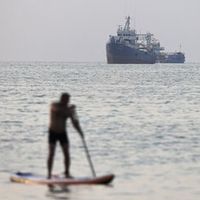
At sea, accounts have diverged sharply but point to the same underlying reality: rising friction around attempts to move vessels through the Strait.
US officials said commercial ships had transited and that Iranian threats had been contained. Iran’s Revolutionary Guards, however, denied that any passage had taken place and warned that “violating vessels” would be stopped.
Iranian media reported that ships attempting to cross were forced to turn back, while Washington rejected claims that its naval forces had been pushed out of the area.
US President Donald Trump, for his part, stopped short of declaring the ceasefire violated.
“(It was) not heavy firing,” he said in a phone interview, adding that “ships are moving” and that reports of recent exchanges were still being assessed.
The combination of rhetoric, incidents and competing claims suggests Tehran is seeking to impose a new reality in the Strait—one in which access is conditional and enforced.
Political figures have echoed that direction, pointing to efforts to formalize new rules governing transit and warning that any US role in shaping maritime access would be treated as a violation of ceasefire terms.
For now, the message from Tehran appears consistent: movement through the Strait will not be uncontested, and any attempt to bypass Iranian control risks drawing a response.