• العربية
  • فارسی
Brand
  • Iran Insight
  • Politics
  • Economy
  • Analysis
  • Special Report
  • Opinion
  • Podcast
  • Iran Insight
  • Politics
  • Economy
  • Analysis
  • Special Report
  • Opinion
  • Podcast
  • Theme
  • Language
    • العربية
    • فارسی
  • Iran Insight
  • Politics
  • Economy
  • Analysis
  • Special Report
  • Opinion
  • Podcast
All rights reserved for Volant Media UK Limited
volant media logo
EXCLUSIVE

Pezeshkian brands IRGC escalation ‘madness’ as tensions rise in Tehran

May 5, 2026, 00:18 GMT+1Updated: 04:31 GMT+1
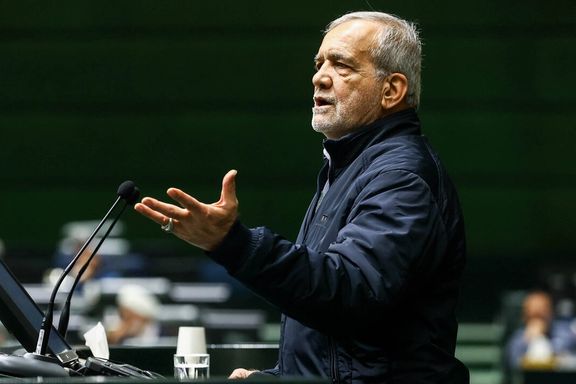
Iran's president Masoud Pezeshkian speaking at the parliament in this undated file photo

Exclusive information obtained by Iran International points to a growing clash between Iran’s moderate president Masoud Pezeshkian and its military leadership over Monday’s escalation in the Persian Gulf and attacks on the United Arab Emirates.

According to sources familiar with Tehran’s deliberations, Pezeshkian has expressed strong anger at actions by the Islamic Revolutionary Guard Corps, led by Ahmad Vahidi, describing missile and drone strikes on the UAE as “completely irresponsible” and carried out without the government’s knowledge or coordination.

Pezeshkian is said to have described the IRGC’s approach to escalating tensions with regional countries as “madness,” warning of potentially irreversible consequences.

Amid a worsening situation and the risk of the country sliding back into war, Pezeshkian has requested an urgent meeting with Mojtaba Khamenei to press for an immediate halt to IRGC attacks on Gulf states and to prevent further escalation.

He is expected to argue that a narrow window remains to salvage the ceasefire through urgent diplomatic action, and that he should be allowed to signal to international mediators Tehran’s readiness to return to negotiations.

The tensions come as diplomatic efforts to preserve the ceasefire continue, but with a widening gap between military and political approaches inside Iran’s leadership.

At sea, accounts of recent developments remain sharply contested. US officials say commercial ships are continuing to transit and that Iranian threats have been contained.

The IRGC, however, has denied that any passage is taking place and warned that “violating vessels” would be stopped, while Iranian media reported that ships were forced to turn back.

President Donald Trump has stopped short of declaring the ceasefire breached, saying recent exchanges were “not heavy firing” and that “ships are moving.”

In Iran’s power structure, major security and military decisions are ultimately taken at the highest levels of the system and in coordination with key state bodies, underscoring the significance of the president’s request.

Sources close to the presidency, who shared the information with Iran International, say Pezeshkian is deeply concerned about potential international reactions and believes the country cannot withstand a new full-scale war.

He has warned that continued unilateral attacks could trigger heavy US retaliation against critical energy and economic infrastructure—an outcome he reportedly said could lead to widespread destruction and an irreversible collapse in livelihoods.

The political deadlock comes as some observers warn that divided command on the battlefield risks pushing the Islamic Republic toward what they describe as “military self-destruction.”

•
•
•

More Stories

Pezeshkian said to clash with IRGC over UAE strikes

May 4, 2026, 23:53 GMT+1

Exclusive information obtained by Iran International suggests an unprecedented surge in tensions between Iran’s government and military leadership.

According to the information, President Masoud Pezeshkian has expressed strong anger at actions by the Islamic Revolutionary Guard Corps, describing missile and drone strikes on the United Arab Emirates as “completely irresponsible” and carried out without the government’s knowledge or coordination.

Pezeshkian is also said to have called the approach of escalating tensions with regional countries “madness,” warning of potentially irreversible consequences.

The claims, which could not be independently verified, point to growing friction at the top of Iran’s political and military establishment as the conflict intensifies.

Iran’s warnings give way to action as US launches Hormuz 'escort' plan

May 4, 2026, 22:46 GMT+1
•
Maryam Sinaiee

Iran has paired a sharp escalation on the water with increasingly explicit threats, signaling what appears to be a deliberate move to deter further US attempts to reopen shipping through the Strait of Hormuz.

Missile and drone activity reported around the Strait and in the United Arab Emirates on Monday—alongside disputed encounters at sea—suggest Tehran is beginning to act on warnings it had issued only hours earlier.

But the more revealing shift may be in tone.

Iranian military and affiliated voices have moved quickly to frame the moment not as a clash, but as enforcement.

“The Strait of Hormuz is entirely under Iranian control,” a senior Iranian source said, according to Hezbollah-affiliated Al-Mayadeen. “The message to the American aggressors is: Advance, and you will be targeted.”

‘Asymmetric operations’

That message builds on earlier warnings from senior commanders that any transit not coordinated with Iranian forces could be treated as a threat.

Ali-Akbar Ahmadian, a member of Iran’s Defense Council, pushed the line further, warning that any US action targeting shipping or energy infrastructure would be met with the Islamic Republic’s “asymmetric operations.”

The statements point to a posture that is no longer simply declaratory, but increasingly operational, especially against the backdrop of state-linked rhetoric in the hours before the incidents..

One day before the reported attacks in the UAE, Iranian state television accused Abu Dhabi of involvement in strikes on Iran’s Siri and Lavan islands during the US-led war, claiming Emirati Mirage jets, Wing Loong drones and unmarked F-16s had taken part.

The claims—unverified but widely circulated in Iranian media—help set the stage for a narrative in which regional actors are treated not as bystanders but as participants, and therefore legitimate targets.

That framing was reinforced after the incidents. Regional authorities reported missile and drone launches toward the UAE, while Iranian media attributed damage at energy facilities in Fujairah to what it described as US “military adventurism,” denying any pre-planned Iranian attack.

‘Ships are moving’

At sea, accounts have diverged sharply but point to the same underlying reality: rising friction around attempts to move vessels through the Strait.

US officials said commercial ships had transited and that Iranian threats had been contained. Iran’s Revolutionary Guards, however, denied that any passage had taken place and warned that “violating vessels” would be stopped.

Iranian media reported that ships attempting to cross were forced to turn back, while Washington rejected claims that its naval forces had been pushed out of the area.

US President Donald Trump, for his part, stopped short of declaring the ceasefire violated.

“(It was) not heavy firing,” he said in a phone interview, adding that “ships are moving” and that reports of recent exchanges were still being assessed.

The combination of rhetoric, incidents and competing claims suggests Tehran is seeking to impose a new reality in the Strait—one in which access is conditional and enforced.

Political figures have echoed that direction, pointing to efforts to formalize new rules governing transit and warning that any US role in shaping maritime access would be treated as a violation of ceasefire terms.

For now, the message from Tehran appears consistent: movement through the Strait will not be uncontested, and any attempt to bypass Iranian control risks drawing a response.
Iran secretly buries executed Swedish citizen at site linked to mass graves

May 4, 2026, 21:58 GMT+1

Iran's security agents secretly buried the body of Iranian-Swedish citizen Kourosh Keyvani in the Khavaran area outside Tehran after he was executed in March on charge of spying for Israel, sources familiar with the matter told Iran International.

The sources said Keyvani was executed on the morning of March 18 without his family being informed, and his body was buried on March 23 in Khavaran.

Keyvani’s family later tried to mark the unmarked gravesite by placing stones nearby, but authorities removed them to prevent the burial location from being identified, the sources told Iran International.

Khavaran, in southeast Tehran, is known as a burial site associated with executed political prisoners, including victims of Iran’s 1988 mass executions. Families of those buried there have long accused authorities of preventing them from marking graves or holding public mourning ceremonies.

Continue reading

100%

Iran secretly buries executed Swedish citizen at site linked to mass graves

May 4, 2026, 21:53 GMT+1
•
Farnoosh Faraji

Iran's security agents secretly buried the body of Iranian-Swedish citizen Kourosh Keyvani in the Khavaran area outside Tehran after he was executed in March on charge of spying for Israel, sources familiar with the matter told Iran International.

The sources said Keyvani was executed on the morning of March 18 without his family being informed, and his body was buried on March 23 in Khavaran.

Keyvani’s family later tried to mark the unmarked gravesite by placing stones nearby, but authorities removed them to prevent the burial location from being identified, the sources told Iran International.

Khavaran, in southeast Tehran, is known as a burial site associated with executed political prisoners, including victims of Iran’s 1988 mass executions. Families of those buried there have long accused authorities of preventing them from marking graves or holding public mourning ceremonies.

Kourosh Keyvani's grave site in Khavaran
100%
Kourosh Keyvani's grave site in Khavaran

Sources said Keyvani had been arrested on June 16, 2025, in Kordan, a mountainous village in Alborz province, west of Tehran and near the city of Karaj.

One source said Keyvani had a strong interest in motorcycling, especially jumping with motorcycles, and was riding in Kordan on the day of his arrest.

The source said security agents confiscated his phone during the arrest and used landscape photos he had taken in the area as evidence in the case, alleging links to Mossad and opposition groups.

Iran's judiciary-linked Mizan news agency on March 18 announced that Keyvani had been executed after his death sentence was upheld by the Supreme Court. Mizan alleged that Keyvani had passed “images and information of sensitive locations” to officers of Israel’s Mossad intelligence agency.

At the time, Swedish Foreign Minister Maria Malmer Stenergard expressed deep regret over the execution and said the Swedish government sympathized with Keyvani’s family in Sweden and Iran. She added that the legal proceedings leading up to the execution did not meet the standards of due process.

Kourosh Keyvani
100%
Kourosh Keyvani

Sources told Iran International that on the night before the execution, Keyvani was summoned via loudspeaker without prior notice and held in solitary confinement until morning.

After Keyvani's detention, his family had no information about his condition or whereabouts for around 40 days. He was held in solitary confinement for nearly eight months and was told he would be released if he accepted the charges and made a "forced confession," according to the sources.

According to forced confessions later published by Iranian state media, Keyvani said he had been forced into espionage because of financial need and residency issues.

But sources indicated to Iran International that he had lived in Sweden for around 10 years and did not face financial difficulties. The sources also described him as intelligent and fluent in six languages.

Keyvani was among the latest in a series of executions in Iran of people accused of espionage for Israel, a pattern that has intensified since the 12-day war in June 2025. The executions have continued during and after the 2026 US-led war.

Iran has one of the highest execution rates in the world and has long used the death penalty in national security cases, including allegations of spying.

Following the conflict, rights groups and international media have reported a sharp increase in arrests and executions on such charges.

Trump wants deal soon or may bomb Iran - Axios

May 4, 2026, 11:40 GMT+1

US President Donald Trump could pursue major military action against Iran if talks do not soon produce the outlines of an achievable deal, Axios reported on Monday, citing a senior US official.

“It’s either we’re looking at the real contours of an achievable deal soon, or he's going to bomb the hell out of them,” the official said.

The report said Trump wants pressure on Iran while keeping diplomatic channels open.

Trump’s envoys Jared Kushner and Steve Witkoff are still exchanging proposals with Iran’s Foreign Minister Abbas Araghchi, it said, citing officials.

A senior US official said the two sides remain far apart.

“There are talks. There are offers. We don't like theirs. They don't like ours,” the official said.

One source described Trump’s Project Freedom to help guide stranded ships out of the Strait of Hormuz as “the beginning of a process that could lead to a confrontation with the Iranians.”

According to the United States Central Command, military support to Project Freedom will include guided-missile destroyers, drones, over 100 land and sea-based aircraft and 15,000 troops.

Most Viewed

Abroad they talk, at home they hang
1
TEHRAN INSIDER

Abroad they talk, at home they hang

2

Islamic Republic puts another political prisoner to death

3
INSIGHT

War shadow lays bare divisions among Iran’s clerics

4

Iran bars jailed British couple from seeing each other

5

Internet shutdown drives Iranians to leave country for access

Banner
Banner

Spotlight

  • Tehran media break silence on war’s toll on livelihoods
    INSIGHT

    Tehran media break silence on war’s toll on livelihoods

  • Iran’s warnings give way to action as US launches Hormuz 'escort' plan
    INSIGHT

    Iran’s warnings give way to action as US launches Hormuz 'escort' plan

  • Iran secretly buries executed Swedish citizen at site linked to mass graves
    EXCLUSIVE

    Iran secretly buries executed Swedish citizen at site linked to mass graves

  • Abroad they talk, at home they hang
    TEHRAN INSIDER

    Abroad they talk, at home they hang

  • Who speaks for Iran: What the public rift means, and what it hides
    INSIGHT

    Who speaks for Iran: What the public rift means, and what it hides

  • ‘Permit for a terrorist’: Canada opposition asks who cleared ex-IRGC official’s entry
    PODCAST

    ‘Permit for a terrorist’: Canada opposition asks who cleared ex-IRGC official’s entry