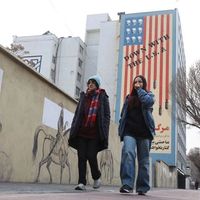
File photo: Iranians walk in Tehran as economic pressure deepens, with layoffs rising and job opportunities shrinking.
Iranians described layoffs, unpaid wages and rising food and medical costs in messages to Iran International, while labor market data and local media reports pointed to a widening employment shock after the ceasefire.
“We do not know how we can go on with these prices. Yesterday I bought two sausages. It cost 1 million rials,” one viewer told Iran International, an amount equal to about 60 cents.
The strain is deepening as Iran’s minimum wage has fallen below $90 and the rial continues to lose value, hitting a new low this week.
Another message said workers at a glass factory had still not received their March wages and that supplementary insurance had been cut.
Several citizens linked the deterioration to factory closures after the ceasefire, shortages of raw materials and rising rents.
“Since the ceasefire, most factories have shut down, especially in industrial estates. Everyone has become unemployed because of shortages of raw materials. Daily goods have become more expensive, deposits and rents have gone up, and medical and drug costs have soared,” one message said.
Service platforms absorb jobseekers
Shargh daily reported that new registrations on the home-services platform Achareh rose sharply in late April compared with the same period last year, especially in lower-barrier work such as cleaning and catering.
Registrations for cleaning and catering rose 239 percent from April 21 to May 2, while electrical work rose 220 percent, plumbing 176 percent, cooling services 150 percent, and building maintenance 140 percent, according to figures provided to Shargh.
File photo: Construction workers take a break at a site in Iran
Bahman Emam, the platform’s chief executive and co-founder, told Shargh that overall job registrations had risen 30 percent.
“We witnessed widespread layoffs this year, and it seems a significant share of applicants are seeking a first job,” Emam said.
Shargh also reported that some workers who had left the platform for traditional markets were seeking to return, while others who could no longer afford life in Tehran asked to activate their profiles in other cities.
Experts warn shock may endure
Ashkan Nezamabadi, an economic journalist in Berlin, told Iran International that Iran’s labor market had entered a dangerous phase.
“Only one of the two main job platforms in Iran announced a few days ago that it had 318,000 new job applications in one day, which was a new record,” Nezamabadi said.
He said new job opportunities had fallen by about 80 percent, while economic losses and internet disruptions added to the strain.
“These changes clearly show something is breaking in the labor market,” he said.
Government plans to issue loans worth 220 million rials (around $120) per worker were unlikely to prevent layoffs or create durable jobs, according to Nezamabadi.
He said assistance would be more effective if directed toward consumers to preserve demand, contrasting it with pandemic-era support programs in Europe and the United States.
Wages fall below subsistence costs
Iran’s Labor News Agency (ILNA) reported that the cost of a basic household livelihood basket had reached 713 million rials (about $385), up from 450 million rials (about $240) used in wage talks earlier this year.
Faramarz Tofighi, a labor activist who calculates livelihood costs, told ILNA that even the earlier estimate was not realistic and that wages did not reach 60 percent of it.
“That same unrealistic 450 million rial basket has today reached 713 million rials,” Tofighi said.
ILNA said the minimum wage including benefits had fallen to about $88 after the rial’s decline, leaving workers unable to cover rent and food.
Workers cited in the report said they were struggling to buy even bread and eggs, with meat and rice removed from many household shopping lists.
File photo: Seasonal workers wait for daily jobs in Tehran
Political fallout grows
Milad Rasaei-Manesh, a political activist based in Stockholm, linked the downturn to broader structural issues.
“Today the economy is effectively destroyed, and the war and policies pursued have led to widespread unemployment and deeper poverty,” Rasaei-Manesh told Iran International.
He said internet restrictions had compounded the crisis by cutting off income sources.
“Internet shutdowns have directly caused job losses and pushed more people into poverty,” he said.
He said economic pressures could drive coordinated protest action. "If workers organize through strikes and collective action, they can accelerate change,” he added.
The mounting evidence points to a labor market squeezed from both ends: more people seeking work, and fewer households able to pay for services.
Smoke rises in the Fujairah oil industry zone, caused by debris after interception of a drone by air defenses in Fujairah, United Arab Emirates, on March 14, 2026. (File photo)
India and Pakistan condemned on Tuesday Iran’s attacks on the United Arab Emirates, calling for restraint and a return to diplomacy.
Indian Prime Minister Narendra Modi said attacks that injured three Indian nationals were unacceptable, adding that targeting civilians and infrastructure must stop.
“India stands in firm solidarity with the UAE and reiterates its support for the peaceful resolution of all issues through dialogue and diplomacy,” he wrote on X.
Prime Minister Shehbaz Sharif also strongly condemned the attacks and expressed full solidarity with UAE President Mohammed bin Zayed in a post on X.
“Pakistan stands firmly with our Emirati brothers and sisters as well as with the Government of the United Arab Emirates at this difficult time,” he wrote.
He said it was essential that the ceasefire be upheld to allow space for diplomacy and called for dialogue to achieve lasting peace and stability in the region.
The United Arab Emirates came under attacks from Iran’s drones and missiles on Monday, causing a fire at the Fujairah Oil Industry Zone.
Abu Dhabi “condemned in the strongest terms the renewed terrorist, unprovoked Iranian attacks targeting civilian sites and facilities.”
People check the latest rates outside a currency exchange in Tehran, Iran, May 2, 2026
Iranian media are now openly discussing the war’s impact on livelihoods—a subject largely avoided until recently, when journalists resorted to indirect language to navigate censorship.
As a fragile ceasefire holds despite exchanges of fire near the Strait of Hormuz, concern has grown about the risk of unrest driven by soaring prices.
The pharmaceutical sector has been among the hardest hit, with some medicine prices reportedly rising nearly six-fold.
“We have a choice between no medicine or making it available at a high price,” Mahmoud Jamalian of parliament’s Health Committee said, according to Asr Iran.
Warnings have also begun to surface about how the state may respond.
Hardline analyst Mostafa Khoshcheshm said on state television that protests over rising prices could be treated as collaboration with foreign powers seeking to destabilize Iran—an indication of how quickly economic grievances could be securitized.
Moderate daily Sharq wrote that after damaging infrastructure, the war is now eroding economic relations and household livelihoods, adding that uncertainty surrounding the conflict is further weakening the economy.
Beyond prices, the disruption has spread across key sectors. Damage to infrastructure and prolonged internet restrictions have slowed or halted parts of the digital economy, while supply chains have come under strain, compounding pressure on businesses and households.
Economist Hossein Raghfar said the government’s handling of the crisis raises serious concerns, warning that continuing current policies will fuel public dissatisfaction.
He argued that frustration over economic conditions—visible during the January unrest—and the state’s inability to address it had weakened the country internally.
Raghfar criticized the use of scarce foreign currency on car imports and said authorities acted too late to halt exports of eggs, rice and meat to stabilize domestic prices.
“Unfortunately, the government is nowhere to be seen these days,” he said, contrasting the current response with the eight-year war with Iraq.
Asked about solutions, Raghfar said Iran still has the capacity to withstand sanctions but lacks the political will to use it. He called for investment in domestic production and urged reallocating funds to revive key sectors.
Another moderate daily, Etemad, reported that workers are emerging as the primary victims of the war and economic strain, with layoffs, unpaid wages and rising poverty becoming widespread.
In Fars Province, between 20 and 100 workers have reportedly been dismissed per workplace; in Rasht, at least 2,000 have lost their jobs in two months.
The Labor Ministry estimates the conflict has cost more than one million jobs, affecting up to two million people directly or indirectly.
Economist Vahid Shaghaghi-Shahri said chronic inflation, temporary contracts and a large informal labor market had already left workers highly vulnerable.
With war, recession and sanctions converging, he urged the government to prioritize “protecting livelihoods and preventing mass unemployment” as an urgent national priority.
An Iranian flag is seen at a nuclear facility in this undated file photo
US intelligence agencies assess that recent military action has caused only limited additional damage to Iran’s nuclear program, Reuters reported Monday, leaving Tehran’s potential timeline to produce a weapon largely unchanged.
The assessment suggests that while earlier strikes on key facilities set back Iran’s program by several months, more recent operations have not significantly extended that delay.
Officials said the program’s overall trajectory—measured in the time needed to accumulate sufficient material for a nuclear device—remains broadly intact.
The findings follow a series of strikes in June that President Donald Trump said had “obliterated” key elements of Iran’s nuclear infrastructure. US officials now say the impact, while real, appears to have been more limited than such claims suggested.
A key constraint, officials said, is Iran’s remaining stockpile of highly enriched uranium, much of it believed to be stored in hardened or undisclosed locations beyond the reach of conventional strikes. That material, combined with surviving technical capacity, has limited the overall effect of recent attacks.
The International Atomic Energy Agency has previously assessed that Iran retains enough enriched material for multiple nuclear devices, though access for inspectors has been restricted in recent months.
Iran has long maintained that its nuclear program is peaceful and that it has never sought to develop weapons, though some voices inside the country have suggested since the June war that Tehran should reconsider its stance.
The latest intelligence underscores a gap between the scale of military activity and its effect on Iran’s core nuclear capabilities, even as tensions between Washington and Tehran continue to escalate.
Trump has continued to frame the war’s central objective as preventing Iran from acquiring a nuclear weapon, saying in recent days that Tehran “cannot have” one.
He has also repeatedly argued that Iran must agree to a new deal, saying any agreement he secures would be stronger than the 2015 accord reached under President Barack Obama.
Talks and exchanges of proposals in Islamabad have failed to bridge the gap between US demands and Tehran’s insistence on its right to uranium enrichment.
Officials cautioned that the situation remains fluid and that further military action, sabotage or covert operations could still affect the program’s trajectory. But for now, they said, the most recent strikes appear to have had only a limited additional impact.
Iran's president Masoud Pezeshkian speaking at the parliament in this undated file photo
Exclusive information obtained by Iran International points to a growing clash between Iran’s President Masoud Pezeshkian and its military leadership over Monday’s escalation in the Persian Gulf and attacks on the United Arab Emirates.
According to sources familiar with Tehran’s deliberations, Pezeshkian has expressed strong anger at actions by the Islamic Revolutionary Guard Corps, led by Ahmad Vahidi, describing missile and drone strikes on the UAE as “completely irresponsible” and carried out without the government’s knowledge or coordination.
Pezeshkian is said to have described the IRGC’s approach to escalating tensions with regional countries as “madness,” warning of potentially irreversible consequences.
Amid a worsening situation and the risk of the country sliding back into war, Pezeshkian has requested an urgent meeting with Mojtaba Khamenei to press for an immediate halt to IRGC attacks on Gulf states and to prevent further escalation.
He is expected to argue that a narrow window remains to salvage the ceasefire through urgent diplomatic action, and that he should be allowed to signal to international mediators Tehran’s readiness to return to negotiations.
The tensions come as diplomatic efforts to preserve the ceasefire continue, but with a widening gap between military and political approaches inside Iran’s leadership.
At sea, accounts of recent developments remain sharply contested. US officials say commercial ships are continuing to transit and that Iranian threats have been contained.
The IRGC, however, has denied that any passage is taking place and warned that “violating vessels” would be stopped, while Iranian media reported that ships were forced to turn back.
President Donald Trump has stopped short of declaring the ceasefire breached, saying recent exchanges were “not heavy firing” and that “ships are moving.”
In Iran’s power structure, major security and military decisions are ultimately taken at the highest levels of the system and in coordination with key state bodies, underscoring the significance of the president’s request.
Sources close to the presidency, who shared the information with Iran International, say Pezeshkian is deeply concerned about potential international reactions and believes the country cannot withstand a new full-scale war.
He has warned that continued unilateral attacks could trigger heavy US retaliation against critical energy and economic infrastructure—an outcome he reportedly said could lead to widespread destruction and an irreversible collapse in livelihoods.
The political deadlock comes as some observers warn that divided command on the battlefield risks pushing the Islamic Republic toward what they describe as “military self-destruction.”
An Iranian soldier stands near military equipment at an undisclosed location, May 2026
Iran has paired a sharp escalation on the water with increasingly explicit threats, signaling what appears to be a deliberate move to deter further US attempts to reopen shipping through the Strait of Hormuz.
Missile and drone activity reported around the Strait and in the United Arab Emirates on Monday—alongside disputed encounters at sea—suggest Tehran is beginning to act on warnings it had issued only hours earlier.
But the more revealing shift may be in tone.
Iranian military and affiliated voices have moved quickly to frame the moment not as a clash, but as enforcement.
“The Strait of Hormuz is entirely under Iranian control,” a senior Iranian source said, according to Hezbollah-affiliated Al-Mayadeen. “The message to the American aggressors is: Advance, and you will be targeted.”
‘Asymmetric operations’
That message builds on earlier warnings from senior commanders that any transit not coordinated with Iranian forces could be treated as a threat.
Ali-Akbar Ahmadian, a member of Iran’s Defense Council, pushed the line further, warning that any US action targeting shipping or energy infrastructure would be met with the Islamic Republic’s “asymmetric operations.”
The statements point to a posture that is no longer simply declaratory, but increasingly operational, especially against the backdrop of state-linked rhetoric in the hours before the incidents..
One day before the reported attacks in the UAE, Iranian state television accused Abu Dhabi of involvement in strikes on Iran’s Siri and Lavan islands during the US-led war, claiming Emirati Mirage jets, Wing Loong drones and unmarked F-16s had taken part.
The claims—unverified but widely circulated in Iranian media—help set the stage for a narrative in which regional actors are treated not as bystanders but as participants, and therefore legitimate targets.
That framing was reinforced after the incidents. Regional authorities reported missile and drone launches toward the UAE, while Iranian media attributed damage at energy facilities in Fujairah to what it described as US “military adventurism,” denying any pre-planned Iranian attack.
‘Ships are moving’
At sea, accounts have diverged sharply but point to the same underlying reality: rising friction around attempts to move vessels through the Strait.
US officials said commercial ships had transited and that Iranian threats had been contained. Iran’s Revolutionary Guards, however, denied that any passage had taken place and warned that “violating vessels” would be stopped.
Iranian media reported that ships attempting to cross were forced to turn back, while Washington rejected claims that its naval forces had been pushed out of the area.
US President Donald Trump, for his part, stopped short of declaring the ceasefire violated.
“(It was) not heavy firing,” he said in a phone interview, adding that “ships are moving” and that reports of recent exchanges were still being assessed.
The combination of rhetoric, incidents and competing claims suggests Tehran is seeking to impose a new reality in the Strait—one in which access is conditional and enforced.
Political figures have echoed that direction, pointing to efforts to formalize new rules governing transit and warning that any US role in shaping maritime access would be treated as a violation of ceasefire terms.
For now, the message from Tehran appears consistent: movement through the Strait will not be uncontested, and any attempt to bypass Iranian control risks drawing a response.