• العربية
  • فارسی
Brand
  • Iran Insight
  • Politics
  • Economy
  • Analysis
  • Special Report
  • Opinion
  • Podcast
  • Iran Insight
  • Politics
  • Economy
  • Analysis
  • Special Report
  • Opinion
  • Podcast
  • Theme
  • Language
    • العربية
    • فارسی
  • Iran Insight
  • Politics
  • Economy
  • Analysis
  • Special Report
  • Opinion
  • Podcast
All rights reserved for Volant Media UK Limited
volant media logo

IRGC official says US warned of military action before talks

Feb 9, 2026, 18:52 GMT+0

A senior official in Iran’s Islamic Revolutionary Guard Corps said the United States warned Tehran it could face military action if it did not accept a set of conditions ahead of renewed diplomatic talks.

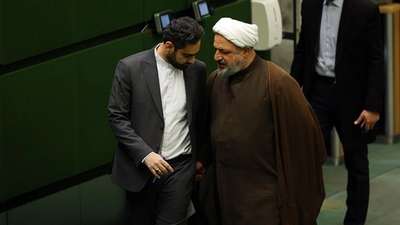
Islamic Revolutionary Guard Corps official Aziz Ghazanfari, a deputy head of the Guard’s political department, said Washington initially presented Iran with four demands that went beyond the nuclear issue when outlining a framework for diplomacy.

According to Ghazanfari, US officials insisted that any diplomatic path would require Iran to address its ballistic missile program, curb support for regional armed groups, and accept limits on uranium enrichment.

In a commentary published by Sobh-e Sadegh, a weekly outlet affiliated with the Revolutionary Guards, he said the message was accompanied by a warning that failure to accept the conditions would leave Iran vulnerable to military action.

Ghazanfari described the approach as “psychological warfare” aimed at pressuring Tehran ahead of indirect talks held in Muscat.

The indirect talks in Oman, which began on Friday through intermediaries, were described by both sides as preliminary.

Officials have said the discussions may continue this week, though neither Washington nor Tehran has publicly outlined a timetable or agenda beyond broad references to diplomacy.

The talks come as the United States has stepped up its military posture in the region. Washington has deployed the aircraft carrier USS Abraham Lincoln and accompanying naval assets to the Middle East, citing the need to deter escalation.

President Donald Trump has warned that “bad things could happen” if Iran does not reach a deal, while also saying he prefers a diplomatic outcome.

Ghazanfari said Iran rejected the US conditions outright and insisted that negotiations be limited to the nuclear file, asserting that Tehran’s position prevented Washington from setting the terms of engagement through threats or coercion.

He portrayed Tehran’s stance as a demonstration of resolve, arguing that refusing to negotiate under pressure reflected what he described as Iran’s “national strength.”

Most Viewed

The Hormuz get out of jail card turned to a grave
1
OPINION

The Hormuz get out of jail card turned to a grave

2

State media slam Araghchi's Hormuz tweet, say it let Trump claim victory

3
INSIGHT

How Tehran bends its own red lines to boost state rallies

4

Iran International says it won’t be silenced after London arson attack

5

US arrests Iranian national over alleged Basij-linked visa fraud

Banner
Banner

Spotlight

  • 100 days after carnage: Iran economy reels from war, inflation, unemployment
    INSIGHT

    100 days after carnage: Iran economy reels from war, inflation, unemployment

  • The Hormuz get out of jail card turned to a grave
    OPINION

    The Hormuz get out of jail card turned to a grave

  • Too early to tell who is winning Iran war, experts say
    PODCAST

    Too early to tell who is winning Iran war, experts say

  • How Tehran bends its own red lines to boost state rallies
    INSIGHT

    How Tehran bends its own red lines to boost state rallies

  • Iran blackout cripples freelancer, small business incomes
    VOICES FROM IRAN

    Iran blackout cripples freelancer, small business incomes

  • Ideology may be fading in Iran, but not in Kashmir's ‘Mini Iran'
    INSIGHT

    Ideology may be fading in Iran, but not in Kashmir's ‘Mini Iran'

•
•
•

More Stories

How images came to carry Iran’s protest dead

Feb 9, 2026, 17:43 GMT+0
•
Niloufar Goudarzi

Digital art and AI-generated images of protesters killed in Iran have flooded social media, turning victims of recent unrest into national icons.

While the identities of many remain unconfirmed, the stories behind these images have helped create a shared narrative for a public mourning thousands of deaths during just two days of crackdown on Jan. 8 and Jan. 9.

In the weeks since, artists have used technology to blend modern tragedy with Persian mythology. These digital tributes often place fallen protesters in settings reminiscent of the Shahnameh, Iran’s national epic, lending the dead a sense of timeless honor.

The firefighter

One of the most widely shared figures is Hamid Mahdavi, a firefighter from the northeastern city of Mashhad, who was killed on Jan. 8 after being shot in the throat.

Social media posts and witness accounts say Mahdavi spent his final hours carrying wounded protesters away from lines of security forces. Digital artists have reimagined him as a guardian figure.

Videos circulating online show a man carrying the injured, but activists say it is difficult to confirm with absolute certainty whether the person in the footage is Mahdavi. For those mourning, however, the image has become inseparable from his story.

The firefighter from Mashhad is now widely seen as a symbol of rescue.

“He was brave, kind and honorable,” one user wrote in Persian on Instagram, where Mahdavi had been active before his killing. “His memory will remain eternal.”

Another wrote: “I’ve watched this video a hundred times and I still cannot stop crying.”

The man as shield

In another story that has become central to the narrative of the January uprising, a man identified by social media users as Mohammad Jabbari, or “Mohammad Agha,” is reported to have died while protecting others.

In a video that has gone viral, a man is seen holding open a building door to let protesters inside for safety, then attempting to force it shut against advancing security agents.

According to activist accounts, agents shot the man at close range after forcing their way through. Digital artists now depict him as a literal shield, with some comparing the scene to moments from the Shahnameh.

While the man’s identity cannot be verified with certainty, the narrative of “the man at the door” has taken on powerful symbolic meaning as an act of self-sacrifice.

Social media comments reflect a deep emotional connection to the scene.

“One day we will see this statue standing in the heart of Tehran,” one person wrote. Others simply posted, “Hold the door,” a phrase that has become shorthand for the act shown in the footage.

“These symbols must be built in our Iran so that future generations remember their history,” another user commented.

Shared memory for the future

The use of AI and rapidly produced digital art has allowed Iranians to create a visual record in real time.

As the government restricts traditional media and periodically shuts down the internet, these images offer a way to preserve stories the state cannot easily erase.

“We do not know the names of everyone who fell,” one user wrote beneath a viral tribute. “But these images carry the meaning of what happened. They are the glue that holds our story together.”

By focusing on individuals like Mahdavi and the man at the door, the protest movement has moved beyond statistics. Even when identities remain unconfirmed, the images ensure that stories of resistance continue to circulate—inside Iran and beyond it.

France, Germany condemn Iran's prison sentence for Nobel laureate

Feb 9, 2026, 17:34 GMT+0

France and Germany on Monday condemned Iran’s latest prison sentence against Nobel Peace Prize laureate Narges Mohammadi, denouncing what they described as a continued effort by Tehran to silence one of the country’s most prominent human rights advocates.

In a statement issued on February 9, France said it had learned “with deep concern” of Mohammadi’s sentencing to seven and a half years in prison.

The French Foreign Ministry said the ruling showed that Iranian authorities had once again chosen “repression and intimidation,” disregarding the fundamental rights of the Iranian people.

“Through this conviction, the Iranian regime is once again choosing repression and intimidation, in contempt of the fundamental rights of the Iranian people, of which Narges Mohammadi is the tireless defender,” the statement said, calling for her immediate release.

Germany also reacted strongly, praising Mohammadi’s courage and condemning the new prison term.

“Narges Mohammadi, Nobel Peace Prize laureate from Iran, fearlessly stood up for human rights," Tobias Tunkel, the Director of the German Foreign Ministry's Middle East and North Africa Department said.

"The regime in Tehran sentenced her to another long prison term. We strongly condemn this attempt to silence her and all the other human rights defenders. It will not succeed,” he said.

Violent protest crackdown has been part of Iran-US talks, Vance says

Feb 9, 2026, 17:02 GMT+0

US Vice-President JD Vance said on Monday that Tehran's brutal crackdown on protesters has "already very much been part of the negotiations that we've had" and "I'm sure that will continue."

"We stand with the people of Iran. we stand with the right of peaceful protest across the world and certainly people who want to exercise that right in Iran," he added during a press conference in Yerevan, Armenia.

Asked about the US red lines in negotiations with Tehran, Vance said President Trump is "going to make the ultimate determination about where we draw the red lines in the negotiations."

"He doesn't announce what he's going to do in a negotiation because he thinks that it constrains him in private. He he's going to have a I think a lot of good conversations with his team and with others in the in the in the days and weeks to come."

US urges ships to avoid Iranian waters after Strait of Hormuz incident

Feb 9, 2026, 16:43 GMT+0

The United States said in a maritime advisory that American-flagged vessels should remain as far as possible from Iranian territorial waters while transiting the Strait of Hormuz, after a ship was harassed last week amid heightened tensions between Washington and Tehran.

"It is recommended that U.S.-flagged commercial vessels transiting these waters remain as far as possible from Iran’s territorial sea without compromising navigational safety," the US Transport Department's Maritime Administration said in its statement on Monday.

"When transiting eastbound in the Strait of Hormuz, it is recommended that vessels transit close to Oman’s territorial sea," it added.

"If Iranian forces seek to board a US-flagged commercial vessel navigating these waters, the vessel’s Master should, if the safety of the ship and crew would not be compromised, decline permission to board, noting that the vessel is proceeding in accordance with international law, as reflected in the Law of the Sea Convention," the statement said.

"If Iranian forces board a US-flagged commercial vessel, the crew should not forcibly resist the boarding party. Refraining from forcible resistance does not imply consent or agreement to that boarding."

Fluent in death: Tehran repeats 1988, at scale

Feb 9, 2026, 15:41 GMT+0
•
Lawdan Bazargan

The killings that swept Iran last month revived memories of 1988, when the Islamic Republic erased thousands of political prisoners in silence—my brother, Bijan, among them.

While the world may see in the staggering death toll of the January protests an unprecedented explosion of violence, those of us who have spent decades seeking justice see something else: the chilling continuity of a regime that has only ever known one way to survive.

For us, the massacre of thousands of unarmed protesters is not a breakdown of the system. It is the system functioning exactly as designed.

The parallels with 1988 are as deliberate as they are haunting.

Back then, the Islamic Republic imposed a total information blackout. Prison doors were bolted. Phone lines were cut. Family visits were suspended without explanation. Families were left in torturous limbo, wandering from prison gates to government offices, met only with silence or lies.

Months later, the truth emerged in the most brutal form: a bag of personal belongings handed to a father, an order not to mourn, and the realization that a loved one was gone.

Today, the regime replicates that silence through digital darkness—a nationwide internet shutdown. But the scale has shifted. In 1988, authorities could intimidate families one by one. They ordered us not to hold funerals, not to cry, not to tell our neighbors. They believed that by hiding the bodies, they could hide the crime.

In 2026, the numbers are too large for secrecy to hold. When the reported death toll reaches 30,000 in a single week, grief becomes a tidal wave no blackout can contain. Familiar tactics of intimidation—extorting “bullet fees,” abducting the wounded from hospital beds, desecrating graves—no longer work as intended.

In 1988, the regime hid its atrocities beneath the soil of Khavaran. In 2026, in an unimaginable cruelty, it staged its terror in the open.

Videos that surfaced despite the shutdown shattered the nation: hundreds of lifeless bodies sealed in black plastic, lined along sidewalks and outside gray buildings like discarded refuse. Families were forced to walk these endless rows, performing a sadistic ritual of identification.

In one widely shared clip, a father’s voice trembles as he searches, calling out, “Sepehr, my son—my Sepehr, where are you?”

For decades, the Mothers of Khavaran—mothers, fathers, siblings, and children—refused to surrender to silence. They were the first to turn grief into political defiance. They wore white to funerals and memorials, rejecting the regime’s imposed black, the color of official sorrow.

White declared innocence. White rejected the legitimacy of the executioners.

They clawed at the dirt of Khavaran with bare hands, searching for truth even as Revolutionary Guards beat them and trampled their flowers.

That spirit has not vanished. It has evolved.

What we see today—mothers dancing at their children’s graves, distributing sweets instead of halva, clapping instead of wailing—is not denial. It is defiance. It is a refusal to allow a theocracy that has weaponized martyrdom for nearly half a century to dictate how death is understood. As one mother put it, our hearts are broken, but our spirits will not bend.

In 1988, impunity—enabled by an international community eager to close the Iran-Iraq war through UN Resolution 598—convinced Tehran that mass murder was an effective tool of statecraft.

Iran in 2026 is different. The world is watching in real time. The “Nuremberg moment” long urged by human-rights lawyers is no longer aspirational. It is necessary.

My brother Bijan and the thousands murdered in the dark summer of 1988 were denied even the pretense of justice: no trials, no headstones, no place in official history.

The Islamic Republic believed it was burying bodies. It was planting seeds.

Those seeds have now erupted. The legacy of the fallen is not buried in the mute soil of Khavaran; it lives in every young Iranian who stands firm before gunfire. We are no longer merely archivists of the dead. We have come to demand accountability.

History has never wavered on this truth: no tyranny is eternal. Their gallows will not save them from the dawn.