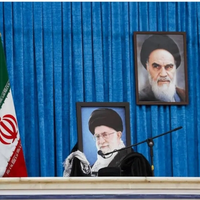
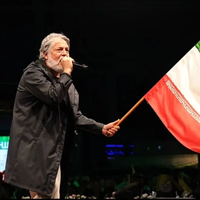
Kids holding Iranian flags in an event to commemorate those killed in Israeli airstrikes, Tehran, Iran, July 31, 2025
Calls for systemic reform and restructuring of Iran’s political and security institutions have intensified after a 12-day war with Israel in June, accompanied by some signs of change but also many signs of continuity.
The Supreme National Security Council (SNSC) is already undergoing structural changes, according to semi-official Fars News, which reported on Friday that former hardline ex-nuclear negotiator Ali Larijani could be appointed as the SNSC’s new chief.
The report also suggested that a new Defense Council may be formed to guide the country’s strategic defense agenda.
Larijani, a longtime conservative figure with moderate tendencies, was closely associated with former president Akbar Hashemi Rafsanjani—widely recognized as the architect of pragmatism in Iranian politics.
His return to a senior security role could signal a shift toward a more flexible approach to domestic and foreign policy, though his recent postwar remarks have closely aligned with Supreme Leader Ali Khamenei’s positions.
Establishment hints at change
Nour News, closely linked to the SNSC, also signaled these impending changes in a July 30 post. More notably, it criticized the state broadcaster for airing interviews with individuals hostile to Western values, warning that such programming “may even lead to undesirable outcomes.”
The call for reform—long associated with Iran’s reformist factions—is now being echoed by conservative figures, reflecting shifting perceptions within the political establishment. Some have warned that failure to adapt after the war could lead to public unrest and new security challenges.
Ayatollah Mohsen Gharavian, a lecturer at the Qom Seminary, said in a July 31 interview with Khabar Online that “the Islamic Republic must revise its mode of governance in light of the war.” He specifically urged an end to government pressure on Iranian women regarding compulsory hijab rules.
He also called for major reforms in both domestic and foreign policy, asserting that Iran’s leadership now recognizes “the tremendous power of patriotism” and is exploring ways to ease the pressure on the weary citizenry.
‘Making up with people’
Ali Akbar Velayati, a former foreign minister and senior advisor to Khamenei, likewise advocated “some social changes to meet public demands,” drawing harsh backlash from ultraconservative media outlets.
Amid rising pressure, President Massoud Pezeshkian withdrew a controversial bill he had previously submitted to parliament that would have further restricted media freedom and access to information.
The conservative daily Farhikhtegan published a July 31 commentary titled “The Next Steps After the War,” urging a deeper understanding of Iran’s sociopolitical conditions to better anticipate future challenges.
While acknowledging Iranian claims of victory, the commentary emphasized credible counterarguments and criticized state television’s complacency.
It called for an assessment of public resilience amid postwar challenges—including energy shortages and the potential return of UN sanctions—which the editorial warned could provoke industrial action or even widespread protests.
Iranian officials say Tehran could run out of water within weeks, but climatologist Dr. Nasser Karami tells Eye for Iran the crisis transcends drought and is a product of government mismanagement, militarized agriculture and deliberate manipulation.
Karami calls it an “engineered drought”—a manufactured emergency that lets authorities avoid long-overdue reforms while shifting the financial burden to citizens.
“There is water,” he said. “But it costs the government more to deliver it in the summer—so they shift the burden to the public instead.”
Only 20–30% of Iran’s water shortage, Karami argues, is due to climate change. The rest is policy-driven—and reversible.
But instead of investing in infrastructure or reforming water use, the government relies on fear to suppress demand, while consumer prices remain unchanged.
“If people reduce their consumption just a little, it saves the government a lot of money,” he explained. “The price they pay for water stays the same, but the state spends less.”
The consequences are devastating.
Across the country, families are going days without water. Residents are hoarding bottles, installing rooftop tanks and depending on tanker trucks—some of which deliver polluted or undrinkable supplies.
Satellite imagery obtained by Iran International shows Tehran’s main reservoirs—Amir Kabir, Lar, and Latyan—at historic lows, holding less than 10% of their usable capacity.
Meanwhile, the capital is literally sinking. Over-pumping aquifers has caused parts of Tehran to subside by more than 10 inches a year.
The crisis is fixable, Karami says, yet the system profits from public panic as ordinary Iranians are left to suffer.
“This is not the first time they’ve said Tehran would run out of water in two weeks,” Karami said. “And yet, the water keeps flowing.”
Beyond drought
"The solution is: you have to take part of the water from agriculture and give it to the people. That is very easy," Karami said.
Agriculture, he said, consumes more than 90% of Iran’s freshwater annually, yet contributes just 9-12% of GDP and employs only about 17% of the workforce. In contrast, households use just 4-5%, and industry only 1%.
Despite its relatively small economic footprint, agriculture’s massive water consumption places unsustainable pressure on Iran’s finite freshwater supplies.
But Karami says this isn’t conventional agriculture but in large part state-guided enterprise aimed at provisioning Iran's sprawling military.
"They’re using all water resources for agriculture to make enough food for the soldiers," he said.
Wells proliferation
The numbers tell the story: Iran’s cultivated land has more than doubled since 1979. Deep wells have exploded from 40,000 to over one million. Roughly 40% of agricultural water is wasted in transport or lost to outdated irrigation methods.
Karami says just a 5% cut in agricultural water use would free up enough water—4 to 5 billion cubic meters—to supply Iran’s entire urban population.
He believes efficiency is possible: through irrigation upgrades, reduced waste, and mechanizing half of Iran’s farmland. But he doubts the political will exists to pursue it.
“We’re the first in the world for soil erosion. First in desertification,” Karami warned.
"The main legacy of the Islamic Republic won’t just be executions or war. It will be this: environmental collapse."
Despite the scale of the suffering, Karami doubts the current crisis will trigger mass protests. He believes the authorities will likely resolve the immediate shortages in the coming weeks—just enough to defuse tension and avoid unrest.
Iran will reorganize its Supreme National Security Council under a conservative stalwart, state media reported on Friday, as Tehran grapples with fallout from a June war with Israel.
"With structural reforms in the Supreme National Security Council finalized, informed sources report the establishment of a new body called the 'Defense Council' — a strategic council tasked with overseeing national defense policies, whose structure is expected to be finalized soon," the Revolutionary Guard-affiliated Fars News reported on Friday.
Ali Larijani, a top advisor to Supreme Leader Ali Khamenei, is likely to be appointed as the new secretary of the Supreme National Security Council in the coming days, the report said.
Larijani would replace Ali Akbar Ahmadian who is expected to "take charge of several special and strategic national dossiers," the report said, calling them "high-level, forward-driving and strategic missions that require overarching coordination and management."
The Defense Council is considered part of the new governance framework in the defense and security sphere, Fars News said without providing further details.
The move elevates a stalwart conservative and personal confidant of Supreme Leader Ali Khamenei, in what may signal a redoubled conservative stance as Iran’s security and diplomatic challenges mount.
Ali Akbar Velayati, another senior adviser to Iran’s Supreme Leader, earlier suggested Iran may reconsider its restrictive social policies in the aftermath of the war with Israel in a remark seen by Tehran media as a rare official acknowledgement of public discontent.
“Maintaining national cohesion, as emphasized by the Supreme Leader, can include changing certain social approaches of the establishment and prioritizing public satisfaction in a way that is tangible for the people,” former foreign minister Velayati posted on X on July 21.
Two days later, prominent imprisoned political activist and ex-official Mostafa Tajzadeh issued a statement demanding Khamenei admit profound failures following a war with Israel and usher in fundamental change or else quit.
The leader of Iran's Green Movement Mir-Hossein Mousavi who has been under house arrest since 2011 has also called for a referendum on a constitutional assembly, arguing that the current political system ruling Iran does not represent all Iranian people.
“The bitter situation the country has faced is the result of a series of major mistakes,” Mousavi said in a statement published on July 11.
A billboard in central Tehran depicting the legendary Iranian figure, Rostam, fighting a seven-headed dragon, July 30, 2025
Allegations of a “shadow government” meddling in Iran’s foreign policy have reignited concerns about the country’s diplomatic direction, just as high-stakes nuclear talks with the West hang in the balance.
The term—now increasingly invoked in political discourse—refers to an unofficial power network believed to influence key decisions behind the scenes, beyond the authority of the Foreign Ministry.
In an unsigned commentary on Tuesday, the conservative Jomhouri Eslami newspaper accused the ministry of failing to assert control over foreign policy, blaming Tehran’s limited success on interference from shadow actors.
“Those whose heavy shadow over the 2015 nuclear deal and many negotiations caused irreparable damage continue to dictate terms in foreign policy, especially in the realm of negotiations,” it wrote.
The piece warned that such interference, “under the very sensitive current circumstances, is more dangerous than deadly poison.”
Jalili in the Crosshairs
Although no names were mentioned, Iranian media widely interpreted the remarks as targeting ultra-hardliner Saeed Jalili and his circle of allies in the Paydari Party.
Jalili, who lost the 2024 presidential election to Masoud Pezeshkian, previously served as Iran’s chief nuclear negotiator during the years leading up to 2010, when multiple rounds of UN sanctions were imposed on Tehran.
He remains a trusted figure for Supreme Leader Ali Khamenei, serving as his representative to the Supreme National Security Council and sitting on both the Strategic Council on Foreign Relations and the Expediency Discernment Council.
Saeed Jalili speaking to media
A day after the Jomhouri Eslami piece, the IRGC-affiliated Javan newspaper hit back.
“If this alleged shadow government truly exists, why doesn’t Jomhouri Eslami reveal its leaders and operators?” it asked. “And if the claim is entirely false, why doesn’t the public prosecutor step in? Is the reputation of the Islamic Republic to be handed out freely to whoever wishes to exploit it?”
Moderates are calling for serious diplomacy and a renewed effort to reach agreements with the US and Europe. Hardliners, meanwhile, accuse them of appeasement and advocate for a more confrontational approach.
With the return of UN sanctions looming under the nuclear deal’s snapback provision, Tehran has warned European governments it may pull out of the Non-Proliferation Treaty in retaliation—threatening a complete breakdown in diplomatic engagement.
Iran's Islamic Revolutionary Guards Corps (IRGC) on Wednesday issued a cryptic warning to Israel that the geography of Tehran's response to any future attack would shift and its arch-foe would face a punishing response.
"The geography of the response and the battlefield may change, and Iran's reactions will be more crushing than previously observed," state media outlet Mehr news cited the spokesman of the sprawling military organization as saying.
“If the Zionist regime launches a new attack on the powerful and resilient Iran, the initiative to end the conflict will be in our hands,’ Ali Mohammad Naeini said.
Israel's surprise 12-day military campaign against Iran last month killed hundreds of military personnel and civilians in air strikes and drone attacks. Missile salvos by Iran killed 28 Israeli civilians.
Iranian military leaders had made similar threats against Israel before the conflict, and official declarations of victory following the war have yet to substantively grapple with the lopsided toll and Tehran's intelligence lapses.
“We will not allow the sirens in the occupied territories to fall silent, and the enemy must not have the opportunity to leave its shelters,” Naeini said. “They will experience more fleeing and displacement than they did during the 12-day war.”
Iran's armed allies in the region have been degraded by nearly two years of Israeli attacks, but an Emirati news outlet reported on Wednesday that a top IRGC general traveled to Iraq to shore up support for Tehran-backed militias there.
Citing Iraqi political sources close to the Shi'ite-run political establishment, al-Ain al-Ekhbariya reported that the commander of the IRGC's elite Quds Force Esmail Qaani made an unannounced visit to Iran's neighbor.
The visit, the outlet said, involved meetings with senior Shi'ite political and militia leaders and aimed at shoring up unity and coordination as parliamentary elections loom.
Mysterious attacks hit Western-run oil facilities in Iraq's Kurdish region this month, in strikes blamed by local officials on Iran-backed militias. The sources cited by al-Ain al-Ekhbariya alleged Qaani described the events as not authorized by Tehran.
Following a US-brokered ceasefire on June 25, Israel and Iran have repeatedly exchanged threats.
Israel 'wiped off the face of the earth'
Iran’s interim chief of staff, Habibollah Sayyari, praised the Islamic Republic’s wartime performance on Wednesday, saying the conflict extended beyond just Israel.
“People must understand that we did not fight just one regime, we fought the world. That means we fought NATO, Europe and the United States. This is very important, yet we emerged from it with our heads held high,” Sayyari said.
Former IRGC chief Mohsen Rezaei added to the uptick of official military rhetoric on Wednesday, threatening to eradicate Israel.
“A day will come when great revenge and severe punishment will be carried out, and Israel will be wiped off the face of the earth forever,” Rezaei said on Wednesday.
A young woman with a carry on walks outside the University of Tehran, Iran, Undated
Tehran is once again urging Iranians abroad to return as part of its patriotic messaging after the war with Israel, but many remain deeply skeptical, citing years of repression, arrests and broken promises.
Last week, President Masoud Pezeshkian said Iranians living in other countries should be able to return without fear.
His culture minister, Reza Salehi Amiri, then appeared on state TV to hammer the message home: “This land belongs to you, and we are rolling out the red carpet."
Yet skepticism runs deep.
Returnees—especially dual nationals—have often been detained, interrogated, or sentenced on vague charges such as propaganda against the system or acting against national security.
‘Almost none stayed long’
“From (President Mohammad) Khatami in the late 1990s to Pezeshkian now, everyone has tried to woo expat professionals and people with financial resources to invest back in Iran,” Kamran, a 56-year-old who runs a family business in Tehran’s Grand Bazaar, told Iran International.
“I know a few who came back over the years, but almost none stayed long enough to invest.”
Kamran’s children live in Canada. He says he prefers they not return, even for short visits.
“They participated in every protest rally in Canada in recent years and have posted anti-government content online,” he explains. “That can get them into serious trouble. I won’t let them take any risks.”
Mitra, a housewife in Tehran, says her relatives avoid returning for the same reason.
“They meet their parents in countries like Turkey once or twice a year. It’s hard for their elderly parents, but they feel it’s better to be safe than sorry.”
New bill, old problems
There are an estimated 4 to 5 million Iranians living abroad—from Turkey and the United Arab Emirates to Australia, North America and nearly every country in Western Europe. Collectively, their wealth is believed to exceed one trillion dollars.
To tap into that potential, parliament is reviewing a bill titled Support for Iranians Abroad, proposing easier travel, expanded consular services, looser dual citizenship restrictions, and new academic and investment incentives.
“I don’t know what the government is thinking, asking diaspora Iranians to come back and invest. They must be fools to do so when neither their lives nor their money is safe,” said Mehdi, a 45-year-old artist in Tehran.
Other critics say the real obstacles are structural: deep corruption, cronyism and the dominance of security institutions over the economy.
“Diaspora Iranians don’t just listen to officials’ words—they watch their actions,” wrote former telecom minister Mohammad-Javad Azari-Jahromi on X. “Concrete reform of policies and procedures matters more than slogans.”
Social media activist Arash Ghaffari mocked the initiative given the country's ongoing water and electricity outages.
“The honorable President has invited Iranians abroad to return to their beloved homeland, overflowing with water and electricity in the summer, an abundance of gas in the winter, a land of stable prices, an economic paradise!” he posted on X.