An airport staff walks past wreckage of a destroyed plane at Sanaa International Airport, in the aftermath of an Israeli airstrike, in Sanaa, Yemen, May 7, 2025.
The surprise ceasefire between the United States and Yemen's Houthis this week underscored the unpredictability of diplomacy over Iran's nuclear talks as they head for crunch time over the weekend, experts told the Eye for Iran podcast.
The panel of Middle East specialists said the surprise deal mediated by Oman and announced by President Donald Trump highlights the US leader's maverick stances and Tehran's flexibility as it tries to clinch a deal to avoid war with Washington.
Iranian and US negotiators are due to meet in Muscat for a fourth round of talks on Sunday after Trump's special envoy Steve Witkoff rejected enrichment by Iran and for the first time mooted ending the talks if Tehran does not budge.
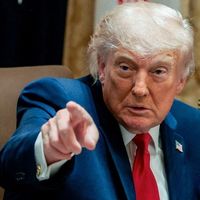
"Trump is totally unpredictable. Nobody knows what's going to happen with him the next day. This is something that is coming across all over the region," said Avi Melamed, a former Israeli intelligence official and current Mideast analyst.
Shock ideas like taking ownership of Gaza and the sudden end of American attacks on the Houthis keep friend and foe alike off balance, he added, and provide a moving target that may scramble any independent plans they have of their own.
"I don't know whether to even to call it policy but basically steps or measures that ... because they are so flexible, vague and unpredictable, create a dynamic that in a convoluted way could be sometimes constructively contributing to stability."
At the same time, according to Yemeni-American policy analyst Fatima Abo Alasrar, the Yemen truce likely signaled the influence of their Iranian backers over their armed proxies in the explosive region.
"It's an amazing strategy by Iran regime's officials to throw in something to show good faith and that they're serious, but also it shows power," said Abo Alasrar, a senior policy analyst at the Washington Center for Yemeni Studies.
"When you're able to stop your proxy... it shows how much power Tehran has in the region. This demonstrates to the US president, look at us, we can do this - we can turn this region upside down if we want to."
Wait and See
The truce between the theocratic guerrilla group and the populist president may prove fragile, and any breakdown between Tehran and Washington could inflame it anew.
"They are talking about nuclear agreement and a nuclear deal with Iran and that therefore Iran will make concessions, etc. And the Houthis maybe will be part of it," said Zineb Riboua, a research fellow at the Hudson Institute.
"It's more of a let's wait and see situation, precisely because a lot of these things are unpredictable."
Not just Washington's Houthi enemies but its Israeli allies seem not to be able to discern Trump's next move.
Israel pounded Yemen's main airport and several power plants the morning before Trump's truce announcement, escalating its military campaign just as their American backers ended theirs.
"This does suggest at least a certain amount of friction or a certain amount of uncoordination between the United States and Israel, at least when it comes to the policy towards the Houthis," said Gregory Brew, senior Iran analyst at Eurasia Group.
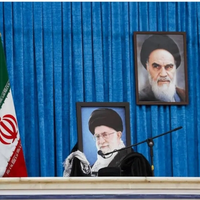
Iran’s Supreme Leader Ali Khamenei on Saturday endorsed chants of “Death to America” during a speech to workers, just a day before Iranian officials are set to resume nuclear negotiations with the United States.
“Your judgment is right,” Khamenei told the crowd after they chanted the slogan during a speech in Tehran.
“Americans fully support Israel — in the true sense of the word,” he added. “In the world of politics, things may be said that suggest otherwise, but that is not the reality.”
The remarks come as Tehran prepares to begin a fourth round of talks with the US on Sunday. Khamenei used the same platform to frame Israel’s campaign in Gaza as part of a broader Western war effort. “The people of Gaza are not facing Israel alone—they are facing America and Britain,” he said.
Hardline rhetoric extended into Iran’s state-aligned press. Kayhan, a daily overseen by Khamenei’s office, published a full-page commentary portraying Donald Trump as emblematic of US power.
“Trump is not a passing phenomenon,” the paper wrote. “He is a framework based on narcissism, superiority delusions, and threat-based tactics.” The editorial warned against mistaking diplomatic outreach for sincerity, calling American gestures “a tool for deception, not an indication of true boundaries.”
In Washington, Trump’s envoy to the talks set out maximalist conditions for a deal. “An enrichment program can never exist in the state of Iran ever again. That’s our red line,” Steve Witkoff told Breitbart News on Friday. “No enrichment. That means dismantlement.”
Witkoff said Iran’s nuclear sites in Natanz, Fordow, and Isfahan must be completely dismantled, and warned that if Sunday’s discussions are “not productive, then they won’t continue and we’ll have to take a different route.” He added, “They cannot have centrifuges, they cannot have anything that allows them to build a weapon.”
Russian President Vladimir Putin, Chinese President Xi Jinping, Tajik President Emomali Rahmon, Turkmen President Serdar Berdimuhamedov and Uzbek President Shavkat Mirziyoyev, attend a military parade on Victory Day, Moscow, Russia, May 9, 2025.
Iranian drones have fueled Russia's full-scale invasion of Ukraine as the two powers have drawn closer but the Islamic Republic's leaders were absent from the 80th anniversary Victory Day military parade in Moscow, drawing some criticism in Tehran.
Iran’s Islamic Republic newspaper on Saturday questioned the absence despite Tehran’s growing alignment with Moscow and ongoing coordination on nuclear talks with the United States.
“Despite Putin’s boasts of friendship with Iran, Iran was missing from the ceremony where he thanked North Korean soldiers for supporting Russia in the war against Ukraine,” the paper wrote, referring to the Friday parade in Moscow marking the Soviet and allied victory over Nazi Germany.
More than two dozen world leaders, including Chinese President Xi Jinping and North Korea’s top military officials, attended the event alongside Russian President Vladimir Putin.
Iranian President Masoud Pezeshkian did not attend, and no high-level Iranian delegation was publicly present. In February, Iran’s ambassador to Moscow, Kazem Jalali, told TASS he would attend the event in his diplomatic capacity, but said participation by senior Iranian officials was still under discussion.
Iranian-made drones
The parade, one of Russia’s most politically symbolic events, featured a display of drones used in Ukraine, including the Geran-2 — a loitering munition based on Iranian designs. Their inclusion underscored growing military cooperation between Moscow and Tehran, even as Iran denies supplying drones for battlefield use.
The absence of senior Iranian officials drew attention in Tehran, where Russia is regarded as a strategic partner and a channel for backdoor diplomacy. Both Iranian and US officials have been in contact with Russian intermediaries in recent weeks as indirect nuclear talks continue.
The Kremlin has also positioned itself as a go-between, with Moscow agreeing to help the US communicate with Iran on its nuclear program and regional activities, according to a Bloomberg report in March, later confirmed by the Kremlin.
Despite this, some Iranian officials and analysts are voicing concern. Former Iranian ambassador to Russia Nematollah Izadi warned that Russia “cannot be an impartial mediator,” citing its own geopolitical stakes in US–Iran tensions.
“They are eager to mediate, but whether they can do so effectively is doubtful,” he told ILNA news agency in March. “They have their own interests. If Iran fails to maintain balance, all its foreign policy eggs will end up in Russia’s basket—and most likely China’s as well.”
Russia and Iran recently signed a strategic cooperation agreement covering defense, energy, and trade. Yet, the Islamic Republic paper warned that appearances like Iran’s absence at the Victory Day parade risk making the partnership appear one-sided.
Iran's former defense minister and former national security chief Ali Shamkhani
Nearly two years after stepping down as the Secretary of Iran’s Supreme National Security Council (SNSC), Ali Shamkhani appears determined to maintain influence over Tehran’s evolving nuclear diplomacy.
The showy kingpin's sensitive interventions into the negotiations, through social media statements in his own name and high stakes leaks by his multi-lingual media outlet, signal he is determined to remain at the heart of diplomacy.
Though no longer officially at the helm of Iran's top security apparatus, Shamkhani retains considerable sway as a political adviser to Supreme Leader Ayatollah Ali Khamenei and a member of the Expediency Discernment Council.
His tenure as security chief ended in May 2023, but Nour News - the multilingual media outlet he founded in 2020 - ensured his public profile would continue to loom large.
Shamkhani and Tehran-Washington talks
Shamkhani’s comments are frequently picked up by Iranian and foreign media outlets, turning his posts into unofficial barometers of Tehran’s policy direction.
A prolific user of the social media platform X, Shamkhani regularly posts in a range of languages—Persian, English, Hebrew, Russian, and Chinese—indicating his wish to be recognized by international audience as an insider with close knowledge of the talks.
Ahead of the first round of indirect Tehran-Washington negotiations in Muscat last month, Shamkhani made headlines by declaring that Iran’s Foreign Minister Abbas Araghchi would attend the talks “with full authority.”
The phrasing, widely interpreted as confirmation that Araghchi was carrying a full mandate from Supreme Leader Khamenei himself, was seen as a rare public affirmation of Iran’s seriousness about reaching an agreement.
More recently, Shamkhani said that both the US intelligence community and the International Atomic Energy Agency (IAEA) had come to accept that Iran does not possess nuclear weapons.
“Both are determined to continue on the right path of talks,” he wrote in several languages, adding, “Sanction removal and recognition of Iran’s right to industrial enrichment can guarantee a deal.”
The tone of Shamkhani’s post suggested a softening of stance and marked a contrast between his earlier, more hardline tone and this new language suggesting diplomatic flexibility.
Shamkhani was among the officials who strongly supported a law that the Parliament passed in December 2020 against the wishes of then-president Hassan Rouhani--- named the Strategic Action Plan to Lift Sanctions and Protect the Nation's Interests.
The legislation required Iran’s Atomic Energy Organization to enrich uranium to 20 percent purity—well above the 3.67 percent limit set by the 2015 Joint Comprehensive Plan of Action (JCPOA)—and to install advanced centrifuges.
Nour News
Much of Shamkhani’s media influence flows through Nour News, a news outlet linked closely to his political network. Launched in Persian in early 2020 and later expanded into English, Arabic and Hebrew, Nour News plays an outsized role in shaping news on Iran’s nuclear talks.
The site frequently publishes exclusive reports on nuclear talks and other matters, often citing anonymous “informed sources.” These reports are widely shared by both domestic and international media, reinforcing the outlet’s reputation as a semi-official voice.
But the interventions have been less welcome at home.
Nour News cited an anonymous source saying the fourth round of talks would focus on “humanitarian and security concerns," without elaborating, suggesting discussions had expanded beyond the nuclear dossier—a detail never disclosed by negotiators.
“Agencies and esteemed officials who receive classified reports must protect them. Leaking information to favored outlets undermines national interests,” retorted Mohammad Hossein Ranjbaran, an adviser to Iran’s foreign minister Abbas Araghchi.
“There’s a difference between building media credibility and childish competition for scoops."
Skeletons in the closet
Shamkhani’s interventions could be aimed at repairing his stature after espionage and corruption controversies dented his reputation.
His departure from the SNSC in May 2023 came amid the fallout from one of the most sensitive espionage cases in the Islamic Republic’s recent history.
Akbari had long been known as a close associate and adviser to Shamkhani, raising questions about internal security breaches at the highest levels of the Iranian state.
Though authorities never directly linked Shamkhani to Akbari’s alleged espionage, the execution cast a pall over his continued leadership of the SNSC.
Shamkhani has also faced persistent allegations of corruption, particularly concerning his family's business dealings. These ventures have been linked to circumventing US sanctions by facilitating oil exports through so-called ghost fleets.
From left to right: Aaron Lobel, Jason Rezaian (front), Mehdi Parpanchi, Yeganeh Salehi, Marzia Hussaini, Samira Gharaei, Gelareh Hon, Arash Aalaei
Iran International received an award at the 12th annual America Abroad Media (AAM) Awards, in a ceremony held on Thursday in Washington DC.
The annual AAM Awards recognize "outstanding leaders whose work exemplifies the power of media to inform, educate, and empower."
Iran International was recognized for its efforts in bringing the voices of the Iranian people to a global audience and its commitment to accurate and transparent reporting.
This year’s recipients also included Dr. Mathias Döpfner, chairman and CEO of Axel Springer SE—parent company of Politico and Business Insider—and a board member at Netflix; Oscar-nominated Lebanese filmmaker Ziad Doueiri, known for The Insult and The Attack; and Moira Forbes, president and publisher of Forbes Women.
Republican Senator Dave McCormick, US presidential deputy special envoy to the Middle East Morgan Ortagus, French Ambassador Laurent Bili, Israeli Ambassador Yechiel Leiter, Egyptian Ambassador Motaz Zahran, and Azerbaijani Ambassador Khazar Ibrahim were among notable guests attending the event held at Fairmont hotel.
The AAM initiative celebrates those who contribute to media education, empowerment, and impactful storytelling, especially in challenging environments. The ceremony gathers diplomats, politicians, and cultural figures from around the world to highlight the importance of dialogue and press freedom.
Fox News senior White House correspondent Jacqui Heinrich (center) along with Iran International's Zoubin Navi (left), Gelareh Hon (second from left), Roxana Kheirkar (right) and Samira Gharaei.
Receiving the award, the executive editor of Iran International in Washington DC Mehdi Parpanchi said, “Iran International is right now the most-watched news channel among Iranians—inside the country and across the diaspora. And we are the only 24/7 newsroom fully dedicated to covering Iran."
“That’s not a technical setup—it’s a line of communication in the dark," he added.
On the sidelines of the ceremony, Parpanchi dedicated the award to the network’s audience and said a significant portion of the channel’s content is drawn from firsthand accounts sent by citizens across Iran.
In May 2024, Iran International was awarded with the 2024 Geneva Summit Courage Award for "fearlessly uncovering the daily abuses of the Islamic Republic of Iran."
A former senior Iranian government official appeared before Canada’s Immigration and Refugee Board on Thursday as part of Ottawa’s ongoing efforts to remove top-ranking figures associated with the Islamic Republic, Canadian media reported.
Afshin Pirnoon, a former director general in Iran’s Ministry of Roads and Urban Development, was brought before the board as the Canada Border Services Agency (CBSA) argued he should be deported due to his role in the Iranian government.
Pirnoon, 49, arrived in Canada in 2022 and has since worked as an Uber driver while seeking refugee status.
Photos published on Iranian government websites show Pirnoon attending official events and speaking at public meetings alongside political and religious leaders. He has denied holding decision-making authority and said his work as a road safety expert was aimed at saving lives.
“Whatever I’ve done in my life so far was to safeguard human beings’ lives,” Pirnoon said at the hearing, according to Global News. “Working for a government does not mean supporting it.”
The hearing is one of several under a 2022 Canadian policy aimed at barring or expelling former Iranian officials accused of rights abuses or ties to groups such as Hamas and Hezbollah. While immigration authorities have investigated dozens of individuals, only one deportation has been completed so far, with others leaving voluntarily.