US and Iran chief negotiators Steve Witkoff and Abbas Araghchi
Nuclear talks between Iran and the United States are faltering over whether Iran will be permitted to enrich Uranium and fluctuating US demands, two diplomatic sources in Tehran told Iran International.
Despite Tehran agreeing to expanded inspections by the International Atomic Energy Agency (IAEA), the dispute over enrichment has cast doubt over the timing and direction of the next round of negotiations, originally scheduled to resume this week after being delayed in Oman.
“Iran has accepted strict and intensive inspections by IAEA inspectors, and the two sides have reached an understanding on verification and control mechanisms,” an Iranian diplomatic source familiar with the talks said on condition of anonymity.
“The key disagreement is over Iran’s right to enrich uranium domestically—something the American side opposes,” the source said, adding that the US team's shifting goals were complicating the negotiations.
“In every round, the Americans bring up new topics—missiles, proxies—without a consistent framework.”
A second diplomatic source confirmed that Iran had agreed to restrain its regional allies, including by asking the Houthis to temporarily halt attacks, partly to deny Israel what he called a "pretext" to obstruct diplomacy.
US officials contacted by Iran International declined to comment on the specifics of the talks but acknowledged the urgency and fragility of the moment.
“Time is short and we need to make progress quickly. To make that happen, the Iranians need to negotiate in good faith and sincerely desire to reach a deal,” a State Department spokesperson told Iran International.
Internal Divisions in Tehran
Meanwhile Iran too has fissures of its own on the talks dossier, with hardliners continuing to criticize the talks but negotiators still appearing determined to clinch a fair deal to avoid war.
“There’s a difference between building media credibility and childish competition for scoops,” Mohammad Hossein Ranjbaran, an adviser to Iran’s foreign minister Abbas Araghchi, posted on X on Tuesday.
“Agencies and esteemed officials who receive classified reports must protect them. Leaking information to favored outlets undermines national interests,” he added, in an apparent reference to a report published the day before by Nour News, a site close to Supreme Leader Ali Khamenei’s adviser Ali Shamkhani.
The outlet cited an anonymous source saying the fourth round of talks would focus on “humanitarian and security concerns," without elaborating, suggesting that the negotiations had expanded beyond the nuclear dossier—something never mentioned by officials involved in the talks.
A diplomatic source told Iran International that unauthorized disclosures could undermine the Iranian negotiating team.
Women walk in front of new anti-US murals on the walls of the former US embassy in Tehran, Iran
Tehran and Washington are set for another round of talks this weekend, but early optimism has dampened amid deep mistrust and mutual threats of attack, making any deal unlikely to lead to a lasting peace.
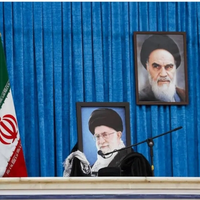
The most forthright caution, curiously, has come from Iran’s supreme leader Ali Khamenei, who—without referring to the current negotiations—reminded his hardline base that deals with foes are permissible if temporary.
The ultimate foe in Khamenei’s mind, of course, is America: presented more as an evil being than a country - the centerpiece of a narrative that manufactures, and is sustained by, hostility.
This narrative is, in many ways, reciprocated. Successive US administrations have portrayed Iran not just as a rival state, but the world’s leading sponsor of terrorism—a rogue actor bent on disrupting the global order.
Like Tehran’s view of America, this framing is not just rhetoric; it underpins policy, shapes alliances and narrows the space for diplomacy.
As talks resume, staunch anti-Americans in Iran warn against trusting “the Great Satan”, while the so-called hawks in the US decry any compromise with “the Mad Mullahs.”
Ingrained enmity
Despite gestures suggesting de-escalation—like the quiet removal of American flags from Iranian street protests—the hostile rhetoric has not faded. That’s because the tension is embedded not just in language, but in military posture.
The Trump administration has deployed two new warships to the region and deepened defense ties with Israel and Iran’s Arab neighbors.
Meanwhile the Iran-backed Houthis in Yemen managed to strike deep into Israel with a ballistic missile landing near its main airport on Saturday.
Both sides are redrawing lines of confrontation. Diplomacy is conducted under a constant shadow of war.
"I’m issuing a serious warning: if you make one wrong move, we will open up the gates of hell on you," Islamic Revolutionary Guard Corps chief Hossein Salami said on Thursday, referring to the United States and Israel.
"Sit down and stay in your place ... we have made extensive preparations."
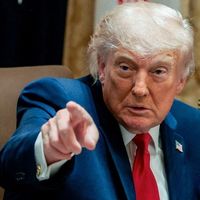
The US government is not far off in tone. President Trump has framed the talks as a binary choice: agreement or war. “There are only two alternatives there," he told a conservative podcast on Wednesday. "Blow them up nicely or blow them up viciously."
Israel’s open threats to strike Iranian nuclear facilities and its insistence on the right to preemptive action only heighten the pressure.
In this climate, negotiations serve less to resolve conflict than to manage it. As long as each side sees the other as an irredeemable enemy—and enters talks prepared for battle—diplomacy becomes an extension of confrontation by other means.
Khamenei’s message about temporary deals may have been cryptic. But it had a clear implication: that diplomacy is a tool for crisis management, not conflict resolution.
Tehran and Washington may speak of de-escalation, but their dominant narratives remain unchanged—and the structures that sustain enmity show no signs of retreat.
Seen in this light, the ongoing talks appear to be more of a phase in a familiar cycle than an auspicious breakthrough.
Even if a deal is reached, without structural change, the hostility will likely endure—and should it unravel, military confrontation may appear a legitimate course more then ever.
Image of an oil refinery published on Xinhai Holdings website
The United States on Tuesday imposed fresh sanctions on another Chinese refinery and multiple logistics firms for facilitating the sale and shipment of Iranian oil, expanding its efforts to squeeze Tehran’s revenues.
The measure targets Hebei Xinhai Chemical Group Co., an independent refinery Washington asserts has received hundreds of millions of dollars’ worth of Iranian crude, some linked to the Islamic Revolutionary Guard Corps (IRGC).
Three Chinese port operators in Shandong province were also sanctioned for managing terminals that received sanctioned shipments from Iran’s shadow fleet, vessels used to hide the origin of shipments.
“The United States remains resolved to intensify pressure on all elements of Iran’s oil supply chain to prevent the regime from generating revenue to further its destabilizing agenda,” treasury secretary Scott Bessent said in a statement released on the website of the treasury's Office of Foreign Assets Control (OFAC).
Seven vessels and the companies that own them were also sanctioned, according to OFAC citing their role in transferring Iranian petroleum to China. Among those were tankers flagged in Panama and Hong Kong.
Two Indian ship captains were also designated for years-long involvement in steering sanctioned tankers carrying Iranian oil, the US treasury said.
The sanctions fall under executive orders by US president Donald Trump as part of his so-called maximum pressure campaign on Iran alongside the ongoing diplomatic push to resolve the standoff with Tehran over its nuclear program.
"We're trying to work on Iran to get that solved without having to get into any bombing," Trump said in his latest statement on Iran on Thursday.
"As we say, big bombing. I don't want to do that. I want them to be very successful," he added.
Iran announced the completion of major maintenance and refueling at its Bushehr nuclear power plant this week, preparing the country’s only operational nuclear facility to meet peak summer electricity demand.
The announcement comes as Tehran accelerates work on two new reactor units at the site and reiterates its long-term commitment to nuclear energy amid stalling US nuclear talks.
The head of the Bushehr nuclear power plant, Reza Banazadeh, said the 1,000-megawatt (MW) facility is now fully prepared to contribute to the national grid during the hottest months of the year.
Daily electricity consumption in Iran can vary, with peaks reaching over 72,000 MW, exceeding the actual power generation capacity of 60,000 MW during the summer.
Since its commissioning, the plant has generated more than 72 billion kilowatt-hours of electricity, equivalent to saving over 110 million barrels of oil, Banazadeh said in an interview with Iranian state media.
"Nuclear energy is one of the safest, cleanest, and most cost-effective sources of power,” Banazadeh said, adding the plant avoids burning fossil fuels and thereby prevents the emission of an estimated 7 million tons of greenhouse gases annually.
Bushehr, Iran’s first commercial nuclear facility, sits on the Persian Gulf and is central to the country’s broader nuclear ambitions.
Mohammad Eslami, head of the Atomic Energy Organization of Iran (AEOI), said earlier this year that 5,000 workers are involved in the construction of Units 2 and 3, which are expected to triple the plant’s output when completed.
“Our aim is to increase nuclear power capacity to 20,000 megawatts by 2041,” Banazadeh said, adding that new projects across the country will help meet rising energy demands and reduce reliance on fossil fuels.
While Iranian officials highlight the civilian and environmental benefits of nuclear energy, the program remains under international scrutiny amid concerns about its potential military dimensions.
Tehran maintains its program is peaceful and conducted under the oversight of the International Atomic Energy Agency (IAEA) despite the restrictions that Tehran has put on the agency’s activities such as expelling inspectors and reducing monitoring equipment.
Iranian President Masoud Pezeshkian during a visit to `Bushehr Nuclear Plant (February 2025)
Tensions around Iran's nuclear facilities resurfaced in recent months, with Israel and the US warning of potential military action. During a February visit to Bushehr, Iranian President Masoud Pezeshkian warned: “If they strike a hundred [nuclear sites], we will build a thousand more ... They can hit the buildings, but they cannot erase the minds of our scientists.”
US President Donald Trump, in a Fox News interview, said he would prefer a diplomatic solution to prevent Iran from acquiring nuclear weapons but acknowledged concerns over possible Israeli military action.
Iran's air force commander Hamid Vahedi said that the country’s defense posture is deterrent but warned of “forceful” retaliation if attacked.
Despite geopolitical strains, Iran’s nuclear chief Eslami highlighted the use of domestically manufactured equipment and engineering milestones in the Bushehr expansion, including 34,000 rod injections to stabilize the reactors’ foundations and a record 22,000 cubic meters of concrete poured in a single day.
The AEOI aims to increase this figure to 65,000 cubic meters daily next year, showing Iran’s intent to push ahead with nuclear infrastructure development.
The IAEA has not yet commented on the latest developments at Bushehr.
Iran's cooperation with the IAEA remains central to international efforts monitoring and constraining its nuclear program under a potential new deal, with the next round of indirect Iran-US negotiations scheduled for this weekend.
Despite a new law targeting the illegal arms trade, Iran’s underground gun market continues to thrive on encrypted Telegram channels where vendors openly offer firearms ranging from pistols to Kalashnikov rifles.
The updated legislation, signed into effect on Tuesday by President Masoud Pezeshkian, imposes harsher sentences for unlicensed gun possession and criminalizes the use of digital platforms to promote or sell weapons.
But Telegram remains awash in posts advertising weapons for prices between 200 million and 1.8 billion rials—roughly $240 to $2,200 at the current exchange rate of 820,000 rials per US dollar.
Telegram channels in Iran are openly advertising firearms for sale
In one 17,000-member channel, a vendor offered a Glock 17 pistol for 280 million rials ($340), a Makarov for 240 million ($290), and a Turkish-made Colt .45 for 360 million ($440). For higher-end buyers, a Kalashnikov was listed at 1.7 billion rials ($2,070), including a video showing it wrapped in cloth beside two full magazines.
“Payment is in Tether,” said one seller when contacted anonymously via Telegram, referring to a cryptocurrency. “Once confirmed, you’ll receive a location—usually a locker in a shopping mall. You have two hours to retrieve it.”
An image from social media advertising guns for sale in Iran
Posing as a buyer we messaged five sellers across different channels. All insisted on cryptocurrency, none offered verification and two responded with identical language and price lists—raising doubts about authenticity.
But sources in Tehran familiar with the illicit trade said the market is not entirely fake. “There are scams, yes,” one source said. “But there are many real vendors. People share experiences, and some of these sellers have been delivering for years.”
Iran’s newly amended firearms law significantly broadens the scope of punishable offenses. Beyond illegal possession, it targets sellers, repairers and those who promote or advertise firearms online.
Penalties range from three to fifteen years in prison depending on the type of weapon, with automatic firearms, heavy arms, and military-grade munitions drawing the harshest sentences.
A clause in the law also authorizes authorities to seize properties, vehicles, or storage facilities used in connection with arms crimes.
According to the text, any digital promotion, sale, or training activity linked to firearms is subject to prosecution.
The law also tightens control over airguns, mandating that those in possession of PCP rifles over 40 joules must surrender them within three months or face penalties equivalent to those for illegal hunting rifles. Owners of PCPs under the threshold must apply for a license.
Still, on Telegram, enforcement appears limited. Sellers openly post weapons and use emojis of guns, bombs, and fire to attract attention.
Sources say these weapons are often smuggled in from Turkey, Iraq, or via the Persian Gulf and may be resold multiple times through local intermediaries. “The dealers who actually deliver have networks,” said a source in Tehran. “They use trusted people. Some even have police protection.”
Iran’s black market extends far beyond guns. Unlicensed alcohol, sex work under the guise of massage services, and a growing narcotics scene—from cocaine to synthetic pills—share the same digital infrastructure, relying on anonymity, encrypted platforms, and rapid logistics.
While authorities promise firm implementation of the new law, Telegram channels remain easy to find and quick to rebrand. For buyers, the market is a gamble. But according to those familiar with Tehran’s illicit economy, enough vendors deliver to keep demand alive.
US Vice President JD Vance participates in a discussion at a Munich Security Conference event in Washington, DC, May 7, 2025.
US Vice President J.D. Vance said on Wednesday that Iran must not be allowed to enrich uranium to levels that would enable it to develop nuclear weapons—remarks that may be seen as an apparent nod to Iran’s insistence on maintaining low-level enrichment.
"They can have civil nuclear power. OK, we don't mind that, but... no one right now has a civil nuclear program with their entire enrichment infrastructure that can enrich to the 90-plus percent needed to get to fissile material and a nuclear weapon," Vance said at the Munich Security Conference in Washington DC.
Vance said the Trump administration has no problem with Iran having nuclear power.
"We're fine with that. But you can't have the kind of enrichment program that allows you to get to a nuclear weapon, and that's where we draw the line," he said.
The United States and Iran appear to be on a collision course over whether Tehran should be allowed to enrich uranium in any nuclear deal between the two arch-foes, potentially endangering talks headed for a fourth round this weekend.
Last month, US Secretary of State Marco Rubio said "there’s a pathway to a civil, peaceful nuclear program if they want one, but if they insist on enriching, then they will be the only country in the world that doesn’t have a 'weapons program,' quote-unquote, but is enriching. And so I think that’s problematic."
The UN nuclear watchdog said last month that Iran is only non-nuclear armed state enriching uranium to 60%. Several countries which do not possess nuclear weapons, including Japan, Brazil, Germany and the Netherlands, enrich uranium at lower levels.
In his Wednesday remarks, Vance said his country is seeking a deal with Iran that would not only completely eliminate the possibility of it acquiring a nuclear weapon but also pave the way for Tehran’s return to the global economy.
"We think that there is a deal here that would reintegrate Iran into the global economy. That would be really good for the Iranian people, but would result in the complete cessation of any chance that they could get a nuclear weapon,"
"That's what we're negotiating towards."
Vance said the Trump administration has been "very happy by how the Iranians have responded to some of the points that we have made" in the Omani-mediated talks.
"Without prejudging the negotiations, I will say so far so good... We've been very happy that some of the intermediaries and some of the folks who are in the room, the role that they've played, the Omanis in particular, have played a very positive role, and we're very grateful to that."
He said "so far we're on the right pathway. But this is going to end somewhere. And it will end either in Iran eliminating their nuclear program, their nuclear weapons program."