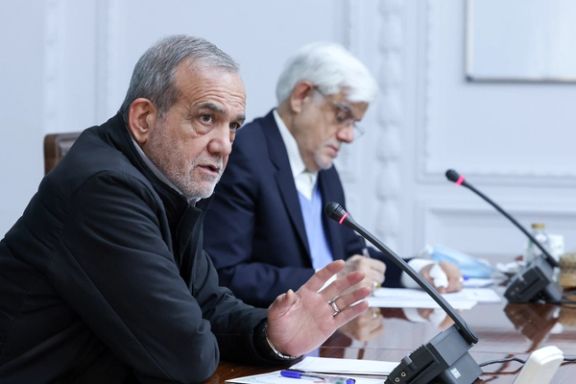
Iran's President Masoud Pezeshkian speaking at a cabinet meeting
Iran's president and parliament speaker once again acknowledged that the country is facing a severe economic crisis, with people under "immense" inflationary pressure, with no relief from sanctions in sight.
Speaking at a February 3 meeting of top state officials, led by the heads of the three branches of government, President Masoud Pezeshkian said his government is three months behind on some employee payments, while security forces arrest those who protest the delays in the streets.
"We owe them the money, and it is our responsibility to pay them," Pezeshkian said, adding that the government has to solve the people's problems. He further urged everyone at the meeting "to avoid angering the people."
He said some foreign officials continue to claim that "Iran has been badly weakened and protests are imminent," accusing foreign governments of seeking to exploit public unrest.
Pezeshkian noted that "nearly half of eligible voters did not participate in the latest presidential election, but we are still responsible for serving and addressing the demands of all citizens, including those who did not vote." He acknowledged that while the government aims to serve the people, "they are not satisfied with the way we work," according to Aftab News.
At the same time, Mohammad Hashemi, an influential centrist politician, pointed out that only Supreme Leader Ali Khamenei can authorize Iranian officials to negotiate with the United States to reach a deal on reducing sanctions.
Meanwhile, Iran's state-run news channel aired remarks from both President Masoud Pezeshkian and Parliament (Majles) Speaker Mohammad Ghalibaf, in which they said they "regret that the people are facing so many financial difficulties." However, some Iranian media outlets, including the state-owned ISNA news agency, only reported portions of their speeches that omitted references to the country's dire economic situation.
Politicians outside the government, including former lawmaker Ali Motahari also echoed Ghalibaf's comment about the dire situation of the economy.
The conservative website Nameh News quoted Pezeshkian as saying at the meeting, "We are duty-bound to solve the people's problems, and if we cannot, we must apologize. Instead, when we fail to pay our debts to them, we mistreat them and send them to jail. These people have worked hard and simply want to be paid for their labor. At the very least, we should speak to them with respect and ask for more time to fulfill our obligations."
Nameh News also quoted Pezeshkian as saying, "Iran's economic situation is unacceptable. Prices are high, people are under pressure, and we cannot fully resolve the crisis, as part of the solution is beyond our control."
Pezeshkian was likely referring to the fact that only Khamenei can authorize negotiations with the United States as a possible step toward addressing Iran's economic problems. The way the heads of the government's branches spoke about the issue on state TV suggests they were making a similar point, possibly attempting to persuade Khamenei to soften his stance on negotiations.
In an interview with the centrist daily Arman Melli, Mohammad Hashemi, a former chief of state television, emphasized that "negotiations with the United States are important for Iran, and only Khamenei, as Supreme Leader, can authorize Iranian officials to participate." He added that "the views of hardliners influenced by the ultraconservative Paydary Party will not determine the fate of the negotiations."
Meanwhile, Iranian media quoted a deputy intelligence minister as saying, "Iran will not negotiate with the United States, as those seeking talks want Iran to retreat from its positions or passively witness the collapse of its political system."
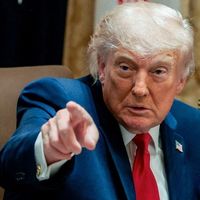
US President Donald Trump speaks as he signs documents in the Oval Office at the White House in Washington, US February 4, 2025.
US President Donald Trump on Tuesday signed a directive restoring the so-called maximum pressure policy on Iran of his first term and warned of "catastrophic" consequences if Tehran does not make a deal on its nuclear program.
Trump said he hoped for an agreement denying Iran nuclear weapons "so that it doesn't end up in a very catastrophic situation," but sounded a dovish note by saying he was prepared to speak with his Iranian counterpart.
"I really want to see peace, and I hope that we're able to do that. They cannot have a nuclear weapon," he told reporters at a press conference alongside Israeli Prime Minister Benjamin Netanyahu in the White House.
"It's very simple. I'm not putting restrictions. They cannot have one thing. They cannot have a nuclear weapon," Trump said.
Iran has denied seeking a nuclear weapon, but Israel has long contended Tehran wants a bomb and that its arch-enemy poses an existential threat.
In withdrawing the United States from a 2015 international nuclear deal in his first term, the Trump administration cited not only its alleged inability to curb Iran's quest for a bomb but also the deal's failure to address Iran's missile program or support for armed allies in the region.
Trump added that if he believed Iran was going to possess a nuclear bomb, that would be "very unfortunate" for Tehran.
"If, on the other hand, they can convince us that they won't, and I hope they can ... it's actually very easy to do, I think they're going to have an unbelievable future."
Iran Directive
Trump earlier in the day signed a directive reviving the maximum pressure policy aimed at driving the Islamic Republic's oil exports to zero.
"This is one that I'm torn about," Trump told reporters in the Oval Office. "Everybody wants me sign it. I'll do that. It's very tough on Iran," he said.
Asked if he would engage in conversations with his Iranian counterpart, Trump responded, "I would." It was not clear whom he meant.
Iran was "too close" to being able to acquire a bomb, Trump added, saying the US has the right to block Iran's oil sales to other nations and threatened Iran with "total obliteration" should they seek to kill him in retaliation.
US law enforcement last year accused Iran of seeking Trump's assassination as retaliation for his order to kill top Iranian commander Qassem Soleimani in 2020.
Trump said he hoped he would not have to follow through on the memorandum.
"Hopefully we're not going to have to use it very much. We will see whether or not we can arrange or work out a deal with Iran and everybody can live together."
Speaking before his White House meeting with Netanyahu, Trump said his predecessor Joe Biden allowed Iran to grow stronger and richer.
"They're not weak. They're very strong right now," he said.
Netanyahu praised Trump for the renewed pressure on Iran, his original decision to pull out of the nuclear deal and helping midwife a Gaza ceasefire deal freeing some Israeli hostages.
Israeli military blows over the course of a 15-month war with Iran and its armed allies, he told the news conference, had weakened the Islamic Republic.
"Israel has never been stronger and the Iran terror axis has never been weaker," he said.
'Malign influence,' snapback
The directive instructs the US Treasury to enforce sanctions and compliance measures against entities that breach current restrictions, Reuters reported earlier on Tuesday citing a US official.
Trump's policy on Iran will be aimed at denying Washington's Mideast nemesis all paths to a nuclear weapon and countering Iran's "malign influence," the official was quoted as saying.
Secretary of State Marco Rubio will also adjust or retract sanctions waivers, working with the Treasury to reduce Iranian oil exports to zero, the official added.
The US ambassador to the United Nations will work with allies to "complete the snapback of international sanctions and restrictions on Iran," the official said.
Snapback refers to the restoration of UN sanctionson Iran which were lifted by a 2015 international deal over Iran's nuclear program, which would likely need to be activated by European parties to the agreement after the US withdrew in 2018.
Trump's maximum pressure approach in his first term beginning in 2018 pummeled Iran's economy, causing a dramatic decline in oil exports and skyrocketing inflation.
In response, Tehran began to taper its adherence to the nuclear deal and ramped up military involvement in the region. During his first term, Trump also ordered the assassination of top Iranian commander Qassem Soleimani in a drone strike in 2020, depriving Iran of its wiliest military operator in the region.
Israeli Prime Minister Benjamin Netanyahu is due to meet Trump in Washington on Tuesday, and their strategy on Iran and its nuclear program is due to loom large.
Over 15 months of punishing military blows by Israel against Iran and its armed Mideast allies has weakened the so-called Axis of Resistance Tehran leads.
Trump said last month that he hoped a deal over Iran's nuclear program would mean the United States did not have to support an Israeli attack on Iran.
Long opposed to foreign wars, Trump has nevertheless adopted a hard line on Iran, saying that Iran cannot be allowed to have a nuclear weapon but also maintaining that Washington should not pursue regime change.
Secretary of Iran’s Supreme National Security Council Ali Akbar Ahmadian
Secretary of Iran’s Supreme National Security Council has suggested that negotiations with those deemed infidels are possible, but only under the guiding principle of resistance against the demands of adversaries through non-violent means.
Ali Akbar Ahmadian argued on Tuesday that dialogue and resistance are not mutually exclusive, leaving unclear whether he was referring to the contentious issue of possible talks with the United States.
"It is even possible to negotiate with infidels," he said, "but based on what principle? It is possible to negotiate based on the principle of resistance."
He emphasized that resistance forms the foundation for understanding the Islamic concept of jihad (struggle) in its various forms.
Citing a Quranic verse, he explained that the greatest jihad involves not blindly accepting the words of adversaries.
He clarified that "not obeying" does not necessarily translate to physical conflict, but rather signifies not uncritically accepting opposing viewpoints.
Over the past three months, calls for negotiations with Washington have grown in Iran as Tehran officials and commentators worry that US President Donald Trump may escalate economic sanctions. In recent weeks, former Foreign Minister and current aide to President Pezeshkian, Mohammad Javad Zarif, has come under increasing attacks by hardliners who accuse him of proposing negotiations with the Trump administration.
Emphasizing the need for careful judgment, Ahmadian suggested that listening to adversaries' arguments is acceptable only when they align with one’s own principles. He warned against misguided compromises, stressing the importance of standing firm when necessary.
Ahmadian's remarks echoed those of Supreme Leader Ali Khamenei in late January, when he implicitly endorsed negotiations but firmly warned officials to uphold Iran's positions.
Without elaborating, he highlighted the role of reason in choosing the lesser of two harms and the greater of two benefits.
Iran's ruler Ali Khamenei during his recent speech, with President Masoud Pezeshkian next to him. January 2025
A prominent conservative commentator in Iran says that Supreme Leader Ali Khamenei's implicit remark about "making a deal" with the United States signals a shift in approach as Tehran faces growing challenges.
However, Mohammad Mohajeri, the former editor of the hardline daily Kayhan, also noted that Khamenei's remark is likely to provoke backlash from hardliners and those cautious about a potential rapprochement with Washington.
In an interview with the Jamaran News website, which is linked to former President Mohammad Khatami of the reformist faction, Mohajeri noted that Khamenei's use of the term "making a deal" suggests the possibility of an agreement. He argued that this could signal support for President Masoud Pezeshkian's efforts to push for sanctions relief.
"It won’t be easy and will take time," Mohajeri added. "Nonetheless, the statement could mark the beginning of a new strategy."
According to Jamaran, Mohajeri was referring to a sentence in Khamenei's latest speech on January 28 this year, in which he said: "Behind the smiles of diplomacy, there are always hidden and malicious enmities and resentments. We must open our eyes and be careful with whom we are dealing, trading, and talking."
“When a person knows his opponent, he may make a deal, but he knows what to do," Khamenei added.
Khamenei made these remarks while sitting beside President Masoud Pezeshkian, who has publicly expressed Tehran's openness to talks. The media widely interpreted the Supreme Leader's statements as a "green light for negotiations."
Asked if Khamenei's statement indicated a green light for starting the talks, Mohajeri said: "I do not like that expression. However, I believe this highlighted a new strategy." He added, "It was interesting that while the hardliners expected Khamenei to endorse their views, he did not express any opposition to negotiations though he warned officials to be wary of the enemy's deceit."
Mohajeri said Khamenei’s remarks angered hardliners, who may remain silent for now but will soon find another pretext to attack the government. "Before long, you’ll see them lashing out over other issues," he said, adding that they may also target negotiators, including Foreign Minister Abbas Araghchi, who is set to lead the talks.
In recent weeks, former Foreign Minister and current aide to President Pezeshkian, Javad Zarif, has come under increasing attack, with hardliners accusing him of proposing negotiations with the Trump administration.
Zarif, however, denied the claim, telling Jamaran News, "We did not make any proposal. We simply responded to their suggestion for interaction."
While reformist-aligned media have strongly defended Zarif, some analysts in Tehran suggest that his position within the government is not particularly strong.
Some conservative figures in Iran, including former state TV chief and Tourism Minister Ezzatollah Zarghami, have also weighed in on recent calls for talks with the US.
While Zarghami had told Iranian media that such proposals had created a "bipolar situation" in the country, he wrote in an X post after Khamenei's remarks that "the Leader’s clever measure put an end to the bipolar situation between supporters and opponents of negotiations with the United States."
Former political Bijan Kazemi arrested and imprisoned for killings of two senior Iranian judges, Iran International has learned.
Iranian security forces are torturing a former political prisoner in a bid to extract a confession that he provided a gun used in the assassinations of two senior judges last month, a source familiar with the matter told Iran International.
Bijan Kazemi's home was raided by security agents in the western town of Kuhdasht in Lorestan province on Jan. 21, the source added, and all electronic devices belonging to him and his family were confiscated.
Kazemi was allowed to make a quick phone call to relatives.
“Kazemi was transferred from Kuhdasht to Ward 209 of Tehran's Evin Prison after his arrest. Intelligence Ministry agents beat him and are trying to extract a forced confession claiming that the shooter who killed Razini and Moghiseh obtained his weapon from him,” added the source, who requested anonymity for security reasons.
The two judges, Mohammad Moghiseh and Ali Razini were shot dead in Tehran on January 18 at the Supreme Court in central Tehran, in a rare attack on veteran top players in the theocracy. Supreme Leader Ali Khamenei led their funeral prayers.
According to Iranian media, the shooter, whose identity has not been revealed, took his own life as he was pursued by security forces.
Since the killings of Razini and Moghiseh, the Intelligence Ministry has arrested several former political prisoners allegedly in connection with the incident. No details have been released on those detainees.
Kazemi was previously imprisoned for two years after an arrest in 2020. He was allegedly affiliated with the formerly armed opposition group, Mojahedin-e Khalq, also known as MEK, according to the Iran Prison Atlas published by the California-based human rights organization United4Iran.
The two jurists, both clerics, had decades-long histories of handing down death sentences and lengthy prison terms to dissidents in numerous cases, and were nicknamed the “hanging judges” by critics.
Judges Ali Razini (left) and Mohammad Moghiseh (right) were assassinated in Tehran on January 18, 2025
Moghiseh and Razini were known for their roles in the 1988 mass executions of political prisoners.
During the targeted attack, one of the guards of the Supreme Court’s 39th Branch was also injured, but his identity has yet to be disclosed.
Islamic Republic officials have given conflicting reports over how the killings took place.
“A note left by the attacker indicates that the People’s Mojahedin Organization of Iran (MEK) instructed him,” said Jafar Ghadiani, the Disciplinary Prosecutor for Judges in a statement on January 26.
A newspaper in Iran published a report on January 19 saying only 13 seconds passed from the moment the shooter entered the office to the time he left, during which he fired six rounds in rapid succession.
The deaths of Moghiseh and Razini struck a nerve in Iran particularly among former political prisoners, many of whom described harsh punishments they meted out.
Iran's Supreme Leader Ali Khamenei visits the country's advanced centrifuges
The costs of Iran’s nuclear program are negligible compared to the achievement of gaining nuclear technology despite sanctions, the country’s atomic energy chief said on Sunday.
"We shouldn’t focus on weighing costs against benefits. While we are paying a heavy price due to sanctions, the emphasis is not on the costs," said Mohammad Eslami, an Iranian vice president and head of the Atomic Energy Organization.
When asked by a state TV interviewer to explain how the expenses are justified, he underscored the importance of acquiring advanced technology that so-called arrogant global powers seek to deny other nations, particularly Iran.
Eslami argued that evaluating the program’s costs and benefits should occur only after what he described as the required technological capabilities were achieved.
“We are now on this path. We’ve reached a stage where we can apply nuclear technology in various fields,” he added.
He maintained that Iran’s nuclear program is transparent and peaceful, accusing critics of using it to fuel what he called Iranophobia internationally.
Eslami's remarks came after Ali Larijani, an advisor to the Supreme Leader, signaled a softer stance on Iran’s nuclear program, calling it vital but stressing that it should not overshadow broader progress as “people must live their lives.”
The nuclear program is a pillar of our development, but not its entirety, he said on Saturday, stressing that despite his direct role in past negotiations, its scope must remain within defined limits.
"The nuclear issue is part of our national strength, but it is not all of it. People must live their lives, and progress must be achieved in various fields. The nuclear agreement [JCPOA] preserved nuclear knowledge, ensuring its continuation, but reduced the number of centrifuges from 9,000 to 5,000," Larijani, who is considered a moderate conservative in the Islamic Republic's political spectrum, argued.
Iran has faced ongoing electricity and gas shortages due to underinvestment and the impact of US-led sanctions which have hindered modernization efforts in its power, oil and gas sectors.
Iran’s leadership has been wrestling with the idea of re-engaging with Washington over the nuclear program in order to reduce US economic sanctions.
Iran's nuclear program: costs vs benefits
On January 23, Eslami highlighted the economic benefits of the Bushehr Nuclear Power Plant, saying it cost $1.8 billion but has supplied 70 billion kilowatt hours of electricity to the grid in more than a decade. He estimated that producing the same amount of energy from fossil fuels would have cost $8 billion. However, government data shows that the reactor produces just 2% of Iran's annual electricity needs.
Critics argue the program’s costs outweigh its benefits.
Outspoken reformist commentator Sadegh Zibakalam criticized the nuclear program in a post on X on January 23, questioning its value.
“Mr. Zarif says we had no intention of producing nuclear weapons and could have built them if we wanted. So why incur such enormous costs for over 20 years?” he wrote. Zibakalam also cited unfulfilled promises to build five nuclear plants comparable to Bushehr.
In a letter to hardline lawmaker Hamid Rasaei in February 2023, Zibakalam argued that Iran could procure fuel for its Bushehr power plant through the International Atomic Energy Agency (IAEA).
“Not only does our insistence on producing nuclear fuel domestically have no economic justification due to its high cost, but also other things like speaking of 'our proud nuclear achievements' are one-sided and exaggerated.”
Since US President Donald Trump imposed what he called maximum pressure sanctions in his first term starting in 2018, Iran’s national currency has depreciated nearly 20-fold, and inflation has surged to 40%.
The sanctions severely disrupted the economy, particularly in the banking, trade, transportation and insurance sectors.
Sanctions have severely disrupted multiple sectors of Iran’s economy, particularly international trade, which has been hit hard by rising costs in banking, transportation, shipping, and insurance.
In a recent state-run television program, Saeed-Reza Ameli, former secretary of Iran's Supreme Cultural Revolution Council, said sanctions have cost the Iranian economy $1.2 trillion over the past 12 years.
Economist Vahid Shaghaghi-Shahri echoed similar concerns in an interview with the Etemad newspaper last week, saying Iran’s gross domestic product has shrunk from $640 billion to $400 billion over the same period.
Without sanctions, he estimated, the economy could have grown to $1 trillion.