• العربية
  • فارسی
BrandBrand
  • Iran Insight
  • Politics
  • Economy
  • Analysis
  • Special Report
  • Opinion
  • Podcast
  • Live TV
  • Iran Insight
  • Politics
  • Economy
  • Analysis
  • Special Report
  • Opinion
  • Podcast
  • Live TV
  • Theme
  • Language
    • العربية
    • فارسی
  • Iran Insight
  • Politics
  • Economy
  • Analysis
  • Special Report
  • Opinion
  • Podcast
  • Live TV
All rights reserved for Volant Media UK Limited
volant media logo

Turkish aviation firm to shut down over US sanctions for Iran ties

Nov 28, 2026, 13:44 GMT+0
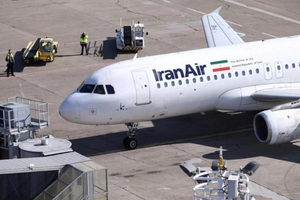
An Iran Air passenger aircraft surrounded by ground-handling vehicles and airport personnel.

Turkish airport ground-handling company FUGO will cease operations after the United States sanctioned it for providing services to Iranian airlines, Turkey’s Demirören News Agency (DHA) reported on Friday.

The company will terminate its operations on November 30, raising uncertainty over the continuation of flights by several Iranian airlines to Turkey, Iranian media reported.

Despite complying with the Turkish Commercial Code, relevant legislation and aviation requirements, the company could no longer continue operations under the current circumstances, FUGO said in a statement cited by DHA.

The company had provided ground-handling services across Turkey for seven years, contributing to the country’s civil aviation and tourism sectors.

All outstanding payments owed to employees would be settled in full, and discussions with other ground-handling companies were underway to secure alternative employment for staff, FUGO added.

The company described the US sanctions imposed on it as “unfair and unlawful,” Turkish aviation news outlet AirportHaber reported.

US sanctions on Iranian aviation

The US Treasury Department sanctioned FUGO on November 4 for providing ground-handling and other services to sanctioned Iranian airlines that continued to operate flights to Turkey.

Iran Airtour, Saha Airlines, Sepehran Airlines, Varesh Airlines, Taban Air and ATA Airlines had direct contracts with FUGO, the Treasury said.

Washington imposed sanctions on 35 companies and one individual linked to Iran’s aviation industry on September 8. FUGO began providing services to several Iranian airlines in the weeks following those sanctions, the department added.

The Treasury warned that it would continue targeting entities supporting Iran’s aviation industry, citing the sector’s role in facilitating weapons proliferation and terrorist activities.

Efforts to maintain flights

Preparations to establish a new ground-handling company to service Iranian and potentially Russian airlines were underway following FUGO’s designation, Turkish newspaper Aydınlık reported on November 17

Strong demand for travel between Iran and Turkey made a complete suspension of flights unfeasible, aviation industry representatives told the newspaper.

Istanbul Airport recorded 748 flights on its Tehran route in October, Aydınlık reported.

The United Arab Emirates, Oman, Iraq, Georgia and Azerbaijan have barred Iranian airlines from operating and cancelled flights to Iran, the US Treasury said on October 30. Turkey has also suspended all Mahan Air flights.

  • US sanctions all Iranian airlines in sweeping aviation crackdown

    US sanctions all Iranian airlines in sweeping aviation crackdown

  • Iranian airlines continue foreign flights after US sanctions deadline - Bloomberg

    Iranian airlines continue foreign flights after US sanctions deadline - Bloomberg

Most Viewed

Trump deploys extra aircraft carrier, says Iran is making ‘big mistakes’
1

Trump deploys extra aircraft carrier, says Iran is making ‘big mistakes’

2
INSIGHT

Iraq shuts more border crossings with Iran under US pressure to seal land routes

3

Iran’s central bank chief admits economic squeeze is hurting families

4

A dark, cold office: Pezeshkian's austerity gesture backfires

5
PODCAST

Who flogs a singer? The ‘public decency’ case against Parastoo Ahmadi

Banner

Spotlight

  • Iran cries wolf over nuclear treaty withdrawal
    ANALYSIS

    Iran cries wolf over nuclear treaty withdrawal

  • Who flogs a singer? The ‘public decency’ case against Parastoo Ahmadi
    PODCAST

    Who flogs a singer? The ‘public decency’ case against Parastoo Ahmadi

  • A dark, cold office: Pezeshkian's austerity gesture backfires

    A dark, cold office: Pezeshkian's austerity gesture backfires

  • Iranian women break silence on a lifetime of violence
    VOICES FROM IRAN

    Iranian women break silence on a lifetime of violence

  • Too poor to marry, young Iranians are offered religious workarounds
    INSIGHT

    Too poor to marry, young Iranians are offered religious workarounds

Banner
Banner
Banner
Banner
Banner
Banner
•
•
•

More Stories

UK revokes Iran-linked TV channel’s broadcasting licence

Nov 28, 2026, 09:40 GMT+0
100%
Houthi leader Abdul-Malik al-Houthi addresses followers via a video link at the al-Shaab Mosque, formerly al-Saleh Mosque, in Sanaa, Yemen February 6, 2024.

Britain’s media regulator Ofcom on Friday revoked the broadcasting licence of Arabic-language channel Lualua TV over content glorifying the October 7 attacks on Israel and the actions of Iran-backed armed groups.

The channel’s licence holder, Shells for Media Productions Limited, was no longer considered fit and proper to hold a British broadcasting licence, Ofcom said, citing antisemitic content, support for proscribed organizations and a lack of transparency during its investigation.

“Freedom of expression is something we guard fiercely in this country, and the bar for action against broadcasters is rightly set very high,” Ofcom’s Broadcasting and Media Group Director Cristina Nicolotti Squires said.

  • Iran uses embassies abroad for surveillance and subterfuge, ex-staff say

    Iran uses embassies abroad for surveillance and subterfuge, ex-staff say

Founded by Bahraini opposition figures, Lualua TV operates from an office in northwest London.

Experts had warned the British government that the channel was a propaganda arm of Iran’s Revolutionary Guards and part of Tehran’s covert influence operations, the Telegraph reported in February.

Praise for Iran-backed groups

Lualua TV livestreamed a 45-minute speech by Yemen’s Houthi leader Abdul Malik al-Houthi on October 7, the third anniversary of the Hamas-led attacks on Israel.

The speech praised Hamas, Palestinian Islamic Jihad and Hezbollah, all proscribed terrorist organizations in Britain. A slogan containing the phrase “Death to Israel” and a curse against Jews appeared throughout the broadcast.

Ofcom found that the channel had aired antisemitic hate speech without editorial challenge or critical analysis. It also identified social media posts glorifying Hezbollah leaders and their actions.

Lualua TV is listed as a member of the Islamic Radio and Television Union, which the US Treasury sanctioned in 2020 for being owned or controlled by the Revolutionary Guards’ Quds Force.

Iran’s media influence in Britain

Ofcom found that the licence holder had failed to provide accurate recordings and did not respond to an invitation to make representations.

The decision bars Lualua TV from regulated British television platforms but does not prevent it from streaming online.

  • One man’s road from Westminster to the machine that carries Iran’s story abroad

    One man’s road from Westminster to the machine that carries Iran’s story abroad

An Iran International investigation published on November 6 found that Tehran had used front companies and cash payments through its embassy in Britain to expand its media influence, including through networks involving former Press TV employees.

US repels drones suspected of Iran links at UK air base – FT

Nov 28, 2026, 09:08 GMT+0
100%
The main entrance at the RAF Lakenheath airbase, which hosts United States Air Force (USAF) personnel, amid reports of a security threat in Lakenheath, Britain, November 13, 2026.

US forces repelled around six drones near a British air base in an episode suspected of having links to Iran earlier this month, the Financial Times reported on Saturday, citing people familiar with the matter.

The drones were driven away using US counter-drone systems after they were spotted flying around RAF Lakenheath in eastern England on November 13, but none were recovered by American or British personnel.

The US Air Force confirmed at the time that it had responded to “suspected unauthorised drone activity” and that “no personnel, aircraft or infrastructure were affected”.

The failure to recover the drones has left US and British authorities unable to rule out the possibility that they were carrying weapons or espionage equipment, the FT reported.

US personnel were instructed to shelter in place following a security alert. News of the episode emerged at the time, but few details were made public.

Home to the US Air Force’s 48th Fighter Wing, Lakenheath is the largest US fighter jet operation in Europe, with nearly 7,000 personnel.

Suspected Iranian plots

The episode follows a series of security threats against British military installations used by US forces, including a suspected plot to attack RAF Fairford. Tehran has denied involvement.

The US military withdrew aircraft from RAF Mildenhall over threats from Iran, the Wall Street Journal reported on November 10, weeks after US bombers were withdrawn from Fairford over similar concerns.

  • UK blames IRGC for RAF plot, vows crackdown on Iranian networks

    UK blames IRGC for RAF plot, vows crackdown on Iranian networks

British Prime Minister Andy Burnham previously said the Iranian government was almost certainly behind the suspected Fairford plot.

Iran had significantly shifted its approach towards targeting British military installations this year, MI5 Director General Ken McCallum warned in October.

Britain strengthens base security

US Air Forces in Europe declined on Friday to discuss its counter-drone systems, citing operational security concerns, and urged the public to report suspicious activity.

“We continually review and strengthen our security arrangements,” Britain’s Ministry of Defence said.

  • Seven-man Iran-linked network helped orchestrate wave of attacks across Europe - ITV

    Seven-man Iran-linked network helped orchestrate wave of attacks across Europe - ITV

Britain is investing £470 million to strengthen security at military installations, including physical protection, surveillance and counter-drone capabilities, the FT reported.

The Royal Air Force has also been moving some aircraft into hangars overnight and plans to install anti-drone netting around others left in the open, Sky News previously reported.

Iran’s central bank chief admits economic squeeze is hurting families

Nov 27, 2026, 18:20 GMT+0
100%
A woman walks in a local market in Tehran, Iran, September 26, 2026. Majid Asgaripour/WANA (West Asia News Agency)

Iran’s central bank governor acknowledged Friday that access to foreign currency was limited, government revenues were under pressure and soaring prices were eroding families’ purchasing power, with the dollar trading above 2.93 million rials on the unofficial market.

“We know how heavily high prices and instability weigh on your lives,” Abdolnaser Hemmati wrote in an open letter to Iranians. “People have the right to be worried, to ask questions and to demand results from officials.”

Hemmati said sanctions and the US naval blockade had made trade more expensive and restricted Iran’s access to its financial resources. Those pressures, together with the strain on state revenues, were affecting both the exchange rate and the prices Iranians pay, he said.

Two days earlier, Hemmati had credited central bank intervention with keeping the currency market relatively stable over the previous two months. The dollar crossed 2.9 million rials that day, up from about 1.6 million in early April. By Friday, the rial had lost about 45% of its value against the dollar over that period.

“The foreign currency constraints are real,” Hemmati wrote, though he rejected the suggestion that Iran had reached a deadlock. He also dismissed talk of an imminent economic collapse, saying the central bank had supplied more than $32 billion in foreign currency for imports through official channels. He gave no timeframe for the figure.

US Treasury Secretary Scott Bessent, in an interview with Iran International last month, warned Iranians to stock up on gasoline and heating fuel ahead of expected shortages, predicting the economy would shrink by more than a quarter in the year ending March 2027.

“I would predict that from March of '26 until March of '27, the economy would contract more than 25 percent, which is more than the Soviet Union contracted after its collapse,” Bessent said, adding that the campaign was intended to pressure Iran's leadership rather than its population.

Hemmati accused the United States and Israel of seeking to turn economic hardship into social instability. But he also conceded that Tehran’s own policies needed reform and that officials had a responsibility beyond asking people to endure the cost.

“Blaming every problem on sanctions is no substitute for reforming domestic policies,” he wrote. The letter announced no new relief for households or producers.

Iran raised the basic monthly minimum wage by about 60% to 166 million rials for the Iranian year that began in March. At Friday’s exchange rate, that wage was worth about $57.

Even at the time of the wage talks, it covered less than 40% of the estimated 429 million rials a worker’s household needed each month for basic necessities. A promised wage review has yet to produce a decision.

Consumer prices in October were 88.7% higher than a year earlier, according to the Statistical Center of Iran. October was the ninth consecutive month in which food prices were more than double their level a year earlier.

Iraq shuts more border crossings with Iran under US pressure to seal land routes

Nov 27, 2026, 10:37 GMT+0
•
Arash Sohrabi
100%
An Iranian traveler walks at the Shalamcheh border crossing between Iraq and Iran, Iraq, March 2, 2026.

Iraq closed two more border crossings with Iran this week, including one run by the Kurdistan region, extending weeks of closures that followed a US request that Baghdad keep only two crossings open, and squeezing one of Tehran's main remaining trade routes.

On Thursday, Iraqi forces closed Sheikh Saleh, a crossing in Iran's western Kermanshah province, the Mehr news agency reported, citing the governor of Salas-e Babajani county. He said Baghdad had acted on a central government order to shut "unofficial" crossings with neighboring countries.

About 300 trucks loaded with goods and building materials were stranded, Kermanshah's customs chief said, and would be rerouted through other crossings.

The same day, Iraq's border forces closed the Bashta crossing with Iran and the al-Waleed crossing with Syria, both run until now by the Kurdistan Regional Government, Reuters reported, citing Iraqi state media.

There were unconfirmed reports that a third crossing, Shoushmi, in Kermanshah's Paveh county, had also been shut. Kermanshah's customs chief said he had received no official notice of it.

'Only two'

Washington asked for this. On November 8, Iraqi Foreign Minister Fuad Hussein said the US Treasury had formally asked Baghdad to close all its crossings with Iran except two, one in the Kurdistan region and one elsewhere in Iraq.

"There are many official and unofficial crossings with Iran, and closing them all is difficult and affects our economy," he told Al Jazeera.

Trade between the two countries is worth $15 billion to $18 billion a year, he said, including about $4 billion in Iranian gas.

  • Iran-backed Iraqi militia prepares for renewed US-Iran war, report says

    Iran-backed Iraqi militia prepares for renewed US-Iran war, report says

The day before, US Central Command had set up Task Force Iron Gate, a unit of about 20 military and civilian staff in Florida, to disrupt the movement of weapons, dual-use technology, sanctioned goods and illicit revenue across Iran's land borders and the Caspian Sea.

Without US personnel at the crossings, it relies on neighboring governments, chiefly Iraq, Turkey and Pakistan, to do the closing.

Open, shut, open again

Iraq and Iran share a border of about 1,600 kilometers, with nine official crossings and many unofficial ones. Over the past six weeks, Baghdad has closed and reopened them one by one, usually citing technical reasons.

On October 21, Iraq closed Chazabeh, known in Iraq as Sheeb, between Iran's Khuzestan province and Iraq's Maysan, citing inadequate preparations.

An adviser to Prime Minister Ali al-Zaidi said Iran had "deliberately undermined Iraq's security," with people linked to it crossing without permits.

  • Iraq plays down Iran border disruption as more closures reported

    Iraq plays down Iran border disruption as more closures reported

Truckers and traders in Maysan protested over rising prices, and the provincial council chairman, who threatened civil disobedience, was briefly detained. Chazabeh reopened on November 10.

On November 13, Iraq closed Somar, known in Iraq as Mandali, between Kermanshah and Iraq's Diyala province, for what it called maintenance before the rainy season. It is still closed.

On November 26, Sheikh Saleh and Bashta followed.

Major crossings such as Mehran, which carries millions of Iranian pilgrims to Karbala each year, remain open.

Why the border matters to Tehran

With its ports under US naval blockade since July and seaborne oil exports all but stopped, Iran depends more than ever on land routes for imports, exports and cash.

Iraq is one of Iran's largest export markets, its biggest buyer of gas and electricity, and a long-standing route around sanctions, through fuel smuggling, currency trading and companies fronting for Iranian interests.

Pro-Iran factions in Baghdad have pushed back. The Badr Organization's bloc in parliament condemned what it called American interference in Iraq's border policy and demanded the crossings reopen, and the Asaib Ahl al-Haq bloc asked why the government's technical explanations differed from the foreign minister's account.

The Revolutionary Guards dismissed Iron Gate, saying Tehran had made arrangements to keep trading with its neighbors.

  • Iraqi forces enter Iran-backed militia stronghold, but who holds power?

    Iraqi forces enter Iran-backed militia stronghold, but who holds power?

  • Iraq begins taking back town held for a decade by Iran’s strongest militia ally

    Iraq begins taking back town held for a decade by Iran’s strongest militia ally

The pressure comes from more than one direction. Iraq's oil revenues still pass through an account at the Federal Reserve Bank of New York, an arrangement dating from the 2003 US-led invasion, and Washington warned Baghdad this year that it could cut off access to them if Iraq did not reduce Tehran's influence in its government, Reuters reported.

US officials also discussed with Zaidi the idea of Iraq leaving OPEC, Reuters reported. The prime minister raised it with his cabinet, but the oil ministry opposed it and proposed seeking a higher production quota instead. The US government said the issue had not been raised in high-level talks.

A standoff with Erbil

The closures in the Kurdistan region are also part of a separate fight. On Tuesday, Zaidi ordered federal authorities to take over all crossings run by the Kurdistan Regional Government, and the federal oil ministry to take over oil fields held by Kurdish security forces in Diyala, Kirkuk, Salahuddin and Nineveh provinces.

After the Kurdistan Regional Government objected, Iraq's Federal Supreme Court ruled on Wednesday that Baghdad could deploy federal forces along all international borders, including in the region.

  • Iran says US land blockade would be nearly impossible, denies supply shortages

    Iran says US land blockade would be nearly impossible, denies supply shortages

Thousands of people protested in the Kurdistan region on Thursday, while supporters of the prime minister rallied in Mosul.

The moves came a week after Zaidi sent troops into Jurf al-Sakhar, a stronghold of the Iran-backed militia Kataib Hezbollah, over an oil smuggling network.

Not all of Baghdad's moves answer to Washington. The operations against smuggling, the push into Jurf al-Sakhar and the takeover of the Kurdistan region's crossings and oil fields also concentrate power in the central government, a goal that overlaps with US demands but is not the same thing.

Both standoffs turn on control of oil, borders and the money that flows across them, and both put Zaidi, who came to power after Washington opposed the return of Nouri al-Maliki, a longtime ally of Tehran, at odds with powerful forces at home.

How far Baghdad can go

Iraq cannot easily cut its ties with Iran. It depends on Iranian gas and electricity, particularly in summer, and Iran-aligned factions sit in parliament, in the governing coalition and in the Popular Mobilization Forces, the state-funded umbrella of armed groups. Moving against them too fast risks unrest at home.

Even Iranian media now describe a shift. Baghdad "appears to be redefining its relations with Tehran," the Iranian news site Rouydad24 wrote on Thursday, in a course that is "less a separation than an effort to increase Iraq's bargaining power with both sides."

Tehran says it can ride out the squeeze. Iran's diplomats, especially in neighboring countries, were working "around the clock" to meet the country's needs and keep trade routes open, Foreign Minister Abbas Araghchi said in the northeastern city of Mashhad.

"The goal is for the enemies to know that besieging Iran is not possible, and that they cannot besiege our country," he said.

Iran’s efforts to offset US naval blockade fall short, economists warn

Nov 26, 2026, 02:04 GMT+0
•
Maryam Sinaiee
100%
Vessels in the Strait of Hormuz, Persian Gulf. (ISNA)

Iranian economists have warned that alternative trade routes and domestic economic measures cannot fully offset the loss of oil revenues caused by the US naval blockade, despite assurances from Tehran that the country can withstand the pressure.

The warnings come as Washington points to the growing impact of the blockade on Iran’s oil exports.

US Treasury Secretary Scott Bessent said Wednesday that Iran had exhausted its floating oil stocks and had not loaded a tanker since Washington launched Operation Economic Outcast in August.

US Secretary of State Marco Rubio recently said the economic damage inflicted by the blockade had been so significant that President Donald Trump no longer saw a need for a large-scale military operation.

Oil exports suffer as Iran seeks alternative routes

Before Washington first imposed its naval blockade in April, Iran exported approximately 1.5 million barrels of crude oil a day to China, its largest customer. The United States reinstated the blockade in July.

In recent months, Iran has reportedly exported limited quantities of petroleum products, including fuel oil and liquefied petroleum gas (LPG), by road to neighboring countries such as Pakistan and Afghanistan. Some natural gas and jet fuel have also reportedly been transferred through ship-to-ship operations east of the Strait of Hormuz.

Writing in the economic daily Donya-ye Eqtesad on October 18, economic analyst Hamid Mollazadeh argued that these limited exports could not compensate for the loss of crude oil shipments.

Iranian officials and some Iranian media outlets have promoted land routes as an alternative for exporting oil and importing goods, but economists have warned of their limited capacity.

Energy expert Hamid Hosseini wrote in the reformist newspaper Shargh on November 2 that potential exports to Tajikistan, Uzbekistan, Pakistan, Turkey, and Iraq’s Kurdistan Region could collectively reach no more than 250,000 to 300,000 barrels a day.

That would amount to no more than a fifth of Iran’s previous crude exports to China.

Hosseini argued that overcoming the blockade would require a diplomatic solution.

Pouya Jabal Ameli, editor-in-chief of Donya-ye Eqtesad, warned in a September 21 editorial that even with alternative export routes, Iran’s foreign currency revenues could fall to approximately one-fifth of their pre-blockade levels.

He said oil revenues had previously accounted for around 35% of government funding, making it difficult to cover the shortfall in the near term without resorting to inflationary policies.

Jabal Ameli estimated that even under the most optimistic assessments, 40% of Iran’s population was already living below the poverty line before the blockade because of sanctions.

He warned that the latest restrictions could push at least two more income deciles into poverty by the end of the Iranian calendar year in March 2027.

In a separate October 5 article published by Eghtesad Ba Ma, he argued that monetary and foreign exchange policies alone could not resolve the crisis and that improving Iran’s international relations was necessary to give businesses a clearer economic outlook.

Economists warn of mounting pressure on government finances

The economic consequences extend beyond lost oil revenues.

Economist Morteza Afghah told Shargh last week that the prolonged military standoff and continuing blockade would put further pressure on Iran’s economy and government finances.

He said the mere prospect of war created uncertainty and discouraged investment, while actual trade restrictions and the naval blockade compounded the damage.

Afghah said short-term measures such as selling state-owned companies, borrowing from the Central Bank and issuing government bonds, all used under former President Hassan Rouhani, could not replace oil revenues in the long run.

Others argue that Iran can cushion some of the economic damage.

Saeed Leilaz, an economist affiliated with the centrist Executives of Construction Party who opposes concessions to Washington, told state television’s Jahan Ara program on Tuesday that the blockade represented the greatest economic shock in Iran’s history.

He said the blockade should be treated like a military conflict but argued that Iran could withstand its effects through sound economic policies and efforts to combat corruption.

Disruptions to imports raise concerns

Beyond disrupting maritime trade, the blockade has also restricted Iran’s access to the foreign currency needed to finance imports.

At least 75% of Iran's foreign trade was previously conducted by sea. The blockade has effectively eliminated the possibility of importing nonessential goods by sea.

Officials have sought to ease concerns over supplies, pointing to strategic reserves and alternative routes for imports.

On Wednesday, First Vice President Mohammad Reza Aref sought to reassure the public, saying increased cargo unloading and customs clearance at border crossings outside southern Iran showed the country could withstand the US naval blockade.

He said stocks of essential and strategic goods were in good condition and called for measures to prevent prices of basic goods from rising for at least three months.

Consumer prices in October were 88.7% higher than a year earlier, while food and beverage prices rose 112.6% year-on-year, according to the Statistical Center of Iran.

To illustrate the capacity of Iran’s land borders, Leilaz cited official estimates putting annual smuggling at $35 billion. He argued that the figure could reach $50 billion without intervention by law enforcement authorities.

Although he acknowledged that shortages and difficulties were inevitable in some sectors, he maintained that a country with thousands of kilometers of land borders could not face a severe import crisis.

Washington has also announced Task Force Iron Gate, an initiative aimed at restricting the movement of weapons and sanctioned materials across Iran’s land borders and the Caspian Sea.

Foreign Minister Abbas Araghchi said Monday that Iran’s size and extensive cross-border trade made a land blockade nearly impossible to enforce.

Hardliners call for military action to break blockade

Hardliners, meanwhile, have called for military action to break the blockade rather than relying on alternative trade routes or negotiations.

The hardline newspaper Kayhan has described negotiations with Washington as an “operation of deception,” arguing that military action is needed to break the blockade.

The newspaper has called for Iranian attacks on oil facilities and US companies in the region in response to the blockade, arguing that such action could increase pressure on Washington from regional countries.

Hardliners have also called in recent days for Iranian oil tankers to challenge the blockade, although no practical action has been taken so far.

In an October 21 article, Jam-e Jam, a newspaper affiliated with state broadcaster IRIB, argued that breaking the blockade could both restore oil revenues and end the prolonged military standoff.

The competing approaches highlight the divisions within Iran over how to respond to Washington's pressure: whether to rely on economic adaptation and diplomacy, or to pursue a more confrontational strategy aimed at forcing the United States to reconsider the blockade.