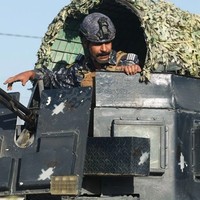
A member of the Iraqi police takes part in a security deployment on the outskirts of Jurf al-Sakhar, Babil province, Iraq, November 20, 2026. REUTERS/Alaa Al-Marjani
Iraq’s deployment of government forces to Jurf al-Sakhar, a longtime stronghold of Iran-backed Kataib Hezbollah, has raised questions about whether Baghdad can restore state authority or has merely reached a new compromise with powerful armed groups.
Experts told Iran International that the deployment marked a significant step in the government’s efforts to rein in militias, but cautioned that a withdrawal of Kataib Hezbollah fighters would not necessarily end Tehran’s influence.
Mukhlad Hazem, a former security adviser to the Iraqi parliament’s leadership, described the deployment as a step no previous Iraqi prime minister had dared to take, but said it was too early to assess its success.
Ahmed al-Sharif, an Iraqi strategic affairs expert, said even if Kataib Hezbollah withdrew from Jurf al-Sakhar, it could relocate its fighters to another strategically important area.
Iraqi Prime Minister Ali al-Zaidi announced on Friday the start of a drive to extend state authority across the country as army and federal police forces entered Jurf al-Sakhar, an area south of Baghdad that had been under the group’s control for 12 years.
“We have not entered a war. Everyone there is your brother,” Zaidi said in a video message to troops deployed in the area, officially known as Jurf al-Nasr.
Zaidi said his government sought to extend its authority throughout Iraq, combat corruption and end the presence of weapons outside state control.
Government forces entered without major clashes despite earlier threats by Kataib Hezbollah and mounting tensions with Baghdad.
However, subsequent reports indicated that Kataib Hezbollah fighters remained in the area even after government forces entered.
A deal to avert confrontation
The standoff escalated earlier this month after details of a confidential 19-page report on suspected oil smuggling in Jurf al-Sakhar appeared in Iraqi media on November 9.
Based on satellite imagery and an examination of oil transportation routes and tanker movements, the report identified suspicious activity near oil pipelines dating back to 2021.
Kataib Hezbollah denied allegations of involvement in illegal oil-related activities.
Zaidi ordered an investigation, but the dispute quickly widened into a confrontation over security control of the area.
Kataib Hezbollah defended its presence, saying it was necessary to prevent the resurgence of Islamic State and protect routes leading to the Shiite holy city of Karbala.
As tensions mounted, Esmail Qaani, commander of the Quds Force of the Islamic Revolutionary Guard Corps (IRGC), traveled to Baghdad for talks with Iraqi political leaders and armed groups.
Kataib Hezbollah confirmed on November 19 that its secretary-general, Abu Hussein al-Hamidawi, had met Qaani alongside Badr Organization leader Hadi al-Amiri and Popular Mobilization Forces (PMF) chairman Falih al-Fayyadh.
Iraqi media reported that Zaidi and Qaani had reached an understanding on the peaceful withdrawal of Kataib Hezbollah and its replacement by a joint security force.
Reuters also reported that Shiite political leaders had mediated a deal to avert an armed confrontation.
Under the arrangement, security responsibilities in Jurf al-Sakhar were divided among the army, federal police, energy police and units of the PMF.
Withdrawal or redeployment?
Sharif described Jurf al-Sakhar as one of Tehran’s key strongholds in its confrontation with the United States.
He said a gradual withdrawal could give Kataib Hezbollah time to await developments in negotiations between Tehran and Washington amid the risk of renewed escalation.
Sharif said Tehran opposed efforts to bring all weapons under Iraqi state control because doing so would deprive Iran of an important source of leverage in its dealings with Washington.
In his assessment, Tehran’s intervention was intended to prevent an armed confrontation between Iraqi government forces and Kataib Hezbollah while securing more time for the group to redeploy its fighters.
The US State Department said on November 18 that Washington expected the Iraqi government to hold Iran-aligned armed groups accountable for their violent and destabilizing activities.
Twelve years of displacement
Located in northern Babil province near the Euphrates River, Jurf al-Sakhar lies close to key routes connecting Baghdad with Anbar and Karbala provinces.
The predominantly Sunni Arab area was recaptured from Islamic State in October 2014 by Iraqi government forces and Shiite armed groups, including Kataib Hezbollah.
The group subsequently took control of security in the area, restricting access for displaced residents, journalists and many government officials.
More than 6,000 families have been displaced from Jurf al-Sakhar since 2014, according to Iraq’s Ministry of Migration and Displacement, with many still living elsewhere.
Hazem said Sunni political factions wanted the issue resolved and displaced families allowed to return.
He said the deployment of government forces and the establishment of an operations center had diminished Jurf al-Sakhar’s status as an area beyond the reach of state authorities.
Completing that process, however, would depend on bringing weapons exclusively under state control and addressing outstanding security and economic issues.
Hazem cautioned that Jurf al-Sakhar’s infrastructure had been severely damaged and that displaced residents would be unable to return without reconstruction.
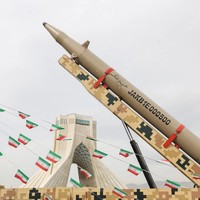
Iranian flags hang next to a missile on display during the forty-seventh anniversary of the Islamic Revolution in Tehran, Iran, February 11, 2026. Majid Asgaripour/WANA/Reuters
An Iranian lawmaker’s claim that Tehran’s missiles can now travel 4,500 kilometers and a front-page boast by Tehran daily Hamshahri that all of Europe is within reach have renewed questions about Iran’s ability to strike the continent.
Experts told Iran International the threat should be taken seriously, though Iran has yet to demonstrate that it can reliably hit targets at that distance.
Ahmad Bakhshayesh Ardestani, a member of Iran’s parliamentary National Security and Foreign Policy Committee, made the 4,500-kilometer claim on Monday without offering technical evidence.
Hamshahri, a newspaper run by Tehran’s municipality, touted a range of roughly 5,000 kilometers. The Islamic Revolutionary Guard Corps (IRGC) has said it lifted its self-imposed 2,000-kilometer limit but has given no details about whether longer-range missiles have been deployed.
What the Diego Garcia launches showed
The clearest indication that Iran may have exceeded its old 2,000-kilometer limit came in March, when it reportedly fired two missiles toward Diego Garcia, a joint US-British military base in the Indian Ocean. One was intercepted and the other failed in flight.
Jim Lamson, a senior research associate at the James Martin Center for Nonproliferation Studies at Middlebury College, assessed that both were intermediate-range ballistic missiles, or IRBMs, capable of traveling at least 4,000 kilometers.
“It does show that Iran had developed at least prototypes of IRBMs, but their design and production status remain unclear,” Lamson said.
He said US and Israeli strikes damaged Iran’s missile development and production facilities, leaving it unclear whether Tehran could build more of those missiles in the near term.
Farzin Nadimi, a senior fellow at the Washington Institute for Near East Policy who specializes in Iran’s military capabilities and Persian Gulf security, said Iran could build on its existing missile technology to extend its reach.
He suspects the two missiles fired toward Diego Garcia may have been modified versions of the Khorramshahr-4, a medium-range missile with a declared range of about 2,000 kilometers. Their identity remains unconfirmed.
“So they were technically capable of reaching Diego Garcia,” Nadimi said, citing the flight paths of both missiles.
The reported launches suggest Tehran was willing to attempt a strike well beyond its old limit.
Nadimi said some parts of southeastern Europe are already within reach of Iran’s existing missiles. He estimated that a range of 4,000 to 4,500 kilometers could put much more of Europe within reach, potentially including Britain.
What Europe should prepare for
Simone Ledeen, who oversaw US defense policy for the Middle East as a deputy assistant secretary at the Pentagon, said the threat to Britain and Western Europe is emerging and called on European governments to invest in missile defense now.
“European governments should plan for the capability arriving rather than wait for proof of it,” Ledeen said.
What Europe should prepare for
Simone Ledeen, who oversaw US defense policy for the Middle East as a deputy assistant secretary of defense, said the threat to Britain and Western Europe was emerging and called on European governments to invest in missile defense now.
“European governments should plan for the capability arriving rather than wait for proof of it,” Ledeen said.
She said the most immediate danger comes from missiles that can already reach US forces and allies in the Middle East.
Reaching the continental United States would require a missile with substantially greater range. Ledeen and Nadimi said Iran’s space program provides some of the technology relevant to developing an intercontinental ballistic missile, a capability that would require further development and testing.
Why Tehran is making the threat now
Tehran’s latest missile claims came a day after US President Donald Trump told Fox News he was inclined to resume strikes on Iran after the new year if no deal was reached.
Kerri Bitsoff, a former senior US Treasury official who helped impose sanctions on networks supplying Iran’s missile and drone programs, said Tehran is using its longer-range missile claims to pressure Washington and its allies to back away from further military action and to turn public opinion against the war.
Bitsoff said Iran’s ability to rebuild and resupply its missile program is under strain. In her view, publicizing a longer range gives Tehran a way to exert pressure while its ability to field those missiles remains uncertain.
“I read it as once again, the regime looking for leverage,” Bitsoff said.
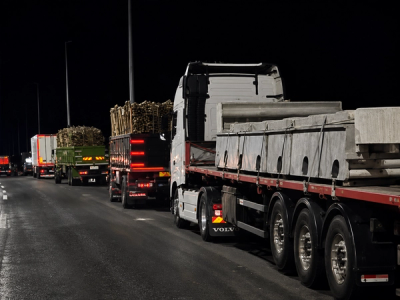
Trucks at the Dogharoun border crossing between Iran and Afghanistan (ISNA).
Iran says a US land blockade would be nearly impossible to enforce, citing extensive economic ties with neighboring countries and alternative supply routes as Washington seeks to widen the reach of its naval blockade.
Foreign Minister Abbas Araghchi dismissed the prospect of Washington sealing Iran's land borders in an interview with state news agency IRNA on Monday, pointing to the country's geographical size and the economic capabilities of its provinces.
“A land blockade of Iran is almost impossible,” Araghchi said.
Speaking after a meeting with heads of the Foreign Ministry's provincial offices, Araghchi highlighted frequent cross-border movement and longstanding historical and cultural ties with neighboring countries.
He said Iran's border provinces could “open the routes that the enemy seeks to close to us.”
His remarks come more than two weeks after US Central Command (CENTCOM) announced the establishment of Task Force Iron Gate to disrupt Iranian supply networks across the country's land borders and the Caspian Sea, targeting shipments of advanced weapons, dual-use technology and sanctioned materials, as well as illicit financial flows.
CENTCOM commander Admiral Brad Cooper said on November 7 that closer coordination with other US government agencies would “further constrain Iran's ability to finance terrorism, rebuild weapons factories, and replenish their military.”
Hamid Ghanbari, deputy foreign minister for economic diplomacy, said Monday that Iran had been preparing for such restrictions for years, developing alternative trade corridors and pursuing preferential trade agreements with neighboring countries and the Eurasian Economic Union to reduce its reliance on southern ports.
“Despite all these pressures, no shortage of goods is being felt in the country today,” Ghanbari said, while acknowledging that US restrictions had inflicted economic damage and caused hardship for Iranians.
He acknowledged, however, that redirecting freight from southern ports to land crossings had exposed shortcomings in Iran's transport infrastructure, which had not been equipped to handle such volumes.
Ghanbari said capacity was gradually being expanded and that temporary disruptions at several eastern and western border crossings had been resolved.
The limitations of overland trade had already raised concerns among Iranian business representatives.
Davoud Rangi, vice chair of Iran's Chamber of Commerce Import Management Committee, warned in August that replacing a single ship carrying essential goods would require around 2,500 trucks.
He said land corridors lacked the capacity to replace maritime imports and that relying on them would sharply increase transportation costs.
Araghchi stressed that efforts to withstand economic pressure did not mean abandoning diplomacy.
“We must make those imposing sanctions despair of achieving their objectives,” he said, adding that diplomatic efforts to negotiate the removal of sanctions were continuing.
Pressure on neighboring countries
Araghchi said the Foreign Ministry had tasked its provincial offices and embassies in neighboring countries with expanding cross-border trade, working with local authorities and businesses to identify new economic opportunities.
Ghanbari said Iran's neighbors had largely maintained commercial ties with the country despite US pressure, with nearly all of its border crossings now operating normally.
Iraqi Foreign Minister Fuad Hussein said on November 8 that the US Treasury had asked Baghdad to close all but two of its border crossings with Iran.
Hussein told Al Jazeera that closing the crossings would be difficult and would damage Iraq's economy, adding that discussions with Washington were continuing.
US officials had spent weeks unsuccessfully pressing Iran's neighbors to close their border crossings, the New York Times reported on November 11, citing three Iraqi officials and a US official familiar with the discussions.
Turkey had largely resisted changing its border policies, while Iraq had rejected Washington's request despite temporarily closing some crossings. Pakistan had intermittently shut crossings, citing security concerns and new import procedures.
The newspaper reported that neighboring countries feared tighter trade restrictions on Iran could damage their own economies and trigger unrest in border communities dependent on cross-border commerce.
The front page of Tehran’s municipal newspaper Hamshahri on Monday featured an image under the headline “All of Europe within Iran’s range.”
Iranian officials have renewed threats against military bases in Europe, with a lawmaker saying the country's missiles can now reach 4,500 kilometers, more than twice their previously declared range.
Ahmad Bakhshayesh Ardestani, a member of parliament's National Security and Foreign Policy Committee, said Monday that Iran's missile range had increased from 2,000 to 4,500 kilometers, placing European military bases within reach.
“Our young leader has announced that missiles must be made accurate and capable of precision strikes. This means we have Europe within our grasp,” Bakhshayesh Ardestani said.
The lawmaker offered no independent technical evidence for the 4,500-kilometer figure. Iran's previously declared missile range of approximately 2,000 kilometers already placed parts of southern and southeastern Europe within reach.
Daily threatens European bases
Hamshahri, a newspaper owned by Tehran Municipality, published an image on Monday under the headline “All of Europe within Iran's range.”
The newspaper suggested that an order to respond to attacks without geographical restrictions could signal a shift in Iran's military strategy.
“Increasing the range of ballistic missiles to approximately 5,000 kilometers has raised concerns among Western countries,” Hamshahri wrote.
On November 3, Hamshahri published a map identifying US military bases and infrastructure across Europe as potential targets. Another article published by Hamshahri Online, citing the newspaper Javan, identified facilities in Cyprus and Greece.
Ebrahim Azizi, chairman of parliament's National Security and Foreign Policy Committee, said Monday that Iran's armed forces had developed the capability to make “enemies” regret attacking the country and were at their highest level of readiness, according to Tasnim, a news agency affiliated with the Revolutionary Guards.
Khamenei orders longer-range missiles
Qassem Qoreishi, deputy head of the Basij organization, said on November 18 that Mojtaba Khamenei had ordered the armed forces to increase missile range in response to the possibility of US operations shifting to more distant bases.
The following day, Qoreishi said Khamenei had also called for greater missile accuracy.
Mohammad Mokhber, an adviser to Khamenei, previously interpreted the leader's call for responses without geographical restrictions as removing limits on missile range.
The Revolutionary Guards subsequently announced that Iran's self-imposed 2,000-kilometer limit had been lifted, without specifying whether longer-range missiles had been developed or deployed.
Tasnim has suggested that modifications to the Khorramshahr-4 missile, including reducing warhead weight, could extend its range to between 3,000 and 4,000 kilometers.
Missile capabilities face questions
An earlier Revolutionary Guards attack on the joint US-British base at Diego Garcia in the Indian Ocean involved two missiles, neither of which reached its target. One was intercepted and the other failed during flight.
Israeli officials estimated their range at approximately 4,000 kilometers, while the Associated Press raised the possibility that satellite-launch technology contributed to the extended range.
The unsuccessful strike did not establish that Iran possesses missiles capable of consistently delivering accurate strikes at such distances.
Damage to missile facilities and difficulties obtaining foreign components have further constrained production, leaving questions about whether Iran's declared longer-range capabilities can be deployed reliably.
US President Donald Trump arrives to speak at a press conference in the James S. Brady Press Briefing Room at the White House in Washington, DC, US, November 20, 2026. REUTERS
US President Donald Trump is considering postponing renewed strikes on Iran despite Israeli pressure for a joint military campaign, as disagreements over military action persist in Washington and regional mediators seek to revive negotiations.
The United States has decided for now to delay a potential attack by at least a week, Israeli news outlet Ynet reported Sunday, citing US administration officials. Trump is reportedly inclined to wait until after the new year before authorizing further strikes if negotiations fail.
The reported delay comes as Israeli Prime Minister Benjamin Netanyahu presses Washington for a short, intensive campaign that he believes could severely weaken Iran's government and potentially lead to its collapse. Trump's advisers remain divided over whether another offensive would achieve that objective or whether Washington should continue relying on its economic blockade of Iran.
US Central Command (CENTCOM), meanwhile, remains at maximum readiness and favors a joint strike with Israel, i24NEWS reported Sunday, citing Israeli security officials. A US source told the broadcaster that CENTCOM wanted either to proceed with an attack or stand down rather than remain on heightened alert indefinitely. An Israeli source described the atmosphere as “anxious waiting.”
Tehran is seeking to break the military and diplomatic stalemate with Washington, with more than 14 oil tankers reportedly gathering near Iran's main crude export terminal on Kharg Island for a possible attempt to breach the US naval blockade. The reported preparations, based on satellite imagery and vessel-tracking data, have not been independently confirmed, and it remains unclear whether the vessels will attempt to cross the blockade.
Asked Sunday about a possible Iranian attempt to breach the US naval blockade, Trump told Fox News: “I hope they do, they'll all be at the bottom of the sea like the rest of the navy.”
Egypt is working with Qatar, Turkey, Saudi Arabia and Pakistan to bring Washington and Tehran back to the negotiating table, Foreign Minister Badr Abdelatty said Sunday.
“I believe that there is a possibility for dialogue, for reaching a deal, and for reaching a compromise,” Abdelatty told CNN.
Iranian Deputy Foreign Minister Kazem Gharibabadi said Sunday that negotiations with Washington were continuing and that the window for diplomacy remained open. Iranian Foreign Minister Abbas Araghchi separately told a cabinet meeting that “the path of diplomacy continues.”
In a Truth Social post Sunday, Trump said Iran had intensified its missile and drone attacks following the November 3 US midterm elections.
“Iran has launched more drones and missiles in the last week than at any time for over a year,” he wrote. “Don’t worry, they’ve all been knocked down, and done no damage.”
In Washington, incoming House Speaker Hakeem Jeffries said Sunday that Democrats would seek to end the conflict when they take control of the House in January.
“We need to end this reckless and costly war of choice in Iran that has skyrocketed gas prices, food prices, and diesel prices,” Jeffries told CBS News.
President Donald Trump said he was inclined to resume strikes on Iran after the new year if no deal was reached, and warned that Iranian ships trying to run the US naval blockade would be sunk, as Iran's attacks on Bahrain drew condemnation across the region.
In an interview with Fox News on Sunday, Trump accused Iranian officials of stalling in talks and said they had become more aggressive than before the US midterm elections. He called Iran's negotiators "professional tap dancers" who talked constantly but said nothing of substance.
Indirect talks with Tehran were continuing, he said, but he expected the exchanges of fire between US and Iranian forces to go on.
Asked about Iranian state media reports that Iran might test the blockade, Trump said: "I hope they do, they'll all be at the bottom of the sea like the rest of the navy."
He also urged Iranians protesting in recent days to keep going, after seeing videos of the protests, Fox News correspondent Trey Yingst reported.
Attacks on Bahrain
The Revolutionary Guards said on Saturday night that they had struck two radars for US Patriot air defense systems at bases in Riffa and Awali in Bahrain with missiles and drones. They called Iran's airspace a "red line" and warned of a response to any violation.
Bahrain's Interior Ministry said a civilian industrial facility had been hit and set on fire. Its Foreign Ministry rejected the Guards' account, saying the target was entirely civilian. Two people were injured, it said on Sunday: a Bahraini citizen with disabilities, whose condition was stable, and a Pakistani resident, who was in critical condition.
A US official told CBS News that the latest Iranian attacks had caused no damage to US forces or equipment in the region. It was the fourth attempted attack in Bahrain in about a week, the official said, after a pause of nearly two months.
Saudi Arabia, the UAE, Qatar, Jordan and the Arab League condemned the attacks, and the Gulf Cooperation Council said it stood with Bahrain. Saudi Arabia warned that Iran would bear the consequences if they continued.
Conflicting reports on tankers
Iran's navy said on Sunday that two tankers had caught fire after hitting mines east of the Strait of Hormuz, after entering the area with their identification and navigation systems switched off. The Guards' navy separately reported explosions that had disabled two supertankers north of Ghanam Island, east of the strait, and warned shipping companies to follow its instructions.
The UK Maritime Trade Operations agency said it had received a report of an incident between a tanker and military forces in the Gulf of Oman and was investigating. It did not confirm the mine accounts, and it is unclear whether the reports describe one incident or several. Seven tankers have been hit in the strait since November 16, the Joint Maritime Information Centre said.
Talks, and fears of a wider war
Deputy Foreign Minister Kazem Gharibabadi said on Sunday that talks with the United States were continuing and "the window of diplomacy is still open," but that Iran was ready for any scenario. Parliament Speaker Mohammad Bagher Ghalibaf said the state of "neither war nor peace" could not go on, and that removing the threat to Iran required "lasting deterrence."
Britain and several Arab states in the Persian Gulf have privately urged Washington not to launch new strikes, fearing Iranian retaliation and a long disruption to energy supplies, Bloomberg reported, citing people familiar with British government assessments.