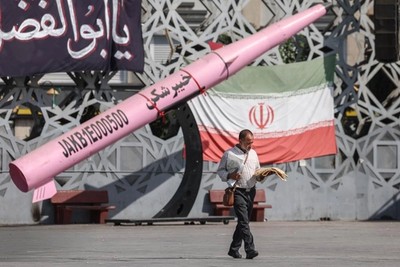
On Iranian state television and in state-aligned media, commentators are debating how to make Tehran's threats of retaliation more credible, with proposals ranging from devastating attacks on military and energy infrastructure to changes in Iran's nuclear posture.
Speaking on the state television programme Be Vaght-e Iran (Iran Time) on Tuesday, international relations analyst Mostafa Najafi argued that Iran's previous military responses had failed to convince Israel that another conflict would carry sufficiently high costs.
Najafi said Israelis had experienced the impact of Iranian missile attacks during the second week of the 12-day war, but that the damage had been less significant during the subsequent 40-day war.
He cited Israeli polling that he said showed 60% of Israelis continued to support military action against Iran, potentially encouraging Israel to launch another operation.
"Any new deterrence equation must credibly convey to the Israeli enemy that if another confrontation occurs, the consequences will go beyond those of the 12-day war, the 40-day war, and the subsequent True Promise 1 and True Promise 2 operations," he said.
Najafi claimed that Iranian decision-makers had resolved to inflict considerably greater damage on Israel in any future confrontation. He argued that Tehran should demonstrate its ability to retaliate within minutes of an attack, sending credible signals before hostilities begin rather than waiting for another war.
Another panellist, Vahid Khazab, argued that Tehran should warn Washington that any new conflict would involve attacks on energy infrastructure.
He cited the attack on Qatar's Ras Laffan energy complex as an example of the damage Iran could inflict, claiming that it had not yet returned to production, unlike Saudi Arabia's East-West Pipeline, which Riyadh had restored after an attack.
Khazab said Israel should also be warned that Iranian retaliation would target its infrastructure.
The discussion has continued even as the war's political consequences become increasingly apparent in Washington. Democrats won control of both chambers of Congress in Tuesday's midterm elections, with Trump acknowledging that the Iran war contributed to Republican losses. Vice President JD Vance went further, identifying the conflict as the principal reason for the defeat.
European targets enter the discussion
The debate comes amid increasingly expansive threats in Iranian state-aligned media about the geographical scope of any future conflict.
Referring to a recently reported meeting between Supreme Leader Mojtaba Khamenei and senior military commanders, Najafi said Tehran had previously warned that another war would become a regional conflict.
He argued that Khamenei's reported instruction to respond to attacks "without any geographical limitations" should now be treated as a credible threat by Iran's adversaries.
On Tuesday, Tehran Municipality-affiliated Hamshahri newspaper published a map of Europe and reported that Iran's armed forces were updating their list of potential targets "without geographical limitations."
The newspaper suggested that US air and naval bases, logistical facilities and other military infrastructure in Europe could be targeted if Washington and Israel attacked Iran's strategic infrastructure.
It also raised the possibility of extending the range of Iranian ballistic missiles, potentially bringing US bases in Europe within reach.
Nuclear doctrine and the NPT
The discussion has also extended to whether Iran should reconsider its nuclear doctrine and its commitments under the Nuclear Non-Proliferation Treaty (NPT).
Najafi criticised Tehran for repeatedly threatening to change its nuclear doctrine before the 12-day and 40-day wars without following through, arguing that this had weakened its deterrence.
He said Iran needed to make a clear decision before another confrontation and communicate it through official channels, backed by a broader national consensus.
"Before the war, the message must be conveyed in every possible way to the other side and to all other parties, including hostile parties and allies who, in one way or another, play a role in our nuclear file," he said.
Najafi argued that changing Iran's nuclear doctrine would not necessarily require withdrawal from the NPT. He suggested Tehran could instead reduce its commitments under the treaty, while warning that withdrawal without a corresponding change in deterrence capabilities could expose Iran to additional threats.
"If you are going to make a change, and that change necessarily involves withdrawing from the NPT, without translating it into nuclear deterrence, I don't think it will create deterrence. It could even create additional threats against the country," he said.
Khazab offered a different approach, claiming he had received reliable information that Iranian decision-makers were considering using the threat of NPT withdrawal as a bargaining chip.
He suggested Tehran could seek concessions, including sanctions relief, in exchange for remaining in the treaty.
Khazab added that any such move would depend on Washington first meeting Iran's seven conditions for ending the war.