• العربية
  • فارسی
Brand
  • Iran Insight
  • Politics
  • Economy
  • Analysis
  • Special Report
  • Opinion
  • Podcast
  • Live TV
  • Iran Insight
  • Politics
  • Economy
  • Analysis
  • Special Report
  • Opinion
  • Podcast
  • Live TV
  • Theme
  • Language
    • العربية
    • فارسی
  • Iran Insight
  • Politics
  • Economy
  • Analysis
  • Special Report
  • Opinion
  • Podcast
  • Live TV
All rights reserved for Volant Media UK Limited
volant media logo

Pezeshkian gets the generals' applause, and no word from the man above them

Niloufar Goudarzi
Niloufar Goudarzi

Iran International

Sep 24, 2026, 11:18 GMT+1
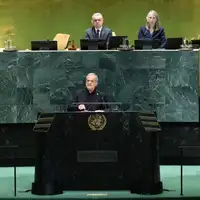
Iran's President Masoud Pezeshkian addresses the 81st United Nations General Assembly (UNGA) at UN headquarters in New York City, US, September 23, 2026.

Iran's generals and hardliners spent the week warning Masoud Pezeshkian not to smile in New York. After his UN speech they lined up to praise him. He had not changed their minds about talking to Washington. He had given a speech that did not require them to.

The one voice that could settle what Tehran wants from the diplomacy under way in New York has not been heard at all. Supreme Leader Mojtaba Khamenei has said nothing publicly about the contacts with Washington, the attacks on his foreign minister, or the speech itself.

He did not receive the president before the trip. And this is the first UN General Assembly in 37 years at which his father was not Iran's supreme leader.

What changed, and what did not

Before the speech, the hardline press was hostile to the trip itself. Kayhan warned that "New York is not a place for smiles and negotiations" and that the General Assembly should be turned into "a court for US crimes." Fars, affiliated with the Revolutionary Guards, wrote that Pezeshkian should not have gone at all.

Moderates pushed the other way: the daily Etemad recalled the meetings Iranian presidents failed to hold with Bill Clinton in 2000 and Barack Obama in 2013, and the reformist Mehdi Karroubi urged Pezeshkian to meet Donald Trump.

Pezeshkian did neither. After Trump used the UN podium to threaten to "annihilate" Iran, the president said he had rewritten his speech. He held up photographs of children killed in the strike on a school in Minab in the war's first hours alongside a portrait of the late Ali Khamenei, said Iran had defended itself "powerfully," said it remained open to negotiation, and said it would not accept "the language of coercion."

There was no offer in it, no gesture toward a meeting, nothing a hardliner could call weakness.

The praise followed within hours, and it praised the defiance.

Revolutionary Guards spokesman Hossein Mohebbi said the president had "at the heart of the system of arrogance, reproduced the message of power, pride, dignity and hope of a nation," in a statement carried by IRNA.

Iran would rely on unity "from the country's highest executive official to the brave fighters in the field and the people in the streets," he said.

Mohammad Mokhber, an adviser to the supreme leader, called Pezeshkian "a worthy representative and the voice of all Iranians" who had been "decisive, reasoned and logical."

The message, he wrote on X, was clear: "we will not bow our heads before a bully, we will not forget our martyrs and we will make the aggressors regret their actions."

Ali Abdollahi, chief of staff of the armed forces and commander of the Khatam al-Anbiya Central Headquarters, Iran's wartime command, said the people "through Dr. Pezeshkian, slapped the criminal president of the United States before the eyes of the world," and that the armed forces stood "in harmony and in one voice with the people and the respected president."

Army commander Amir Hatami followed on Thursday. "Mr. President, well done. We sincerely thank you," he said, calling the address "a manifestation of the unity and coordination of all Iran against the bullying enemy."

Parliament speaker Mohammad Bagher Ghalibaf wrote that Pezeshkian "spoke not just for a government, but for a 3,000-year-old civilization."

Every one of those statements praised the speech for what it refused. None mentioned the talks.

The missing voice

In previous years, state media made a point of showing the president meeting the supreme leader before a major trip, including before the General Assembly. The meeting was the signal: the president traveled with the leader's mandate, and everyone in Tehran knew it. No such meeting was announced this year. Mojtaba Khamenei has not been seen or heard in public since he was named to succeed his father in March, and he has issued nothing on New York.

The closest anyone has come to speaking for him was Major General Yahya Rahim Safavi, one of his military advisers, on Wednesday. "If the Supreme Leader has deemed it expedient and left the government's hands open in the negotiations, that is an important act of prudence," Safavi said on state television. Even the adviser spoke in the conditional.

That leaves the generals' applause doing a job the leader's meeting used to do. Their statements told Tehran that the speech was approved. What they did not tell anyone is whether the contacts around it are.

The fight that did not stop

The argument over those contacts continued through the praise, and it is an argument about authorization, not about whether to talk.

Ebrahim Rezaei, of parliament's National Security and Foreign Policy Committee, challenged Foreign Minister Abbas Araghchi on Wednesday over his meeting in New York with US envoy Steve Witkoff. "

On the basis of which authorization and policy did the foreign minister meet the representative of the aggressor enemy?" he wrote on X. Iran's seven conditions had already been conveyed to Washington, he said, and "nothing comes from such an illegal meeting except a sign of weakness."

Tasnim, also affiliated with the Guards, called Araghchi's explanation "childish and vile" and, citing Mohsen Rezaei, the secretary of the Supreme National Security Council, said the approved plan had been to pass the conditions through mediators, not to meet Witkoff. It called the meeting "a major error." Fars argued the contact had eased pressure on Washington without securing anything.

On Thursday Ali Khezrian, another member of the Committee, said Araghchi had not been authorized to hold direct talks and that MPs had registered a motion to impeach him. "Araghchi must, after returning from his trip, answer in parliament on what basis this conversation with the American side took place," he said.

The foreign minister had defenders. MP Mojtaba Zarei said his own inquiries showed Araghchi had been authorized to meet Witkoff. "There was and is no negotiation," he wrote; the seven conditions had been delivered directly to Trump's envoy. Mohebbi, for the Guards, had already set the terms: "We don't reject diplomacy, but we impose our own conditions. Our defensive power will be proven in the field."

The man who stayed in his seat

A second row concerned Nasser Asadi, a member of Iran's UN mission who remained in the hall during Trump's address. Hossein Ali Haji-Deligani, deputy head of parliament's Article 90 Committee, which handles public complaints against state bodies, called it "a source of shame and regret" and said MPs would use "all supervisory tools, including the impeachment of Araghchi." Hardline accounts contrasted Asadi with delegations that walked out.

Foreign Ministry spokesman Esmail Baghaei defended him. "Iran's seat in a place such as the United Nations General Assembly is our trench," he said. "If we are supposed to leave this trench because of the harsh words, hostility and insults of others, then we certainly have not done our duty."

  • Pezeshkian squeezed at home over meeting Trump in New York

    Pezeshkian squeezed at home over meeting Trump in New York

  • Threats and counter-threats complicate new US-Iran diplomacy

    Threats and counter-threats complicate new US-Iran diplomacy

  • New US-Iran talks run into old question of who speaks for Tehran

    New US-Iran talks run into old question of who speaks for Tehran

Most Viewed

Tehran sets out terms as US-Iran talks intensify in New York
1

Tehran sets out terms as US-Iran talks intensify in New York

2

Trump sees ‘momentum’ for Iran deal after New York meetings

3

Iranian airlines continue foreign flights after US sanctions deadline - Bloomberg

4
ANALYSIS

Freeway sign hack aims to frighten Iranians in Los Angeles, experts say

5

Khamenei adviser says Tehran can negotiate, hardliners say it must not

Banner
Banner

Spotlight

  • 'Bully at home, victim abroad': Iranians on Pezeshkian's UN speech
    VOICES FROM IRAN

    'Bully at home, victim abroad': Iranians on Pezeshkian's UN speech

  • Pezeshkian gets the generals' applause, and no word from the man above them

    Pezeshkian gets the generals' applause, and no word from the man above them

  • War deepens Iran’s energy crunch ahead of winter
    ANALYSIS

    War deepens Iran’s energy crunch ahead of winter

  • Threats and counter-threats complicate new US-Iran diplomacy
    INSIGHT

    Threats and counter-threats complicate new US-Iran diplomacy

  • New US-Iran talks run into old question of who speaks for Tehran
    ANALYSIS

    New US-Iran talks run into old question of who speaks for Tehran

  • They can erase you without arresting you
    TEHRAN INSIDER

    They can erase you without arresting you

  • Iran executed IT expert after months in isolation and forced confession
    EXCLUSIVE

    Iran executed IT expert after months in isolation and forced confession

  • Freeway sign hack aims to frighten Iranians in Los Angeles, experts say
    ANALYSIS

    Freeway sign hack aims to frighten Iranians in Los Angeles, experts say

Banner
Banner
  • 'Killers in suits': Iranians ask New York's mayor why Pezeshkian walks free

    'Killers in suits': Iranians ask New York's mayor why Pezeshkian walks free

  • Khamenei adviser says Tehran can negotiate, hardliners say it must not

    Khamenei adviser says Tehran can negotiate, hardliners say it must not

•
•
•

More Stories

'Killers in suits': Iranians ask New York's mayor why Pezeshkian walks free

Sep 24, 2026, 09:13 GMT+1
•
Saba Heidarkhani
100%
Foreign Minister Abbas Araghchi, seen from behind, listens as President Masoud Pezeshkian addresses the UN General Assembly in New York on September 23, 2026.

Iranians writing to Iran International this week did not see a diplomatic visit. They saw the men they hold responsible for January's massacre walking free in New York, and they asked the city's mayor, who once promised to arrest Netanyahu, why.

As President Masoud Pezeshkian and Foreign Minister Abbas Araghchi arrived for the UN General Assembly, the messages came in with a phrase that recurred until it became the story's own name: the "killers in suits." The demand attached to it was the same almost every time. Arrest them.

Voices from Iran draws on messages sent to Iran International by people inside the country. Names are withheld for their safety.

100%
Foreign Minister Abbas Araghchi (left) and other members of Iran's delegation in the General Assembly hall listen as President Masoud Pezeshkian speaks in New York on September 23, 2026.

The demand

A writer from Fardis, on the western edge of Karaj, pointed to the latest human rights reports and asked why officials responsible for crushing 40,000 protesters in January were not being detained in New York.

Another wrote simply that now they were there, this was a good chance to arrest Pezeshkian and Araghchi.

  • UN says Iran crackdown amounted to crimes against humanity

    UN says Iran crackdown amounted to crimes against humanity

  • UN says Iran committed crimes against humanity, US committed war crimes

    UN says Iran committed crimes against humanity, US committed war crimes

The UN fact-finding mission on Iran said in its new report that many of the violations committed in the crackdown on the January 2026 protests, including murder, imprisonment and severe deprivation of liberty, amounted to crimes against humanity. Its chair, Sara Hossain, said the true number of victims could be "significantly" higher than the government's own figure.

One writer suggested that while the officials were at the United Nations, footage and documents of the killings should be handed to the same body. Others addressed Donald Trump directly, asking him to act on the crackdown rather than host or negotiate with the delegation.

And several turned to Zohran Mamdani, who as a candidate for mayor of New York said he would have Benjamin Netanyahu arrested if the Israeli prime minister set foot in the city, citing the International Criminal Court warrant against him.

"The mayor of New York who wanted to arrest Netanyahu," one wrote, "does he by any chance not intend to arrest the criminals in suits who sit on the Supreme National Security Council and whose signatures are on the massacre of January 8 and 9?"

The visas

A second thread was anger at what writers called the West's double standard: condemning the repression while receiving the men accused of it.

"My question is this," one wrote. "Didn't Mr. Trump always talk about the January massacre? So why has he given visas to the ringleaders of the killers of Iran's children?"

The State Department has said that admitting the core members of the Iranian delegation was an obligation Washington carries as host of the United Nations, and that the delegation's movements were restricted. The US government also agreed to Araghchi's request for a security detail during his stay.

"Bodies attached to the United Nations say the leaders of the Islamic Republic have committed crimes against humanity," another writer addressed the president. "Why are they now freely, and even under your escort, in America and at the UN?"

Not everyone expected an arrest. One writer said it was probably beyond the West to detain the officials, and proposed instead that Iranians abroad gather outside UN headquarters.

'A puppet'

The other constant in the messages was that Pezeshkian does not decide anything, and that his presence at the UN is a performance of the system that does.

Writers called him a marionette, a wind-up doll, and the tea boy of the power mafia, and called the trip a circus staged for legitimacy.

  • US slaps movement curbs on Iran's UN delegation to scotch shopping trips

    US slaps movement curbs on Iran's UN delegation to scotch shopping trips

Some pointed to how little it achieved. One wrote that for years the Islamic Republic's only gain from attending the UN had been shopping in New York, and that Trump had taken even that away.

Last September the State Department restricted the Iranian delegation's access to wholesale and luxury stores during its stay.

Beneath the mockery ran a fear. Several writers worried that a deal might be struck, and that the file on the killings would be pushed aside for it.

Threats and counter-threats complicate new US-Iran diplomacy

Sep 23, 2026, 23:30 GMT+1
•
Maryam Sinaiee
100%
File photo: Crowds gather during a state-sponsored event in central Tehran, Iran

Iran warned Wednesday that any renewed US attack would draw a stronger military response, even as officials from the two countries pursued a new diplomatic opening in New York that has triggered a backlash among hardliners in Tehran.

The warnings followed President Donald Trump's threat at the United Nations to “annihilate” Iran, while Tehran has said further negotiations depend on Washington accepting seven conditions it has put forward for ending the conflict.

Mohsen Rezaei, secretary of Iran's Supreme National Security Council, sharply criticized Trump in remarks broadcast on state television, saying Iran would not return to what he described as the previous model of diplomacy.

He said the United States would first have to meet Iran's seven conditions before Tehran would agree to reopen the Strait of Hormuz and begin negotiations.

Rezaei said it had been agreed at a meeting with President Masoud Pezeshkian that Foreign Minister Abbas Araghchi would communicate the conditions to intermediaries during his visit to New York.

That account has become significant amid a growing dispute in Tehran over Araghchi's contact with US special envoy Steve Witkoff on Tuesday and whether the foreign minister had authorization to meet him directly.

US officials have described the latest contact between the two sides as face-to-face, while Iranian accounts have emphasized the role of mediators and said the purpose was to convey Tehran's conditions to Washington.

‘Childish and vile’

Iran's state broadcaster reported Tuesday evening that Araghchi had met Witkoff at the insistence of the American side and that the purpose of the meeting was to communicate Iran's conditions for reopening the Strait of Hormuz.

Foreign Ministry spokesman Esmail Baghaei said contact with the US side took place through Qatari mediators and was intended to communicate conditions including an end to the war on all fronts, a halt to US military operations, an end to the naval blockade and economic war, and the release of Iranian assets.

The contact prompted strong criticism of Araghchi from hardline and IRGC-affiliated media.

Tasnim News Agency, which is affiliated with the IRGC, described Araghchi's explanation as “childish and vile” and demanded an apology, questioning why he needed to meet Witkoff if Iran's conditions had already been communicated through intermediaries.

Ebrahim Rezaei, spokesman for parliament's National Security and Foreign Policy Committee, also questioned the meeting and asked Araghchi to explain what authorization he had received.

But parliament member Mojtaba Zarei defended Araghchi, saying his own review indicated that the foreign minister had been authorized to meet Witkoff.

“There was and is no negotiation,” Zarei wrote, saying Iran's seven conditions, including the lifting of the blockade of Yemen, had been communicated directly to Trump's representative.

Pezeshkian’s revised speech

The dispute unfolded as Pezeshkian and Trump publicly exchanged warnings while leaving open the possibility of diplomacy.

Pezeshkian said during his address to the General Assembly on Wednesday that he had changed his prepared remarks after hearing Trump's speech.

Holding up photographs of children killed in the attack on a primary school in Minab alongside an image of late Supreme Leader Ali Khamenei, Pezeshkian accused the United States and Israel of imposing the war on Iran and said the Islamic Republic had “powerfully” defended itself.

But he also said Iran remained open to negotiations in pursuit of peace and would not accept what he called “the language of coercion.”

Trump, meanwhile, issued a fresh warning against Iran while also expressing optimism that the dispute between Washington and Tehran could be resolved.

Speaking Wednesday at a meeting with Gulf Cooperation Council leaders in New York, Trump said the United States would “immediately” attack Iran if it carried out activities at the Kolang underground facilities.

Later Wednesday, after meeting British Prime Minister Andy Burnham, Trump said negotiations were continuing and that he believed the two sides would ultimately reach an agreement.

Iran's General Staff of the Armed Forces and the Khatam al-Anbiya Central Headquarters accused Trump of using the UN podium to justify military action and said Iran was prepared to deliver “stronger, crushing and unpredictable blows” in response to any renewed attack.

The simultaneous threats and diplomatic contacts have left the two sides pursuing negotiations while publicly warning that renewed military action remains possible.

Iran’s new school year begins in the shadow of protest and war

Sep 23, 2026, 20:11 GMT+1
100%
Schoolchildren walk to class on the first day of the new academic year in Savadkuh, northern Iran, Sept. 23, 2026.

Iranian children returned to classrooms Wednesday for an unusually somber start to the school year, the first since young people were killed in a government crackdown on January protests and in the war with the United States.

The normally jovial ceremonies marking the first day of the Iranian school year were shadowed by the memory of children who might otherwise have returned to class this week.

Children were among those killed by Iranian security forces during the January protests, while 120 children died when a primary school in the southern city of Minab was struck on the first day of the war on Feb. 28.

More than 16.5 million students returned to over 124,000 schools across Iran for the new academic year, according to state media. Classes had been suspended after the United States and Israel launched strikes on Iran.

A United Nations fact-finding mission said last week there were reasonable grounds to believe US forces were responsible for the Minab attack and that the strike was indiscriminate and violated international law.

The mission also found that Iranian authorities committed crimes against humanity in their crackdown on the nationwide protests, including unlawful killings, torture and arbitrary detention.

War enters the classroom

But accounts sent to Iran International from several cities suggest the war and the government's response to it were following students back into school in other ways as well.

A parent in Mazandaran province said the principal of her son's school had warned students that failing to bring an Islamic Republic flag on the first day of school could negatively affect their end-of-year grades.

In Garmdareh, west of Tehran, another person said several flag-bearing vans and a vehicle equipped with loudspeakers entered Barati school on the first day, playing religious mourning music at high volume.

Military personnel were also present in the school grounds, the person said.

‘Cultural battle’

Iran's Education Ministry announced during the summer that material related to the conflict and the country’s military and nuclear capabilities would be incorporated into educational content.

The country's Organization for Educational Research and Planning has printed and distributed 12 million copies of educational materials titled “We Defend Our Iran” for older primary and secondary school students.

Officials with the student Basij have spoken of training tens of thousands of student “commanders” under a program called Yavaran-e Velayat for what they describe as a “cultural battle.”

As children filed back into classrooms across Iran, Pezeshkian was in New York addressing the UN General Assembly, where diplomacy aimed at ending the war was also gathering pace.

He held up photographs of children killed in the Minab strike as he accused the United States and Israel of attacking Iranian civilians.

For the children returning to school at home, however, the events of the past nine months were already part of the new school year.

New US-Iran talks run into old question of who speaks for Tehran

Sep 23, 2026, 17:47 GMT+1
•
Behrouz Turani
100%
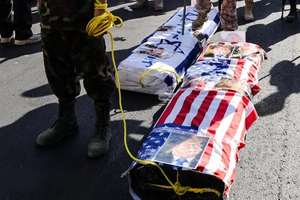
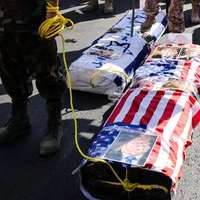
Participants stand beside mock coffins draped in US and Israeli flags during a Janfada mobilisation rally in Iran, September 18, 2026

Any effort to end the Iran war faces a fundamental obstacle even after the resumption of US-Iran diplomacy in New York: apparent divisions within Tehran over who has the authority to negotiate and how far those negotiations can go.

Iranian President Masoud Pezeshkian devoted both the opening and closing sections of his address to the United Nations General Assembly on Wednesday to rejecting President Donald Trump's accusations against Tehran.

He also made clear that while Iran welcomed negotiations, it would not yield to coercion or what he described as Trump's “bullying.”

The tension between those two messages reflects the difficult political terrain surrounding the latest diplomatic opening. Pezeshkian and Foreign Minister Abbas Araghchi have signaled a willingness to pursue talks, but criticism from hardliners has raised questions about how much room they have to negotiate.

Those divisions surfaced after Araghchi's contact with US envoy Steve Witkoff in New York on Tuesday.

The IRGC-affiliated Tasnim News Agency reported Wednesday that the contact had taken place without authorization from Iran's policymaking bodies, including the Supreme National Security Council.

Citing Mohsen Rezaei, secretary of the council, Tasnim said the approved plan had been limited to conveying Iran's seven conditions through mediators. It described Araghchi's reported interaction with Witkoff as a “major error” and called on the foreign minister to explain his actions.

The criticism points to a potentially important fault line in Tehran: not necessarily over whether diplomacy should continue, but over how direct that diplomacy is permitted to become.

Accounts of Tuesday's discussions have themselves differed. US officials have described a three-hour diplomatic exchange positively, while Iranian accounts have emphasized the role of mediators and said Tehran's conditions were conveyed to Washington.

An Iranian diplomat told Reuters before Pezeshkian's speech that discussions on ending hostilities could continue in New York and described the General Assembly as “a golden opportunity for America to return to diplomacy.”

US Secretary of State Marco Rubio said any agreement would require sustained work over time and that Trump retained military options.

Rubio also pointed to divisions within Tehran, saying potential agreements had repeatedly faltered after being referred back to the country's revolutionary establishment. He blamed the IRGC for the collapse of an earlier US-Iran understanding after it attacked ships in the Strait of Hormuz.

Hardliners test the limits

Despite Tasnim's criticism of Araghchi, some hardline messaging immediately before and during the New York talks appeared to leave room for diplomacy.

Before opposition to the talks became more vocal, even the hardline Kayhan newspaper sounded unusually supportive of Pezeshkian on Wednesday morning.

IRGC spokesman Hossein Mohebbi also delivered a dual message following reports of the talks.

“We don't reject diplomacy, but we impose our own conditions. Our defensive power will be proven in the field,” he was quoted as saying.

The formulation suggested that the IRGC was not rejecting negotiations outright, even while insisting that diplomacy take place on Tehran's terms and alongside continued military pressure.

The dispute over Araghchi's contact with Witkoff suggests the argument may therefore be less about whether Iran should negotiate than about the format, limits and authorization of those negotiations.

Pezeshkian's own language at the United Nations appeared designed to preserve that room while demonstrating that negotiations would not amount to capitulation.

Responding to Trump's rhetoric, he warned the United States, Israel and regional actors that Iran would respond forcefully to threats, while insisting that Tehran still believed in diplomacy.

Major General Ali Abdollahi, chief of staff of Iran's Armed Forces, similarly argued that “rhetoric doesn't change the power calculus” and described Trump's remarks as “a sign of desperation” on the US side.

The sequencing problem

The mediation channel has so far allowed the two sides to exchange complex proposals without requiring the politically riskier spectacle of a meeting between Trump and Pezeshkian.

But even if Tehran's internal disagreements can be contained, substantial differences remain over what each side must do first.

Washington is reportedly insisting on the clearance of maritime choke points and assurances related to Iran's nuclear program before easing its naval blockade.

Tehran, by contrast, is demanding an immediate end to US interdictions and the release of $24 billion in frozen foreign assets as conditions for further progress, according to a source close to the Iranian diplomatic team.

Iran has also linked progress in negotiations to reopening the Strait of Hormuz.

The diplomatic opening in New York therefore leaves two related questions unresolved: whether Washington and Tehran can agree on the sequence of steps needed to end the conflict, and whether Iran's diplomats have sufficient authority at home to deliver whatever they negotiate.

The reaction from the IRGC and other hardline institutions in the coming days may provide an early indication of the answer.

Khamenei adviser says Tehran can negotiate, hardliners say it must not

Sep 23, 2026, 13:41 GMT+1
100%
Iranian President Masoud Pezeshkian disembarks from his plane after arriving in New York for the United Nations General Assembly on September 22, 2026.

A military adviser to Iran's supreme leader said the government has room to deal with Washington, and within hours a lawmaker and Guards-affiliated outlets condemned reported contact with it. The split surfaced as the Guards were reported to be directly engaged in Yemen.

Major General Yahya Rahim Safavi said Supreme Leader Mojtaba Khamenei’s decision to leave the government’s “hands open” in negotiations reflected significant strategic judgment.

“If the Supreme Leader has deemed it expedient and left the government’s hands open in the negotiations, that is an important act of prudence,” Safavi said in a televised interview.

  • Tehran sets out terms as US-Iran talks intensify in New York

    Tehran sets out terms as US-Iran talks intensify in New York

He also pointed to coordination between Iran’s military and political leadership and said he hoped decisions by the Supreme National Security Council would help prevent another war.

The remarks provided rare public confirmation from a senior military figure that Pezeshkian’s government has the leadership’s approval to pursue negotiations. They followed a day of indirect exchanges between Iranian and US delegations in New York, though major differences remain over Washington’s naval blockade and Tehran’s conditions for ending the conflict.

The prospect of diplomacy also exposed competing views inside Iran over how far Pezeshkian should go.

Lawmaker Ebrahim Rezaei and the IRGC-affiliated Tasnim and Fars news agencies criticized Foreign Minister Abbas Araghchi’s meeting with US envoy Steve Witkoff. Rezaei questioned its authorization and called it a “sign of weakness,” while the outlets argued that it rewarded Washington and eased pressure on the United States.

Reformist politician Gholamhossein Karbaschi, meanwhile, said the president should meet Trump to help resolve the country’s problems, echoing a similar appeal from senior reformist figure Mehdi Karroubi.

Lawmaker Ahmad Bakhshayesh Ardestani went further, predicting that a Pezeshkian-Trump meeting would take place in New York.

“In my view, the meeting between Pezeshkian and Trump will take place,” he said. “Last year, Pezeshkian decided to meet, but the Americans did not show up.”

Bakhshayesh Ardestani, a member of parliament’s national security and foreign policy committee, also advocated acquiring a nuclear weapon before leaving the Nuclear Non-Proliferation Treaty.

“Buy or build the atomic bomb, then say you are withdrawing from the NPT,” he said, while acknowledging that senior officials were not currently seeking withdrawal.

The competing statements illustrated the political constraints surrounding the New York diplomacy: Pezeshkian is said to have received apparent backing to negotiate, but officials and political factions remain divided over direct contact with Trump and the concessions Iran should seek or offer.

Those talks are unfolding as US economic pressure begins to narrow Iran’s international connections. Iranian airlines continued operating some foreign services Wednesday after a US deadline aimed at grounding the country’s fleet by threatening sanctions against companies providing fuel, ground handling, ticketing and other services.

Bloomberg cited flight-tracking data showing at least six flights leaving Iran for destinations including Bangkok, Phuket, Shanghai and Kabul after the restrictions took effect.

But the pressure appeared to be uneven rather than ineffective. Iran’s Civil Aviation Organization said flights to Baghdad and Muscat had been canceled, while Azerbaijan suspended Iranian airline services and Turkish Airlines halted its flights to Iran until at least March 2027.

  • The price of US pressure moves up Iran’s social ladder

    The price of US pressure moves up Iran’s social ladder

The restrictions add urgency to Tehran’s diplomacy by extending the economic confrontation beyond shipping and oil into civilian aviation. At home, however, authorities sought to show that wartime damage was being repaired.

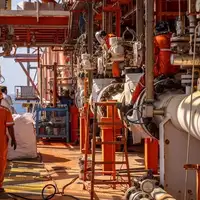
An Oil Ministry official said around half of the damaged capacity at the South Pars gas field had returned to service and that the remaining planned restoration work would be completed before winter.

At the same time, a report of a deeper Iranian military role in Yemen showed how the conflict continues to extend across the region. IRGC personnel were on the ground helping the Houthis seize Yemen’s Red Sea coast from pro-government forces, the Associated Press reported, citing 10 officials and soldiers.

The report said Iranian personnel helped direct a rapid 115-kilometer offensive, marking Tehran’s most direct intervention on behalf of the Houthis since Yemen’s civil war began in 2014. Houthi forces also penetrated the communications of the National Resistance, allowing them to monitor movements and sow confusion.

That reported intervention could complicate efforts to contain the conflict while Tehran and Washington negotiate. Iran is signaling that its government has authority to pursue an agreement, but its regional military posture and the expanding sanctions campaign continue to generate pressure that could either drive diplomacy forward or deepen the confrontation.