An Iranian lawmaker said he expected President Masoud Pezeshkian to meet US President Donald Trump in New York, adding that Pezeshkian had agreed to a meeting last year, but the other side did not attend.
“In my view, the meeting between Pezeshkian and Trump will take place. Last year, Pezeshkian decided to meet, but the Americans did not show up,” Ahmad Bakhshayesh Ardestani said.
The member of parliament’s national security and foreign policy committee also said Iran should acquire a nuclear weapon before withdrawing from the Nuclear Non-Proliferation Treaty.
“Buy or build the atomic bomb, then say you are withdrawing from the NPT,” he said.
Iranian authorities executed IT expert Hossein Pedaran after what sources familiar with his case described as months of solitary confinement, severe physical and psychological pressure and a forced confession.
Pedaran, born on June 26, 1985, was married and had two children, aged 15 and 11. He was arrested in July 2025 and executed on September 19 at Isfahan Central Prison, also known as Dastgerd Prison.
One informed source told Iran International that plainclothes agents raided Pedaran’s home when he was arrested and seized his personal and work belongings, along with electronic devices belonging to him and members of his family.
The source said Pedaran was then held for months in solitary confinement and in detention facilities run by security agencies, where he faced severe physical and psychological pressure.
Prolonged detention in dark conditions and deprivation of sunlight caused injuries and sores on his toes, the source said. Interrogators also pressured and threatened Pedaran and his wife to force him to make statements against himself, according to the source.
Iran Human Rights previously reported that Pedaran spent four months at the Isfahan Intelligence Department’s detention center before being transferred to an intelligence detention facility in Tehran. He was returned to Isfahan a month later.
Work in information technology
Information obtained by Iran International shows that before his arrest, Pedaran worked in information technology at a company called Gostareh Tarahan Naghsh Almas.
His work included designing and setting up USSD codes and developing digital businesses.
Iran’s judiciary said after his execution that Pedaran had been sentenced to death for “espionage and intelligence cooperation in favor of Israel” and that the sentence was carried out after being upheld by the Supreme Court.
The judiciary accused him of providing Mossad with information about military and missile facilities in Isfahan province.
An informed source rejected the judiciary’s account that Pedaran had access to military or missile information, telling Iran International that his professional work was commercial and focused on information technology and digital services.
Iranian authorities have executed dozens of people in recent months on charges including involvement in the January uprising and espionage.
Trial process
A source familiar with Pedaran’s case told Iran International that Judge Mohammadreza Tavakoli of the Isfahan Revolutionary Court issued the death sentence and that defense submissions filed by the family’s lawyer were not considered.
The family had appointed lawyers at different stages of the case, the source said.
According to the source, one of the lawyers told the family on the night before the execution that no notice confirming the final approval of the sentence or setting an execution date had appeared in the judiciary’s Sana electronic system.
Pedaran’s family therefore did not know when he would be executed until the sentence was carried out, the source said.
Security agencies had also pressured Pedaran’s wife from the time of his arrest not to publicize the case and had told the family that he might receive a pardon, according to the source.
Body handed over after two days
The source said Pedaran’s family faced obstacles when trying to recover his body after the execution.
His body was handed over to the family late in the day after about two days of attempts to obtain it, the source said.
Pedaran was buried under security restrictions at Bagh-e Rezvan cemetery in Isfahan, and his family was not allowed to hold a public mourning ceremony, according to information obtained by Iran International.
Relatives described Pedaran as calm, disciplined, kind and hopeful about life. They said he remained hopeful until his final family visit before the execution.
Mizan, the judiciary-affiliated news agency, did not provide details about when Pedaran was arrested, his access to legal counsel or the conditions of his detention in its report on his execution.
After his death, state media also broadcast excerpts of what authorities described as Pedaran’s “confessions.”
A US flag hangs in a street of Los Angeles' "Little Persia" where about 500,000 Iranian-Americans live, in Los Angeles, California, US, June 21, 2025.
A hacked freeway sign in the heart of Los Angeles’ Iranian community directed drivers to a website threatening opponents of the Islamic Republic, in what cyber and security experts describe as a psychological operation designed to spread fear.
The digital sign on Interstate 405, near Westwood's Persian Square, briefly displayed the address of Goorkan, a Persian-language site that publishes names, photographs and personal information of people it identifies as opponents of Iran's government.
"It touches the heart of the diaspora and sends a message. We can touch you wherever you are. The sophistication is irrelevant. The message is chilling," said Roger Macmillan, an Iran and terrorism specialist and former director of security at Iran International.
Who carried out the intrusion has not been publicly established, and US authorities have not confirmed a link to the Revolutionary Guards.
Three cyber and security experts told Iran International that the incident shows how a simple intrusion can intimidate a community far from the people who carried it out.
A simple hack, a powerful message
The intrusion looked unsophisticated next to the capabilities of Russian and Chinese operators, said Amin Sabeti, a cybersecurity researcher who specializes in Iranian cyber operations.
"It's not that sophisticated hacking. It's more about the propaganda," Sabeti said.
The attackers did not need to disable a transport network or break into a secure system. Putting a web address on a public sign beside one of the largest Iranian communities outside Iran was enough.
Sabeti said the effect falls hardest on ordinary Iranians who attend protests and keep public social media accounts. Finding their photograph or their details on a threatening website leaves them wondering who is watching and what it may cost them.
"It's more about creating chaos amongst the diaspora," he said.
Emel Karsaz, an Iranian-born Los Angeles resident, told the New York Post she reported the matter to the FBI after finding her name, photograph and personal information on the site, and that she had also received threats on social media.
The California Department of Transportation confirmed that an unauthorized message appeared on the sign and said it had instructed a contractor to restore normal operations. A review is under way.
The crudeness offers no comfort, Macmillan said.
"That the hack itself is unsophisticated doesn't reassure me. If anything it confirms what this operation was actually for," he said. "Sophistication was never the point. Fear was."
Tehran has long used intermediaries and loosely affiliated actors to intimidate its opponents abroad, Macmillan said, which lets it benefit from such operations while keeping its own involvement out of view.
How vulnerable was the freeway sign?
It appears to have been a straightforward compromise of a badly secured system, said Annie Fixler, director of the Center on Cyber and Technology Innovation at the Foundation for Defense of Democracies.
"This incident is 100% about intimidation," Fixler told Iran International.
Without the investigation's technical findings, she suspected the sign had an unsecured internet connection that let the attackers change what it displayed.
"It is deeply disturbing for those that saw the message but that is probably the extent of what the hackers could do with that access," she said.
The ease of it points to a larger problem with internet-connected public infrastructure, she added.
"The incident itself is not a big deal but the fact that so much of our systems are unprotected or misconfigured such that even low level hackers can do damage is the main take away. We need to be taking security seriously."
A familiar cyber playbook
The sign follows a run of cyberattacks on American infrastructure that experts have read as demonstrations of reach rather than attempts at damage.
In August, Iran International reported that attacks on water and wastewater facilities in at least seven states appeared aimed less at crippling infrastructure than at unsettling the public.
Federal authorities opened an investigation and did not publicly attribute responsibility, though US media reported that officials considered Iran the leading suspect.
Fixler described the tactic at the time as perception hacking: gaining limited access to a system, then publicizing it to suggest a far larger capability.
Los Angeles follows the same pattern with a narrower audience.
A wider campaign against dissidents abroad
The hack comes with renewed warnings about Iranian operations against opponents abroad.
On September 15, US, British and Dutch authorities issued a joint advisory that Iranian state cyber actors had deployed spyware known as Chosen Brick against dissidents, activists and journalists. The malware can pull communications and contacts from an infected device, exposing not only the target but everyone they know.
The same month, the Islamic Republic promoted a platform called Alaj, meaning remedy in Persian, which asks the public to identify and report opponents living abroad. Iranian state media say it has identified and monitored 1,600 people, 600 of them through public submissions.
It publishes names, photographs and, in some cases, further personal details, and lists measures that could follow, including asset freezes and restrictions on consular and citizenship services.
No operational connection between Alaj, Goorkan and the freeway sign has been publicly established.
"Treating it as trivial because the hack was crude would be a mistake," Macmillan said.
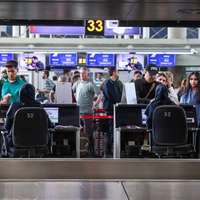
File photo: Passengers check in for flights at Tehran’s Imam Khomeini International Airport
Expanding US pressure on Iran's aviation sector is bringing a class dimension to the debate over the costs of the country's growing isolation, with some Iranians welcoming restrictions they say are finally reaching the better-off.
Washington has threatened sanctions against airports and companies that provide services to Iranian carriers as international travel options are already narrowing.
Mahan Air has suspended flights to Turkey and Oman, while Georgia has announced a halt to flights by all Iranian airlines.
Iran International asked its Instagram audience what they thought about the growing restrictions. Responses ranged from support for measures seen as increasing pressure on the state to concern about their consequences for medicine, essential goods and family travel.
“At last, the water has reached the upper decks,” one respondent wrote.
The phrase captured a recurring argument among those who welcomed the restrictions: hardships that have long affected ordinary Iranians may now be reaching wealthier or better-connected sections of society.
Others argued that air travel had already become unaffordable for much of the population and said they were prepared to tolerate further restrictions if they increased the economic and political cost for the authorities or made it more difficult for officials and those close to them to travel abroad.
The responses do not constitute a representative survey of Iranian public opinion, but they point to a revealing tension over who bears the cost of external pressure.
‘The issue isn't just travel’
US Treasury Secretary Scott Bessent said Iranian airlines would effectively be shut out of international operations from September 23, warning that airports and companies providing them with services could themselves face US sanctions.
The restrictions do not amount to the closure of Iranian airspace or automatically prohibit foreign airlines from flying to Iran. But the threat of sanctions could make it increasingly difficult for Iranian carriers to operate abroad.
For some respondents, that raised concerns extending well beyond passenger travel to medicine, raw materials, spare parts and other goods entering Iran by air.
“Everyone is thinking about passenger flights, but the real problem that will emerge is cargo flights,” one wrote.
“The issue isn't just travel,” another respondent wrote. “A lot of goods reached Iran by air, such as medicine … what is supposed to happen to patients now?”
Others pointed to higher ticket prices, longer journeys involving indirect routes and increasing difficulties visiting relatives abroad. Some feared higher import costs would feed into inflation, further squeezing household finances.
“In the war and confrontation between the government and America, it is the people who are being crushed,” one respondent wrote.
Some also pointed to congestion at land crossings such as Bazargan and Razi, fearing that further disruption to air travel would push more passengers onto already strained overland routes.
Where does tolerance for pressure end?
The responses also revealed differing interpretations of what Washington is trying to achieve.
Some saw the aviation restrictions as another sign of escalating confrontation, while others interpreted them as an attempt to increase pressure on Tehran to reach an agreement.
Several said years of sanctions and economic crisis had left society increasingly accustomed, or even numb, to new restrictions.
Measures perceived as restricting officials, state institutions or wealthier Iranians attracted support from many of those who responded to Iran International.
But that support became less straightforward when people contemplated medicine and essential goods becoming harder to obtain, more expensive travel, separation from relatives or further increases in household costs.
The responses suggest tolerance for outside pressure can be easier to sustain when its costs appear concentrated on the state. Once those costs become tangible in everyday life, the calculation becomes more complicated—even among Iranians who want greater pressure on Tehran.
Iran formally set out its conditions for ending the war as indirect talks with the United States intensified in New York on Tuesday, with the Strait of Hormuz and Washington’s naval blockade emerging as central points in efforts to turn renewed contacts into an agreement.
Foreign Ministry spokesman Esmail Baghaei said Iran conveyed its conditions to the United States through a Qatari mediator in New York. They included an end to the war on all fronts, a halt to what Tehran described as US “acts of aggression,” an end to the naval blockade and economic warfare, and the release of Iranian assets.
The Iranian account gave the clearest official description yet of what Tehran had put before Washington during a day of indirect contacts at the UN General Assembly. US special envoy Steve Witkoff said mediators shuttled between American and Iranian delegations throughout the day and that the two sides completed a round of discussions he hoped would prove “constructive and promising.”
The talks coincided with Iranian President Masoud Pezeshkian’s arrival in New York for the General Assembly. Before his trip, Iran’s Armed Forces General Staff and Khatam al-Anbiya Central Headquarters said they hoped he would convey the message of the Iranian people and armed forces to the international community.
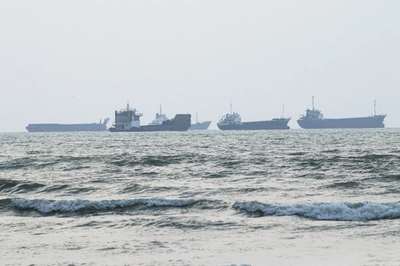
The conditions outlined by Baghaei also showed why the Strait of Hormuz has become central to the negotiations. Tehran has linked an easing of restrictions on the waterway to US steps on military pressure and the blockade, while Western and regional governments have increasingly focused on restoring normal navigation through the strait. Reuters reported that a senior Iranian official said Tehran could reopen Hormuz within seven days if Washington eased military pressure and lifted its blockade on Iranian ports.
European diplomacy in New York was converging on the same issue. EU foreign policy chief Kaja Kallas said she and Foreign Minister Abbas Araghchi discussed ending the war and fully reopening Hormuz, arguing that navigation should be free and unimpeded and that there should be no tolls or fees after the war.
French President Emmanuel Macron also said reopening the strait was the “main objective” of his Monday talks with US President Donald Trump. Macron said the situation in Hormuz had been “probably underestimated” and that France was prepared to become more involved in enabling transit while avoiding a direct confrontation.
Those efforts, however, have not removed the core disagreement over Tehran’s demands. Al Arabiya reported, citing a US source who attended a meeting with the Iranian delegation, that Washington had rejected Iran’s request to lift the blockade and that major obstacles to an agreement remained.
That leaves the New York diplomacy with a clearer negotiating framework than before — Iran has publicly set out its conditions and Washington has confirmed sustained indirect talks — but also with the blockade and access through Hormuz still at the center of the gap between the two sides.
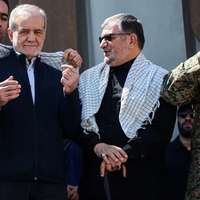
Iranian President Masoud Pezeshkian attends the Janfada mobilisation rally in Tehran, September 20, 2026
Iran’s President Masoud Pezeshkian is facing competing pressure at home over whether to use his UN visit for direct diplomacy with US President Donald Trump or strike a more defiant tone as the two countries remain at war.
Conservative and hardline figures have warned Pezeshkian against conciliatory gestures, while moderates have urged him to go as far as meeting Trump.
The debate comes as direct contacts between the two sides were already under way before Pezeshkian landed in New York.
Trump said Tuesday there was “a lot of momentum” toward a deal after US envoy Steve Witkoff and adviser Jared Kushner held a three-hour meeting with Iranian Foreign Minister Abbas Araghchi. Trump called the meeting “very good” and said he believed a settlement would be reached.
The hardline Kayhan newspaper warned Pezeshkian that “New York is not a place for smiles and negotiations,” arguing instead that the UN General Assembly should be turned into “a court for US crimes.”
“Care must be taken that no signal is given during the New York trip that could be interpreted by the enemy as weakness on the Iranian side,” it wrote.
Kayhan also called on Pezeshkian to criticize regional countries that have made their territory and military bases available to the United States.
Fars news agency, which is affiliated with the Revolutionary Guards (IRGC), went further, arguing that Pezeshkian should not have travelled to New York at all.
“Last year, after the 12-day war, we should not have attended, and this year we should absolutely not attend,” Fars wrote, citing attacks on Iran’s nuclear facilities, civilian deaths and the blockade.
Conservative politician Hossein Kanani-Moghadam argued that even an incidental encounter with US officials could be exploited by Washington to ease pressure on energy markets.
“Trump is seeking to use the Iranian president’s visit to lower oil prices on the global market,” he said.
Calls for a meeting with Trump
Trump has said he is prepared for a possible meeting with Pezeshkian, prompting some reformist politicians and media outlets to urge the Iranian president to use his visit for direct talks.
Moderate daily Etemad pointed to missed opportunities for meetings between former Iranian President Mohammad Khatami and President Bill Clinton in 2000 and between Hassan Rouhani and President Barack Obama in 2013.
“The history of Iran-US relations has for years been written not by the meetings that took place, but by the meetings that did not take place, and New York is once again waiting for the next page of this history,” it wrote.
Heshmatollah Falahatpisheh, a former chairman of parliament’s National Security and Foreign Policy Committee, told Donya-e Eqtesad that Pezeshkian should not limit himself to a UN address and should “conduct serious negotiations.”
“If the president does not have the authority to resolve diplomatic deadlocks, his presence in New York will only be a waste of national resources,” he said.
Former parliament speaker Mehdi Karroubi, one of the leaders of the 2009 protests who spent 15 years under house arrest, also urged Pezeshkian to meet Trump and discuss achieving lasting peace.
Karroubi called on Pezeshkian to move beyond “taboos” that had prevented Iran from securing its national interests and not remain passive in the face of domestic opponents of talks with Washington.
Reformist journalist Ahmad Zeidabadi said Pezeshkian would need “explicit and official authorization from all the highest levels of the establishment” to meet Trump.
“Such an event seems very unlikely, but politics at moments of crisis always has thousands of unexpected tricks up its sleeve,” he wrote.
Pezeshkian’s UN agenda
Pezeshkian is scheduled to address the UN General Assembly on Wednesday. His five-day visit also includes meetings with foreign officials, discussions with US academics and think tanks, and a meeting with Iranians living in the United States, according to official reports.
Before leaving Tehran, Pezeshkian struck a more confrontational public tone, saying he would use the UN gathering to speak about “the crimes of the enemies and the distrust they have created.”
“We have sat at the negotiating table several times and signed an agreement. Despite the negotiations and understanding, they acted [against it],” he said. “The world has seen and sees that they easily violate understandings.”