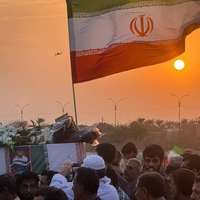
Mourners carry a coffin during the funeral of people killed in a US strike on Sirik, southern Iran, September 3, 2026.
Moderate and reformist figures in Tehran are increasingly warning that the country cannot sustain a prolonged war, challenging hardline calls for Iranians to accept further economic hardship as the price of resistance.
Their warnings come amid rising tensions in the Persian Gulf and Strait of Hormuz and growing concern that renewed military confrontations could escalate into a broader conflict.
Conservative lawmaker Gholamreza Tajgardoon on Tuesday urged Iranians to be prepared to “pay a price for their resistance.”
But several moderate and reformist figures have argued that years of sanctions, inflation and now war have left ordinary people with little capacity to absorb further economic pressure.
“Right now, in certain border and maritime regions, we are witnessing tension, conflict and military engagements,” veteran reformist figure Mohammad Atrianfar told Khabar Online on Tuesday. “One of the public’s serious concerns is whether these conflicts will lead to a full-scale war.”
Atrianfar said preventing a return to widespread war was an “unavoidable necessity” and called for clear red lines and emergency communication channels to help manage the conflict.
His comments come amid US strikes on Iranian tankers and Iranian attacks on American bases and warships in the region.
Atrianfar argued that diplomatic compromise should not automatically be treated as capitulation, saying the distinction between an honourable compromise and a damaging retreat depended on whether an agreement served national interests and restored stability.
Moderate political figure Mansour Haghighatpour made a similar argument, pointing to inflation and what he described as growing public exhaustion.
While Iran should maintain its ability to defend itself against foreign threats, he said, “the priority should remain securing a peace that guarantees national interests.”
His comments appeared to respond directly to Tajgardoon’s appeal for Iranians to accept the costs of resistance. Expecting people to endure continuing hardship without diplomatic progress was becoming untenable, Haghighatpour said.
Reformist politician Mahmoud Mirlohi focused on the physical and economic risks of a drawn-out conflict, warning that critical infrastructure, including power and petrochemical facilities, could become targets.
“Prolonged war and harsh sanctions have pushed Iranian society to its limits,” he said, arguing that Iranians needed “a chance to breathe.”
Mirlohi also criticised what he described as “extremist rhetoric and maximalist behaviour” at home, saying portraying Iranian political figures as advocates of continued war or nuclear escalation made diplomacy more difficult.
The increasingly public warnings reflect a broader argument within Iran over not only how the war should end, but how much more economic and social pressure the population can reasonably be expected to bear.
Hamidreza Jalaeipour, a reformist political figure generally supportive of the existing system, said Iranians had already endured more than two decades of sanctions, high inflation and stagnant economic growth.
He claimed more than 40% of the population was now below the poverty line and warned that “prolonging a war of attrition exacerbates this severe economic strain and risks severe public fatigue.”
“Iran needs realistic governance rather than radical idealism,” Jalaeipour said, accusing hardliners and partisan media of obstructing the flexibility needed for diplomacy and risking greater social unrest.
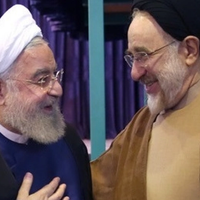
Iran's former presidents Mohammad Khatami and Hassan Rouhani. File photo.
Calls by former presidents Hassan Rouhani and Mohammad Khatami to end Iran’s war with the United States have triggered a fiercer political confrontation after they invoked public opinion in support of diplomacy rather than continued fighting.
Both men have called for an “honourable” end to the war, but Rouhani has gone further, arguing that public opinion should be taken into account in deciding whether Iran continues down the path of confrontation.
“Tell them that our plan is to fight the great powers of the world for another 20 years,” Rouhani said at a recent meeting with former officials. “If the people say they accept this, very well, let us continue. But if the people do not accept it and show us another way, do we not want to accept it?”
The argument has provoked a sharp backlash from hardliners, who say questions of war and national defence cannot be reduced to public opinion while the country remains under attack.
Hossein Shariatmadari, editor of the hardline Kayhan newspaper, accused Rouhani and Khatami on Tuesday of distorting reality, saying their calls amounted to “dishonourable and humiliating surrender” and would deliver the United States and Israel what they had failed to achieve through two wars.
The dispute comes amid renewed military escalation, with the United States and Iran again exchanging attacks after a relative lull and diplomatic efforts failing to produce a lasting settlement.
President Masoud Pezeshkian has nevertheless repeatedly argued that Iran should end the conflict while it remains in a position of “power and dignity,” pointing to inflation, sanctions and a sharp decline in foreign trade as reasons to reach a diplomatic understanding rather than prolong the confrontation.
But Rouhani’s appeal to public opinion has taken the debate into more contested political and constitutional territory.
“We must, according to the overwhelming majority of the people, end the war with dignity so that we can build the country …so that we can have hope for the future,” he said.
Rouhani did not explicitly call for a referendum, but his remarks revived one of the most sensitive arguments in Iranian politics: whether major questions of national policy should be put directly to voters.
Article 59 of Iran’s constitution allows the exercise of legislative power on major economic, political, social and cultural issues through a referendum and direct consultation of voters.
No referendum under the provision, however, has ever been held.
Former Supreme Leader Ali Khamenei rejected calls for referendums to resolve major national disputes in 2023, arguing that ordinary people were not equipped to analyse complex political, economic and international questions.
That divide is now being reframed around the war.
Tabnak, a website close to Supreme National Security Council secretary Mohsen Rezaei, rejected Rouhani’s argument by recasting the choice itself.
“If a referendum is to be held, the question must be precise and honest: ‘Are the people in favour of defending the country against foreign attack?’ or ‘Do you allow the country to surrender?’” it wrote.
“The difference between these two questions is the difference between political analysis and playing with words.”
Tasnim, a news agency linked to the Revolutionary Guards (IRGC), similarly attacked Rouhani as a symbol of a political current that had “simplified complex issues such as negotiations, peace and war.”
It accused the group of “naivety and wishful thinking,” arguing that they believed “a few legal clauses and two signatures” could resolve decades of tensions between Iran and the United States.
Kayhan argued that proposing a referendum during wartime would weaken Iran’s position and that turning the defence of territorial integrity into a factional issue amounted to shirking national duty and assisting the enemy’s pressure campaign.
The attacks have extended beyond the media. At a nightly gathering in a public square, one speaker said that with the Supreme Leader and the Supreme National Security Council in place, Rouhani had no right to take a position on the issue.
Hardline cleric and eulogist Mehdi Salahshour said on X that asking the public whether the war should continue or stop would “only destroy national resolve and sow seeds of doubt in the hearts of fighters on the battlefield and in the streets.”
The response has not been uniformly hostile.
Conservative news website Khabar Online noted that, with the exception of former president Mahmoud Ahmadinejad, who has been largely silent in recent years, Iran’s other living former presidents had chosen to intervene at a critical moment.
“These days Khatami speaks of ‘honourable peace’ and Rouhani of a ‘dignified end’,” it wrote.
Moderate website Rouydad24 contrasted their interventions with what it described as the relative silence of reformists serving inside Pezeshkian’s government, arguing that Rouhani was articulating a position many Iranians had expected to hear from their representatives in government.
Mohammad Ali Sobhani, a former Iranian ambassador to Qatar, Jordan and Lebanon, also backed Khatami’s position, arguing that Iran could not leave the conflict suspended indefinitely.
“We must change the situation, bring the playing field towards dialogue and compromise so that the world supports us and we can impose peace on the other side,” he told Khabar Online.
Young Iranian women are seen in a shopping center without mandatory hijab.
Iranian authorities are holding back from enforcing mandatory hijab as extensively as they would like because of “war conditions,” a senior official said Wednesday, even as pressure grows for tougher enforcement.
“Look at how the enemy has managed to promote that decadent Western lifestyle in our society. Look at the hijab issue itself. Because of the war conditions, for now we cannot enter this front the way we should,” Gholam-Ali Haddad-Adel, a member of Iran’s Expediency Council, and Supreme Leader Mojtaba Khamenei’s father-in-law said at a gathering of student associations.
The effects would be visible in schools, making the authorities’ task “much harder than in 1981, when we started working,” Haddad-Adel added.
His comments came a day after an official representing supreme leader in Iranian universities announced that mandatory hijab instructions for universities had been drafted and would soon be issued by the ministries of science and health.
Women without mandatory hijab are seen at an outdoor market in Iran.
Universities prepare hijab rules
Existing hijab regulations were already sufficient but needed renewed attention, Saeed Karami, the cultural and political deputy of leader’s representative body in universities, told Mehr news agency Tuesday.
“We certainly will not see the bitter occurrences in universities that we sometimes see on the streets,” Karami said.
The new rules should be described as “instructions” rather than a “hijab charter,” Karami added.
Women without mandatory hijab are seen at a shopping center in Iran.
Lawmaker Mohammad-Taghi Naghdali also criticized the government Tuesday for what he called a “retreat” on hijab and for failing to promulgate legislation known as the Chastity and Hijab Law.
Parliament would continue pursuing the issue, Naghdali added.
The comments are part of a renewed push by officials for greater enforcement after years of disobedience by women against compulsory veiling.
Officials press for tougher enforcement
The secretary of Iran’s Supreme Council of the Cultural Revolution said Wednesday that mandatory dress rules were not being observed in some government offices and pharmacies.
Women without mandatory hijab walk along a street in Iran.
“In some government offices, hijab is not observed, and in some pharmacies things have gone beyond not wearing hijab,” Abdolhossein Khosropanah said at a meeting of university faculty members in Hamedan.
Government agencies and public-service institutions, including offices and facilities such as pharmacies overseen by ministries, were required to monitor compliance with regulations, Khosropanah added.
The Supreme Council of the Cultural Revolution had adopted “comprehensive and sufficient” measures on hijab over the past two decades, meaning new measures were unnecessary, he said.
A woman without mandatory hijab walks along a street in Iran.
Other officials have made similar calls in recent weeks.
Hossein Akbari, the Revolutionary Guards commander in North Khorasan province, announced Saturday that groups tasked with verbally warning people about their dress would be revived and reorganized to promote mandatory hijab.
Lawmaker Mostafa Moeini Arani has called for action against women deemed improperly veiled and urged parliament speaker Mohammad-Bagher Ghalibaf to promulgate the hijab law.
Kayhan, a newspaper overseen by a representative of Khamenei, has also urged the government to address what it described as a failure to enforce hijab requirements.
Government supporters have staged demonstrations in several cities. They formed a human chain in Qom on August 29 demanding enforcement, while Friday prayer attendees demonstrated outside the South Khorasan governor’s office in Birjand a day earlier.
Young Iranians attend a social gathering without mandatory hijab in Iran.
A video sent to Iran International showed a group of women supporting the government demonstrating in Isfahan on August 24 and chanting for the hijab law to be implemented.
Women continue to defy mandatory hijab
Women have continued to appear without mandatory hijab in public despite pressure from authorities, extending a form of civil disobedience that expanded after the 2022 Woman, Life, Freedom protests.
Citizens have sent Iran International videos and messages criticizing renewed enforcement efforts at a time of rising prices and economic hardship.
They have described mandatory-hijab advertisements in Mashhad, confrontations with women in the streets, warnings issued to shops and cafes and the closure of dozens of businesses in cities across the country.
Women without mandatory hijab walk along a street in Iran.
CNN reported in August that authorities had increased pressure on women over mandatory hijab but were avoiding widespread direct street enforcement because of concern that it could trigger another wave of protests.
Authorities were instead relying on legal measures, business closures and economic pressure while women continued their civil disobedience, CNN reported.
Haddad-Adel’s reference to “war conditions” comes as the Islamic Republic faces continuing military conflict alongside a worsening economic crisis and growing pressure on household finances.
The doubling of Iran’s highest petrol price tier has also increased official concern about public discontent and possible protests.
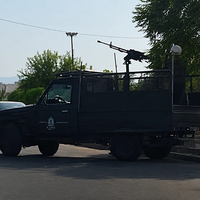
A mounted machine gun deployed in Khorramabad, western Iran, on Monday, September 7, ahead of a fuel price increase.
Iranian security forces deployed around fuel stations and on streets across the country as a gasoline price increase took effect, with people warning of further pressure on household budgets and rising prices for other goods and services.
Messages, videos and accounts sent to Iran International described deployments of police, special units and Basij forces in Tehran, Mashhad, Shiraz, Karaj, Isfahan, Tabriz, Birjand, Khorramabad, Khomein, Abadan and Qeshm.
Reports of slower internet connections also emerged from several cities, including Tabriz and Babol.
Petrol prices doubled on Monday for drivers buying fuel outside their monthly subsidised quota, rising from 50,000 to 100,000 rials a litre, about 2.3 to 4.5 US cents. The government announced the increase two days earlier.
Monthly subsidized allocations remain unchanged. Motorists can buy 60 liters at 15,000 rials per liter, about 0.7 cents, and another 50 liters at 30,000 rials, about 1.3 cents.
The dollar figures are negligible. The wages are the point. Average monthly pay in Iran is around 250 million rials, about $113 at Tuesday's rate, and many workers earn closer to 200 million, or roughly $90 a month.
Security forces gather around fuel stations
Several residents of Mashhad told Iran International that security forces appeared around petrol stations on Sunday, hours before the new price took effect.
“On Monday evening, I passed three gas stations. Several police vehicles were stationed outside each one, and at one station there were large numbers of Basij motorcyclists and special unit forces,” one resident said.
Another Mashhad resident described police and special units positioned at fuel stations across the city.
Video sent to Iran International from Khorramabad in western Lorestan province showed security personnel, vehicles and motorcycles deployed around the city, including what appeared to be a mounted machine gun.
Fuel supplies had already faced disruptions over the previous three weeks in areas including Razavi Khorasan, South Khorasan, Tehran and Alborz provinces.
Citizens in early September reported station closures, long lines, restrictions on purchases and waits of about two hours to obtain 10 liters of gasoline.
A Birjand resident said some filling stations had closed and displayed notices blaming “technical problems,” while police were positioned at others.
Similar deployments were described in Shiraz, where a local reported a large security presence around Maali-Abad early Tuesday, and in Karaj, particularly Fardis, Gohardasht and Mehrshahr.
A resident of Khomein in Markazi province also described a long line and numerous police officers at a fuel station on Shohadaye Daneshjoo Street.
Special units deploy in Tehran
Several Tehran residents reported increased security deployments from Monday evening, including in Shahr-e Rey and Salsabil neighborhoods.
“The station was heavily secured. Special units and the Basij were constantly moving around, and the streets were crowded,” a resident who visited a fuel station near Ferdowsi Square in central Tehran around midnight said.
Another who went to a station on Pirouzi Street in the east described long vehicle lines with special units positioned nearby.
People in Isfahan and Abadan also reported armed police at filling stations. In Qeshm, a resident said armed personnel were deployed around major squares on Monday evening and that a confrontation occurred at the entrance to a filling station in Dargahan.
Two messages from Tabriz described a large security presence alongside deteriorating internet service.
“The city of Tabriz is full of special units. The forces are armed, and heavy equipment can also be seen,” one said.
A Babol citizen also reported slower mobile and fixed internet connections, though the reason for the disruption could not be established.
Gasoline prices carry particular political sensitivity in Iran. A sudden increase and rationing in November 2019 triggered demonstrations across dozens of cities that quickly expanded into nationwide anti-government protests.
Security forces killed around 1,500 people during the crackdown, according to a Reuters tally at the time. Thousands were arrested and authorities imposed a nationwide internet shutdown.
Government defends higher gasoline price
First Vice President Mohammad Reza Aref defended the new rate, arguing that even 100,000 rials per liter remains far below the government's cost of importing gasoline.
Imported gasoline costs the government more than 700,000 rials per liter, equivalent to about 30 cents, Aref said. Imported fuel would gradually be sold at prices closer to its cost, he added.
The government's figures for what petrol costs to produce have not held up well to examination. In November 2025, after officials put the cost at 340,000 rials a litre, about 15 cents at current rates, Iran International went through the refineries' own financial statements. They showed operating costs, excluding the value of the crude going in, of around 35,000 rials a litre, roughly 1.6 cents, a tenth of the official figure.
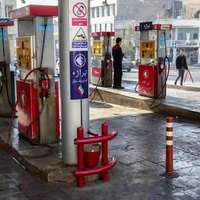
A general view of a gas station in Iran
Economist Mousa Ghaninejad has estimated actual gasoline consumption inside Iran at about 70 million liters a day and argued that much of the remainder recorded as consumption is smuggled out of the country.
Iranians warn of knock-on price increases
Thousands of people responding to an Iran International question about the fuel increase focused on its potential impact beyond filling stations, warning that transportation costs could push up food prices, fares and other everyday expenses.
“100,000 rials for a liter of gasoline may just be a number for some people, but for people it means another step toward making life harder,” one respondent wrote.
Another said petrol was not the problem on its own, and pointed to food. A five-liter container of cooking oil that used to cost 22 million rials, about $9.90, now sells for 40 million, roughly $18.
On a monthly wage of 200 million rials, that is a fifth of a month's pay for one container of oil.
“We buy everything at expensive dollar-linked prices, but our base salary is only $100. Where in the world can you see something like this?” one person wrote.
Another said wages would have to rise alongside prices, since households could not absorb repeated increases on incomes that had barely moved.
For younger respondents the loss was smaller and more particular. "The feeling of going on a trip is gone. Going out for a 10-minute drive is gone. We young people said goodbye to small pleasures a long time ago," one wrote.
File Photo: Drivers fill up their cars at a gas station in Tehran, Iran
Iran will double the price of gasoline bought outside subsidized quotas from Tuesday, pushing ahead with a politically sensitive increase as households struggle with rising prices and the country faces fuel shortages.
Government spokesperson Fatemeh Mohajerani said Sunday that the third-tier gasoline price would rise to 10,000 tomans per liter from 5,000 tomans, effective September 8.
Monthly subsidized allocations will remain unchanged, with motorists entitled to 60 liters at 1,500 tomans per liter and a further 50 liters at 3,000 tomans.
Mohajerani blamed current conditions and past policies for rising consumption, saying the increase was intended to maintain the balance between supply and demand and strengthen “national resilience.”
The decision comes as Iranian households contend with high inflation, a sharply weakened currency and rising costs for basic goods.
President Masoud Pezeshkian had signaled the increase in late August but gave no date for its implementation. Since then, Iranians have expressed concern that higher gasoline prices could feed through into transport costs and the prices of other goods.
Shortages add to pressure
The price rise comes amid growing strains on Iran’s gasoline supply.
Esmail Saqqab Esfahani, head of Iran’s Energy Optimization Organization, said last month that the country faced a daily gasoline deficit of around 14 million to 15 million liters.
The gap between consumption and production predates the war, but fighting and the US blockade have added to the strain, disrupting supplies when domestic production was already failing to keep pace with demand.
Mohajerani said all additional revenue generated by the increase would be spent on supporting household livelihoods, without specifying how the money would be distributed.
Hossein Samsami, a member of parliament’s Economic Commission, warned last month that raising gasoline prices under current conditions could be like a “spark in a powder keg.”
Memories of 2019
Gasoline prices are among the most politically sensitive economic issues in Iran.
A sudden increase in November 2019 triggered nationwide protests that quickly expanded into broader anti-government unrest.
Authorities imposed a near-total internet blackout and security forces carried out a deadly crackdown in which at least 1,500 people were killed, according to a Reuters investigation.
Iranian officials have shown concern that renewed economic grievances could again spill into the streets. Parliament speaker Mohammad Bagher Ghalibaf said last month that Iran’s enemies could seek to exploit public dissatisfaction over gasoline.
The increase leaves the government trying to curb a widening gap between gasoline consumption and domestic supply without adding to public anger over the cost of living.
Senior hardline cleric Ahmad Alamolhoda is seeking support to become president of Iran’s Assembly of Experts, an 88-member clerical body responsible for selecting and overseeing the supreme leader, a Tehran-based outlet reported citing informed sources.
Entekhab reported that maneuvering over the assembly’s leadership has intensified ahead of its next session because of concerns about the health of its current president, Mohammad-Ali Movahedi-Kermani.
Alamolhoda, who represents Razavi Khorasan province in the assembly and serves as Friday prayer leader in Mashhad, is seeking to secure enough votes to take the presidency, according to the report.
His main rival is said to be Alireza Arafi, the assembly’s second deputy president, a member of the Guardian Council and head of Iran’s Islamic seminaries.
Another potential contender is Mahmoud Rajabi, who succeeded Mohammad-Taqi Mesbah-Yazdi at the Imam Khomeini Educational and Research Institute. Entekhab quoted an informed source as saying that Rajabi believes he has a stronger chance of securing the post.
Alamolhoda is one of the Islamic Republic’s most prominent hardline clerics and has for years used his influential Friday prayer platform in Mashhad to advocate some of the establishment’s most uncompromising positions on social and political issues.
He is also the father-in-law of late President Ebrahim Raisi, who died in a helicopter crash in May 2024.
Alamolhoda’s positions have included fierce opposition to challenges to compulsory hijab. In 2024, he likened defiance of the Islamic dress code to collaboration with Iran’s enemies, and the previous year suggested that religious hardliners might need to intervene themselves as women increasingly rejected mandatory hijab.
The European Union sanctioned Alamolhoda in March 2023 over serious human rights violations linked to the suppression of protests. The EU cited speeches in which it said he propagated hostility toward women, protesters and religious minorities.
Alamolhoda has remained an outspoken supporter of the Islamic Republic’s leadership following the death of Ali Khamenei.
In June, he said no agreement or commitment by Iran would be acceptable without Supreme Leader Mojtaba Khamenei’s approval and described hostility toward the United States as a fundamental principle of the Islamic Republic.
The contest would put Alamolhoda at the head of a body that played a central role in the succession earlier this year. The Assembly of Experts selected Mojtaba Khamenei following his father’s death, although Iran International reported divisions among members over the process and the choice of the former supreme leader’s son.
The assembly normally elects its leadership for two-year terms. Movahedi-Kermani was elected president in May 2024 with 55 votes, succeeding Ahmad Jannati, while Hashem Hosseini-Bushehri and Arafi serve as first and second deputies respectively.